
- AI
- A
Geo — is it a deception? Will SEO survive? How to promote in AI search results: GEO without pitfalls and illusions
Honestly, do you fully understand what GEO is and what it gives you?
There is a feeling that there is not enough information to make an objective assessment. In our 2026, we still see the same two camps: for some, GEO is a magical pill, while for others, it's a placebo. As an SEO/GEO specialist, I will tell you — it's neither. Let me explain. But for now, let's get philosophical.
The problem is that the internet has opened another window. And while it is open, with promises of new opportunities behind it — the market always rushes to where it can gain and sign up.
“In GEO, you can achieve results faster than with traditional SEO without long months of normal content, without reputation, without proof.”
Why do we latch onto the first part of the sentence but not the second? Companies will make self-congratulatory statements, position themselves as leaders, and build coalitions of “you mention me — I’ll mention you,” but will not focus on improving the quality of business.
And this is what I like the least.
Firstly, such things really work as long as they work: they affect the classic output, and through it — the LLM responses that rely on retrieval (RAG).
Secondly, if we look at the cases of January 2026 volatility, where major brands saw visibility plummet sharply and massively, among the recurring patterns of those affected is precisely an excess of self-promotional “best” materials.
It would be fine, because this is a real opportunity for highly competitive niches — but poor service ultimately harms the consumer (if the reputation matches the quality — there are no questions).
And let’s also take a look at the technical side of the issue: against the backdrop of the new race, many start measuring GEO as if it were a natural SERP. And we at SparkToro remind you: AI brand recommendations are highly inconsistent due to stochasticity — the same query can yield different sets of brands and different orders, so tracking “AI visibility” easily turns into self-deception. Not because it’s meaningless, but because too much attention is given to it (and really important things get neglected).
That is, on one hand, the market is currently immersed in studying and mastering new mechanics, which is great. On the other hand, its "greenness" makes it an ideal environment for dirty tricks and legends.
And here is my position (to avoid any misunderstanding later):
GEO is not a magic pill (not a replacement for SEO) and not a placebo (it really works under all conditions). It is a tool. With effects, costs, misunderstandings, and limitations.
Moreover, the tool exists against the backdrop of a paradox: "dying search" is a myth, and the decline in organic traffic does not lead to a collapse "everywhere and all at once." But on top of this foundation, a new layer emerges—AI responses—where you can influence, but you cannot guarantee. And as soon as the influence becomes widespread, a cycle begins: someone finds a loophole → everyone repeats → the system adapts → the "working scheme" turns into a toxic pattern → then comes the correction, and it turns out that you optimized not a strategy, but a temporary gap in the mechanics/business.
Lily Ray literally describes this as “it works, until it doesn’t.” Just like with the Gpt chat.
Therefore, the article will not be about how to deceive users and algorithms (to hack, so to speak), but about what is more honest and beneficial for business:
what is really changing in organic traffic and why SEO will survive;
where GEO really works and where you are just happy with random responses;
how much GEO costs in infrastructure/crawling/support (and why it is undervalued);
and why "clever" schemes can provide quick results but turn into a toxic asset when Google starts tightening the screws.
In general, I am FOR GEO when it is reasonable. Let's figure out what that means.
More of me and my thoughts here (my TG channel). Or directly in private.
“Is SEO no longer relevant?” Relevant. But differently.
If you have lived in the information field of marketing for the past year/six months, you have certainly heard this many times:
“Organic traffic is EVERYTHING. Neural networks have taken the traffic. Search engines can do nothing.”
And here I suggest doing one boring but useful thing: looking at the data.
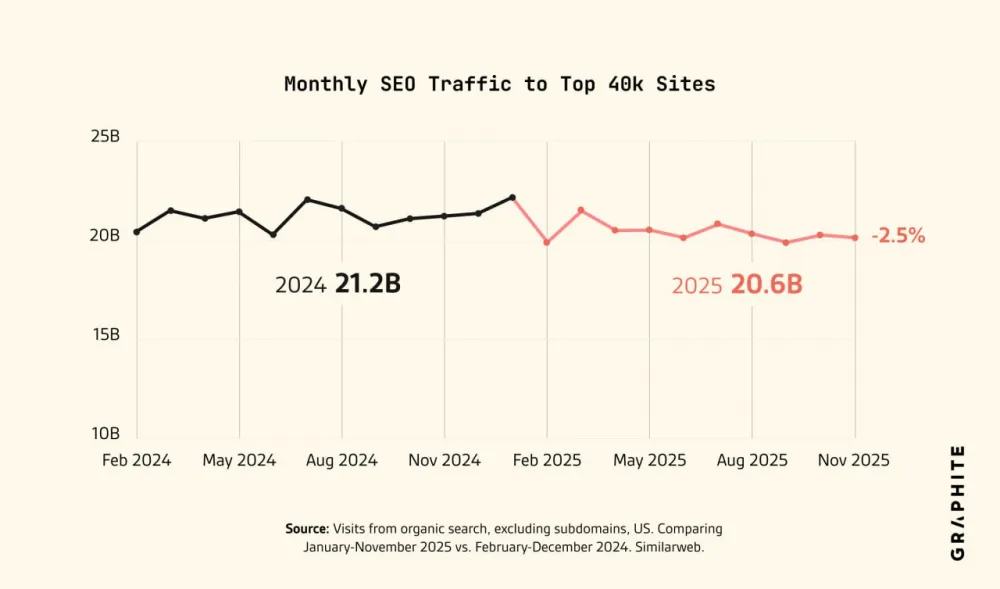
Graphite together with Similarweb looked at 40,000 of the largest websites in the USA and tried to verify the main myth — that SEO traffic has "collapsed by 25–50%." And they found a picture that is much less dramatic:
organic traffic has slightly declined, rather than collapsed: about −2.5% YoY. It has always fluctuated.
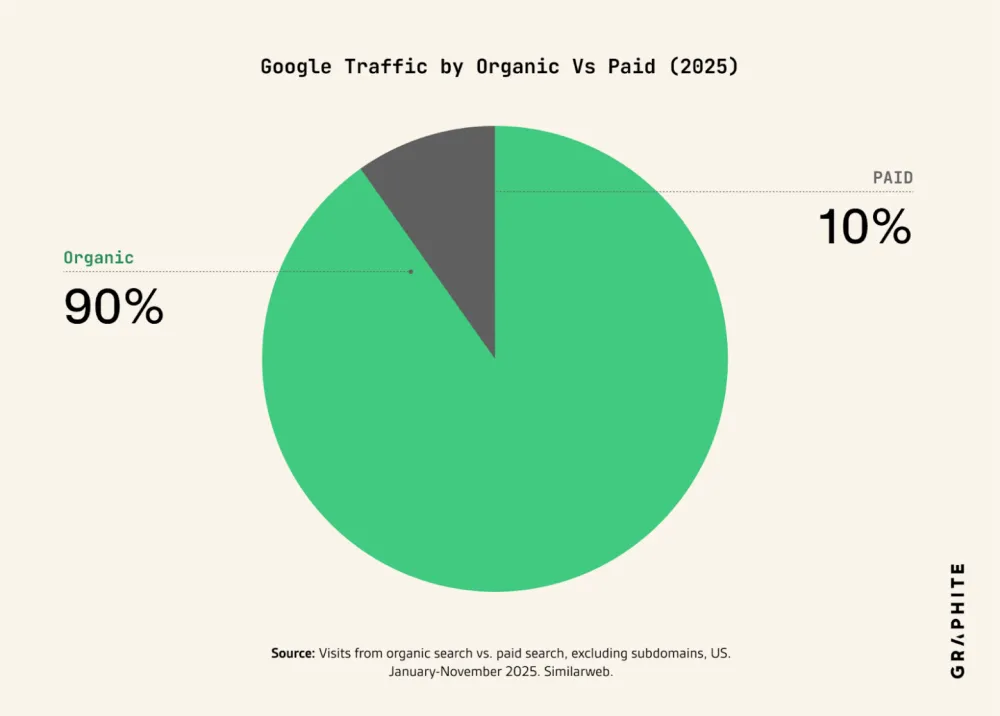
even with the increase in advertising, organic still dominates: about 90% of clicks go to organic, around 10% to paid; on average, there are about 10 times more organic clicks than advertising clicks.
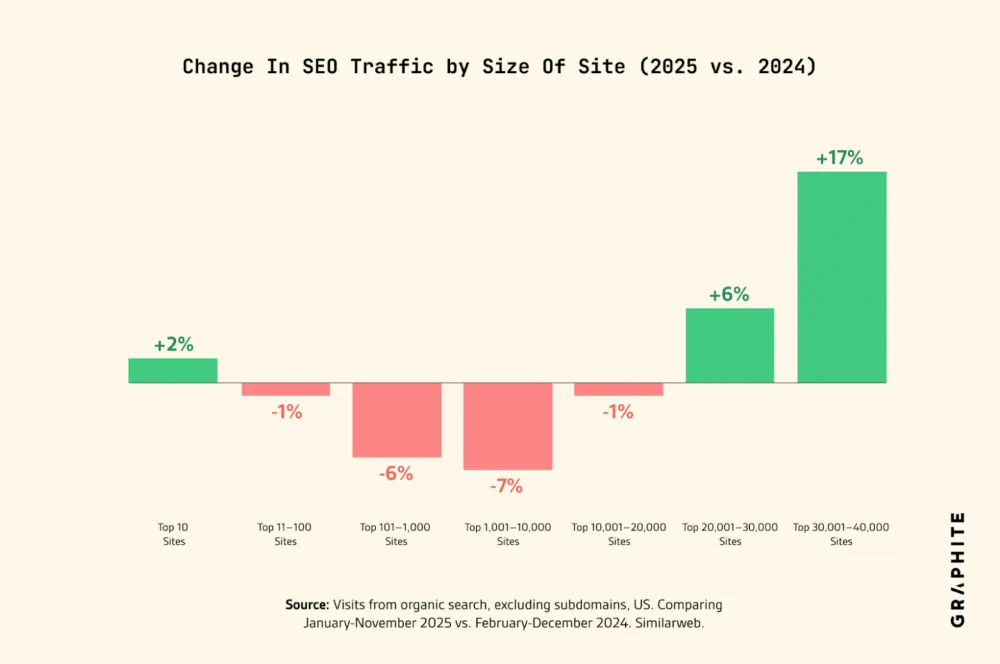
the decline is unevenly distributed: the largest sites (top-10) have actually increased on average (+1.6%), while the "mid-tier" sites (range top 100–top 10,000) have suffered more.
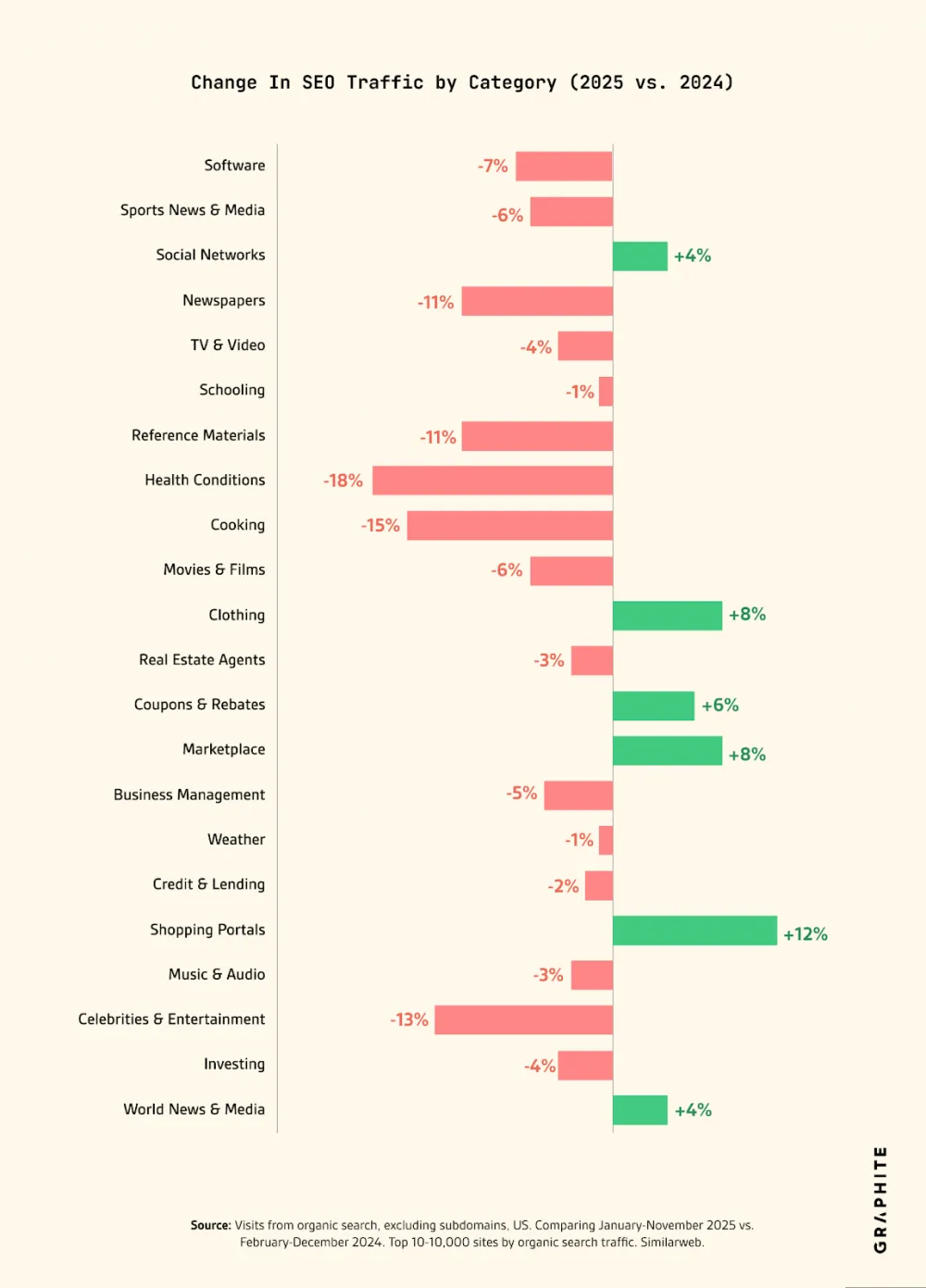
there is also no single story by niche: news/health/cooking/entertainment saw a more noticeable decline (−10%+), while clothing/shopping/marketplaces showed growth.
meanwhile, traffic to search engines has not disappeared overall and looks rather stable in recent periods, rather than declining (up to +0.4% across all search engines), with Google at about +0.8%).
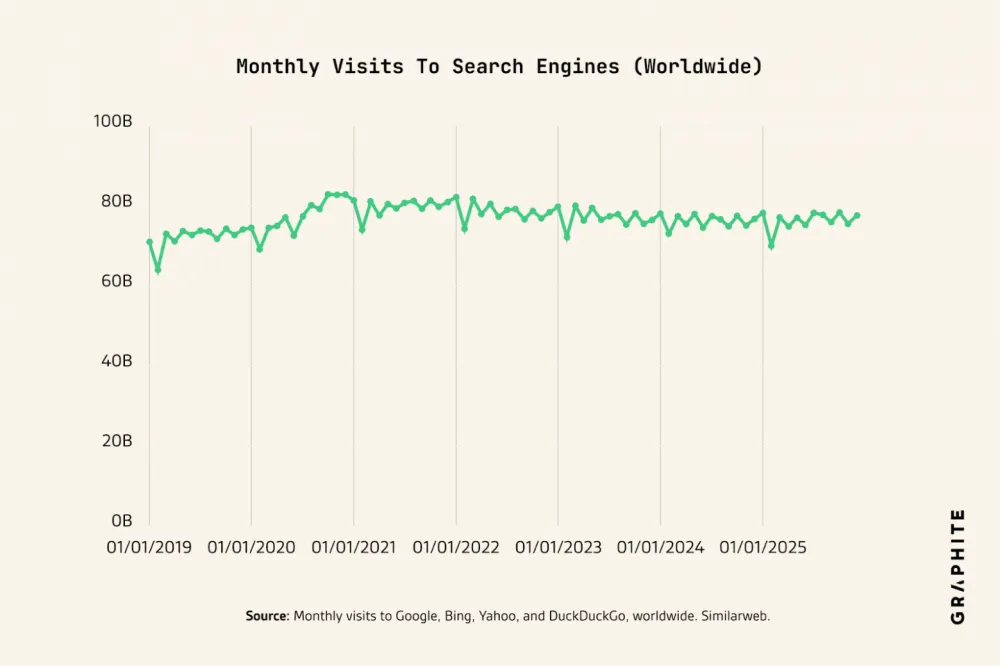
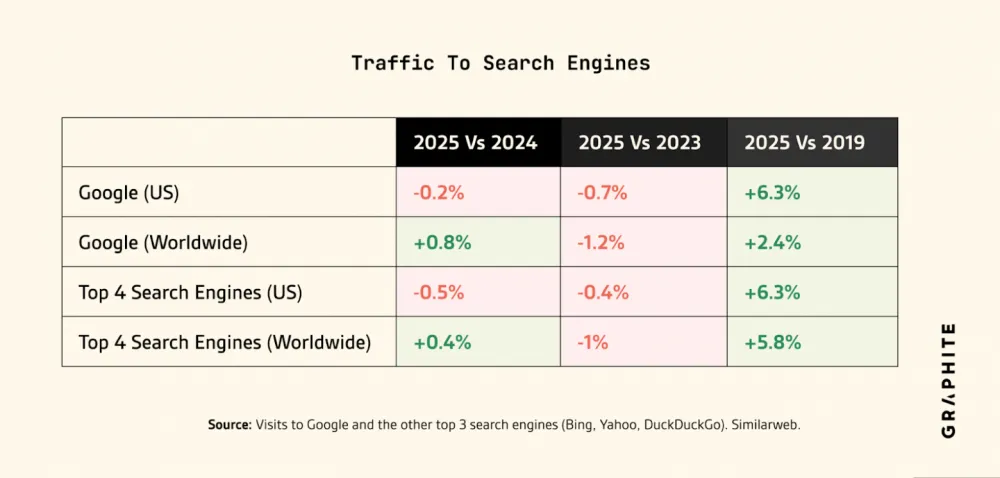
So the basic reality is this: search has become more capricious and strict, but this is related to new conditions — not relevance.
Now an important argument for all disputes:
“Come on, our CTR has dropped!
Yes. And this is also reflected in the data: when AI Overviews appear, Graphite notes a drop in CTR to organic of about −35%. But there is a nuance that is rarely communicated: AI Overviews do not appear all the time, in research — about 30% of the cases. That is, website owners are doing more for this “additional layer” than for the main strategic growth point.
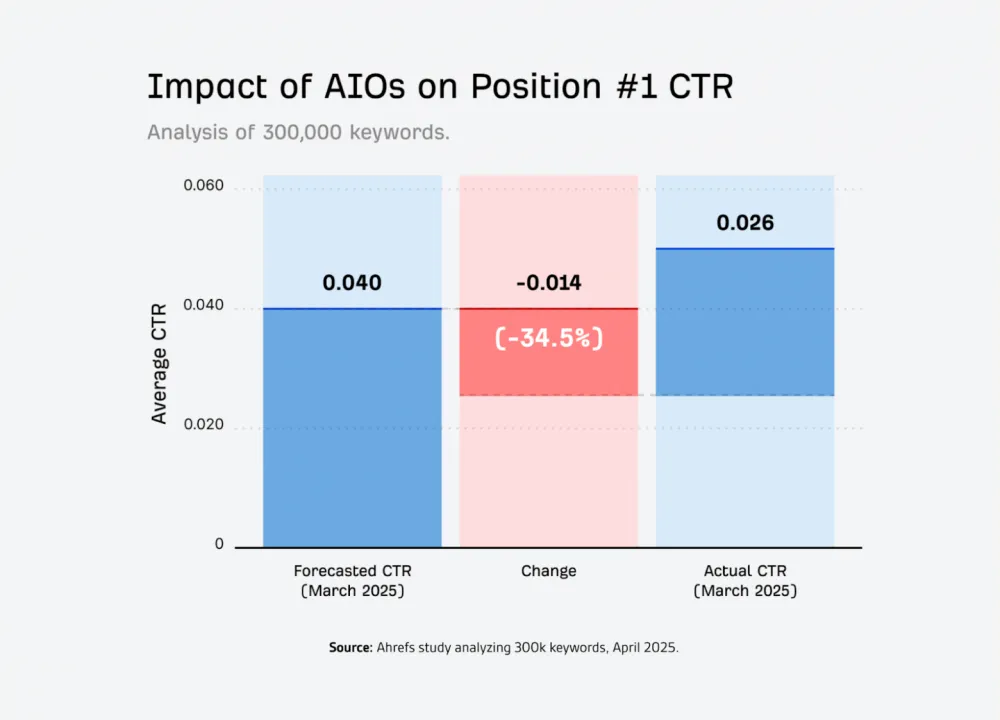
And this is why I am so particular about the wording.
Because “AI cuts clicks” — is true. But “AI has pushed SEO aside” — is already a legend that sounds categorical, sells alarm, but poorly correlates with reality.
But what is the reality?
Organic results have become “uneven”.
Some areas see larger drops, some almost none, and some even growth — it’s better to understand what is normal in your niche and why.A new layer of response has emerged.
Before — for a spot in the search results (SERP). Now additionally — ADDITIONALLY, for a chance to become a “source” for the answer (reference to GEO).
And that’s why GEO emerged as a tool: not to replace SEO, but to enhance it (another layer of competition for attention appeared on top of SEO).
Where GEO is, and where randomness lies
The main trap with GEO right now is this.
We are trying to measure AI output like SERP:
“I was in the answer → so I’ve improved”.
But this is not SERP. It’s a probabilistic system. And it behaves like a probabilistic system — even if you want to fix the result — you won’t be able to due to instability.
AI recommendations do not repeat. Almost never.
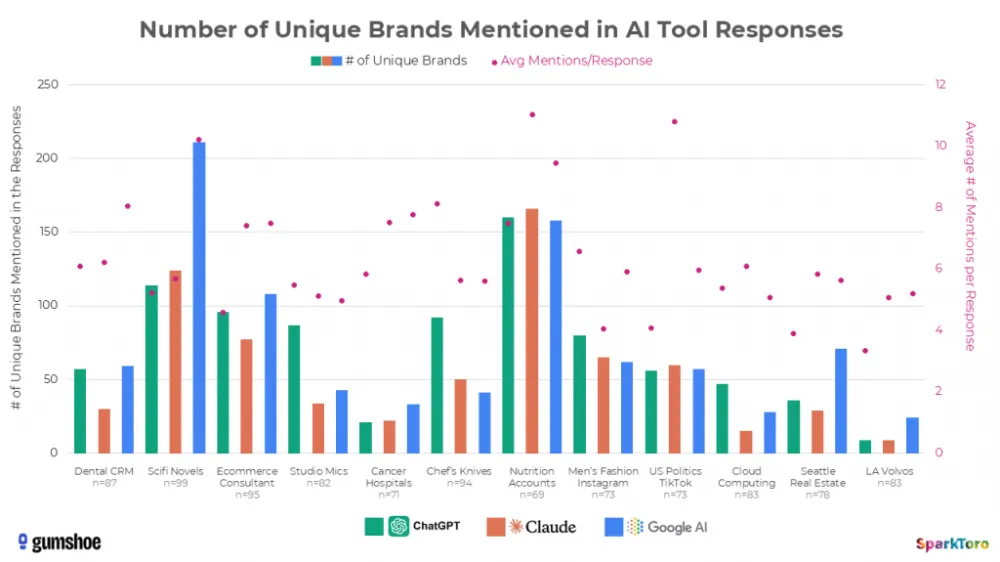
SparkToro did what everyone in their niche should do: simply run the same queries multiple times and see what the model returns.
And there’s quite a cold shower for all “AI visibility trackers”:
the chance of ChatGPT and Google AI returning the same list of brands upon repetition is less than 1%
the chance of getting the same list in the same order is less than 0.1%
This means if you hit the answer once — congratulations.
It doesn't mean anything at all.
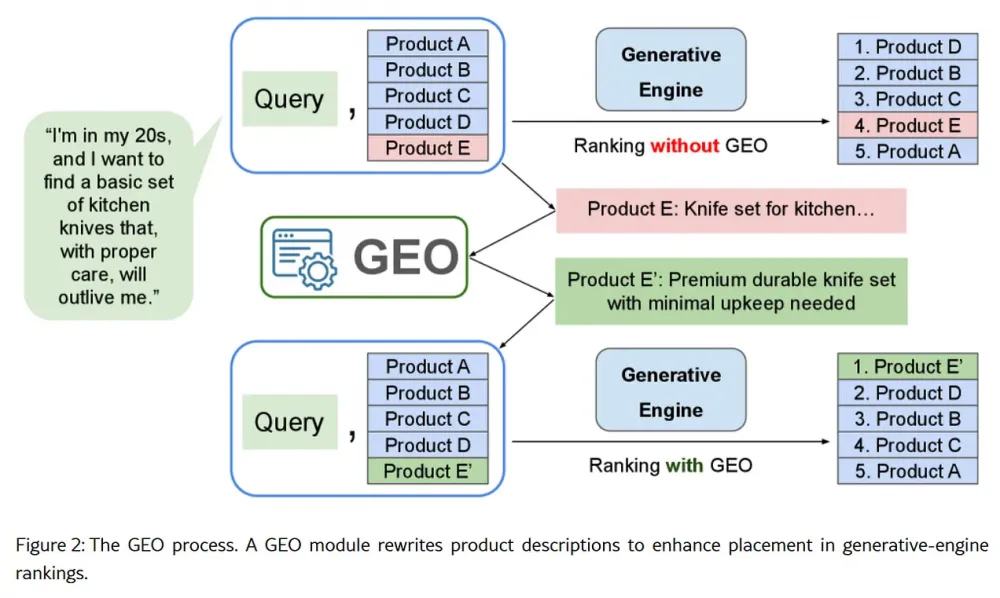
This only means one thing: you landed in one of the generation options.
So, is this a revelation about GEO?
“How can we influence at all then?” — you can. But this influence is unstable.
Growth Memo states this plainly: influencing responses is possible, but the field is both unstable and dangerously easy to manipulate:
LLM — is a non-deterministic ranking machine. It’s randomness at a micro-level: the same prompt gives different answers.
Even if you run the same prompt 5 times, “consistently” not all brands will appear: Growth Memo estimates that only about 20% of brands are shown consistently in such repetitions.
So let's clarify about GEO: GEO does not give you a position in the results but increases the likelihood.
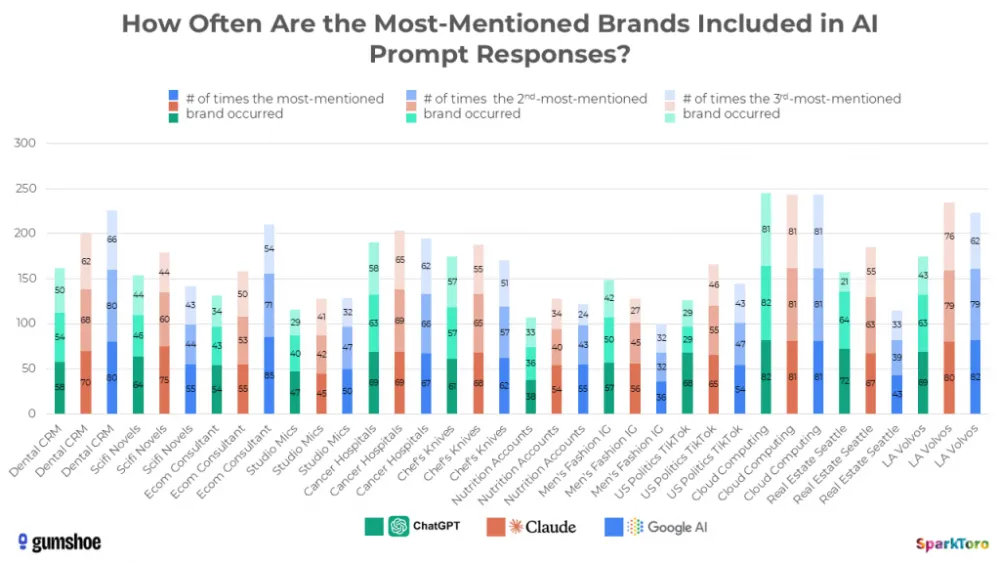
If you measure it as the frequency of appearance over distance (a series of runs, different wordings, different intents) — it starts to resemble reality more. If you choose a systematic approach to content development and brand, GEO will bring normal business value and feasibility. And against the backdrop of the fact that AI recommendations fluctuate almost always, even a small stable shift in probability is already an advantage, especially if you establish it not as a one-time trick but as a repeatable base.
This is unpleasant for those who thought they wouldn’t have to dive deep. Because every new tool leads the market to expect “do X → get Y”. Unfortunately.
The cost of GEO: you pay not only with money...
Since we are speaking so openly and revealingly here — there is another unpleasant truth that almost no one writes about in GEO case studies.
GEO as “let's create more entities”:
more pages, more options, more “under intents,” more “for cities/cases/categories/comparisons” — is also a losing strategy.
As long as you view it as a content task — everything seems fine. But the search engine has a limit on indexing.
Google explicitly named the top problems it faces in crawling in 2025. And the main issues are those that GEO approaches tend to provoke:
faceted navigation (and everything that generates endless combinations of URLs)
parameters and “junk URLs” that look like new pages but provide no value
And that is the cost of “hacking neural outputs.”
GEO blurs the website in the network — and the search engine starts spending budget in the wrong places
Algorithms are important: what to crawl, what to index, and what to consider important.
If you create variations without control:
the crawler starts to wander through endless options,
important pages receive less attention,
and then you sit there wondering: “why aren’t new materials being indexed and why is the CTR of old ones dropping.”
GEO is an operating system, not a one-time content project
Forgive me, but the second part of the price is time and support.
Because GEO almost always requires “variable entities”: lists, comparisons, collections, directories, local pages, different formats. That is, it’s better to work on the space around an entity than to spawn a bunch of them.
And after you have done a good comprehensive job — it needs to be maintained (just like in SEO):
consistency of facts (so there are no different versions of the truth on different pages),
variability of queries/intents (so that queries match the trends of demand),
structure (to avoid turning the site into a faceted maze),
and cleanliness of the URL space (so that parameters do not multiply duplicates).
In short, if you do GEO chaotically and without strategy/structure, you will create more technical problems.
White GEO vs Toxic GEO
In short: without proof of expertise, you won’t get very far.
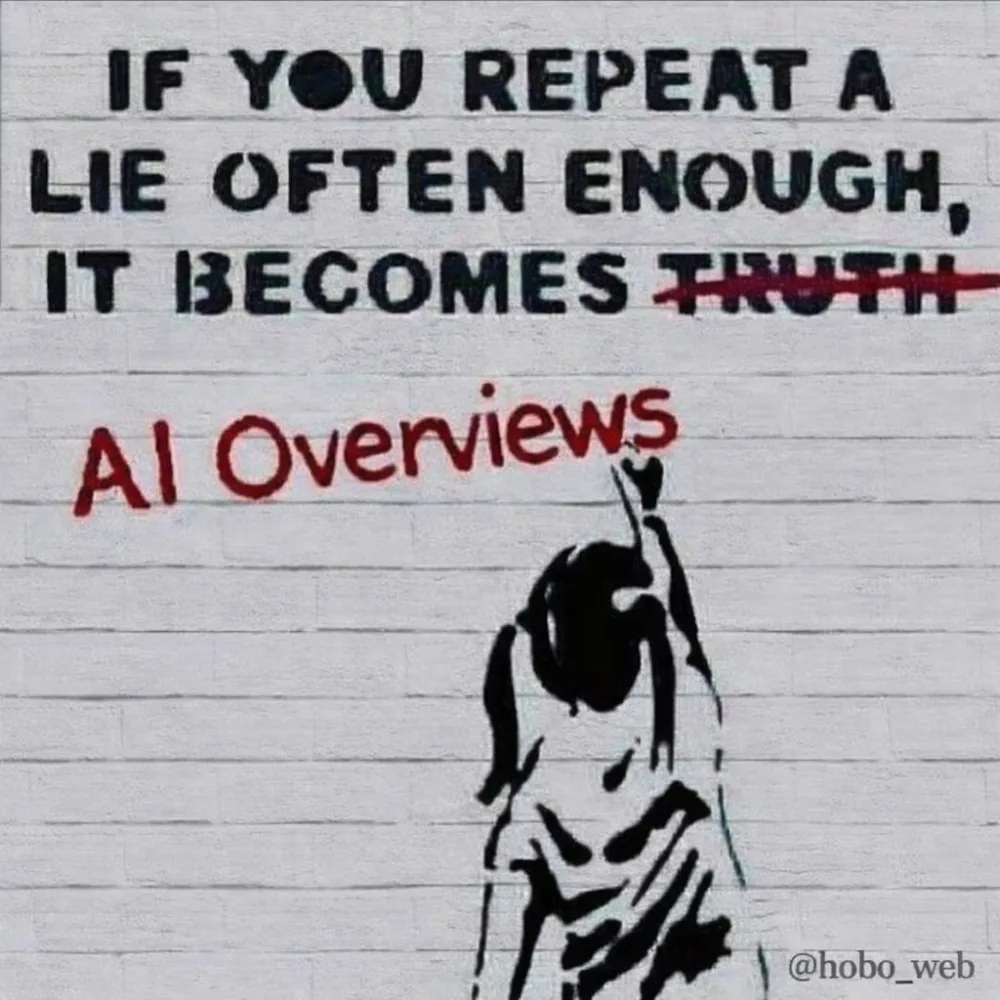
Lily Ray in her analysis shows that notable drops are also experienced by brands that have massively increased self-promotional “best” pages and similar constructions. No, listicles are not prohibited by good GEO, but keep in mind that Google, for example, is starting to take a closer look at trust in reviews and how exactly this format is used.
This leads to quite pragmatic rules of the game.
If you are making a “rating/comparison/collection” — do it as a review, not as self-promotion
3 mandatory elements:
Transparent methodology: what criteria do you use to rank, what is more important, what do you exclude. (This is exactly what separates useful content from format manipulation)
Balance and choice: in a good review, it is always clear that the author actually weighed the options, rather than leading to the desired answer. Even if they did lead — learn to be native))
Disclosure of interest: if you are a market participant — the reader should understand this, otherwise it looks like advertising disguised as a review.
The essence: you can use the format, but in a way that it looks like help to the user (addressing the issue from different angles), not as persuasion without evidence.
You cannot be first everywhere
If you are participating in a list (often places in them are purchased) — do not take first place everywhere. Your product should stand exactly where it logically fits according to the criteria.
Not “mentions for the sake of mentions” but “mentions with useful function”
Make mentions that serve a purpose for the user. While competitors praise themselves and each other.
Practically it looks like this:
not “we are partners/friends/recommend”,
but “here are scenarios when this option is suitable / not suitable”,
with limitations and conditions.
This way you achieve the same “presence”, but without the feeling of trickery and imposed recommendation.
Technically support GEO
For the same competent distribution of crawling budget, adhere to:
one scenario → one canonical URL (without endless variations),
parameters should not create “new pages” — only clusters,
important pages and search query groups must be accessible to the crawler,
https everywhere and without mixed content
mobile speed ~< 1.8s as a guideline,
complete coverage of structured data: especially useful are FAQPage / HowTo where the format fits.
Make pages “easy to extract”: TL;DR, lists, tables, “if-then” blocks, mini-algorithms (3–7 steps).
And the most practical: reinforce the effect not by “hitting” but by repeatability
Your next step:
You check not the fact of spot and singular presence, but how often we appear in the context of one intent. And work on increasing the frequency — this is “white” optimization of probability.
What should a website owner do in this reality: how to properly deal with GEO
If GEO is about probability, then the main question becomes boring and adult: how to systematically increase this probability, rather than just catching lucky runs?
The answer (and it’s the most boring one): GEO is an engineering cycle. It’s not a one-time content refinement → waiting. But a stack of hypotheses that is constantly replenished. For example: prompts → content matrix → edits → measurement → next iteration.
Goal #1 — become a stable source. It is necessary to create a strong foundation + also brand (for extractability). In total: seo + pr + reputation marketing. What can be done:
1. Choose the right layer
GEO doesn’t make sense everywhere: AI responses don’t appear everywhere and not always. Therefore:
take non-branded, informational intents,
and do not make branded/low-frequency intents the center of the strategy.
2. Form a stack of prompts
The same request in AI easily gives different lists (the chance of getting the same brand list in 100 runs is < 1 in 100, and the same order is closer to 1 in 1000). So the protocol is as follows:
15–30 target queries (on topics that are really important to you),
each run as a series (the same request several times),
fix the frequency of presence.
3. Restructure content for extractable structure
short definition,
list of selection criteria,
tabular comparison,
block “when NOT suitable,”
mini-FAQ.
4. If you’re making a “rating/top/selection” — turn it into a proof-based review
instead of “we are #1” → “here is the methodology + here are different selection scenarios,”
selection based on conditions/limitations
5. Don’t kill everything with crawling (otherwise GEO won’t survive to see results)
don’t create endless URL combinations,
parameters should not create “new pages,”
important sections should be easier to navigate than secondary variations.
6. Introduce “limiters” because influence is possible — and that’s why it’s dangerous
build presence so that it does not depend on a single source,
avoid mass copying of the same technique,
focus on materials that look like a source, not like optimization,
keep one version of the truth on the site and other sources.
7. Work as a “universal”
Content + tech + measurement. And so on:
you should have one owner of the process (not content separately, tech separately),
one GEO metric (frequency of presence in the series),
one publication and update regulation.
GEO is a new area of responsibility
So basic work on the site and SEO is necessary. But on top of that foundation, a new layer has indeed emerged — and it lives, of course, by different rules.
This immediately explains why GEO has two sides:
A shorter path: the effect is quick — but it also quickly turns into a toxic asset when the pattern becomes too widespread.
Discipline: structure, verifiability, consistency, and technical base.
Here’s my final thought: we need to learn to keep the system as a whole and see the consequences of our actions at different levels (technical, content, trust, analytics, etc.).
Just a reminder, you can find me (and read/chat) in the tg channel / in personal messages
To all GEO, but without fanaticism)









Write comment