- AI
- A
Silicon King: How NVIDIA Laid the Foundation for the Neural Network Revolution
How did a company whose chips were originally designed to render polygons in video games become the main beneficiary of the AI revolution and break through the $5 trillion market capitalization ceiling?
This is not just a story of a lucky confluence of circumstances or the crypto bubble. In this article, we will break down the engineering anatomy of NVIDIA's monopoly: from the nearly bankrupt startup's square polygon chip NV1 to the multi-billion dollar bet on the CUDA platform, which has become the most reliable vendor lock-in in the modern industry.
The modern generative artificial intelligence landscape is impossible to imagine without colossal computing power. The boom in large language models (LLMs), which began with the triumphant rise of ChatGPT, and the integration of AI tools into products of IT giants like Microsoft, Google, and Amazon triggered unprecedented demand for specialized hardware. At the center of this hardware frenzy was a company whose market capitalization broke all-time records, surpassing both Apple and Microsoft. We are, of course, talking about NVIDIA.
The paradox of the situation is that the main beneficiary of the current neural network revolution has been primarily associated with the video game industry for decades. Today, NVIDIA controls the overwhelming majority of the data center accelerator market, dictating terms to entire industries, and multi-month queues of corporations willing to pay tens of thousands of dollars per unit form for Hopper generation chips (such as the H100).
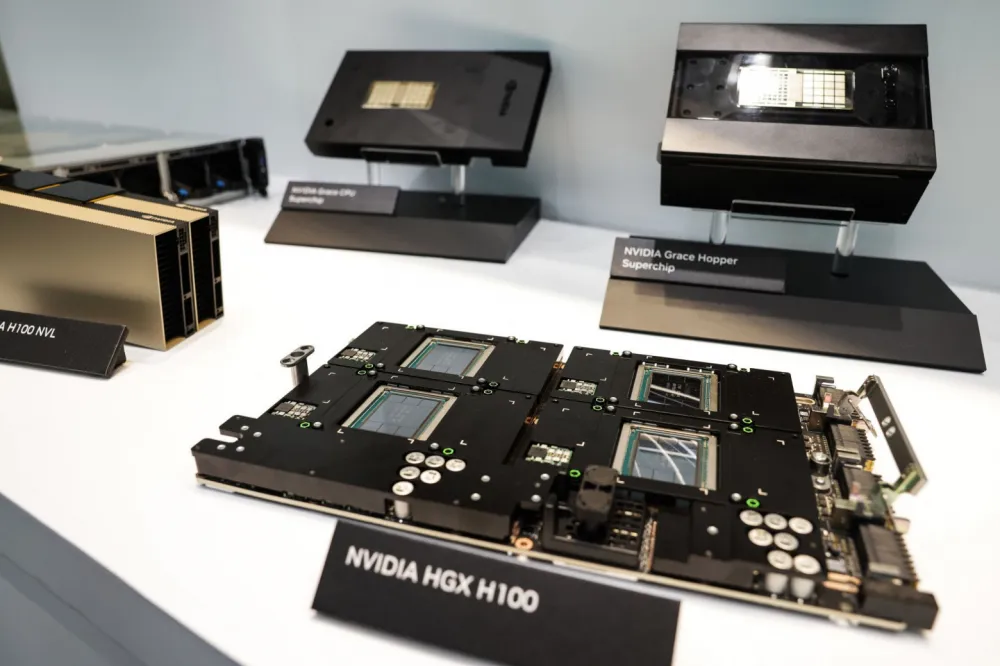
How did a vendor that started out producing graphics adapters for gamers end up an absolute monopolist in the most resource-intensive area of modern computing? Is this a natural outcome, or did Jensen Huang simply get lucky by being in the right place at the right time with the right silicon?
Analyzing NVIDIA's history makes it obvious: their current dominance is not the result of a random coincidence of circumstances, but the consequence of systematic, sometimes extremely risky ecosystem planning. The company's path from a startup with $40,000 in capital to a technological hegemon is paved not only with innovations, but also with serious architectural miscalculations, painful pivots, and non-obvious investments in software.
In this article, we will analyze the engineering and strategic evolution of NVIDIA. We will look at how the failure of non-standard geometry in early chips taught the company to adapt to the industry, why they spent millions developing the CUDA GPGPU platform when no one believed in it, and how a specific management style allowed them to retain a team capable of implementing this multi-year plan.
2. The cost of non-standard architecture: The lesson of NV1 and salvation through standardization
The history of NVIDIA, founded in 1993 by Jensen Huang, Chris Malachowski, and Curtis Priem (with an initial capital of just $40,000), could have ended just three years after it started. The reason for the near-bankruptcy was a classic mistake of hardware startups: attempting to impose their own proprietary computing paradigm on the market, detached from software realities.
In 1995, the company released its first product, the NV1 multimedia accelerator. From an engineering standpoint, the chip was ambitious: it attempted to combine graphics processing, sound processing, and gamepad management. However, the main problem lay in the rendering architecture. While the emerging 3D graphics industry was leaning towards using triangular polygons as basic primitives for building 3D scenes, NVIDIA bet on quadratic surfaces (Quadratic Texture Maps, or simply quads).
On paper, quads seemed like an elegant solution: they required less computational power to create curved surfaces. But the market decided otherwise. Microsoft, forming the foundation for PC gaming, released the Direct3D API, which was based on the mathematics of triangles.
The NV1 turned out to be hardware-incompatible with the main industrial standard. Game developers had no intention of rewriting engines for a non-standard architecture just for one graphics card. The situation was worsened by a contract with the Japanese giant Sega: NVIDIA was developing a graphics processor for the upcoming Dreamcast console based on the same square-based algorithms. When it became obvious that the industry had moved towards triangles, Huang had to admit defeat to Sega's management. The contract was terminated (although Sega, paradoxically, did not demand the return of investments, which gave NVIDIA several life-saving months).
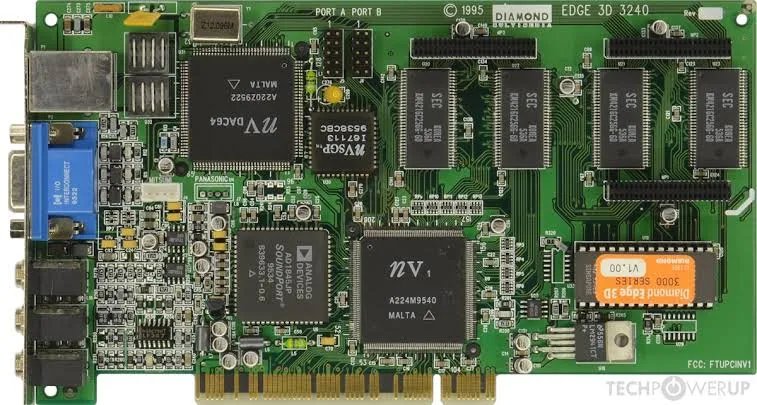
By the end of 1996, the company was on the brink of collapse: money was running out, and the staff had to be reduced by more than half (from a hundred to about forty people). This crisis became the most important lesson for Jensen Huang. It became clear: no matter how innovative the hardware is, it is dead without support from software APIs and developers.
NVIDIA made an emergency pivot. In 1997, the RIVA 128 microarchitecture hit the market. The company completely abandoned squares, switched to the standard triangular polygons, and provided deep hardware support for Direct3D and OpenGL. The result was not long in coming: RIVA 128 became a hit, with over a million chips sold in the first few months. The company not only survived — it realized that the key to dominance lies not only in silicon but also in seamless integration with software standards. This lesson will become the foundation for NVIDIA's most important decision ten years later.
3. From Video Cards to GPU: Market Capture and Talent Acquisition
Having learned the lesson from the RIVA 128 and cemented its success with the RIVA TNT lineup, NVIDIA reached a turning point that would forever change the distribution of roles inside PCs. Until the late 1990s, graphics output devices were called "3D accelerators" or simply video cards. Their functionality was limited to rasterization — filling pixels and applying textures. All the heavy math related to calculating scene geometry and lighting fell on the central processing unit (CPU). Because of this, even the most powerful systems would "choke" when trying to render complex three-dimensional worlds.
In 1999, NVIDIA unveiled the GeForce 256 chip. The company's marketers introduced a new term into circulation — GPU (Graphics Processing Unit). This was not just a naming move, but a fundamental architectural shift. The GeForce 256 was the first mass-market chip with an integrated Hardware T&L (Transform and Lighting) block.
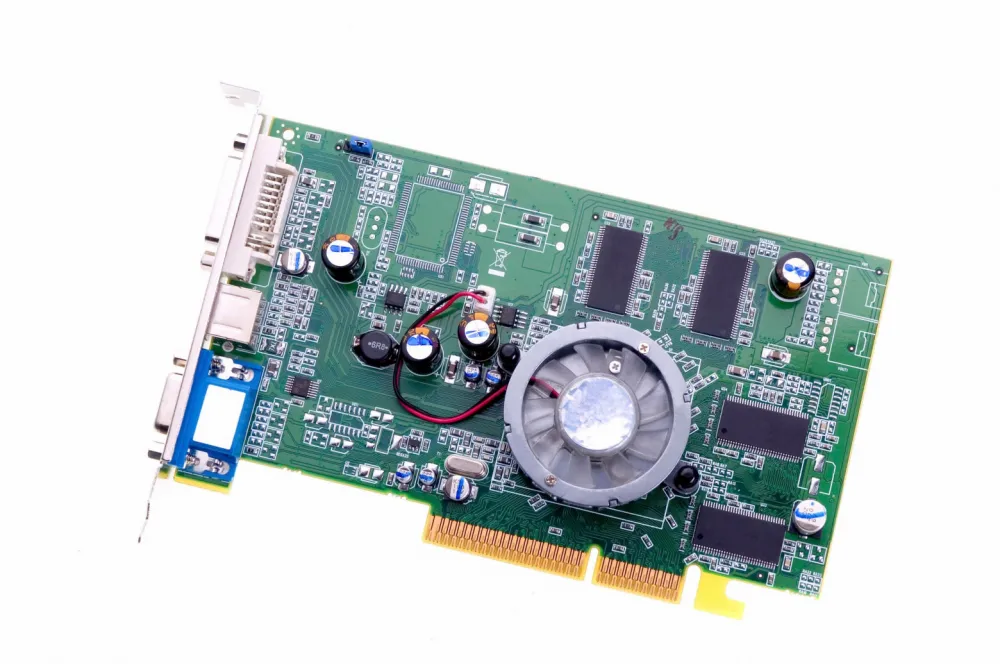
The hardware implementation of T&L meant that the calculation of polygon transformation and dynamic lighting was moved from the universal x86 CPU cores to the specialized silicon of the graphics card. The graphics pipeline became more autonomous. This solution proved a core concept: an array of specialized cores performing identical mathematical operations in parallel handles geometry many times more efficiently than a general-purpose processor. It is this concept of parallelism that would years later form the foundation of the neural network boom.
Alongside its engineering breakthroughs, NVIDIA began aggressively building a monopoly in the talent market. In the late 1990s, the main competitor of the "green" company was 3dfx Interactive, the creator of the iconic Voodoo accelerators. However, 3dfx made a series of fatal business mistakes (in particular, it tried to become the exclusive manufacturer of its own video cards, cutting ties with third-party vendors), which led to its bankruptcy.
In 2000, NVIDIA acquired the remaining assets of 3dfx for a modest $70 million by industry standards. What's interesting here is how Jensen Huang assessed this deal. Later he admitted that he had no interest at all in 3dfx's market share or its brand. The main goal of the acquisition were engineers and patents. NVIDIA carried out a classic acqui-hire (acquisition for hiring purposes), bringing on board around a hundred top specialists in graphics architecture and a powerful intellectual property portfolio.
This approach became the company's calling card. By buying out competitors, NVIDIA was buying brains, cementing its technological leadership. By the early 2000s, the company not only dominated the PC market, but also began expanding into the console segment, having developed graphics chips for the original Xbox and PlayStation 3. Having captured the gaming market, Huang prepared a springboard for the most grand and risky adventure in the company's history.
4. The Software Adventure of the Decade: Why CUDA Was Needed
In 2006, while at the peak of success in the consumer segment, NVIDIA took a step that Wall Street initially considered financial madness, and gamers simply didn't understand. The company launched CUDA (Compute Unified Device Architecture) — a hardware-software platform for parallel computing.
By the mid-2000s, graphics processors had already evolved into arrays of hundreds of cores. By their nature, GPUs are ideally suited for the SIMD (Single Instruction, Multiple Data) architecture, where the same mathematical operation is applied simultaneously to a huge array of data. Even then, scientists and researchers were trying to use graphics cards for complex simulations, but this was a tortuous process: to make a GPU add two matrices, programmers had to "trick" graphics APIs (OpenGL or Direct3D), "packing" computations into textures and pixels.

CUDA changed everything. It provided developers with a proper interface — compilers (primarily for C/C++) and libraries that give direct access to the graphics chip's computing resources. This is how the concept of GPGPU (General-Purpose computing on Graphics Processing Units) was finally formalized.
From an engineering and financial perspective, launching CUDA was a colossal risk. Adding extra logic to manage general-purpose computing increased the silicon die size, complicated manufacturing, and reduced chip profit margins. Investors asked Huang a reasonable question: why spend hundreds of millions of dollars on R&D for a niche tool for a handful of scientists, when the target audience buys graphics cards solely for high FPS in The Elder Scrolls IV: Oblivion?
But Huang already understood back then that a GPU is not just an accelerator for rendering polygons, but a miniature supercomputer. And NVIDIA made a decision that was brilliant in its foresight: CUDA support was integrated into every released chip, from ultra-budget office placeholder GPUs to flagship products.
This allowed NVIDIA to pull off an unprecedented ecosystem scaling trick. Any student, graduate student, or data scientist who bought a regular gaming graphics card got a full-fledged workstation on their desk. As a result, NVIDIA didn't just sell hardware — it raised a whole generation of engineers accustomed to writing code for CUDA.
Years later, this unobvious software layer would turn into the deepest and most insurmountable economic moat in the IT market. NVIDIA created the perfect vendor lock-in: when the world suddenly needs infinite parallel computing, it will turn out that all existing research and commercial software is written and optimized exclusively for the "green" architecture.
5. Matrix computations: How GPUs met neural networks
The defining moment of NVIDIA's years-long strategy came in 2012 at the ImageNet image recognition competition. A research group that included Ilya Sutskever, future co-founder of OpenAI, presented the convolutional neural network AlexNet. It didn't just outperform its competitors — it crushed them by a huge margin, proving that deep learning (Deep Learning) actually works if you give it enough computing power. AlexNet was trained on two consumer GTX 580 graphics cards using the CUDA platform.
The secret of this synergy lies in fundamental mathematics. Training neural networks is based on forward and backward error propagation algorithms, which essentially boil down to the continuous multiplication and addition of matrices of colossal size (GEMM operations). It turned out that calculating lighting physics for millions of pixels in a 3D shooter and computing weights in the layers of an artificial neural network are computing tasks of the same class. Central processing units (CPUs) with their complex pipelines, caches, and branch prediction blocks proved too sluggish for this task, while thousands of simple ALUs in GPU architecture chewed through matrix math like nuts.
Realizing the scale of what was happening, Jensen Huang made another radical move: NVIDIA began structurally separating its silicon development efforts. After leaving the GeForce product line for gamers, the company poured massive R&D resources into creating chips specifically for data centers.
The evolution of server architectures began: Tesla, Pascal (P100), Volta (V100), Ampere (A100), and finally Hopper (H100). These "silicon monsters" differed drastically from regular graphics cards:
Tensor Cores: NVIDIA added specialized blocks to the architecture, designed exclusively for mixed-precision matrix operations (FP16, INT8, and later FP8). This drastically accelerated network inference and training.
HBM Memory: The shift to multi-stacked memory with enormous bandwidth solved the "bottleneck" problem of feeding terabytes of data to the cores.
NVLink: The realization that modern models would not fit on a single chip led to the creation of a proprietary high-speed interconnect. NVLink allowed combining dozens and hundreds of GPUs into a single logical supercomputer.
Back in 2016, NVIDIA released the DGX-1, a pre-configured server node designed specifically for AI development (Huang personally delivered the first unit to the office of the then-young non-profit laboratory OpenAI).
It was this infrastructure foundation that enabled the 2022 generative boom. And while the consumer market was roiled by cryptocurrency frenzies (where miners also exploited GPUs' ability to parallelize hashing for PoW algorithms, buying graphics cards at triple the regular price), NVIDIA was steadily building a monopoly in the corporate sector. When Microsoft, Google and Amazon rushed to train their own ChatGPT-like models, it turned out that the H100 was the only product in the world capable of meeting their needs. Queues for these $30,000–$40,000 accelerators stretched for months, and Microsoft purchased them in the hundreds of thousands, turning NVIDIA into a trillion-dollar company.
6. "Flat" Hierarchy: Engineering Management at NVIDIA
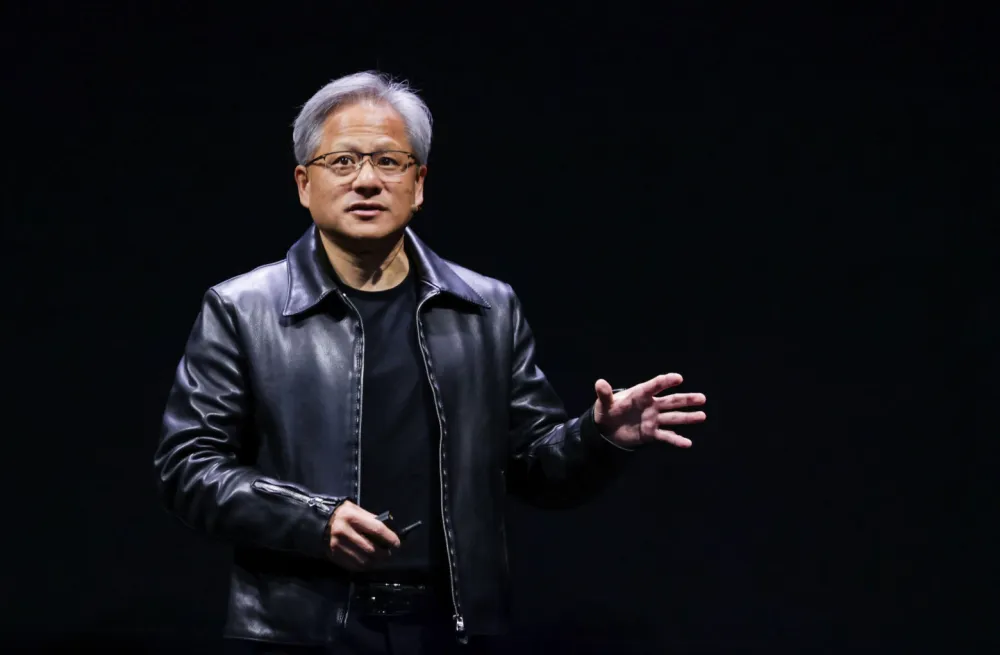
The success of such long-term, high-risk planning (from the launch of CUDA in 2006 to reaping the benefits of the 2022 AI boom) is impossible without a specific corporate culture. In Silicon Valley, where the average tenure of a founder-CEO rarely exceeds a decade, Jensen Huang has remained NVIDIA's unchallenged leader for over 30 years. And his management framework is far from classic MBA standards.
The primary architectural feature of NVIDIA as an organization is an extremely flat hierarchy. Huang has roughly 60 direct reports. For comparison, a typical CEO of a corporation of this scale (with a market capitalization in the trillions of dollars and a headcount of over 35,000 people) usually has between 5 and 10 direct reports.
Why create such a "bottleneck" at the very top? Huang is convinced that a traditional deep hierarchy breeds information distortion and bureaucracy. The more people report directly to the company head, the fewer management layers separate top management from the actual engineers. This radically speeds up decision-making: an issue that arises at the chip logic design level reaches the CEO without having to pass through five tiers of vice presidents.
At the same time, Huang categorically does not hold traditional one-on-one (1-on-1) meetings. Instead of closed offices and secret planning sessions, he follows the practice of thinking out loud in front of large groups of employees. There is no "elite" information in the company that is only accessible to a select circle of directors. If an issue is discussed, it is discussed openly, which synchronizes context for all involved teams.
This transparency is offset by extremely high standards. Huang himself is a workaholic who works seven days a week, and he makes no secret of the fact that NVIDIA is a tough work environment. Perfectionism and zero tolerance for mediocrity are cultivated here. This is partly a legacy of his own personal background: his teenage experience working as a dishwasher and surviving reform school instilled in him a maniacal level of discipline, which he transmits across the entire company.
However, despite intense pressure, employee turnover at NVIDIA is anomalously low for a big tech company at 2.5%. While other corporations are carrying out mass layoffs, NVIDIA is retaining its team. The reason is not only the meaningfulness of the tasks, but also powerful financial incentives: aggressive stock growth has meant that the vast majority of employees who received stock options have become dollar millionaires. People simply see no point in leaving a company that not only builds the foundation of the future, but also generously shares its market capitalization with those who design that foundation.
7. Summary: Why it is so hard to break a monopoly
Today NVIDIA controls more than 90% of the market for chips used for neural network training and over 92% of the discrete graphics market for PCs. The latest Blackwell server architecture (named after mathematician David Blackwell) operates with a monstrous 208 billion transistors per chip — for comparison, the revolutionary GeForce 256 had only 23 million. But transistors alone do not guarantee a monopoly.
Tech giants are fully aware of the dangers of relying on a single supplier. Google has long been developing its tensor processing units (TPUs), Amazon is designing Trainium and Inferentia chips, Microsoft is investing in Maia accelerators, and its main hardware competitor, AMD, is actively promoting its Instinct line. It would seem that with BigTech having unlimited budgets, NVIDIA's hegemony should have been shaken. But this is not happening. Why?
The answer lies in the concept of ecosystem moat (ecosystem moat) that NVIDIA has been building over the past 15 years. Competitors can release silicon that outperforms the H100 or Blackwell in raw teraflops. But bare hardware without software, as the painful experience with the NV1 chip back in 1995 showed, has no value.
The entire modern artificial intelligence development stack — from PyTorch and TensorFlow to highly specialized libraries — is deeply rooted in CUDA. For a data center or research lab to "switch over" to accelerators from another vendor, they need to do more than just swap out the cards in their servers. They will have to rewrite massive codebases, fight compatibility bugs, and retrain their engineers. Alternative software stacks (such as AMD's ROCm) are evolving rapidly, but they have to catch up to a platform that has evolved since 2006.
Moreover, NVIDIA has long since stopped being just a chip manufacturer. After acquiring Mellanox (a leader in InfiniBand networking technologies), NVIDIA began selling not standalone GPUs, but fully assembled supercomputers and entire data centers, where processors, memory, and interconnects are woven into a single unified architecture. Its attempt to acquire ARM for $40 billion in 2020 was a logical step toward absolute control over the entire computing stack, and only the intervention of global antitrust regulators halted this deal.
NVIDIA's history is perhaps the best example in the modern IT industry of how long-term vision works. After learning a harsh lesson about the importance of standards in its early days, Jensen Huang's company did not just learn to adapt to them. It spent decades and billions of dollars to become the standard itself, a standard that is now practically impossible to circumvent. The boy who washed dishes at Denny's built an empire whose software-hardware foundation has become the backbone of the entire artificial intelligence era.
- What do engineers at OpenAI, Microsoft, and AWS think about the future of AI: honest answers from the AI Engineer World's Fair 2025
- ZeroTier Magic: Creating a Personal VPN Network for Home and Cloud in 20 Minutes
- Goodbye, Android: how Huawei is building its digital empire without Google and Microsoft






Write comment