- AI
- A
How Adaptive RAG Works That Doesn’t Need an LLM At All
One of the most popular ways to reduce the hallucination rate of language models is the RAG method, a scheme where the model accesses external data as needed instead of relying exclusively on its internal knowledge.
All current-generation LLMs work with RAG, but it increases the system's computational costs and can itself produce errors if the external context is poor or irrelevant.
Today I will break down the study LLM-Independent Adaptive RAG: Let the Question Speak for Itself, in which researchers from MWS AI, AIRI, Skoltech and several other universities propose a solution to this problem via a new approach to adaptive retrieval, where RAG is not run automatically, but only when needed.
What is novel about the method
You would be right to exclaim, “this concept is not fundamentally new!”. But don’t rush to conclusions: almost all existing adaptive RAG approaches make the “search / do not search” decision using the LLM itself: based on its internal states, output signals, or uncertainty estimates. This again incurs significant computational costs and largely erases the efficiency gain that adaptive retrieval was originally designed to deliver.
The study authors propose abandoning the expensive LLM-based check for whether RAG is needed, and replacing it with a lighter method: determining whether retrieval is required based on external features of the question itself and the entities associated with it. They named their approach LLM-independent adaptive retrieval.
In other words, the researchers propose looking not inside the model, but at the question itself. To do this, external features related to the question and the entities contained in it are collected.
For example:
popularity based on view counts on Wikipedia;
how well the model itself generally knows such entities;
what type the question is and how complex it is.
Here is how the framework works:
First, the system receives the question → required external features are extracted from this question → then a lightweight classifier (not an LLM) decides whether retrieval is needed or not.
If external search is required, the system performs it first, then passes the retrieved context to the generative model. If it is not required, the model responds immediately, without an extra step.
The key advantage here is that the search decision is moved out of the expensive layer of the large model into the cheaper feature and classifier layer.
Even the knowledgability feature, which relates to how well the model knows entities, is pre-calculated: iAR precomputes these scores, and they are then used without making a new request to the LLM for every question.
This approach allows spending less than 1% of the total computational resources (FLOPs) required to generate an answer on the search decision, which is significantly cheaper than classic RAG approaches.
Technical details
Under the hood there is a lightweight feature layer (the authors consider a total of 27 features grouped into 7 categories) that operates before answer generation. The layer takes the question, extracts a set of external signals from it, and based on these signals, a trained classifier decides whether retrieval is needed or not.
Here are all 7 groups:
Graph features: Features derived from the Wikidata knowledge graph. For entities in the question, the number of their connections as both subject and object is calculated; then the minimum, maximum, and average values are taken.
Popularity features: How popular the entities in the question are, based on Wikipedia page views over the past year; again, min, max, and mean are used.
Frequency features: How often entities appear in a large text corpus, plus the frequency of the rarest n-gram in the question.
Knowledgability: A score of how well the LLM "knows" an entity; this signal is obtained in advance, offline, via the model's verbalized uncertainty related to the entity.
Question type: The probability that a question belongs to one of nine types — ordinal, count, generic, superlative, difference, intersection, multihop, yes/no, comparative.
Question complexity: Whether the question is single-step or multi-hop, i.e., whether it requires additional reasoning steps.
Context relevance: How relevant the retrieved context is to the question overall.
The way these feature groups are calculated is also important. For entity linking and entity extraction, ready-made NLP tools such as BELA and DeepPavlov are used.
Question type they obtain via a classifier based on the bert-base-uncased model trained on Mintaka; at the output, the model outputs nine probabilities for question types, and the reported validation accuracy of this classifier is 0.93.
Question complexity is constructed as a one-hop vs multi-hop classification based on the N-hop feature from FreshQA; DistilBERT is used for this purpose, and the final test F1 score is 0.82. Context relevance is computed via a BERT cross-encoder: the question and each context segment are fed into the model, after which the minimum, maximum, and mean relevance probabilities are aggregated across all contexts, and context length is also taken into account separately.
The router itself is not a large neural network, but a standard ML classifier built on top of these features. Each feature group can be used to train a classifier that predicts whether retrieval is required or not.
In the appendix, the authors test several standard models, and ultimately use a soft-voting ensemble of the two best-performing models on the validation set. In addition to individual feature groups, they also test hybrid variants: HybridExternal – all external features, HybridUFP – all external features excluding popularity and frequency, and HybridFP – uncertainty plus external features excluding popularity and frequency.
The base setup uses LLaMA 3.1-8B-Instruct as the generator and BM25 as the retriever. The transferability of results to Qwen2.5-7B-Instruct is tested separately. Testing is conducted on six QA datasets: SQuAD v1.1, Natural Questions, TriviaQA, MuSiQue, HotpotQA, and 2WikiMultiHopQA.
In-Accuracy (InAcc) is used for quality assessment: this metric checks whether the correct answer is contained in the model response. For efficiency evaluation, Retrieval Calls (RC) – the average number of retrieval calls per question, and LM Calls (LMC) – the average number of language model calls per question, including steps for uncertainty estimation, are used.
Results
The iAR method does not necessarily achieve the highest absolute accuracy, but it provides a very favorable trade-off between quality and computational cost. The best external features were found to be knowledgability and question complexity, with average InAcc scores of 38.9 and 38.8 respectively. For comparison, Always RAG achieves 38.4, while the best one-step uncertainty baseline, Hybrid UE, achieves 39.3. This means the gap with strong uncertainty-based approaches is relatively small.
In terms of average answer accuracy, there are also higher average results, for example, AdaptiveRAG – 40.3 and DRAGIN – 41.1. Conclusion: external features perform nearly as well as strong adaptive methods, while being significantly cheaper in terms of the number of model calls.
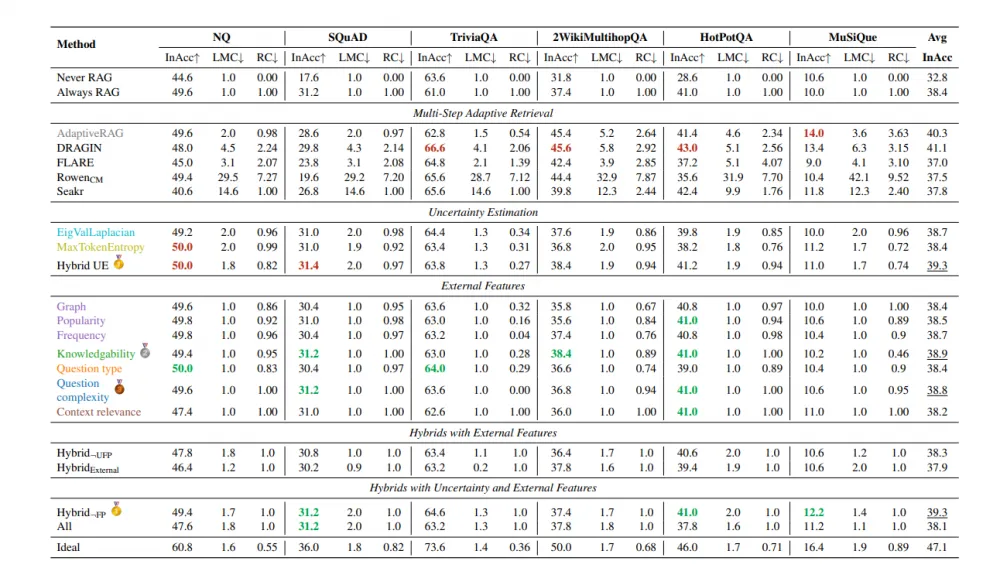
For external methods, LMC is usually 1.0, meaning on average there is one LLM call per question. For uncertainty-based methods, this metric is higher: for example, for Hybrid UE it is 1.7–2.0, for AdaptiveRAG it is up to 5.2 depending on the dataset, for DRAGIN up to 6.3, for SeaKR up to 14.6, and for RowenCM 42.1. External features are precomputed, so they do not add LLM overhead during inference.
But can external features complement uncertainty-based approaches?
According to the study's findings, on most datasets external features are more likely to replace uncertainty signals rather than enhance them. A noticeable gain from the combination is observed mainly on the MuSiQue dataset; on the other sets, no clear advantages were obtained from mixing the two approaches.
Conclusion
In fact, the reviewed research work focuses on finding a more cost-effective approach to making decisions on the need to use retrieval. The concept of lightweight ML for query routing is one way to reduce inference costs, which all businesses strive for and which all AI developers fight for. Thus, the LLM-Independent Adaptive Retrieval method has good chances of gaining widespread adoption. .
https://aclanthology.org/2025.emnlp-main.439/ - link to the paper.
Maria Marina, Nikolay Ivanov, Sergey Pletenev, Mikhail Salnikov, Daria Galimzianova, Nikita Krayko, Vasily Konovalov, Alexander Panchenko, and Viktor Moskvoretskii. 2025. LLM-Independent Adaptive RAG: Let the Question Speak for Itself. In Proceedings of the 2025 Conference on Empirical Methods in Natural Language Processing, pages 8697–8709, Suzhou, China. Association for Computational Linguistics.








Write comment