- AI
- A
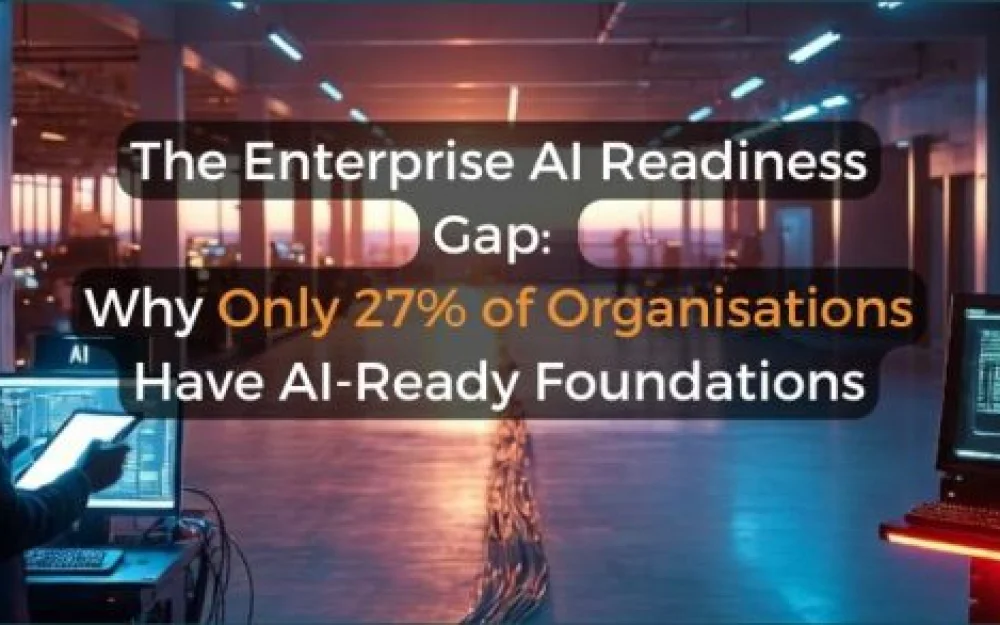
Why only 27% of organizations are ready for AI
Key findings
94% of enterprise executives believe that tightly interconnected data, processes, and applications are critical to AI success. Only 27% say their organization has them.
65% report that their structured data is AI-ready. Only 39% say the same about their unstructured data, which stores the majority of institutional knowledge.
39% of organizations use AI as standalone tools positioned alongside workflows. Only 12% have implemented AI directly within the workflow itself.
17% of enterprises have deployed agentic AI. 32% have abandoned their attempts.
The primary constraint on the value of enterprise AI is the operating model, not technology.
Source: Harvard Business Review Analytic Services, «Bridging the Readiness Gap to the Agentic Enterprise», December 2025, n=325 enterprise-level decision makers.
What is the enterprise AI readiness gap?
The enterprise AI readiness gap is the difference between what an organization says it needs for AI to succeed, and what it has actually built. A survey of 325 enterprise-level decision makers conducted by Harvard Business Review Analytic Services in December 2025 measured this gap at 67 percentage points. 94% of executives believe that interconnected data, processes, and applications are extremely important for AI success. Only 27% say their organization currently has them.
This gap is the most significant predictive signal in the report. It explains why AI pilot projects get stuck, why claims of productivity growth do not appear in profit and loss (P&L) statements, and why most agentic AI deployments stall at the proof-of-concept (proof of concept) stage.
This is not a model quality issue. This is not a compute capacity issue. And in a basic sense, it is not even a talent issue.
The same pattern manifests itself regardless of industry — in banking, insurance, telecommunications, and retail. Pilots are funded faster than fundamental foundations are laid. Models are deployed faster than data management is put in order. The gap is structural in nature, and first and foremost it is an operational model problem, and only then anything else.
Why does the AI readiness gap exist?
Three reasons, and all of them are organizational.
First, AI got a budget before data got a strategy. Pilot projects and narrow-specialized solutions were cheap, fast, and visible. Fundamental work on master data, semantic layers, content management, and integration with them is neither cheap, nor fast, nor visible. When organizations optimize processes for demonstration speed, they underinvest in the foundation that allows demonstrations to scale.
Second, business and IT have been describing the same entities differently for years. "Customer" in CRM is not the same as "customer" in the billing system. "Policy" (insurance policy) in underwriting is not the same as "policy" in claims settlement. AI does not tolerate such fragmentation. It reveals inconsistency, giving answers that no one trusts.
Third, governance was perceived as a brake, not as a foundation. Most organizations add governance after deployment, when the cost of refactoring is maximum and political will is minimal.
Emi Machado, senior research manager in the Content and Knowledge Discovery Strategies program at IDC, directly formulates the consequence in an HBR report:
If organizations don't trust their data and content, they won't trust AI built on top of it. And if they don't trust the system, they won't deploy it widely or rely on it for more complex decisions.
This causal chain is the entire problem of scaling corporate AI in two sentences.
Why are unstructured data more important than most enterprises admit?
The HBR survey provides the clearest argument in favor of this in any recent study. 65% of organizations say that their structured data is, to some extent, fully ready for AI. Only 39% say the same about their unstructured data.
Unstructured data includes text, images, videos, emails, PDF files, contracts, loss settlement records, meeting transcripts and call recordings, which make up the majority of what an enterprise actually knows about itself. In the bank described in the HBR report, the operations director estimated that 60% of organizational data is unstructured. In insurance, financial services and the public sector, this share is often even higher.
This is important because the most valuable AI use cases (underwriting decisions, claims triage, customer service, compliance checks, knowledge work) depend on unstructured content. An organization that is ready for AI when it comes to database tables, but not ready for its document repository, is ready for AI for the wrong 40%.
Karma Hicks, Chief Operations and Process Improvement Officer at American National Bank of Texas, describes the diagnostic approach the bank now uses:
"When we map our processes and look for opportunities to improve efficiency, we focus on the data itself: where people get it from, and whether it ends up in our data warehouse. Is it structured or unstructured? Is it sitting on someone's desktop?"
That last question is the one most enterprises avoid. Desktops, email inboxes, SharePoint folders, shared drives that no one owns. Until these repositories are inventoried, classified, and either integrated or decommissioned, an AI initiative only works with a small fraction of the knowledge it needs.
Machado adds a more complex layer that lies deeper:
If you don’t have good data, you won’t have good [AI] outcomes. AI is built on the data you have access to. This means not just modernizing content, but also the applications used to work with that content. Many companies still run outdated applications with data they can’t access, because it’s difficult to integrate and coordinate. Modernization has truly become a strategic imperative.
The imperative to modernize extends beyond data to the platforms that store it.
Embedded AI vs. standalone AI: what actually works?
Embedded AI works at enterprise scale. Standalone AI rarely operates at that scale. HBR data clearly illustrates this divide.
Approach | Share of organizations | What it looks like | Why it matters |
|---|---|---|---|
Standalone AI | 39% | A separate application positioned adjacent to a workflow. Users switch contexts to get assistance. | Context is lost with every switch. Decisions are not fed back into record-keeping systems. Adoption relies on individual user discipline. |
Embedded AI | 12% | AI is embedded directly into a workflow. It operates within the context the system already has. | It scales across the entire organization. It creates audit trails. Adoption follows process design, not individual user habit. |
Hybrid | 27% | Some processes use embedded AI, others use standalone AI. | This is a transitional state. Its value depends on which processes were embedded first. |
No AI in processes yet | 19% | AI tools are not deployed in operational workflows. | Foundational work still lies ahead. |
Amy Machado of IDC frames a design principle in language that should be posted on every CIO’s wall:
«When you don’t integrate AI into your workflow, it feels like just another thing you have to learn. It’s not just system integration. It’s the integration of processes and the experience itself. If it feels like just another tool, it won’t take hold».
Stephanie Woerner, senior research scientist at the MIT Sloan School of Management and director of the MIT Center for Information Systems Research, draws a conclusion about enterprise scale:
«Companies have struggled to grasp the value of autonomous AI tools for productivity. They can see it, but mostly at the individual level. The point where you start making real progress is when you move to enterprise-wide solutions. But it will be much harder to derive value from them if you don’t have in-place data and processes».
This understanding is reshaping interaction design. The first question for any corporate AI workflow is not what model to use, or even what use case to pursue, but what the underlying workflow is. Until the process is mapped end-to-end and the points where context is lost and decisions are made are clear, no implementation work can deliver value.
What does agentic AI actually require?
Agentic AI requires everything that traditional AI requires, plus more.
Agentic systems plan, make decisions, and act autonomously within defined goals and constraints. Infrastructure requirements are correspondingly higher. Interconnected data across systems. Orchestrated workflows that can execute a decision end-to-end. Governance built into the foundation, rather than checked after the fact. A feedback loop that allows the system to learn from its own actions.
An HBR survey shows the current state of play. 17% of enterprises have deployed agentic AI. 47% are exploring or testing pilots. 32% are not currently moving forward.
The last figure is the more interesting one. Nearly a third of enterprises with AI experience have looked at agentic AI and decided to stop. They learned lessons from previous AI implementations: if the foundation is not in place, another pilot built on the same fragmented foundation will deliver the same disappointing result.
MIT Sloan's Stephanie Werner summarizes the bar:
«As companies move to advanced and agentic forms of AI, the bar is being raised. Many organizations know what they need to do, but the real complexity is getting systems, governance, and data capabilities in order to scale.»
The takeaway for executives is simple. Agentic AI is not the next AI initiative to fund. It is the AI initiative that the fundamentals need to be ready for. Until the operating model can support it, additional investments in agentic pilots will yield the same results as previous investments in autonomous AI.
How should enterprises measure the value of AI?
An HBR survey found that 51% of organizations measure AI success through productivity, 41% through work speed, 38% through cost savings, 33% through employee experience, and 30% through return on investment (ROI).
Productivity beats ROI by 21 percentage points. This gap is not a measurement framework. It is a protective mechanism.
Productivity is easy to claim. ROI is hard to defend. Hours saved are not dollars saved if the redistributed time does not create value that the business is already tracking. As AI moves to work with higher judgment, the quality of output becomes more important than the speed of output.
Nick Tabbal, co-founder and chief consultant at Agentic Consulting, articulates the measurement challenge:
«ROI is very difficult to calculate for someone coming in from the outside. You can start by measuring productivity gains, hours saved, or increased output volume, and then translate that into dollars, but you also need to look at the quality of the work being produced.»
He adds a caveat that is particularly important for agentic systems:
«It’s not just about how fast people are moving. It’s about whether the work coming out of these systems is actually more valuable and is being done with the right governance and controls in place.»
Leading practitioners in the HBR report measure differently. Karma Hicks of American National Bank of Texas describes the discipline:
“Just because you’ve bought an application doesn’t mean it will yield a return. It’s about how you use it and how you demand it be used.”
Bank now conducts proof-of-concept assessments tied to real business processes before making a purchase. ROI is evaluated upfront. Existing platforms are assessed for underutilized opportunities before adding new ones.
At University of Maryland Global Campus, Sagar Sagiraju, Vice President of Platform Engineering, uses adoption and engagement as a proxy for value:
“From an ROI perspective, we look at adoption and engagement and whether that’s reflected in outcomes.”
The discipline is transferable. Define what “good” looks like in metrics the business already cares about. Measure adoption, quality, and integrity of solutions, not just speed and volume. If an AI investment can’t be tied to an outcome the CFO already tracks, it’s a line item expense, not a strategy.
How can enterprises bridge the readiness gap?
Enterprise AI adoption work is built around three frameworks that directly address the gaps identified in the HBR report.
Phase Zero is a layer of design thinking. Before any technology solution, Phase Zero maps critical workflows, identifies where decisions are made, where context is lost, and where institutional knowledge resides. This yields a target operating model that business and IT can agree on. This is the work that 27% did and 73% didn’t.
DAPA (Digital AI Platform Accelerator) is a pre-built technical architecture that turns the Phase Zero output into an operation. It directly addresses the fragmented foundations problem: data integration, content modernization, semantic alignment, governance, baked into the foundation.
FloJo is an enterprise-grade agile delivery framework that translates the architecture into production. It’s built to address the workflow conformance problem that the HBR report identified as the biggest predictor of AI value: AI built into the workflow, not bolted on alongside it.
Confirmations are operational. Cell C achieved a 10x increase in digital revenue. Comair and Kulula reached 98% aircraft occupancy, serving 4 million passengers. Vodafone Portugal launches over 2,900 pipelines processing 3.6 petabytes of data. The platform supports over 150 machine learning models in production, serving 37 million digital users.
The pattern in these interactions is consistent. First, the fundamentals. Then alignment with business workflows. Then measurement frameworks tied to outcomes the business already values. The AI initiative is successful because the operating model is designed to support it, not because the model is better than alternatives.
AI strategy requires a solid foundation
The HBR Analytic Services research concludes with a question from IDC's Amy Machado, which should be at the start of every corporate AI strategy review:
"AI will continue to become more capable. The question for organizations is whether their data, content, and processes can keep up with it."
The answer for most enterprises today is no. 73% do not have well-integrated foundational layers. 61% are not ready when it comes to unstructured data. 39% deploy AI as standalone tools alongside workflows. 32% abandon or suspend attempts with agentic AI.
The path forward is not more pilots. It is the foundational work that 27% have already completed. A unified data strategy signed off by both business and IT. Unstructured content prepared at scale. Workflows mapped and redesigned for embedded intelligence. Governance built into the core. Measurement frameworks tied to business outcomes.
Strengthening the foundations of content, data, and processes is not a precursor to AI success. It is AI success.





Write comment