- AI
- A
AI will not replace us. But not everyone will be taken into the future
We analyze what data, economic history, and research say about the impact of artificial intelligence on the labor market.
Hello, tekkix! My name is Vladimir Drobot, I am the SRE Lead and head of the technical support center in the MWS advertising technology cluster.
In recent months, I have been studying the topic of replacing human labor with artificial intelligence: reading research, analytical reports, articles by economists and tech companies. This interest was sparked not only by publications in the media but also by the mixed reactions of my colleagues. There is no consensus in the professional community: some are convinced that AI will replace a significant portion of specialists in the coming years and seriously fear this, while others approach these claims with clear skepticism.
Like many people today, I am implementing AI into my work and would like to share my analysis of the impact of AI on the labor market. In 2026, we live in a strange informational reality. On one hand, leaders of major AI companies claim that artificial intelligence will soon replace programmers and half of office workers. On the other hand, employment data in developed countries does not show mass unemployment.
The problem is that most forecasts about the impact of AI are based on the technical capabilities of the models rather than the economics of their implementation.
Who is right? The alarmists or the optimists?
In this article, I will try to separate forecasts from facts and offer a calmer perspective on what is happening. My hypothesis is simple: Artificial intelligence does not so much destroy professions as accelerates the natural process of labor redistribution, which has always occurred in the economy, and raises the demands for people's adaptability.
Loud Forecasts About Labor Replacement
Forecasts that artificial intelligence will replace humans in various fields are no longer surprising, yet they continue to create confusion among office workers. Many of these forecasts attract widespread attention, as they are made by well-known individuals with authority in the IT and AI sectors. Here are some news items from early 2026:
At the World Economic Forum (WEF) in Davos in January 2026, Dario Amodei, the CEO of Anthropic, made a number of resonant statements about the impact of AI on the labor market. He believes that it is quite likely that models will take over all coding tasks within 6–12 months, and the number of entry-level office employees could be reduced by about half over the next 1–5 years.
Mustafa Suleyman, head of Microsoft AI, believes that most office tasks will be automated with the help of AI within 12–16 months.
At the end of 2025, renowned scientist Geoffrey Hinton, referred to as the godfather of artificial intelligence, expressed the opinion that mass layoffs related to the implementation of AI could occur in 2026.
Pessimism regarding the impact of AI on employment is also evident in this study of how this technology is perceived by ordinary employees in the U.S.:
60% believe that in 2026 there will be more job losses than new jobs created;
51% fear that they will be laid off in 2026;
4% believe that AI will create additional jobs.
Nevertheless, many executives from large international companies at the Davos forum expressed optimism and stated that thanks to AI, additional jobs will emerge in the future, and in their companies, they will focus on training people and transitioning them to new positions.
Additionally, a survey of CEOs of large international companies showed that many of them expect a certain increase in hiring for some positions in 2026, and they plan to change some roles due to the automation of routine tasks.
In 2016, the already mentioned Geoffrey Hinton called to stop training radiologists, as artificial intelligence analyzes X-rays better than humans. However, by 2026, the demand for radiologists in the USA has increased, and they remain in demand and well-paid specialists. There are several reasons for this:
models do not perform as well in real conditions as on test benchmarks;
insurance companies are reluctant to cover the costs of fully autonomous systems;
the work of a radiologist involves not only analyzing images but also communicating with patients and colleagues.
Currently, there is a paradox in radiology: computers help analyze images better, but overall the workload on humans has not decreased. A similar effect can be expected in the early stages of AI implementation in other fields that require high qualifications and a comprehensive approach to tasks.

What the data shows
It is important to understand that forecasts are often based on the technical capabilities of models rather than the economic and organizational reality of their implementation. PricewaterhouseCoopers, one of the largest auditing firms in the world, in 2025 conducted a study of the AI labor market.
The main findings are:
Since 2022, the company's revenue per employee has tripled in industries where AI was actively implemented.
In these industries, salaries are growing twice as fast.
Employees with AI skills receive higher salaries.
Skill requirements in AI-related professions change 66% faster than in less AI-exposed ones. Companies are increasingly looking for people who are ready to adapt and work with AI tools.
The number of jobs is growing even in professions where tasks are most easily automated by AI. This means that automation does not lead to a mass disappearance of jobs, but rather transforms them.
The main conclusion of the study: AI enhances the value of workers, accelerates productivity and wage growth, and does not lead to mass job loss, but requires workers to quickly update their skills and adapt to new technologies.
In a scientific study published at the end of 2025 in the Harvard Data Science Review, forecasts from 2012 to 2025 regarding job losses due to AI are examined. Most of these predictions turned out to be false or inaccurate. Forecasts based on the automation of certain tasks are found to be unreliable because the possibility of automating one or more tasks performed by a professional does not automatically mean the disappearance of that profession.
Currently, there is no reliable data confirming mass job loss due to the implementation of AI. Moreover, unemployment in developed countries remains low, and in some professions, there is a shortage of personnel.
The main takeaway from the study: it is impossible to accurately predict the impact of AI on employment due to numerous unknown variables. The authors suggest focusing on preparing workers for changes—developing digital and AI skills, rethinking work processes, training in interaction with AI, and social adaptation.
As for the many layoffs in the US in 2025 attributed to the implementation of AI, many of them are more likely caused by regular cost optimization, while AI is used as a pretext. For example, although the CEO of fintech company Block, Jack Dorsey, announced layoffs of 40% of his company's staff due to increased productivity from AI implementation, analysts explain this primarily by the decline in both the cryptocurrency market as a whole and the company's stock prices. In most cases of layoffs, there was not a stable AI-based system ready to replace the laid-off employees.
As of today, there is no convincing empirical data on mass job losses due to AI. There are individual layoffs and changes in hiring structures, but it is still difficult to separate the influence of AI from the economic cycle, cost optimization by companies, and other factors. A study by Goldman Sachs at the end of 2025 finds no clear evidence that layoffs are directly related to the implementation of artificial intelligence. There is data on the transformation of roles and an acceleration of skill requirements.
Why forecasts often diverge from reality
As can be seen from the examples provided, which could be multiplied many times, expectations of the global impact of AI on the economy currently exceed the actual effect.
Why are expectations of AI often overly optimistic regarding the successes of AI and pessimistic about job preservation? There is no definitive and simple answer, but many explanations can be offered:
Researchers and journals publish only successful and bright results. We see the tip of the iceberg and do not see failures and modest successes.
Forecasts are often made by people at the cutting edge of technology development. Predictions stem from the capabilities of the best AI models in laboratory conditions.
Opinions about AI replacement should rather be related to specific operations and tasks, rather than professions as a whole.
The complexities of implementing specific solutions in specific businesses are not taken into account.
And of course, the simple desire to attract attention and investment should not be underestimated.
Predictions of rapid and radical changes in society due to AI are based on technological capabilities but not on the economics of implementation. History shows that the technical possibility of automation is just the beginning of a long economic process, not its end.
Creative destruction: how technology is changing the labor market
AI is not the first technological innovation in history that has had a significant impact on society's life. Currently, there is a consensus in economic literature that in the long term, the introduction of new technologies does not lead to mass unemployment; on the contrary, it can lead to an increase in jobs.
The process of replacing old technologies with new ones in the economy is described by the term "creative destruction," associated with the name of the economist Joseph Schumpeter, who described this process in his book "Capitalism, Socialism and Democracy" in 1942. The process of creative destruction, which constantly changes the structure of the economy by destroying the old and creating the new, is considered by him to be key to capitalism and keeps it in motion. In the phase of destruction, employers associated with old technologies leave the market, which directly leads to job losses. In the phase of creation, new, more efficient industries emerge with new jobs that typically require higher skills. This process ultimately leads to productivity growth and a higher standard of living.
The theory of creative destruction has recently come back into focus following the awarding of the 2025 Nobel Prize in Economic Sciences to Joel Mokyr "for identifying the prerequisites for sustainable growth through technological progress" and to Philippe Aghion and Peter Howitt "for the theory of sustainable growth through creative destruction." Their work has significantly expanded the understanding of how innovation and technological progress become drivers of long-term economic growth and why, without support for an innovative environment, growth may slow down. The theory of creative destruction has transformed from Schumpeter's conceptual philosophical idea into a rigorous economic growth theory.
Recently, authors often refer to historical examples to draw analogies in an attempt to assess the impact of AI implementation. Let us consider a few examples.
The Industrial Revolution in England in the 18th–19th Centuries
Key technological innovations: Watt's steam engine and the new weaving loom, against which the well-known Luddites protested back in school. As a result, the efficiency of fabric production increased 200 times. New professions emerged: workers, engineers, railroad workers, and by 1851, more than 40% of the workforce was employed in industrial professions. It is impossible to calculate how many additional jobs were created since the process took several decades, statistical data is limited, and the population was growing rapidly. Nevertheless, historians agree that more jobs were created than destroyed, leading to a significant improvement in living standards due to greater availability of goods thanks to machine production and rising wages. However, during that time, it came at a high cost: weavers' wages fell by 60%, and hand spinning was virtually eradicated as a profession, with high unemployment levels among the rural population for a long time.
Telephone Exchange Operators
A closer example is telephone exchange operators, who manually connected calls between subscribers on telephone lines. In the United States in 1950, there were still 350,000 operators working in telephone companies, and their number dwindled to almost zero over the decades.
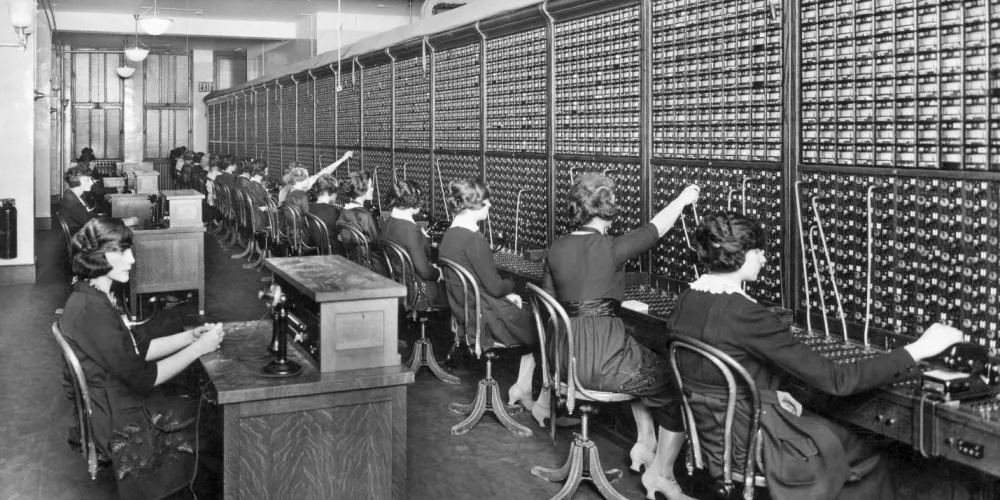
The automation of telephone exchanges created demand for new professions: maintenance technicians for automatic exchanges, communication engineers, programmers for the first digital stations. Mass unemployment among operators, who were overwhelmingly women, was not recorded; however, this was not because operators became engineers en masse. The main options were:
Natural aging of the profession (people were not laid off en masse but were no longer hired).
Career change with retention or loss of salary (typists, secretaries, waitresses, and so on).
Interestingly, the process of replacing operators could have gone much faster. The technology of automatic connection (ATC) was invented back in 1880, but the first commercial installation only occurred in 1919, and the complete transition was finished in 1978. This process stretched out—not only because of the AT&T monopoly but also because it required changes in billing, accounting, customer service, tariffs, and even the organizational structure of the company.
One lesson from this story: major innovations require a total restructuring of the business, not just a replacement of one technology. This takes years and decades.
The Emergence of ATMs

After the world’s first ATM was installed at Barclays bank in London in 1967, there were concerns that this would lead to mass layoffs of tellers in bank branches. However, it turned out that over the next 30 years, the number of tellers in the U.S. increased by 10%. Thanks to ATMs, it became cheaper to open bank branches because fewer tellers were needed at specific branches, but the number of branches increased. Only with the development of online banking did the number of employees in bank branches rapidly decrease.
Office Computerization
If we move to more recent times, according to McKinsey, over 3.5 million jobs in the U.S. were eliminated since 1980 due to the implementation of computer technologies; however, during the same period, more than 19 million new jobs were created. In other words, the net effect was about 15.5 million new jobs over several decades. At the same time, we see divergent impacts on qualifications:
decreased requirements: cashiers in supermarkets no longer need to be able to quickly calculate change in their heads;
increased requirements: programmers, operators of complex medical equipment, repair technicians for new technology.
The overall historical pattern looks like this: technologies destroy specific roles but expand the economy as a whole.
Where AI Stands Now
The American research and consulting company Gartner, specializing in information technology markets, introduced the technology maturity model in 1995, reflecting the general patterns of development—Gartner Hype Cycle. In Russian, the name is often translated literally as "Hype Cycle," "Arousal Cycle," or more formally as "Technology Maturity Cycle."
The graph has become popular among analysts and clients and has now transformed into an annual report. According to the model, a new technology goes through five stages of development, each characterized by a specific level of expectations.
Innovation trigger
A new technology becomes known, startups emerge, and venture investments grow. Media reports begin to appear about initial successes in laboratory conditions, while commercial use remains unclear.
Peak of inflated expectations
Success stories emerge, the number of companies offering the new technology increases, as does the number of people using it. The media pays even more attention to the technology. There is little evidence that the technology can deliver the desired results.
Trough of disillusionment
Interest wanes as experiments and implementations face difficulties and do not yield the expected effect.
Slope of enlightenment
It becomes clearer how the technology can bring specific benefits to businesses. New generations of products emerge.
Plateau of productivity
Mass adoption begins. The technology is widely applied in the market, and it clearly pays off.
The Gartner Cycle is not a strictly scientific approach, and technologies are not required to follow this graph rigidly. They may disappear before reaching the plateau of productivity or be replaced by others. Not all technologies are identified at early stages. The time between different stages can vary significantly for different technologies.
Nevertheless, Gartner reports are used by clients for a better understanding of the current situation, assessing the risk of investments in new technologies, and making decisions in the context of their industry.
In Gartner's 2025 materials on AI, it is stated that although AI continues to evolve at an unprecedented pace, there is still difficulty in achieving measurable business goals.
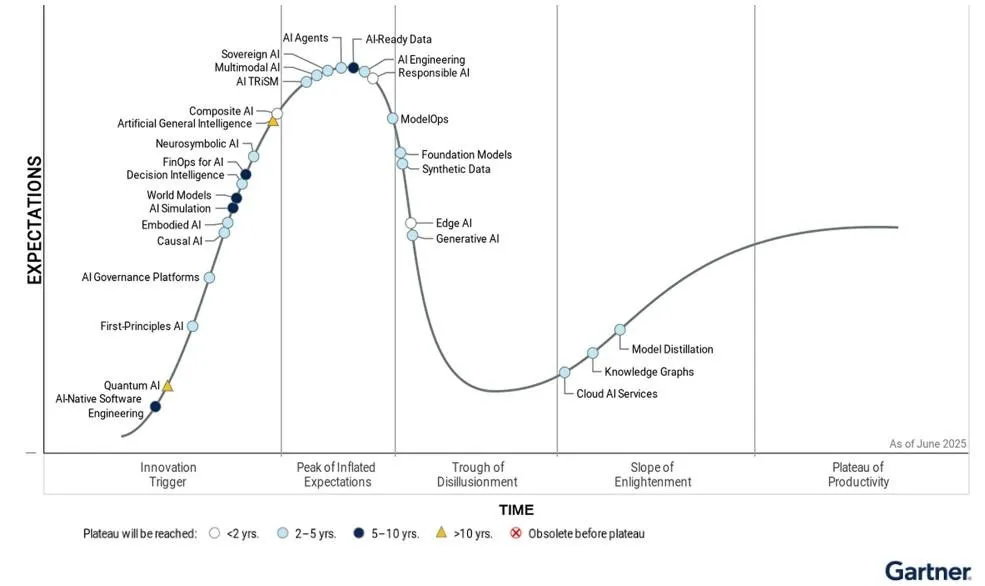
The overwhelming majority of AI technologies according to Gartner are placed either in the Innovation Trigger stage or in the Peak of Expectations stage. Generative AI, according to Gartner, is entering the Trough of Disillusionment: according to their data, less than 30% of CEOs are satisfied with the return on investment in generative AI.
This does not indicate a lack of technology — it merely means that efforts are still needed to achieve sustainable results in business. These stages are characterized by inflated expectations from enthusiasts and skepticism from those who are accustomed to measuring outcomes based on the presence of stable and measurable results. Gartner's analysis effectively states about AI: the technology has proven its potential, but businesses are still learning to extract sustainable measurable value.
A recent study shows that the impact of AI implementation can more often be measured by representatives of advanced AI industries. The authors discuss a structural shift in society due to AI and confirm that the stage of active implementation, mass adoption, and measurability of AI will occur in the coming years. Overall, two-thirds of respondents do not expect a decrease in the payroll fund due to the implementation of artificial intelligence, but plan to use the freed-up time of employees to address new business development tasks.
According to estimates by McKinsey, by 2030, up to 375 million people worldwide will need to change professions. This is not a new problem in itself, as the need to adapt to new technologies has existed for some time. The question of the speed of implementation remains open. So far, the implementation of technologies has stretched over years; however, will the speed of implementation be much faster in the era of AI? We do not know for sure yet, but the experience of past changes suggests that technologies are adopted more slowly than might initially seem, due to organizational and systemic constraints.
The history of technology shows: in the long term, the economy almost always creates more jobs than it destroys. However, there is an important "but".
Not everyone will be taken into the future
The emergence of new technologies leads to what economists refer to as structural changes in the labor market: old professions die out, but at the same time, new ones emerge, often in greater numbers and with better working conditions. This leads to increased labor productivity and an improved standard of living. History shows that not everyone is indeed taken into the future — but almost always more people than it seems at the moment of panic. All this looks like great news for humanity! But what does this mean for the individual? For a specific person at a specific moment in time, it can turn into a personal catastrophe.
Not every representative of a dying profession will be able to acquire new skills for various reasons, so personal tragedies are inevitable in each case. A 19th-century weaver, left without work, could not immediately become a mechanic. He had neither the knowledge, nor the tools, nor access to education. Today, a bank cashier whose function has been replaced by a mobile application cannot retrain as a programmer in just one week.
New jobs often arise in other cities or even countries and in completely different industries. A miner cannot just pack up and move to a metropolis to work in an IT startup — he lacks the money, housing, and often even the desire.
Previously, people had more time to adapt. The transition from an agrarian society to an industrial one took centuries. Now technologies (for example, the implementation of AI) are changing the market in just a few years. A person aged 50+ may simply not have time or may not want to retrain.
At the level of states and corporations, these problems are addressed through retraining programs, while at the individual level, these issues are resolved through the ability to adapt, the willingness to learn new things throughout life, and the skill to notice opportunities where others see only crisis.
Will you lose your job because of AI?
In principle, it is quite possible; let’s not close our eyes to this. However, a reasonable strategy in the current situation would be not to panic and not to make plans on how to survive in your garden plot after the global victory of robots, but to actively study AI tools in your field, understand their capabilities and limitations, and participate in their implementation. This will help you remain a valuable specialist in the market even in an unfavorable situation.
A rational approach might look like this:
Master AI as a working tool, not as a topic for discussion.
Automate some part of your routine.
Develop skills that are enhanced by AI, rather than replaced by it:
systemic thinking;
communication;
decision-making;
process management.
Focus not on headlines but on the economy of your industry.
Moreover, it is worth remembering the now-famous words of NVIDIA CEO Jensen Huang: “You won’t lose your job to AI — you’ll lose it to someone using AI.”





Write comment