- AI
- A
Orbital Data Centers: Nvidia Unveils Vera Rubin AI Module for Satellite Constellations
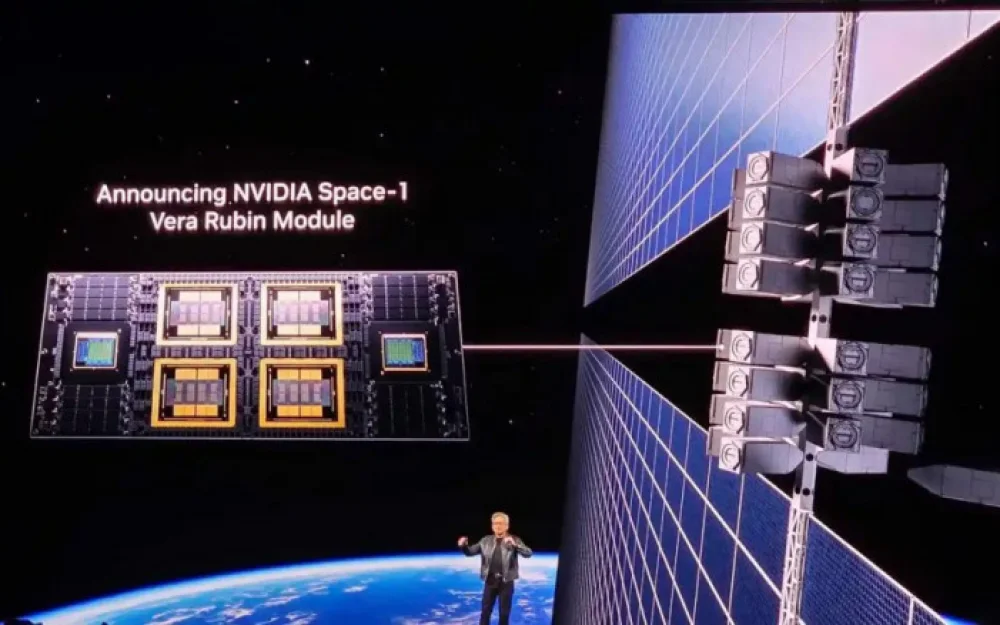
Nvidia has introduced the Space-1 Vera Rubin platform for transferring computing power beyond Earth. The new equipment provides inference performance 25 times higher than H100 server processors. The platform is already being tested by six commercial partners creating the first orbital data centers.
Teraflops in Space: The Hardware Base of Extraterrestrial Computing
Nvidia has expanded its line of accelerators for operation in space. The flagship of the announcement is the Space-1 Vera Rubin module, which combines the Rubin GPU, integrated CPU architecture, and high-speed interconnect. The device is designed with the strict weight and size constraints of spacecraft in mind. Its main task is to allow satellites to process data arrays from onboard instruments in real time without sending them back to Earth.
At the same time, Nvidia has opened access to the IGX Thor and Jetson Orin platforms for edge computing on satellites, while for ground stations, it offered the RTX PRO 6000 Blackwell Server Edition GPU, which accelerates the processing of geospatial data by 100 times compared to older CPU-based systems. The Vera Rubin module will be delivered to customers later.
A Server in Space — A Challenge
The main intrigue of the announcement lies not in teraflops but in a fundamental paradigm shift. Historically, a satellite was merely an "eye" or "mirror" that collected information and transmitted it down to Earth, where all heavy analytics took place. Now Nvidia and its partners (including the interested SpaceX) want to transform orbital constellations into full-fledged flying data centers.
However, corporation CEO Jensen Huang during the presentation briefly mentioned a key technical problem — cooling powerful AI chips in the space vacuum. Heat dissipation in an environment where there is no air for convection requires massive radiators and complex thermal regulation systems, which directly contradicts the philosophy of creating lightweight and compact satellites. This gives rise to a number of unresolved technical and economic contradictions that the corporation so far leaves out of official press releases.
Orbital Intelligence Architecture
Before the advent of Space-1 Vera Rubin, launching complex neural networks into space seemed like science fiction due to hardware limitations. Nvidia's new module removes some of these limitations: its architecture allows base and large language models (LLM) to be deployed directly in orbit.
According to the developers, the module's computational power for inference tasks exceeds the capabilities of the flagship last-generation terrestrial accelerator H100 by 25 times. This means that the space vehicle will be able to independently conduct primary analytics and even make "autonomous scientific discoveries," analyzing terabytes of raw optical or radar data on the fly.
"Space computing, the final frontier, has arrived," said company CEO Jensen Huang during the keynote address. "As satellite constellations are deployed and space exploration deepens, intelligence must be where the data is generated."
Commercial Hyperscale Race
Nvidia's idea didn't hang in a vacuum — the company already has six industrial partners: Aetherflux, Axiom Space, Planet Labs, Sophia Space, Kepler Communications, and Starcloud. The last two companies illustrate two different approaches to technology adoption.
Kepler is deploying simpler Jetson Orin modules throughout its satellite constellation for intelligent data flow management. Starcloud is going more radical: the company is designing specialized orbital data centers. Back in November 2025, Starcloud successfully launched a test satellite into orbit with a full H100 graphics processor on board.
«With Nvidia, we can put true hyperscale AI-class computing into orbit — processing data on site, reducing dependence on downloading data to Earth, and enabling customers to run training and inference workloads in space for the first time», — claims Starcloud CEO Philip Johnston.
Physics and Economics: «The Elephants in the Room»
Despite loud announcements about hyperscale computing in space, several critical «blind spots» gap in the official materials, which question the scalability of the project in the near future. These problems remain open questions for the entire industry:
First, no source clarifies how Nvidia circumvented the classic tradeoff between performance and hardware protection. For decades, slow, duplicated chips with large process nodes have been used in space due to ionizing radiation. The radiation hardness physics of modern AI chips (with their microscopic transistors) in space conditions is an open question, the answer to which is not provided in press releases.
Second, the documents completely omit the power budget of a satellite with such hardware. Running heavy computational tasks requires colossal energy consumption from solar panels, and it remains unclear whether this is technically justified for mass constellations.
Third, the question of economic feasibility remains open. There are no independent estimates (from analysts or space agencies) proving that AI computing in orbit is more beneficial than ground-based.
Cyber-Dilemma: Vulnerabilities of Orbital LLMs
The most paradoxical and frightening «blind spot» of the announcement is the cybersecurity of autonomous vehicles with onboard LLMs. Equipping satellites with the ability to make decisions locally using AI creates an entirely new vector of cyber threats.
Experts' opinions on aerospace security regarding how powerful AI servers will affect the vulnerability of satellite constellations have not yet been presented by Nvidia or its partners. A satellite capable of autonomous data analysis (for example, object recognition on Earth or maneuvering) becomes an unpredictable threat in orbit if hacked, transforming from a surveillance tool into a potential danger. How exactly isolated data center nodes will be protected from hacking attacks and algorithm manipulation is a crucial open question that needs to be solved before mass deployment of such systems.
The New Space Race
Nvidia's announcement at GTC 2026 marks the transition of the space industry from the task of "how to deliver hardware into orbit" to "how to make this hardware think autonomously." And while engineers will likely overcome physical barriers, the issues of security and the profitability of independent orbital intelligence will stir the markets for many years to come.
Sources
NVIDIA Launches Space Computing, Rocketing AI Into Orbit — globenewswire. Authors: Nvidia Corporation
NVIDIA Launches Space Computing, Rocketing AI Into Orbit — stocktitan. Authors: Stock Titan
Nvidia announces Vera Rubin Space Module — up to 25x the AI … — tomshardware. Authors: Luke James
Nvidia Debuts an AI Chip For Space-Based Data Centers — pcmag







Write comment