- AI
- A
Digital Muse: Art in the Age of Neural Network Revolution
Guess which invention dramatically changed human life?
My name is Arthur Vartanyan, I am a leading content manager at RUTUBE, an art enthusiast, and a former journalist. I graduated from an art school, participated as a curator of exhibitions in my native Krasnodar, didn't miss a single significant art exhibition in Moscow and St. Petersburg, and in 2020, when we were all in quarantine, I completed a training course in art history to systematize my knowledge. I study everything related to classical and contemporary art, design, architecture, fashion, marketing, and—surprise!—postmodernism as a cultural phenomenon. I very much love presenting information about beauty as something topical and paradoxical, without highbrow pathos and eye-rolling. I have been lecturing on classical and contemporary art since the distant year of 2019.
Art Before the AI Revolution
Culture never stands still. Art, particularly painting, graphics, and sculpture, has long been the fruit of the human mind and inspiration. And within it, the language and tools through which an artist could express themselves, their sense of the historical moment, or demonstrate the patron's level of wealth and intellect, constantly changed. Let's not forget that art was for a long time entertainment for the aristocracy (elite, oligarchs, bourgeoisie—pick the option that suits you best). But gradually, everything began to change. Art became closer to the people thanks to one tool that split human history into before and after. And no, it's not artificial intelligence. It's Gutenberg's printing press.
The appearance of a new tool forces either an adjustment of the language of imagery or its complete reinvention. Thus, among other things, thanks to book printing, engraving appeared, which required a completely different approach to visualization. The modern age needed new media. Engraving became the answer to the era's demand.
And this list of innovations can go on forever. Oil painting, the discovery of perspective principles and the camera obscura added depth to flat images; the invention of the pencil and paints in individual tubes freed artists from the need to create directly in workshops; the invention of photography initiated the process of moving away from the realism of the image in favor of sensory impressions and abstraction. But all these fruits of progress, in one way or another, pushed artists to search for new forms and a new language of expression. What about neural networks, though? It's not so straightforward here.
Rethinking Authorship and Originality
The most sensational breakthrough of AI in the field of art was the Christie's auction in New York in 2018. Alongside the painting "Lucretia" by Artemisia Gentileschi (a Baroque artist of the 17th century, a contemporary of Caravaggio), a truly strange work by the French art collective Obvious was put up for auction. The work was called "Portrait of Edmond de Belamy," depicting one of the members of the fictional Belamy family. Even a cursory glance at the work was enough to understand how derivative it was. However, this painting sold for a record $432.5 thousand, and the bidding lasted in hot competition for over 6 minutes.
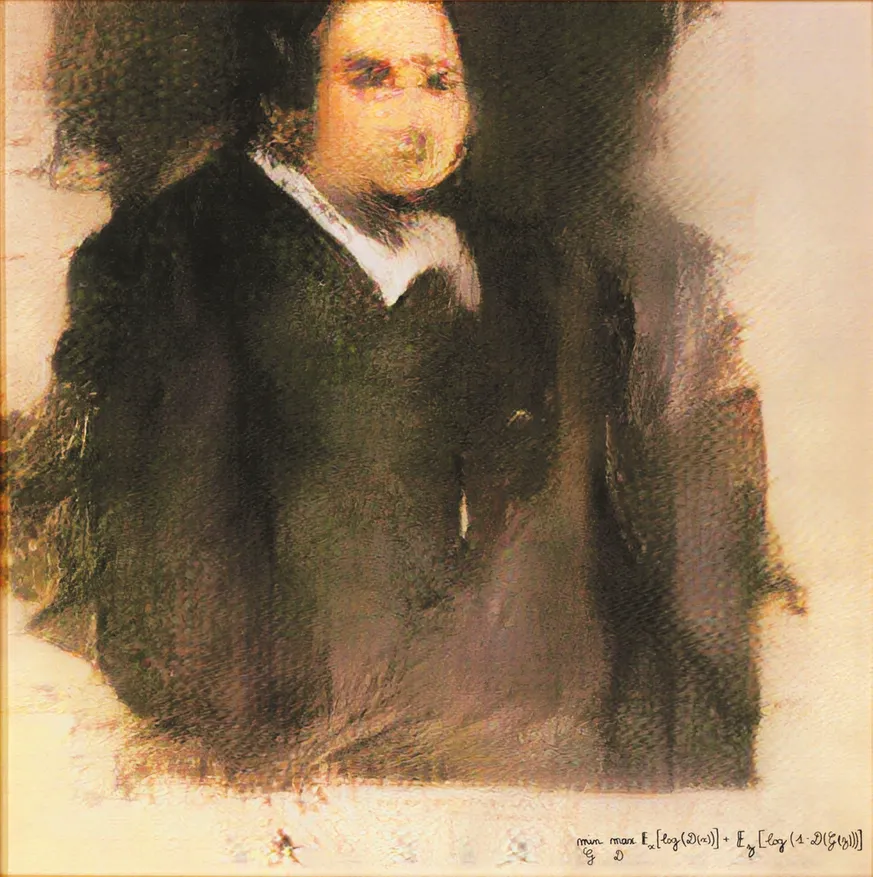
So, what does this painting represent? The first thing to know is that there was no Edmond de Belamy in reality. Nor is there a family to which this character belongs. This portrait was developed by a generative adversarial network (these are two neural networks playing an antagonistic game: one generates samples, the other rejects the "incorrect" ones; as a result, it is possible to generate images that humans perceive as natural). The founders of the art group first uploaded 15,000 portraits created between the 14th and 20th centuries into the generator, and then the AI generated new works until it could pass a test designed to distinguish a painting created by a human from one generated by a machine. The surname of the fictional family is also not so simple. The guys from Obvious decided to pay tribute to the AI researcher who invented the generative adversarial network in 2014, Ian Goodfellow (Good fellow or "bel ami" in French).
All these preliminaries created the necessary media buzz around this work. In fact, the painting put up for auction was written by an algorithm through the compilation of a data array, creating a non-existent character with a non-existent lineage, written in the style of pseudo-classicism, but as 'seen' by a neural network, and with a title that refers to academism, but in reality is just a linguistic joke. According to Pierre Fautrel, one of the creators of the portrait and a member of Obvious, if the staff at Christie's had not approached them, it's quite likely no one would have known about them. Here we observe an example of two cognitive biases - the halo effect and the authority effect - when a respected auction house in elite circles, famous for its reputation and taste, legitimized the existence of a phenomenon like 'AI art' with its attention alone and made the art group's creativity financially justified. And when asked by a journalist, so after all, can artificial intelligence be considered an artist or is it just a tool, Pierre replied that it is still a tool in the hands of creative people. Quote from Pierre's interview with RBC journalist. Style: 'Simply, a neural network also reproduces something. I don't say "creates," because the true creator remains the artist. Creativity is inherent only to humans. No matter how clever your dog is, it cannot be called creative.'
This whole story literally screams: the author is dead!
And here we come to the main 'ailment' that our era 'suffers' from - postmodernism.
Quote of a quote: neural network as the ideal postmodernist
The phenomenon of AI has been comprehended by pop culture for quite some time. The 1999 film 'The Matrix' is a hymn to this phenomenon. But also the work of the (now sisters) Wachowskis was a vivid illustration of the philosophy of postmodernism and one of its ideologists, Jean Baudrillard. It was Baudrillard who introduced the concept of the simulacrum, a copy without an original. Artificial intelligence is a pure generator of simulacra, an accumulation of quotes, a compilation of fragments of already existing narratives.
Postmodernism does not try to invent something new, for ideas have long since ended, all plots are written in biblical texts, and the author is dead because he discredited himself by trying to impose the dictatorship of his own view on reality.
In the fashion and beauty industry's perspective, neural networks offer endless possibilities to sew something unexpected from scraps of old things, to look at familiar things with fresh eyes (perfume created by AI (for example, “She was an anomaly,” Etat Libre D’Orange, created in collaboration with the AI robot Carto) or the fashion house Iris van Herpen, whose creations seem made by neural networks), while representatives of the modern art market get rich food for thought about the impact of artificial intelligence on human life in general and culture in particular.
The main problem with AI lies in its limitation by predictive models, in its striving to be perfect to please us. AI is powerless to go beyond the data it relies on. AI is like Agent Smith from the movie “The Matrix” – a virus that begins to copy itself infinitely, destroying uniqueness. When everything becomes average and the same, we intuitively understand that art is dying.
However, these global limitations do not restrain artists; on the contrary, they give impetus to the search for new meanings.
For example, the American artist of Turkish origin Refik Anadol (b. 1985) builds his work at the intersection of technology, science, and art. He literally “paints” pictures based on data streams processed by AI. That is, Refik’s creative method is the aestheticization and visualization of soulless sets of information. He transforms huge data sets (from archives to climate indicators) into “machine hallucinations.” For example, his installation “Unsupervised” at MoMA analyzes the museum's collection in real time.
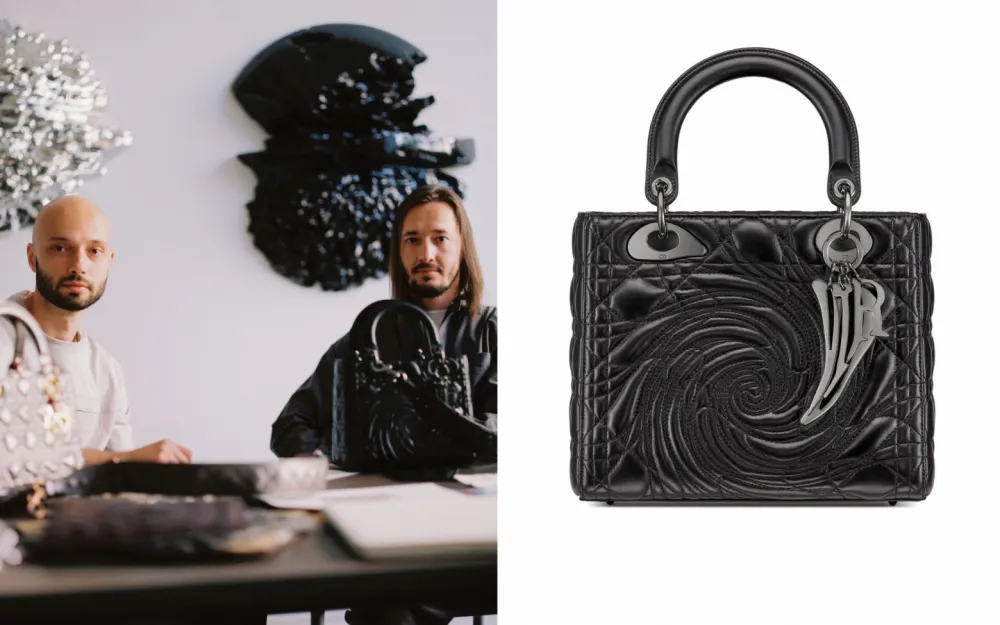
Another example of comprehending AI's impact on us as a species is the duo Recycle Group of artists Andrey Blokhin (b. 1987) and Georgy Kuznetsov (b. 1985) (which is especially pleasing, one of the participants is my fellow countryman from Krasnodar). Behind their impressive installations, sculptures, and stained-glass windows, the theme of human interaction and transformation in the digital age is discernible. Their language is also postmodernist. How is this expressed?
Take, for example, their grandiose 2020 work "Artificial Environment." It is located in the "Krasnodar" park (which we, residents of Krasnodar, more often call Galitskogo Park) and consists of a semicircular multi-figure bas-relief made of plastic mesh, 130 meters long. On a wall 2.5 meters high, pseudo-antique figures made of mesh material are placed. The figures seem frozen in a dynamic surge: in a rush, a jump, a cry, and a wave of the hand. The center of the composition is an attempt to translate the phenomenon of human play into the language of computer code. The authors seem to ask: can an algorithm not just imitate the process, but also adopt living human excitement?
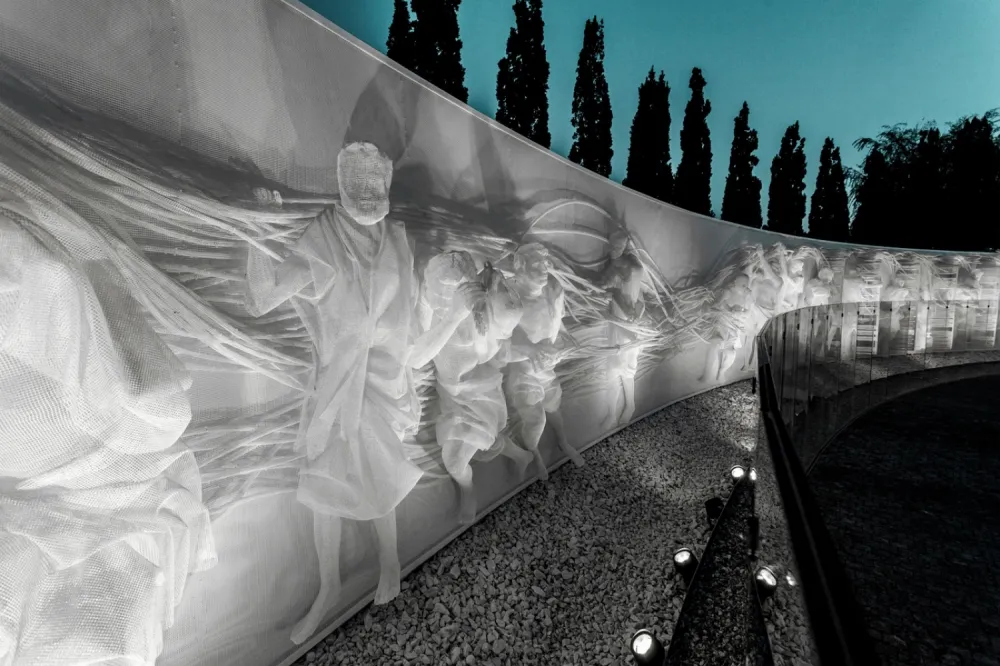
We see a group of people diligently collecting data, transferring it to servers to make contact with the algorithm. The machine transforms the classic concept of "play" in its own way, involving the authors in a constructed digital environment. That is, we see the staged training of a neural network. In the finale, robots become the subjects of the gameplay, while humanity is relegated to the role of outside observers, watching what is happening through smartphone screens and other devices.
This is how the creators from Recycle Group describe their work: "We worked with neural networks and know that the most meticulous work is teaching them something."
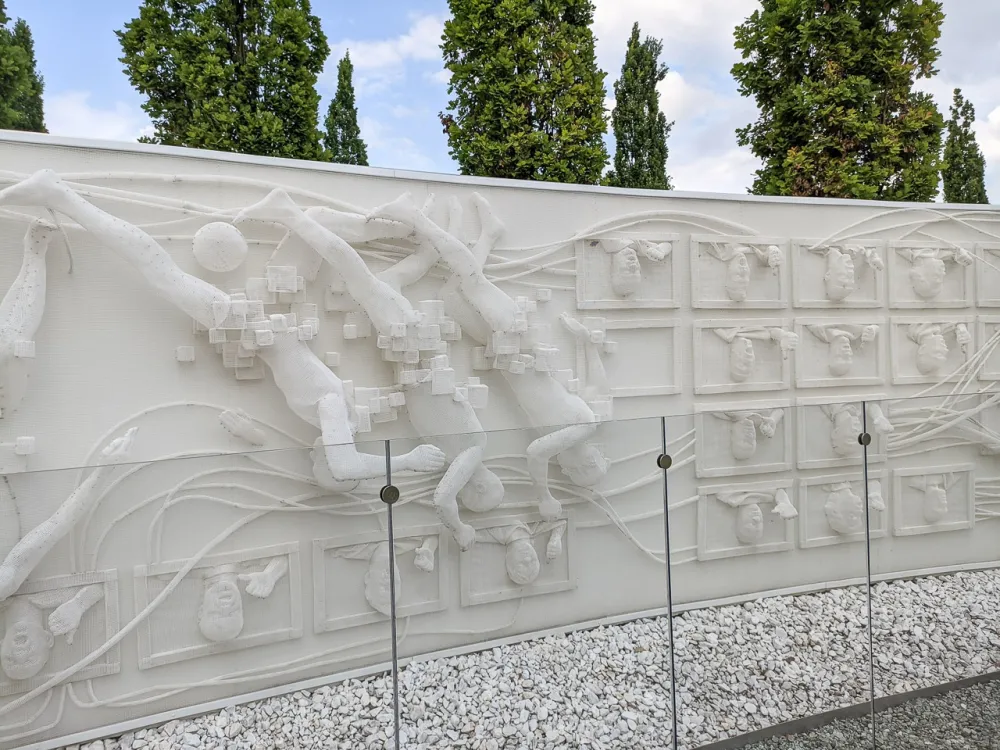
Andrey Blokhin adds: "In our 130-meter bas-relief in the 'Krasnodar' park, about 15 plots are hidden, which no one has yet deciphered. Among them is an image of Nimatron, the first computer gaming machine from 1940. It looked like light bulbs arranged in columns, which the player and the computer turn on in turn. The one who lights the last bulb wins. Then, for the first time in the history of cybernetics, the computer was deliberately slowed down because it reacted so quickly that a person couldn't keep up, which scared them wildly. Then the creators of the game simulated the function of thought. The changes happening now also scare us with their speed."
This work is stunning, especially at night when it is illuminated. Seeing it for the first time, you get the impression that you are looking at a restored ancient Greek bas-relief, brought to Krasnodar from Athens. However, upon closer inspection, you notice that it is not marble, but a plastic mesh, and the plots are not quite academic, but very modern. This is how postmodernism works, deceiving expectations and playing on recognizable codes.
I also consider the collaboration between Recycle Group and the fashion house Dior as another act of postmodern irony, where they were so impressed by the artists' work that they invited them to reimagine the classic Lady Dior bag. Capitalism, in the person of the fashion house, does not confront but tries to monetize the philosophical vision of the creative duo. To be fair, at Dior, this is a whole direction where they borrow the language of contemporary artists (while contemporary artists themselves fully use borrowings in their works. Such is meta-irony).
Another prominent figure in postmodern art, in which a neural network seems to be an accomplice, is the Belgian artist Wim Delvoye (born 1965). A provocateur and the creator of the first artwork that is a living person, which he officially sold as an art object, he anticipated artists' interest in modern media. Wim Delvoye does not shy away from mocking the rules of the art market, repeatedly baffling both professionals and the general public. His most famous works appear to have been created by a hallucinating neural network. But that's not true. Wim Delvoye positions himself as a creator who imitates artificial intelligence, but does so with such precision that you, as a viewer, are amazed by the quality of execution and the meanings conveyed in these works.
Delvoye's postmodern approach also builds on piecing together existing phenomena to produce an unpredictable result. In his case, the result always delights. Just look at the utterly prosaic objects, far from art, that are executed in a high Gothic style.
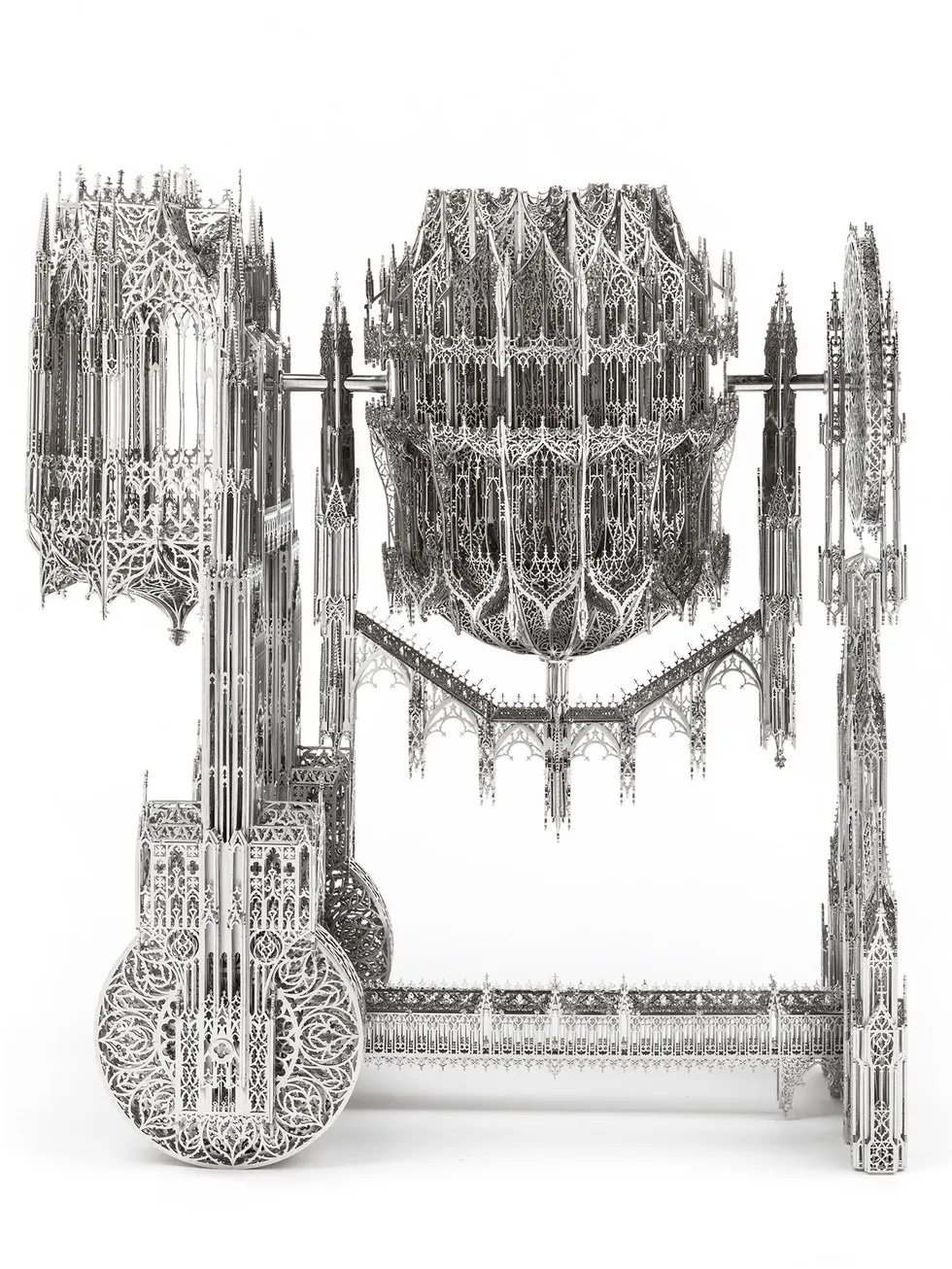
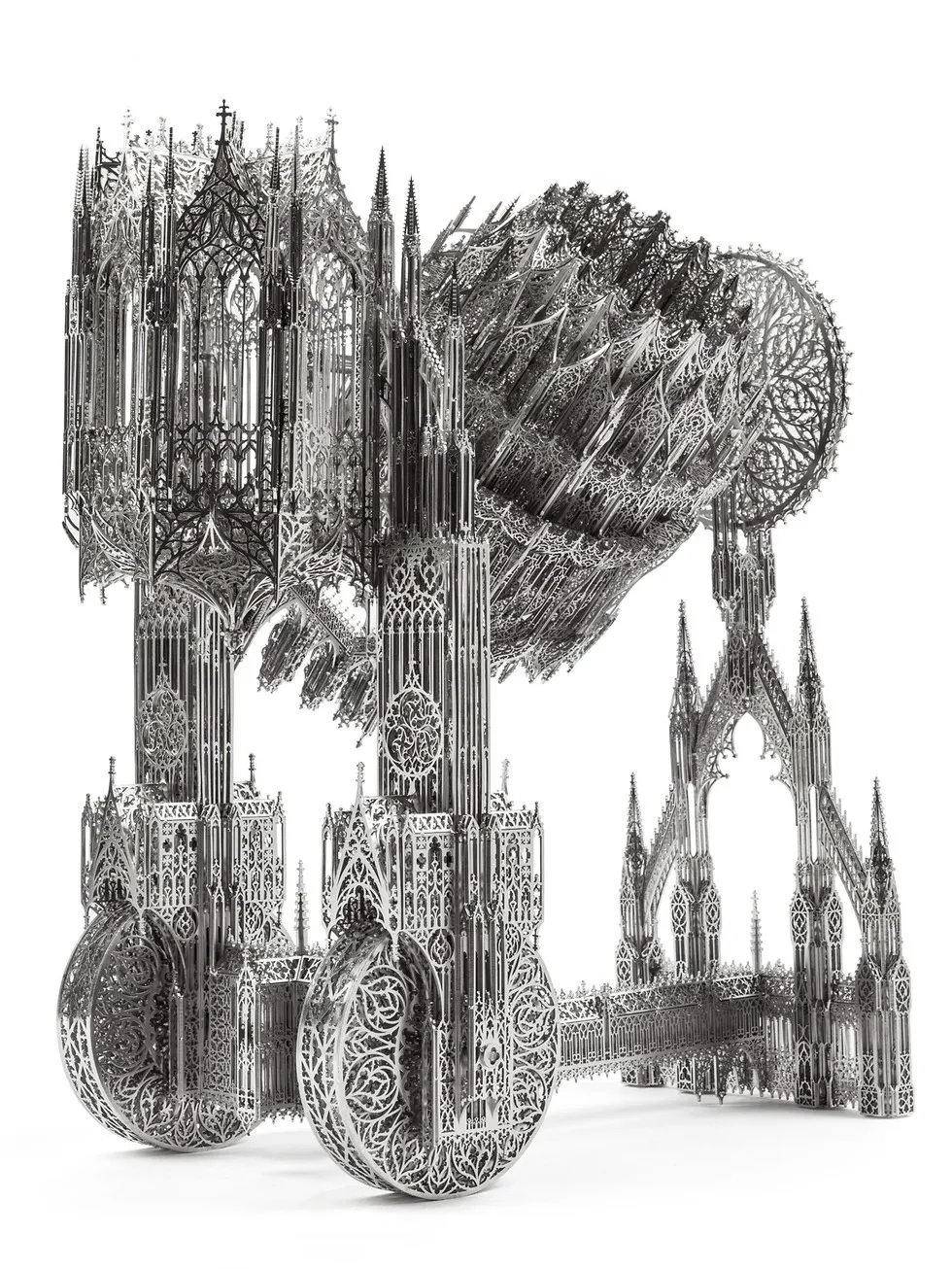
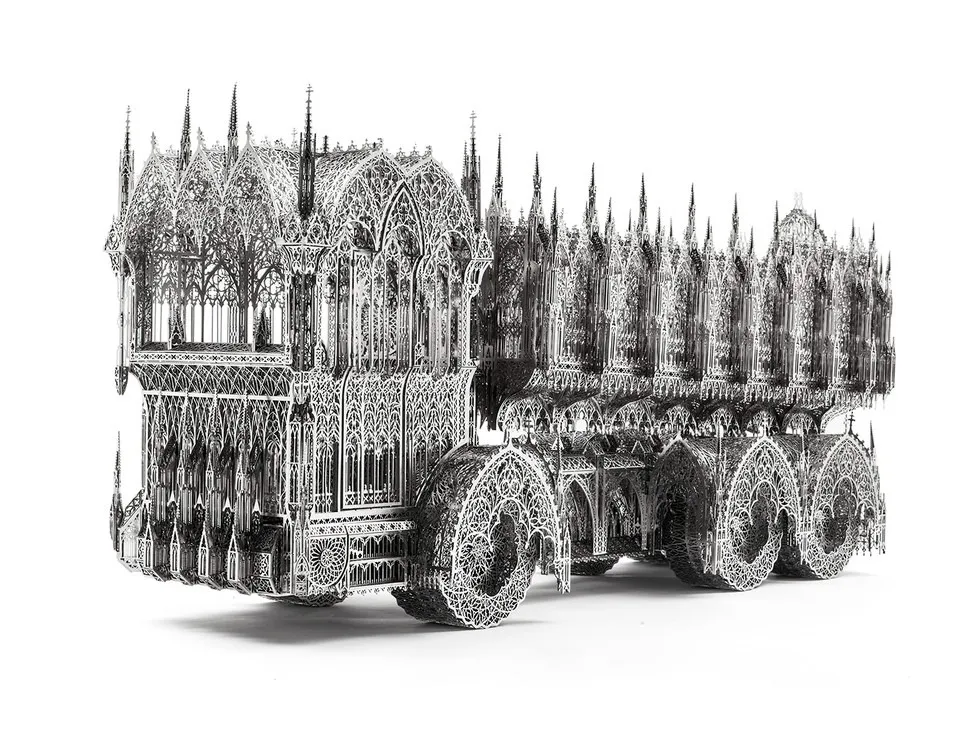
Moreover, many of these works were created using laser cutting or 3D printing long before they became mainstream. By the way, Muscovites can see Wim Delvoye's work Dump truck with their own eyes by simply visiting the new ZILART museum. There, the piece stands on the square in front of the museum entrance. I highly recommend exploring the work of the Belgian artist, because it represents that postmodernism and that level of intellectual irony after which you look at AI attempts with completely different eyes.
The fact that the AI issue is acute and preoccupying the creative community is evident from the number of exhibitions and biennales on neural networks in Russia and worldwide. At the time of writing, the MAMM (Multimedia Art Museum, Moscow) is hosting the Second International Biennale "Art of the Future", where over 35 artists are reflecting on a wide range of questions related to technological progress. However, the key theme, of course, has been the rapid development and pervasive integration of artificial intelligence into all spheres of our lives. Some fear the humanization of the algorithm, others, conversely, advocate for AI rights and create works understandable only to the "gaze" of a neural network and incomprehensible to humans without special tools; for some, artificial intelligence resembles magic and, like anything incomprehensible, is sacralized and deified. This is the fundamental difference between a human and an algorithm: we are imperfect, we are like Neo, a "brilliant" anomaly that introduces chaos into the mathematical order. And as long as this "error" exists, our culture exists too.
Finally, the most important thing: let's not forget that it is humans who created AI. And we have the right not to play by the rules that algorithms try to impose on us.
P.S. This article was written by a human. But it's not certain =)



Write comment