
- AI
- A
Google offers a unified 'watermark' for images, videos, and text created by AI
Images, videos, music, and texts produced by artificial intelligence are now becoming much higher quality than at the start of generative model development, and distinguishing them from human-created content is becoming increasingly difficult.
The problem has long moved beyond ordinary experiments and now affects social networks, news, search engines, and other resources that people use every day, inevitably leading to the spread of misinformation.
Google and the DeepMind team have been developing SynthID for several years—a system for hidden labeling of content created by artificial intelligence. Recently, the company announced that in addition to use in its own services, the technology is beginning to be implemented in products from other major AI developers. SynthID adds a special invisible signal to an image, video, audio file, or text already at the generation stage. Such a marker is preserved even after editing, compression, or forwarding and helps determine that the material was created by a neural network.

What SynthID Is
Currently, Google does not abandon the previously used marking methods, including the C2PA standard with cryptographic signatures. However, the SynthID technology differs from everything tried before: instead of attaching external metadata or visible labels to the file, which are easily removed during saving or forwarding, the system embeds a special signal directly into the structure of the content itself during generation. In images, it is distributed across pixels, in video — across frame sequences, in audio — across sound waves, and in text — across token selection probabilities. The signal is formed statistically and is recognized only by a trained detector; human eyes or ears do not notice it.
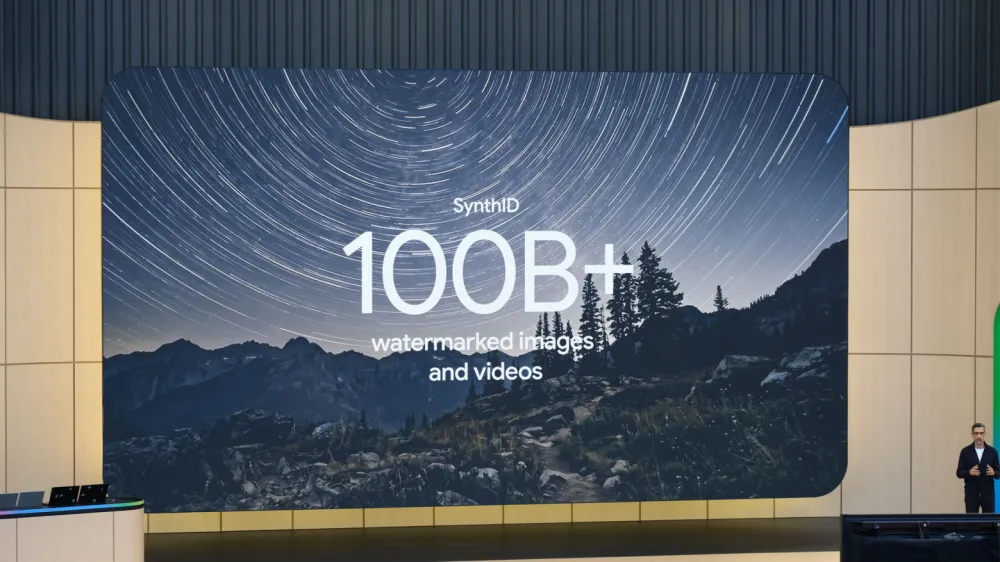
During its operation in Google services, SynthID has already processed more than a hundred billion images and video fragments, and the volume of processed audio is comparable to 60,000 years of continuous sound. The marking is added automatically during generation and does not require any actions from the user, so the technology can be quickly integrated into mass-market products.
Как SynthID работает с изображениями, видео и аудио
При генерации изображений специальный блок нейросети — embedder — начинает работать одновременно с основной генеративной моделью. Он вносит крошечные, математически рассчитанные корректировки в значения пикселей, распределяя их равномерно по всей площади кадра. Эти изменения формируют уникальный статистический «узор», который не создает видимых артефактов и не влияет на четкость, цвета или композицию. Детектор в последствии анализирует этот узор по всему изображению, а не по отдельным участкам, что позволяет восстановить информацию даже после обрезки или поворота. То же самое касается и маркировки видео — «прошивается» сразу множество кадров, что позволяет распознать SynthID даже если видео сжато или обрезано.
In the case of sound, the system leverages the peculiarities of human hearing. During generation, SynthID embeds a marker directly into the sound wave, but does so in parts of the signal that the human ear cannot detect. In models like Lyria for music or NotebookLM for narrated reviews, the system already works in standard mode. Like with other formats, it also accounts for all typical manipulations—compression, effects layering, or re-encoding.
With text, SynthID works differently than with images or sound. During generation, the system slightly alters the probability of selecting individual words and phrases, forming a hidden statistical fingerprint. To the reader, the text appears completely normal—neither the style, meaning, nor coherence of the presentation changes. However, a special detector can later analyze the token sequence and determine that the material was created by a model with SynthID support. At the same time, the language model itself does not need to be retrained: the technology is integrated at the text generation stage.
Google has already opened part of the technology to other developers so that a similar mechanism can be embedded in third-party language models. With minor edits or slight rephrasing, the marker is usually preserved and continues to be recognized by the detector. However, if the text is completely rewritten or translated through another model, the accuracy of detection decreases. Nevertheless, for most common editing scenarios, the signal remains readable, and the system itself allows for a unified approach to labeling text, images, video, and audio.
Partnerships and industry expansion
In May 2026, Google announced a significant expansion of participants. Now SynthID is being implemented by OpenAI for images in ChatGPT, Codex, and via API, by NVIDIA in their Cosmos models, as well as by Kakao and ElevenLabs. Each company retains its generation features but adds a compatible identification layer that is recognized by common tools.
However, a significant portion of projects currently still use their own methods for labeling AI-generated content or do without them altogether, which often leaves the origin of images, videos, audio, and text unclear. The involvement of several major developers with SynthID makes the system more universal and allows materials created in different services to be verified in the same way. If more participants join, recognizing synthetic content could become significantly easier over time, regardless of the platform.
Users can already check suspicious content directly through Gemini. Simply upload an image, audio, video, or paste text, and the system will attempt to detect the presence of a SynthID marker. However, the model honestly states that it only checks for Google AI generation and cannot guarantee that the content was not generated using other services. Plans are underway to add verification tools to Chrome, Search, and mobile services like Lens and Circle to Search.
OpenAI has also launched its own verification tool, which can work with both C2PA metadata and SynthID signals. With it, you can quickly check the origin of an image or other material without installing separate software. Additionally, the companies are preparing APIs for businesses so that such verification can be embedded into third-party services and workflows.
While full API access is currently restricted to prevent malicious actors from having time to experiment, it is planned to be expanded in the future. The check takes seconds and provides a clear result even for those far from technical details. Ultimately, anyone interested will be able to quickly figure out where a particular piece of content came from.
What else
What stage is the technology implementation at now? So far, SynthID only works in models and services where the technology is built-in from the start. If an image, text, audio, or video was created by another neural network without support for such labeling, the detector will not detect anything. Moreover, at the moment, the system does not provide a 100% guarantee even in supported models. If the material is heavily rewritten, processed multiple times, or compiled from several sources, the accuracy of identification can decrease significantly.
Attempts to bypass such mechanisms also remain a problem. Developers are constantly testing the robustness of markers against editing, compression, and other changes, but completely eliminating the possibility of signal removal or damage is currently impossible. Therefore, SynthID is more likely to help determine the probable origin of content rather than serve as absolute proof. But every journey begins with a single step.
Nevertheless, such systems are gradually becoming an additional verification tool alongside C2PA metadata and other identification methods. If more services and models start supporting them, checking the origin of images, videos, audio, and texts could become noticeably easier.







Write comment