- Gadgets
- A
Five Mini PCs at the Beginning of 2026: Screens, Modularity, and High Performance
At the beginning of 2026, there are noticeably more mini-PC devices that break away from the traditional format. This is not just about performance growth, but also about attempts to assemble a compact desktop computer differently: adding auxiliary screens, creating modular connections, integrating power supplies, or using mobile platforms without simplifications. This collection features mini-PCs showcased at CES 2026 and immediately after, which stand out for their developers' unusual approach to design and capabilities.
AOOSTAR G-Flip — mini-PC with a flip-up touchscreen and Ryzen 7 255H
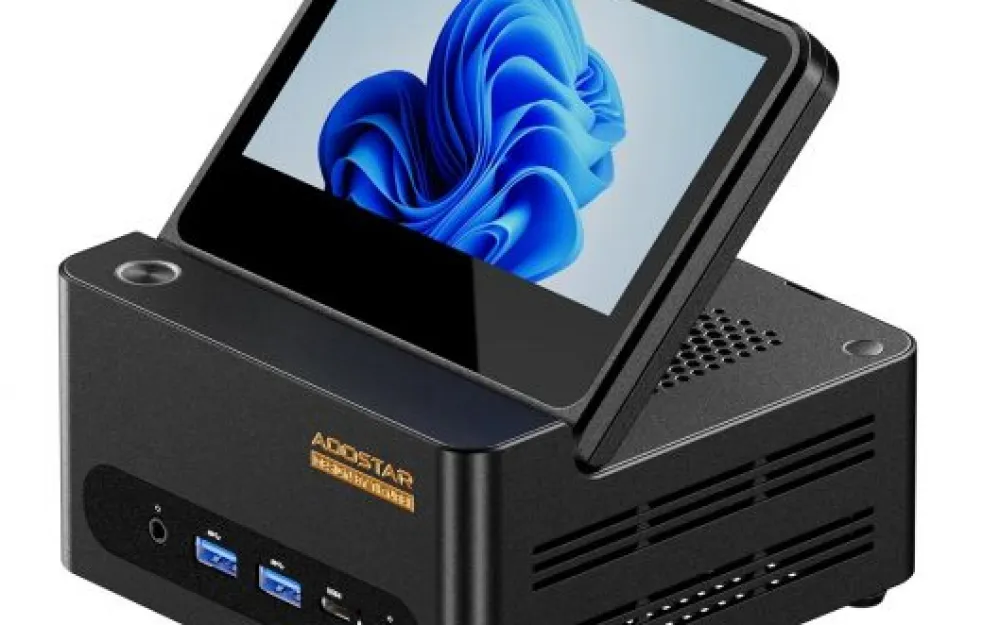
Here we have an unconventional mini-PC that AOOSTAR has been developing for almost a year, experimenting with form factors and processor platforms. The model featuring the RyzenTM 7 255H has become the most affordable in the lineup: it was released in early 2026 and is significantly cheaper than earlier versions using Strix Point and Core® Ultra®.
The main feature of the G-Flip is its small touchscreen display that flips up and becomes visible from the front. This is not just a decorative element but a full-fledged screen with Full HD resolution that can be used as an auxiliary display. For example, for system monitoring, notifications, media player control, or quick actions without turning on the main monitor.
The new version is based on the AMD RyzenTM 7 255H from the Hawk Point generation. It is a close relative of the RyzenTM 7 8845HS but without the NPU block for AI tasks. In terms of processor performance, it shows comparable results in synthetic tests and appears to be a successful option for those who do not need integrated AI accelerators but prioritize price. Moreover, the mini-PC remains expandable: it has two slots for RAM and two full-size M.2 slots for fast NVMe drives.
In its price category, the G-Flip competes with regular mini-PCs without displays, yet it offers additional functionality that can be useful in work scenarios, home servers, or as a compact desktop system.
Specifications:
Processor: AMD RyzenTM 7 255H (Hawk Point),
Graphics: integrated Radeon,
Memory: 2× SODIMM DDR5-5600, up to 128 GB,
Storage: 2× M.2 2280 PCIe 4.0 NVMe,
Screen: 5 inches, touch, 1920×1080, 60 Hz, foldable,
Ports: 1× OCuLink (PCIe 4.0 x4, up to 64 Gbps), 2× USB4 Type-C (40 Gbps), 2× USB 3.2 Gen 2 Type-A, 2× USB 2.0 Type-A, 2× Ethernet 2.5 GbE, 1× HDMI 2.1, 1× 3.5 mm audio, power connector,
Wireless interfaces: Wi-Fi 6, Bluetooth 5.2,
Cooling: active, with fans and vapor chamber.
The model went on sale in January 2026. The base version without memory and storage is offered at a price starting from $339–350, depending on the store and configuration.
Cloud infrastructure for your projects
Virtual machines in Moscow, St. Petersburg, and Novosibirsk with pay-per-use pricing.
Khadas Mind Pro — pocket-sized mini-PC with Panther Lake focused on modularity
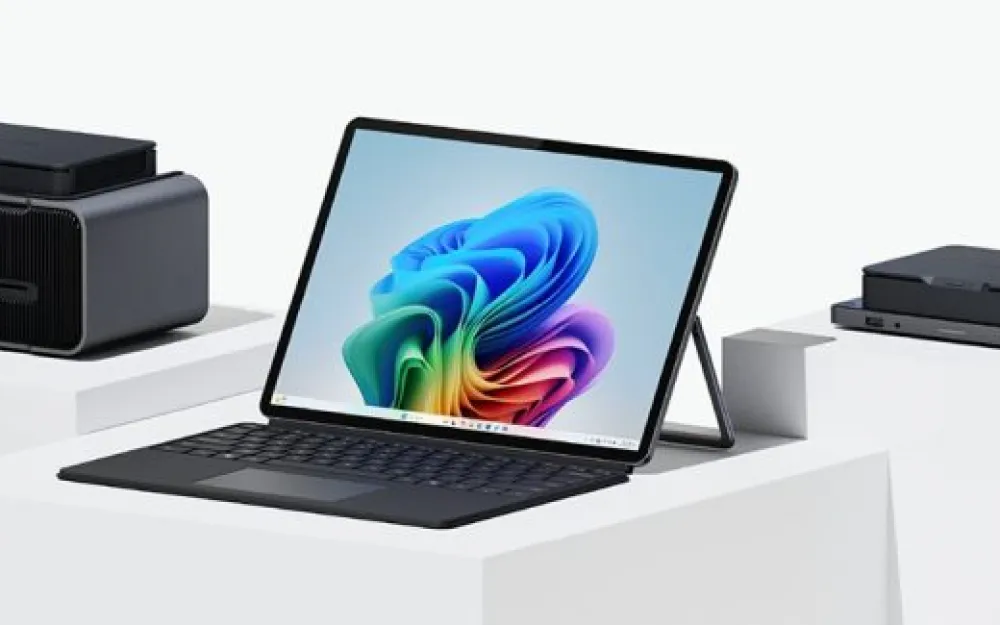
This new generation of ultra-compact mini-PCs from Khadas, showcased at CES 2026, is immediately aimed at the high-end segment. With dimensions of just 146 × 105 × 28 mm, the device's internal components are closer to a powerful laptop than a classic mini-PC. It is based on Intel Panther Lake mobile processors with powerful integrated Arc Pro graphics, and the key feature remains the proprietary Mind Link interface, allowing connection of external modules — from docks to eGPUs and portable displays.
Unlike most mini-PCs, the Mind Pro was originally designed as part of an ecosystem. The computer itself is a basic computing module that can be used as a desktop system, carried in a bag, or connected to additional accessories. Weighing about 560 grams, it is lighter than almost any laptop, and the built-in battery allows safe transport of the device between workspaces without shutting down and handling brief power outages without data loss.
At launch, only one configuration is available, but Khadas has indicated plans to expand the lineup. Interestingly, the company has bet on more powerful integrated graphics, even at the cost of reducing the bandwidth of the interface for external graphics cards. This makes the mini-PC more self-sufficient, without the need for a mandatory eGPU connection.
Specifications:
Processor: Intel® Core® Ultra X7 358H (Panther Lake),
Graphics: Intel Arc B390 Pro (integrated, 12 cores),
RAM: 64 GB LPDDR5x-8533 (in the base version),
Storage: 2 TB PCIe 4.0 NVMe SSD (M.2 2230),
Expansion interface: Mind Link (PCIe 5.0 x4),
Ports: 2× Thunderbolt 4, 2× USB 3.2 Gen 2 Type-A, 1× HDMI 2.1,
Wireless interfaces: Wi-Fi 7, Bluetooth 6,
Power: 100W USB-C adapter,
Cooling: active, with a fan and vapor chamber,
Built-in battery: 7.98 Wh (up to 48 hours in standby mode),
Body volume: 0.43 liters,
Weight: about 562 g.
Khadas Mind Pro has been available for pre-order since January 2026. The base configuration with Core Ultra X7 358H, 64 GB of memory, and a 2 TB SSD is offered for $1799, with a subsequent retail price increase to $1999 after the pre-order period ends.
MINISFORUM M2 Pro — mini-PC with Panther Lake, built-in power supply, and LPDDR5X-9600
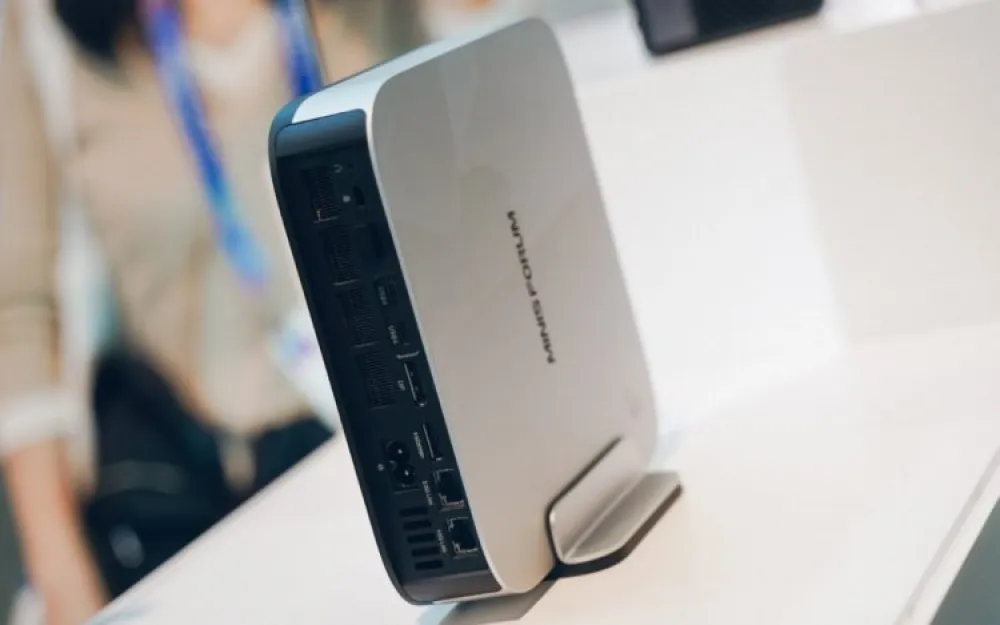
The mini-PC that the company showcased at CES 2026. It is designed for mobile Intel Panther Lake processors up to the Core® Ultra X9 388H. It stands out among its "peers" with several atypical solutions for mini-PCs. The main one is the built-in power supply: the computer connects directly to the outlet with a regular cable, without an external adapter. A small detail, but it’s nice.
In terms of hardware, the M2 Pro is closer to high-end laptops than to classic desktop "boxes." It uses soldered LPDDR5X memory with a frequency of up to 9600 MT/s and a capacity of up to 96 GB, while graphics are handled by the integrated Intel Arc B390. This setup is intended for tasks where high memory bandwidth and compactness are important, rather than future upgradeability.
The port selection on the M2 Pro is impressive for its size: several USB4 ports, video outputs, and two network interfaces — one for 10 gigabits and another for 2.5 gigabits. The mention of OCuLink remains in question: it is listed in the descriptions, but the connector is not visible in the published photos.
Specifications:
Processor: up to Intel® Core® Ultra X9 388H (Panther Lake),
Graphics: integrated Intel Arc B390,
RAM: LPDDR5X-9600, up to 96 GB,
Ports: 3× USB4, 2–3× USB Type-A, HDMI, DisplayPort, Ethernet 10 GbE and 2.5 GbE, 3.5 mm audio,
Power: built-in power supply,
Additional: Copilot button, presumed fingerprint scanner, microphones.
Unfortunately, by the end of January, the company has not yet announced either the price or the start date for sales.
Machenike GTS — Mini PC with Flip-Up Screen and Arrow Lake-H
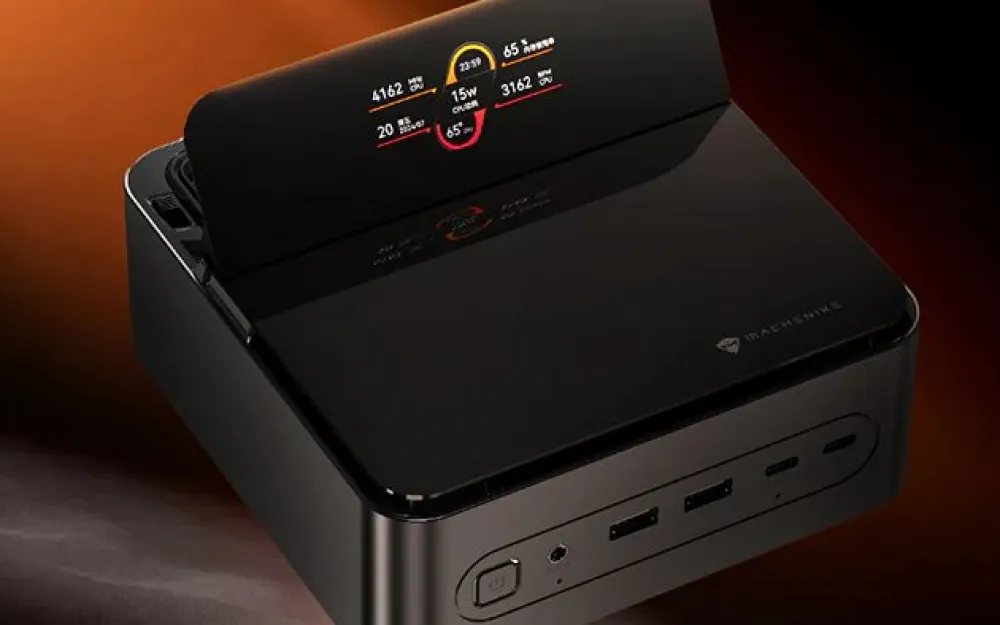
The main feature of the device is a 2.33-inch LCD display, built into the lid and mounted on a hinge. The screen is too small for working with interfaces or applications but is well-suited for displaying operational information. Machenike offers its own "smart screen" software that allows displaying data about CPU, graphics, memory load, temperature, and power consumption on the display. This is not a unique feature but rather a niche solution for those who want to see the system's status without launching utilities on the main monitor.
Overall, the Machenike GTS is a typical high-performance mini PC housed in a metal case measuring 147 × 147 × 61 mm. Inside are mobile Intel Arrow Lake-H processors up to the Core® Ultra 9 285H, two slots for RAM, and two full-size M.2 drives. In terms of hardware, it's more of a compact work machine than an office "box," and the cooling system is designed for prolonged operation under high loads.
Specifications:
Processor: up to Intel® Core® Ultra 9 285H (Arrow Lake-H, 16 cores),
Graphics: integrated Intel Arc,
Memory: 2× SODIMM DDR5-5600, up to 128 GB,
Storage: 2× M.2 2280 PCIe 4.0 NVMe,
Screen: 2.33 inches, LCD, flip-down, for system status display,
Ports: 2× USB4 Type-C (40 Gbps), 1× USB 3.2 Gen 2 Type-C (10 Gbps), 4× USB 3.2 Gen 1 Type-A, 2× Ethernet 2.5 GbE, 1× HDMI 2.0, 1× DisplayPort 1.4, 1× 3.5 mm audio, power connector,
Wireless interfaces: Wi-Fi 6E, Bluetooth 5.3,
Cooling: active, four fans and two heat pipes,
Power consumption: up to 65 W under sustained load, up to 70 W for short durations,
Body: metal, 147 × 147 × 61 mm.
The Machenike GTS went on sale in early 2026. In China, basic configurations with Core® Ultra 5 225H and 32 GB of memory are priced at around $800. Outside of China, the device is significantly more expensive: versions with Core® Ultra 9 285H and 64 GB of memory are offered at around $1800.
MINISFORUM AI X1 Pro-470 — updated mini-PC with Ryzen AI 9 HX 470
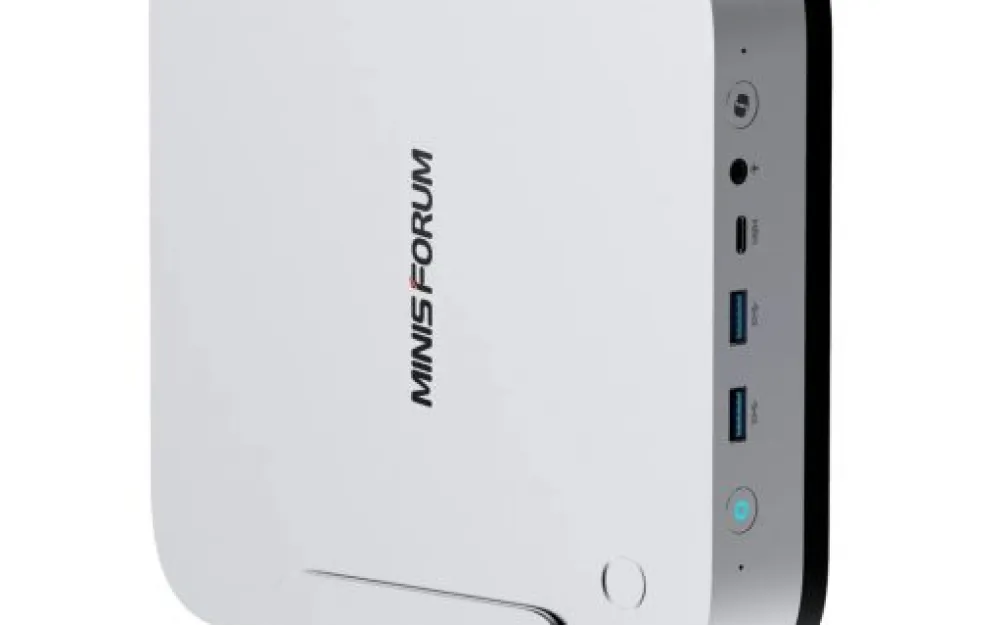
This is one of the most versatile mini-PCs in the MINISFORUM lineup. It now features the new RyzenTM AI 9 HX 470 processor from the Gorgon Point generation. Externally and structurally, it shares the same case as the 2025 model, but with slight improvements in performance and AI capabilities.
Like the previous version, the AI X1 Pro is aimed at users who need a compact yet highly expandable desktop PC. The device supports up to 96 GB of RAM, installation of multiple NVMe drives, output to multiple displays, and connection of an external graphics card via OCuLink.
The RyzenTM AI 9 HX 470 processor is architecturally similar to the RyzenTM AI 9 HX 370: it has the same 12 cores and 24 threads with a combination of Zen 5 and Zen 5c, and the same integrated Radeon 890M graphics with 16 RDNA 3.5 blocks. The main differences are slightly higher clock speeds and an updated NPU that provides up to 55 TOPS of AI performance compared to 50 TOPS in the previous version. In total, MINISFORUM claims up to 86 TOPS when the CPU, GPU, and NPU work together.
The metallic case, built-in power supply, fingerprint scanner, stereo speakers and microphones, SD card slot, and a set of modern interfaces make the device a convenient option for developers, content creators, and so on.
Specifications:
Processor: AMD RyzenTM AI 9 HX 470 (Gorgon Point, 12 cores / 24 threads),
Graphics: Radeon 890M (16 RDNA 3.5 blocks),
NPU: up to 55 TOPS,
RAM: DDR5, up to 96 GB,
Storage: up to 3× PCIe 4.0 NVMe SSDs,
Video outputs: support for up to 4 displays,
Interfaces: OCuLink for external graphics card, 2× USB4 (40 Gbps), USB Type-A, DisplayPort, HDMI, SD card reader, audio jack,
Network: Wi-Fi 7, Bluetooth 5.4, 2× Ethernet 2.5 GbE,
Case: metallic, with built-in power supply,
Additional: fingerprint scanner, stereo speakers, dual microphones, Copilot button.
MINISFORUM AI X1 Pro-470 is available for pre-order as of the end of January 2026. The base version without memory and storage is priced at approximately $760. The configuration with 32 GB of RAM and a 1 TB SSD is offered at a significantly higher price — about $1360. Shipping is scheduled to start on February 10, 2026. So the wait isn't long.
Which mini-PC from the selection did you like the most and why? If none, perhaps you can suggest your own option?






Write comment