- Network
- A
3 Tbps in plain terms: why DDoS became a threat to any business in 2026
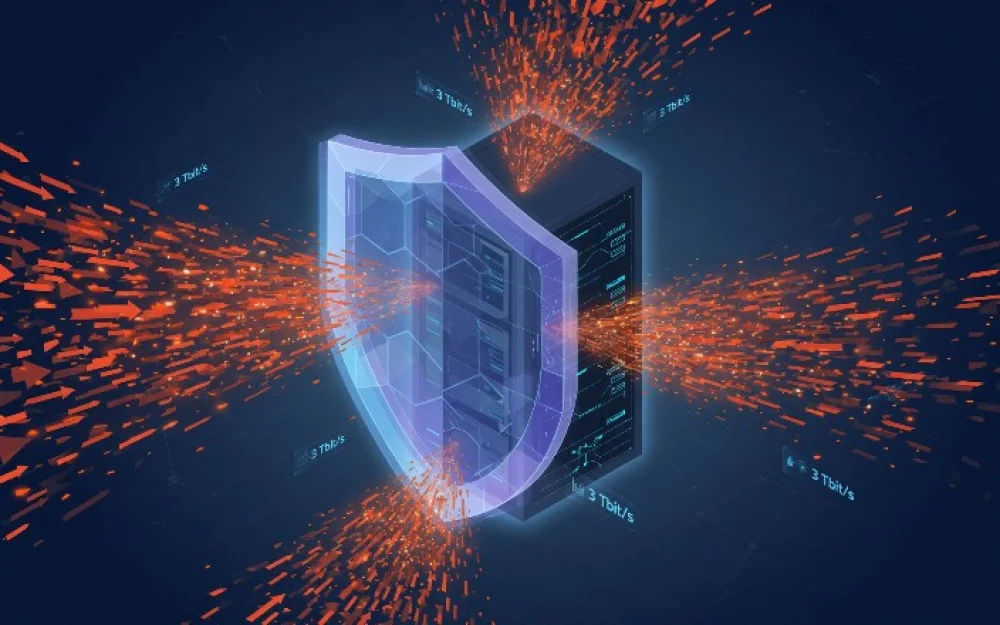
In Q1 2026, Russia faced DDoS attacks exceeding 3 Tbps for the first time. Attacks have become shorter, smarter and more dangerous, and it is no longer possible to defend against them on your own. We gathered the latest statistics from StormWall and Cloudflare to break down what actually works against terabit traffic streams.
For a long time, ultra-powerful DDoS attacks were viewed as someone else's problem: somewhere out there Cloudflare heroically repels terabyte-scale traffic streams, while the worst we'd get is “a website being down for a couple of hours”. In 2026, this perception of the world stopped holding true. According to data from analytics center StormWall, in Q1 2026 in Russia, DDoS attacks with a capacity of over 3 terabits per second were recorded for the first time. This is no longer abstract global statistics, but traffic that is actually impacting Russian infrastructure.
We break down what has changed, why traditional protection methods are no longer effective, and what businesses can do about it.
What Q1 2026 revealed
StormWall has identified several types of attacks that became dominant in Russia at the start of the year:
Multi-vector attacks — 37% of all incidents, a 62% year-on-year increase. They strike different network layers and infrastructure elements simultaneously, meaning defenses have to cover multiple fronts at once.
Pulse attacks — 32% of incidents, a 47% increase. They last from tens of seconds to 2–3 minutes and repeat every 5–10 minutes. Many protection systems simply do not have enough time to detect and respond to them.
"Carpet bombings" — 26% of incidents, a 36% increase. The target is not a single address, but an entire subnet range with hundreds and thousands of IPs. This takes down the entire target infrastructure.
Attacks over 3 terabits per second — the new trend of the season. The majority of these targeted the telecom and financial sectors; the result was IT infrastructure outages, downtime, and financial losses.
The key finding of analysts is simple: now Russian companies have to defend themselves not from one threat, but from a whole set of destructive techniques at once, and it is practically impossible to cope with them "on their own".
This is part of a global trend
According to Cloudflare, in 2025, about 47.1 million DDoS attacks were recorded worldwide - a 121% increase over the year. The record power of a single attack reached 31.4 Tbit/s: the attack lasted only about 35 seconds, but in terms of peak power, it exceeded large attacks at the end of 2024 by more than 700%.
Behind such figures are huge botnets made up of infected IoT devices - routers, surveillance cameras, and even Android TVs with outdated firmware. In the record campaign at the end of 2025 (Aisuru-Kimwolf botnet), the count of compromised devices was in the millions. In essence, DDoS has finally transitioned from the category of "digital hooliganism" to an industrial-scale tool.
Why old protection schemes are stalling
Three reasons why "we have a firewall" no longer works:
Short and impulsive attacks. When an attack lasts seconds and repeats in waves, reactive protection designed for "notice and enable filtering" constantly lags behind. Continuous active traffic cleaning is needed.
Multi-vector attacks. An attack on L3/L4 simultaneously with L7 requires comprehensive protection, not just a single "box" that covers one level.
DDoS as a smokescreen. More often than not, a volumetric attack is just a distracting maneuver: while the information security team puts out the fire, data exfiltration or malware injection is happening in parallel. This changes the very logic: protection is needed not only for availability but for the data perimeter as a whole.
What to do about it
The basic principles of cyber resilience in such a threat landscape boil down to several points:
DDoS protection at the provider/cloud level, rather than on your own channel side. A terabit flow should not physically reach your infrastructure — it needs to be filtered upstream, on the wide channels of the protection operator.
Network segmentation and access control — so that the DDoS "smokescreen" does not open a path to the data.
Resilient backups and disaster recovery plan (DR) — in case the attack still led to downtime or was accompanied by ransomware.
Readiness of processes and people, not just the presence of another product in the rack.
Where is the cloud here?
The logic of 'defending at the ingress point' is exactly why businesses migrate to the cloud. By hosting your infrastructure with a provider that has its own high-bandwidth channels and traffic scrubbing systems, you offload the burden of fighting terabyte-scale traffic flows to the party that has the capacity to handle them.
For example, provider Cloud4Y offers exactly a set of features that mitigate the risks described above: DDoS attack protection, hosting in a secure cloud (including certified segments for personal data that meet regulatory requirements), as well as backup (Backup as a Service) and disaster recovery (DRaaS). In other words, both service availability, data preservation, and a Plan B for incidents are all available in a single infrastructure, with no need to own and maintain all these components on your own.
There is no such thing as 100% protection — you cannot fully safeguard yourself against attacks. But when attacks in Russia have already crossed the 3 Tbps threshold, moving the traffic filtering point "to your own channel" is almost a guaranteed loss. The cloud model at least shifts the fight to a level where the defending party has a chance.
Conclusion
Q1 2026 recorded an unpleasant milestone: ultra-powerful DDoS attacks have reached Russian infrastructure, and they are becoming increasingly sophisticated — using short pulses, across a large number of vectors, sometimes covering up more dangerous actions with them. The good news is that the set of countermeasures is known and available: cloud DDoS protection, segmentation, backups, and DR. The only question is whether to implement them in advance — or after the first truly costly downtime.



Write comment