
- AI
- A
Senior Developers as an Endangered Species
How AI changes the career ladder in development: why the problem is not the disappearance of seniors, but the market getting worse at growing new engineers. We discuss automation of lower-level tasks, AI ceiling for juniors, responsibility contour, and the risk of breaking specialist reproduction.
Not because AI has replaced experienced engineers. But because the market is ceasing to cultivate new ones.
For the past few years in IT, a nearly comforting phrase has been repeated: AI won't replace developers; it will become their assistant.
In 2026, this phrasing describes reality less and less accurately.
AI tools are no longer just filling in lines in an IDE. Codex, Claude Code, and other agentic environments are increasingly taking on the full implementation cycle: they read the codebase, edit files, run commands, write tests, and prepare changes for review. A human remains in the process, but their role shifts from being the author of every line to a reviewer of the result.
I would formulate it this way:
Human involvement in development is becoming critical, but minimal.
Critical—because someone needs to understand the task, make architectural decisions, verify the result, and be responsible for production.
Minimal—because an ever-larger volume of direct code production is moving to the model.
At Cloud Next 2026, Google Cloud's main event for developers, companies, and partners, publicly stated that 75% of new code within the company is already generated by AI and approved by engineers. What's important is not just the figure itself, but the phrasing: the code is generated by AI, and the human approves it.
And here a deeper problem emerges than "AI will replace juniors."
The problem is that the market still wants seniors, leads, and architects, but it increasingly fails to support the path through which they used to emerge.
AI isn't taking the entire profession at once. It's taking the bottom layer.
When people say "AI will replace developers," the debate often goes to extremes.
Some imagine the complete disappearance of the profession. Others respond that complex systems still require people, so nothing fundamental will change.
But the real shift is happening between these extremes.
AI doesn't need to replace the entire profession at once to radically change the market. It's enough for it to automate the bottom layer of tasks:
Typical CRUD scenarios;
Simple components;
Migrations;
Basic integrations;
Tests;
Documentation;
Simple bug fixes;
Primary refactoring;
Explaining someone else's code;
Quick prototypes.
It was on these tasks that junior developers used to learn.
A trainee would join a team, be given a small task, do it slowly, make mistakes, receive feedback, rewrite, ask questions, break the local environment, fix it again, and gradually understand the codebase and learn to see the consequences of their decisions.
This wasn't the most efficient way to close tasks here and now, but it was a way to grow engineers.
Now, the company looks at the same task differently: why give it to a junior for several days when a mid-level or senior developer with Codex, Claude Code, Copilot, or another agent can close it faster, cheaper, and with fewer organizational risks?
The problem with a junior isn't that they've become worse; the problem is that their training tasks are becoming too well-automated.
Code production is separating from the developer profession
In the report Sonar State of Code Developer Survey 2026, developers estimate that 42% of their current code is already AI-generated or significantly AI-enhanced. By 2027, they expect this to grow to 65%. Among those who have tried AI tools for development, 72% use them every day.
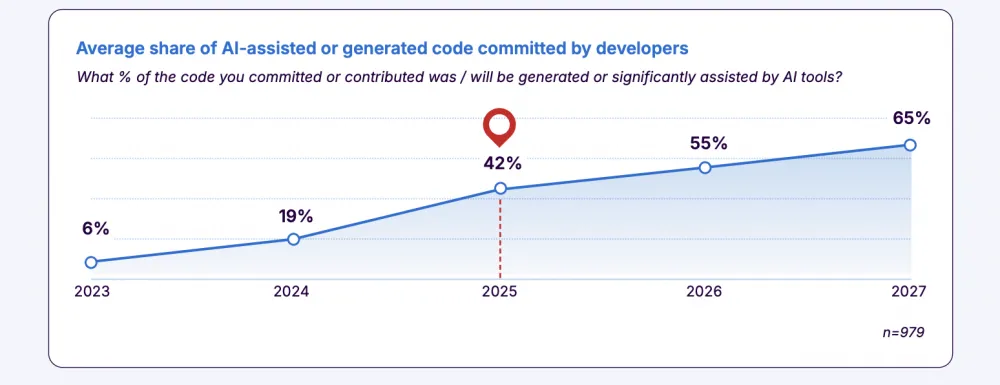
One can argue about the accuracy of each individual figure. One can say that "AI-assisted" is not the same as fully generated code. It can be rightly noted that auto-completion, chat, an agent in the IDE, and autonomous work with PR are different levels of model participation.
But the direction is clear: code production is becoming less and less of a manual process.
Anthropic in its report on Agentic Coding Trends 2026 describes a similar shift: developers are increasingly not writing every line themselves but managing agents that take on implementation, testing, documentation, and codebase work. An important caveat: according to Anthropic's internal research, developers use AI for about 60% of their work, but they can fully delegate only a small fraction of tasks—typically 0–20%.
I explored this Anthropic report in more detail on my Telegram channel.
Development is becoming less like manual code production and more like managing a flow of decisions that need to be verified, constrained, and tied to the real system.
Boundary of Responsibility
Here the first important term appears.
Boundary of responsibility is everything that remains with the human, even if a machine writes the code:
understand the problem;
clarify requirements;
choose an architectural approach;
define system constraints;
assess security;
check performance;
consider edge cases;
organize testing;
conduct a review;
accept the risk;
be accountable for production.
AI can generate code.
But AI is not responsible for a broken payment scenario, data leak, service outage, growing technical debt, or an architectural decision that will make the system unmaintainable in six months.
Therefore, the new role of a strong developer is not just to write code faster.
The new role is to hold the boundary of responsibility.
This sounds abstract, but in practice it looks very concrete.
The old process:
developer got a task
→ wrote code
→ wrote tests
→ opened PR
→ got review
→ fixed
→ merged
The new process:
developer formulated the task for the agent
→ agent wrote the code → agent opened the PR
→ developer checked the diff
→ found an incorrect abstraction
→ strengthened the tests
→ checked security
→ took responsibility for the merge
In the first process, the human produces most of the code.
In the second process, the human may write a smaller part of the code, but still bears 100% of the consequences.
This is the new asymmetry of development: less operational involvement, more responsibility.
A person may write 5% of the code but be responsible for 100% of the result.
What this changes in team work
Let's consider a typical task: add a new endpoint, store data, return a response, cover with tests.
Previously, this could be a normal task for a junior. Not too complex, but useful: to understand routing, DTOs, validation, data access layer, tests, local environment, and team rules.
Now the same task can be given to an agent.
After some time, the agent will open a PR. It will include the endpoint, migration, tests, possibly updated documentation.
Business is happy: the task is completed faster.
Senior is happy: less routine.
But this gain has a hidden cost: no one went through the learning cycle.
There was no thoughtful reading of someone else's code;
There was no error in the migration;
There was no question during the review: 'why did you put this logic here?';
There was no independent attempt to figure out why the test fails locally;
There was no understanding of where the boundaries of responsibility lie in this system.
The task is closed. The engineer did not grow.
If this happens once - nothing terrible.
If the entire entry funnel into the profession is structured this way - the market begins to impoverish itself.
Break in the reproduction of engineers
A senior developer is not someone who simply wrote code for longer.
This is a person who has gone through errors, reviews, others' outdated code, poor architectural decisions, incidents, deadlines, controversial compromises, production bugs, and responsibility.
Seniority cannot be fully learned from documentation. It cannot be acquired solely through pet projects. It cannot be mastered only through prompts. It is formed through practice. But if the lower layer of practice is automated, a gap in the reproduction of engineers emerges.
The gap in the reproduction of engineers is a situation where the market still needs strong developers, but stops supporting the steps through which these developers used to grow.
Companies want mid-level developers, seniors, team leads, architects.
But fewer and fewer want to hire people who need to go through the path from simple tasks to complex ones. For business, this is becoming a difficult investment: a junior requires onboarding, reviews, and mentorship, and the return is not immediate or may never come. Against the backdrop of relatively cheap AI tools, this investment is increasingly looking less obvious.
Stanford AI Index 2026 records an alarming signal: employment of software developers aged 22–25 has dropped by almost 20% since 2024. At the same time, the effects of AI on the labor market are uneven and concentrate more strongly in hiring and the youngest workers in AI-prone professions.
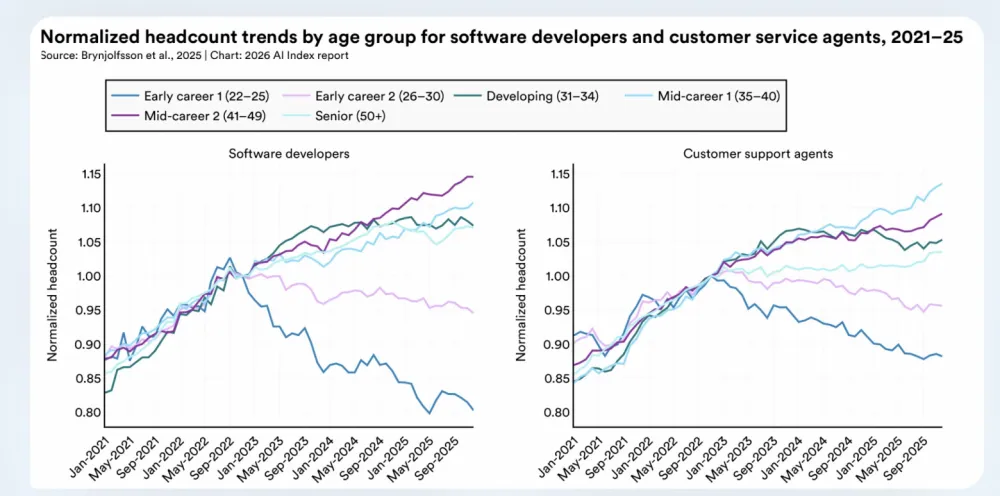
This does not prove that AI single-handedly "killed juniors." The market is influenced by rates, post-pandemic correction, layoffs, bootcamp market saturation, hiring geography, and general corporate caution.
But AI is amplifying an already existing shift.
If earlier a newcomer was an investment in a future mid-level developer, now they are increasingly looking like an expensive and slow way to close tasks that can be handed to a model under the control of an experienced engineer.
AI junior ceiling
Thus, a second term emerges - the AI junior ceiling.
AI junior ceiling is the barrier between entering the profession and real engineering practice.
A novice is no longer competing only with another novice.
They are competing with a combination of:
an experienced developer + AI tools + ready-made infrastructure + the team's accumulated context.
And this is an unfair competition. The junior is not losing because they are lazy or studied poorly.
He loses because the market compares him not to a person of the same level, but to an enhanced AI experienced developer.
That is why the title “senior developers as a disappearing species” is more important than “juniors are disappearing”. Because a junior is not a separate type of employee. A junior is a future senior at the first stage of formation.
If the normal path for a junior disappears, in a few years the flow of new seniors starts to disappear.
Cognitive ceiling: a junior can't form a base
The AI-ceiling has not only a market but also a cognitive side.
A junior today is not just entering the development profession. He is entering a profession that is restructuring itself faster than he can form a foundation.
He needs to learn a language, frameworks, Git, databases, testing, architecture, security, working with legacy code - and on top of that, a layer of AI-tools: Cursor, Claude Code, Copilot, Codex, agent scenarios, context, prompts, AI code review rules, new testing modes, and new risks.
For an experienced engineer, this can be an amplifier. He already has an internal map: he understands where the model makes mistakes, what needs to be checked, and which decisions are dangerous.
For a newcomer, the same layer of tools often turns into an overload. When a task is unclear, delegating to a model looks rational. The model will explain the error faster, write a function, suggest tests, and assemble a prototype.
But here a cycle of cognitive surrender appears:
unclear task:
→ overload
→ AI delegation
→ quick result
→ weak internal understanding
→ the next task seems even more complicated
→ even more delegation.
A person wins the task but loses the skill.
Anthropic demonstrated a similar risk in a recent study on the impact of AI assistance on programming skill development. In a randomized experiment, participants with AI completed tasks slightly faster but then showed weaker understanding: the average test score for the AI group was 50% compared to 67% for the group that wrote code manually. The researchers separately noted that aggressive implementation of AI in the work environment may yield productivity gains but could harm the development of skills necessary for reviewing AI-generated code.
This doesn't mean beginners shouldn't use AI. On the contrary, they will have to use it. But the method of use becomes critical.
There is a big difference between:
"do it for me"
and
"explain the principle, show options, help find the error, but I must understand the solution myself."
In the first case, AI closes the gap in understanding.
In the second—it helps to fill that gap.
Therefore, the main question for a junior developer in 2026 isn't:
"Can I use AI?"
But rather:
"Am I becoming stronger after using AI?"
If after each task a person receives a result but doesn't gain understanding, they don't grow as an engineer. They simply learn to manage someone else's thinking.
In this sense, the AI ceiling for juniors isn't just a hiring problem. It's a learning problem.
Even if a beginner formally enters the profession, it's becoming increasingly difficult for them to walk the path of deep understanding: the temptation to fill gaps in comprehension with generation is too great.
The market is already showing the first symptoms
Separately, it's worth discussing the job market.
In Russia, this is already being felt not just as an abstract conversation about the future. For beginners, the market has become noticeably tougher.
Yes, vacancies still exist and there are many of them. On hh.ru, Tekkix Career, and other platforms, you can find announcements for juniors and interns. But the presence of a vacancy on a site doesn't always mean real, active demand.
Some listings hang for months. Some collect resumes "for the future." Some get closed by internal candidates. Some stall due to frozen hiring or lengthy approvals.
For a junior developer, the difference is small. They see a job opening, apply, complete a test task, wait for a response—and are met with silence.
The phenomenon of “ghost job postings” is already discussed in HR circles: this term refers to listings that create an illusion of growth or gather candidate pools, but don’t necessarily lead to actual hiring right now.
In parallel, public analyses of the Russian IT market in 2026 reveal another issue: in some tech stacks and specializations, the imbalance between job openings and active resumes has become so pronounced that a small number of vacancies can attract a massive flood of applications. One analysis on Habr directly describes it as “2 vacancies, 1,000 applications per day.” This isn’t an academic study of the entire market, but it’s a telling symptom of how the market feels from the inside. From my own experience, I’ve encountered huge waves of applications for junior/intern positions when posting vacancies 5–6 months ago, and the situation is now even more acute.
There’s also a broader trend: the job market is shifting from hyper-demand and mass hiring toward retention, internal rotation, and professional development for already hired employees. hh.ru’s February report for 2026 shows that the average number of active vacancies has decreased year-on-year, while active resumes have grown.
Therefore, the phrase “the market needs IT specialists” has become too general.
Which specialists are needed?
Strong ones – yes.
Experienced ones – yes.
Rare ones – yes.
People who can quickly take responsibility for a system – yes.
But does the market need the same volume of entry-level specialists as during the growth era of 2020–2021? That’s already a big question.
This is where AI intensifies the painful shift. And in this new economy, a junior developer ends up in the most vulnerable position.
They haven’t yet delivered senior-level speed;
They don’t yet own a clear area of responsibility;
They still require onboarding;
They still make mistakes;
They still need code reviews;
Meanwhile, the tasks where they could learn are increasingly being automated.
The main question now is not whether AI will replace developers
AI doesn't cancel development.
But it cancels the old development economy, where a newcomer could gradually grow on simple tasks.
AI strengthens those who already know how to design, test, and respond. But at the same time, it automates the layer of tasks through which people used to learn.
Seniors are not disappearing now. On the contrary, strong engineers become even more valuable.
But if the market stops growing new specialists, in a few years the problem will return at a different level. Companies will complain not about the lack of juniors, but about the lack of people who can be responsible for complex systems.
And here, IT companies face a new challenge: what to do with beginner specialists?
Not with Olympiad winners and rare talents - they will almost always find their way.
Not with those who already write complex infrastructure projects at 20.
But with ordinary juniors who could become good mid-levels in a few years of practice.
Where will they go if businesses need them less and less?
This is not a question of morality. Business is not obliged to hire people just because they need to learn somewhere.
But if the entire industry starts to optimize only for short-term efficiency, it may break its own talent cycle.
There will be more code
There will be more AI agents
There will be more automatic PRs
The speed of feature delivery will be higher.
But there may be fewer people who understand how it all works.
So the main question of the coming years doesn't sound like this:
“Will AI replace developers?”
And not like this:
“Will juniors be needed?”
The main question is tougher:
“Who will train engineers if simple tasks no longer require people?”
If IT companies don't build a new career elevator, the market will get a strange structure: at the top - expensive seniors and AI agents, at the bottom - a crowd of people who want to enter the profession, and between them - fewer and fewer living steps.
Senior developers as an endangered species is not about current seniors no longer being needed. It's about the industry still wanting mature engineers, but understanding less and less how to create conditions for them to appear.
And, perhaps, this will become one of the main HR issues in IT in the AI era.
If you're interested in such analyses about AI, the development market, product shifts, and how the work of IT teams is changing, I continue to write about it in my personal Telegram channel



Write comment