
- AI
- A
Generative Output Raises Source Requirements: Overview of Key GEO News and Research 2026
Generative search is rapidly evolving: it demands higher reliability from sources, uses limited text, and remains notably variable in recommendations. This shifts GEO's focus: instead of aiming for one-time mentions, ensuring a sustainable brand presence in responses and AI search blocks is more important. This requires evidence-based materials, clear page structures, understandable presence metrics, and an understanding of how AI search utilizes website information.
Below is my analysis of 4 recent publications that complement each other and provide a comprehensive picture of changes in generative output at the beginning of 2026.
My name is Roman Kovalev, and I am a co-owner of the advertising agency “Kovalevy” and the creator of the GEO service “Tsunami.” I try to keep up with all the news in the world of optimization for neural networks.
1. What recommendations is Google increasingly considering unreliable – and why is this important for GEO?
A telling example is an analysis by Lily Ray: on several domains, she notes that collections of best self-promotional content regularly fall into the risk zone and can be accompanied by significant visibility drops after volatility in search.

The problem is not with the format of “collection/ranking” itself, but with how it is made. When a company publishes material like “Top X in the niche” and consistently places itself in first place, readers (and algorithms) expect an independent assessment. If there is no transparent methodology, criteria, evidence of actual comparison, and clear ranking logic, such text looks not like a recommendation but rather like self-presentation disguised as a review.
Case in numbers: what exactly did Lily Ray show
In one of the examples provided in the material, the visibility of the site decreased by 49% over a short period from January 21 to February 2, 2026.
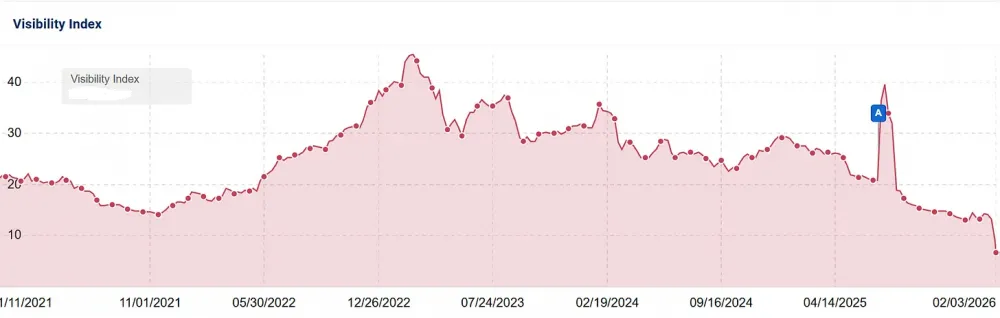
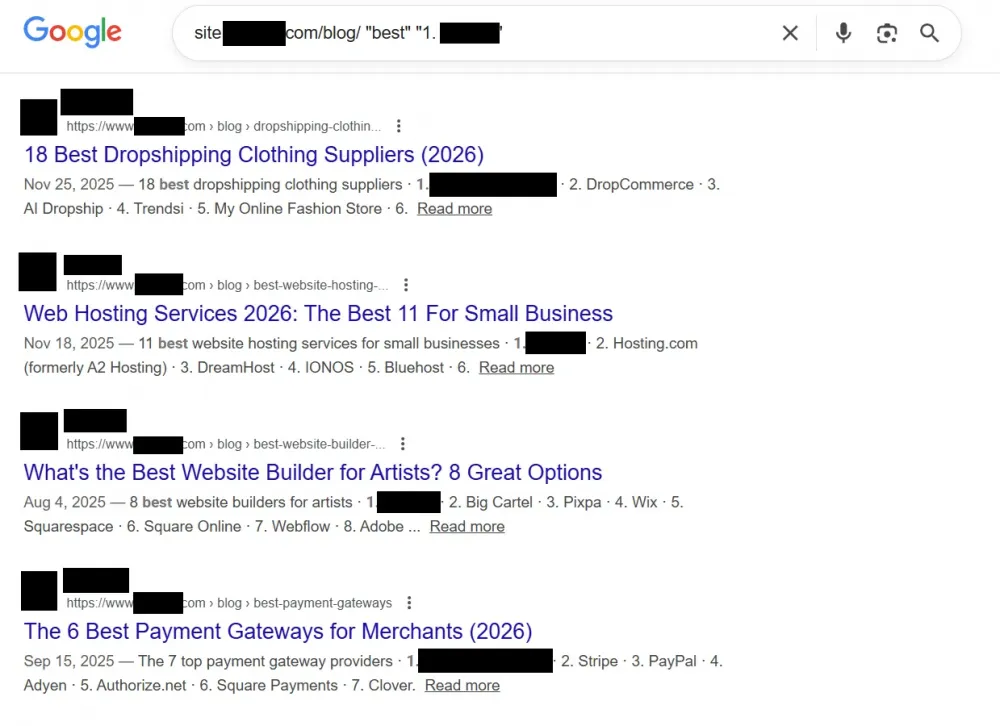
At the same time, 77% of all visibility was provided by the blog – that is, the impact was primarily on the content contour, rather than on commercial pages. Within the blog, 191 self-promotional publications of the best format were found (essentially collections where the brand places itself in top positions).
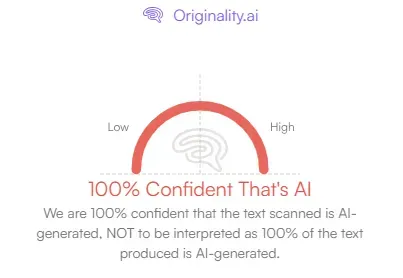
Additionally, the author notes that checking a number of texts with the detector from originality.ai showed 100% confidence in AI generation – this is not a verdict, but it strengthens the feeling of template-based content and a weak evidential base if such pages are scaled by hundreds.
Practical Conclusion
The format of collections is not prohibited and is not useless in itself. But when the ranking format turns into a mass conveyor without a verifiable methodology, it becomes vulnerable during the reevaluation of content quality.
Materials become sustainable when they can be cited as a source:
with clear criteria and methodology,
with verifiable grounds and limitations,
with careful separation of “objective review” and “about us” page.
2. How much content reaches the generation of a response – and how does this affect the structure of pages?
After discussing the reliability of sources, a second, less obvious filter arises: even a high-quality article does not make it into the generative response in its entirety. The model does not work with all the text, but with a limited set of fragments that the search engine selects from several sources.
A good reference point is provided by research by Dejan.ai (Dan Petrovic) on the size of so-called grounding fragments – text fragments that Google sends to the model as support before generating a response. The authors compared the fragments used in the response with the full text of pages from a sample of 7,060 queries and 2,275 pages.
Key Findings of the Research
There is a total text limit for one request: about 2,000 words combined from all sources, with a median of 1,929 words and a 95th percentile of 2,798 words. It is important that this limit appears to be quite stable and almost independent of the length of pages and the number of sources.
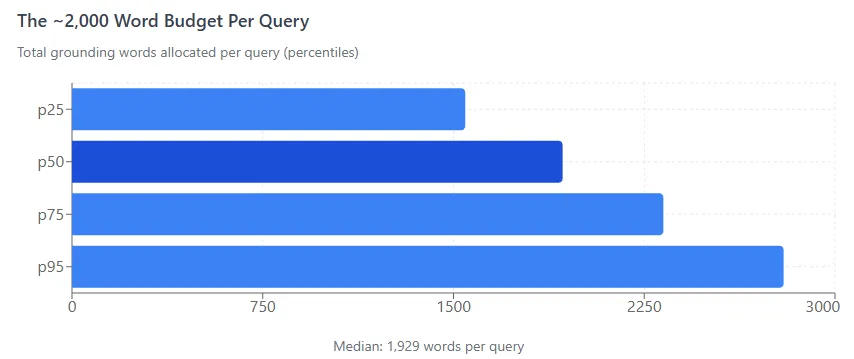
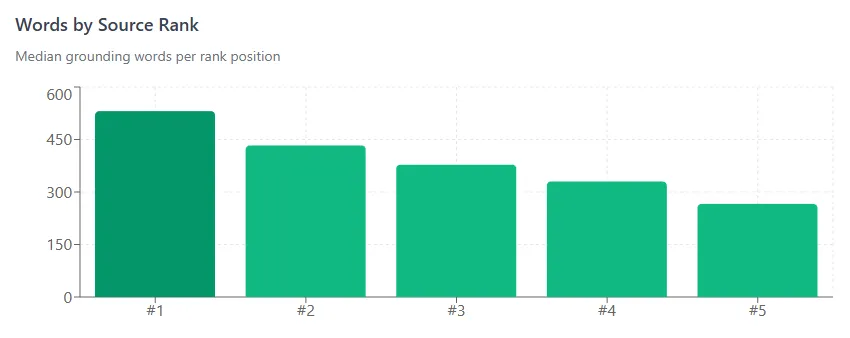
2. This limit is divided among sources by "rank" (essentially – by how relevant the source is considered within the set):
source #1 receives a median of 531 words (28% of the total volume),
source #5 – 266 words (13%).
In other words, the competition is not for the "longest text," but for a share of a fixed volume.
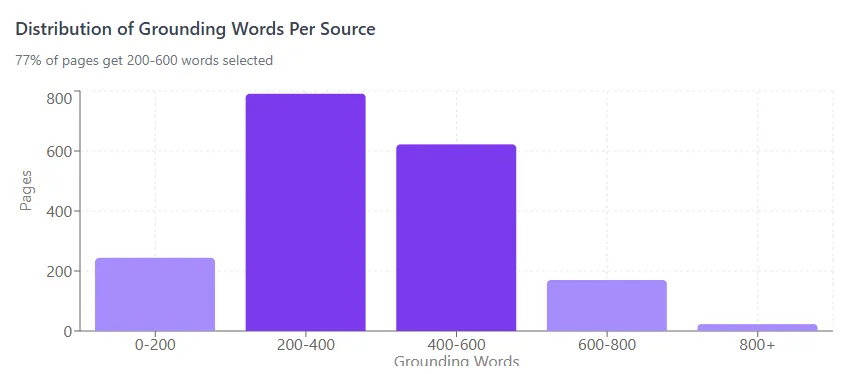
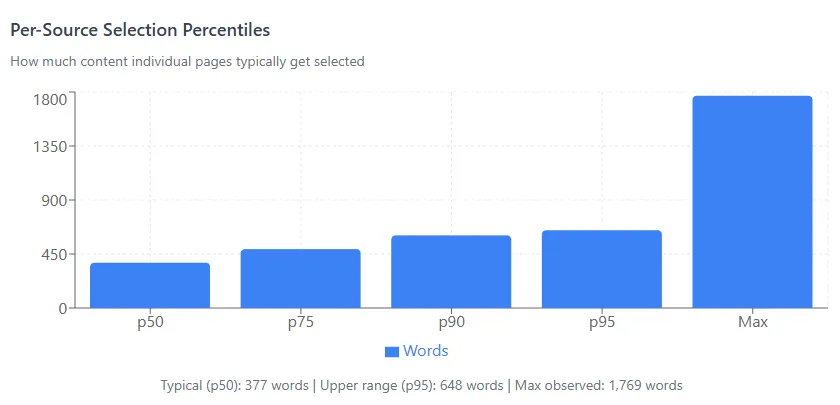
3. For a separate page, the selection is even stricter: a median of about 377 words make it into the "supporting context," and in 77% of cases, 200-600 words are selected.
4. The share of "coverage" decreases as the page length increases: for short pages (<1,000 words), an average of 61% of the text is included, while for long pages (3,000+ words) – about 13%.
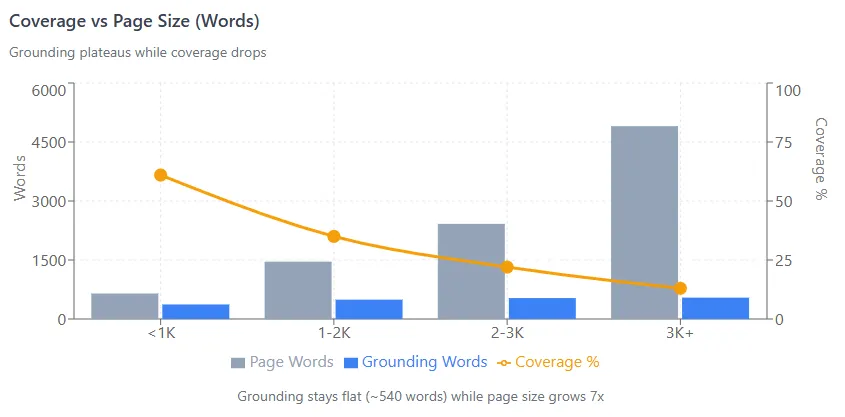
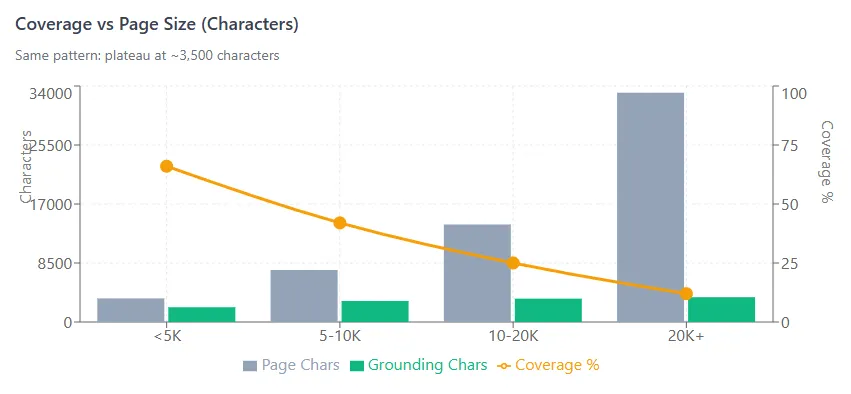
At the same time, the volume of selected text levels off at around ~540 words/~3,500 characters: adding text increases the page length but hardly increases what will be used in generation.
What does this change for GEO in practice?
More important than the "first layer of meaning" is maximum completeness.
If the generation often lands in the range of 200-600 words, then it is precisely within this range that things must exist, without which the answer will inevitably become inaccurate: definitions, conditions of applicability, key limitations, selection criteria, basic comparisons.Structure begins to work as a factor of accuracy.
Headings, short paragraphs, lists, tables with criteria, blocks of "suitable/not suitable" increase the chance that the necessary fragments will be extracted in full and without semantic gaps.Long materials do not disappear – but change their role.
Detailed texts are still needed by people (to verify, understand details, make decisions). However, for a generative response, it is critical that the material has a compact and unambiguous "core" that can be taken without losing meaning.It is not length that wins, but relevance to a specific request.
Since the overall limit is fixed and shared among sources, the growth of "share" is achieved not by adding paragraphs, but by making the page more suitable for a specific question and answering it more clearly.
The logical continuation of this conclusion is the measurement problem: if content is limitedly included in the response, and recommendations vary from query to query and from user to user, then classic visibility metrics begin to fail. This is what the next material leads to.
3. Why are neural network recommendations unstable – and how to measure GEO then?
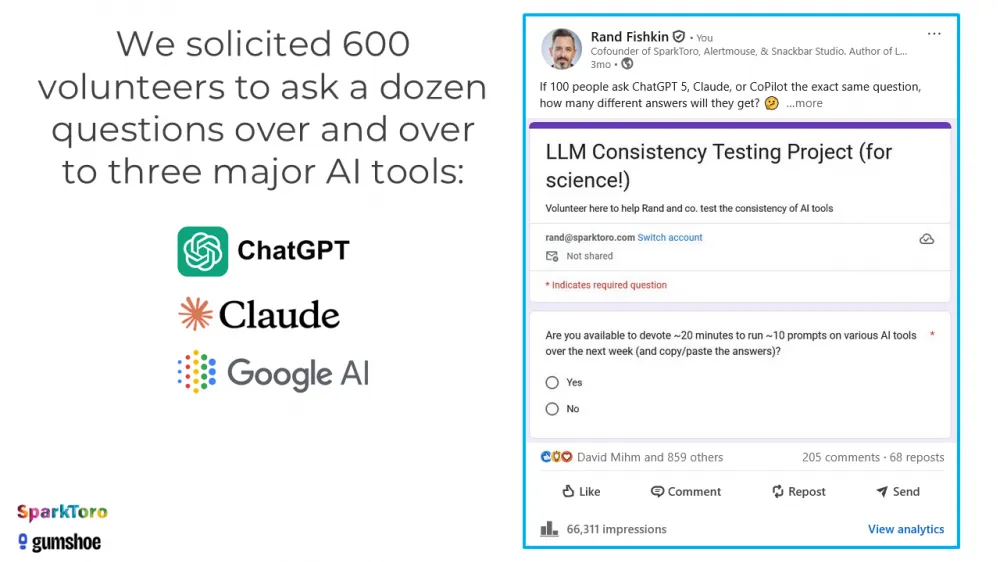
In the study by SparkToro and Gumshoe, they examined how consistently three popular tools (ChatGPT, Claude, and Google AI in search) provide lists of brands/products in response to identical phrasings. Data was collected through mass repetitions: 600 volunteers ran 12 queries across 3 systems a total of 2,961 times, recording responses and standardizing the results.
Why is this important? Some teams are still trying to measure brand visibility in neural responses like traditional SEO – through "ranking in the list." If the lists themselves and their order are unstable, such a metric quickly becomes misleading.
How random are recommendation lists in practice?
The key finding of the study: repeatability is very low.
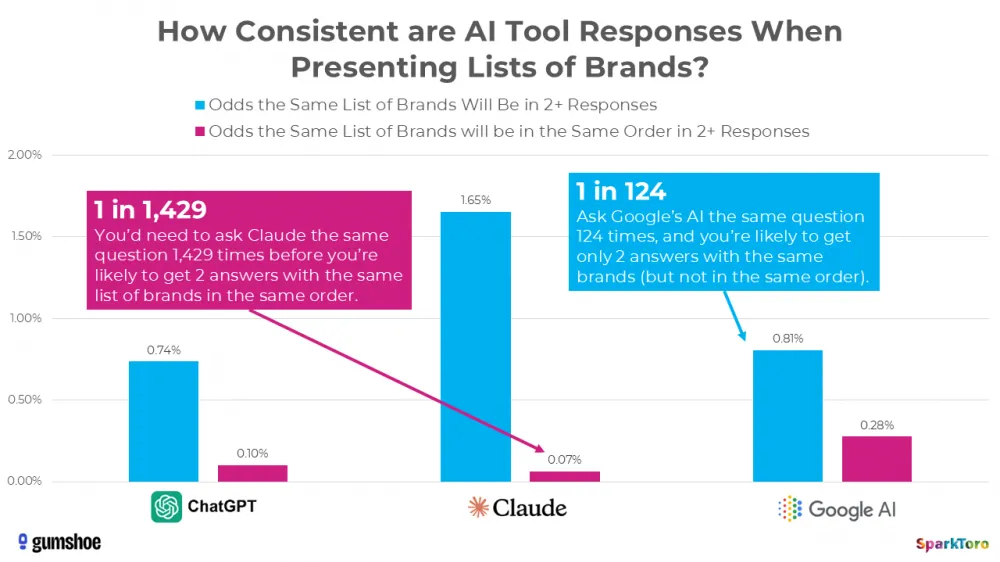
The probability of getting the same list of brands in two runs is less than 1% for ChatGPT and Google AI (that is, less than 1 case in 100 runs).
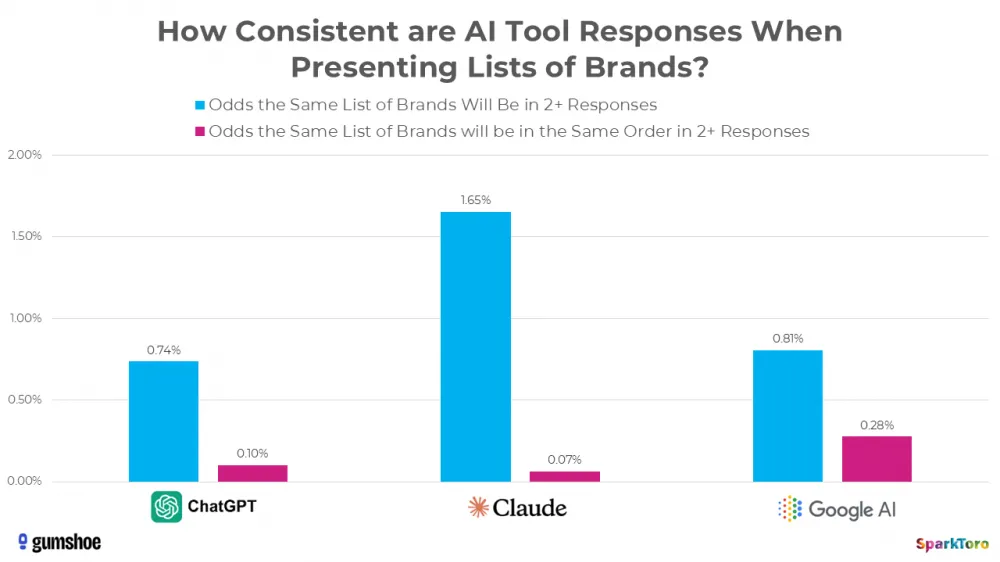
The order is even worse: the same sequence in the list occurs at about a rate of 1 time in 1,000 runs.
Why does the position in the list stop being a reliable metric?
If the lists and their order change from run to run, the position in the output ceases to be a reliable signal: in one response a brand may be fifth, in another it may disappear, and in a third it may appear in a different set and with a different number of recommendations. Therefore, for GEO, a single check proves nothing.
However, with large volumes, a stable indicator appears: if you make many repetitions and count the share of mentions, you can see the "core" of brands that the system consistently considers relevant to this intent. This was demonstrated in the study using the example of choosing headphones for travel: for 142 different phrasings of one intent, 994 responses were collected, and key brands (Bose, Sony, Sennheiser, Apple) appeared in 55–77% of the responses – the lists changed, but the leaders were repeated.
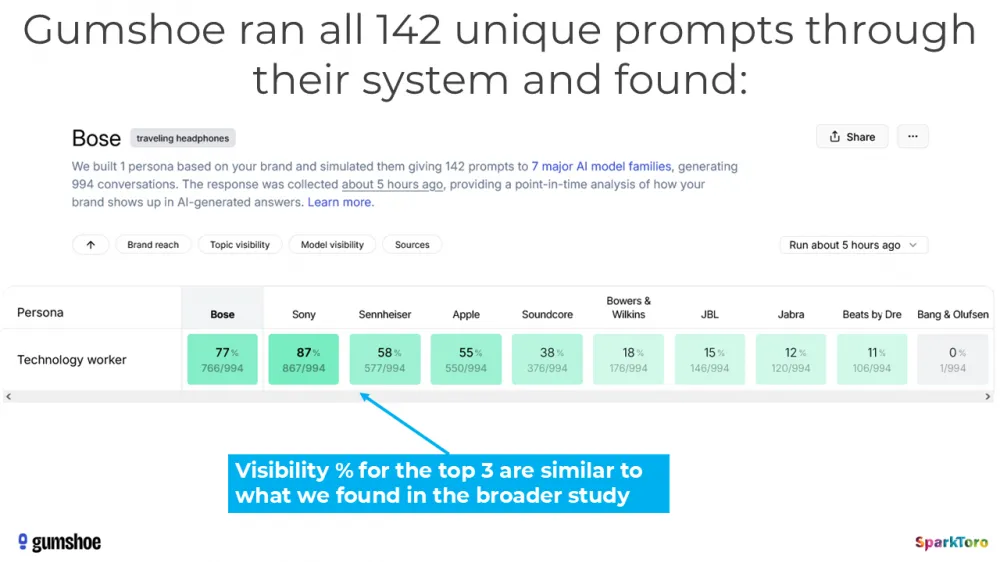
It is also important that the phrasings of the questions were very different: the average semantic similarity was assessed as low (0.081), however, the systems still recognized the common meaning and returned a similar circle of leaders.
So how should GEO measurements be properly constructed?
Count not places, but share of presence
Not "what place in the list," but how often the brand is mentioned for a fixed set of intents (and separately - how often the source becomes a site/page).Work in series, not single checks
Repeatability is low, so a batch of runs for one request is needed (dozens of iterations), otherwise the conclusions will be random. In the research, the same queries were run multiple times (dozens of times).Separate user intents
The same brand may be stable in "choosing a tour operator" and hardly appear in "where to go with children." For GEO, the map of intents is more important than the overall "average percentage."Fix a set of formulations and change it consciously
Otherwise, the measurement changes along with the content. The research shows that people formulate queries in extremely diverse ways - this is a normal part of the channel.
4. What control mechanisms for websites does Google discuss - and why is this important for GEO?
This section is based on Google's official position regarding what settings are already available to website owners and what options the company is considering for AI search features. It is important to distinguish: part of what is described are active mechanisms, while part is a direction of development, i.e., plans without guarantees of timelines and final format.
What can be controlled right now
Google explicitly states that websites already have tools that affect how content is displayed and used in search, and these same settings apply to AI summaries in search:
robots.txt – managing access for crawling (what can be bypassed and indexed).
nosnippet – a ban on showing text snippets from the page in the results.
max-snippet – limiting the length of the text snippet that can be shown.
Google-Extended – a separate control related to the use of content for training Gemini models (this is specifically about training, not about the page's participation in AI summaries).
Practical meaning: even without "special GEO settings," the website already has levers that determine what volume of text can be extracted and displayed and which pages are generally available for crawling.
What Google considers the next step
The key thesis of the document: Google reports that it is exploring the possibility of separate controls that would allow sites to opt out specifically from AI Overviews and AI Mode, while still participating in regular search. This means a more precise choice than the binary "included in results/not included in results."
Google emphasizes the requirements for future controls: they must be simple, scalable, and not degrade the quality of search. This shows the overall direction: the participation of content in generative elements of results is gradually becoming a separate managed zone, rather than just a side effect of indexing.
In summary
The reliability of the source becomes crucial. Recommendation materials without transparent methodology and evidence are more likely to fall into the risk zone. For GEO, this means that resilience is provided not by formats, but by grounds: criteria, examples, limitations, and verifiable logic.
It’s not volume that wins, but density and structure. Even strong articles are used partially: typically, only a limited fragment is included in the response. Therefore, the value shifts towards the "core meaning" – definitions, criteria, and conditions of applicability, which are located near the beginning and are formulated unambiguously.
What needs to be measured is not “position”, but presence and quality. Recommendations in generative responses are variable, so individual checks prove almost nothing. Managed work begins where the share of mentions, correctness of context, and stability of results are measured over a series of repetitions for the same pool of intents.
Control of content participation becomes part of the strategy. As settings develop and rules for material use in AI search are discussed, it is important for teams to define boundaries in advance: what can safely be paraphrased as reference, and where it is critical to preserve context, conditions, and accuracy of formulations.
In total, this sets the practical definition of GEO for 2026: not to seek isolated successful mentions, but to build reproducible results – through the quality of sources, page structure, accurate measurements, and clear rules for content participation in AI search.







Write comment