- AI
- A
Tesla Optimus: Reality vs Promises
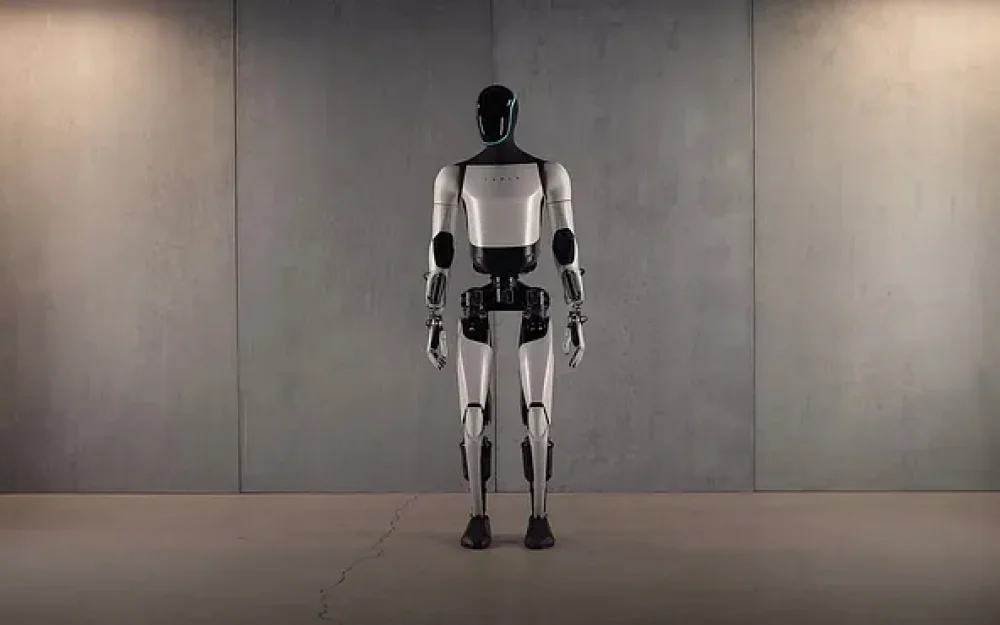
Elon Musk's statements about the Tesla Optimus robot are astonishing in their scale. He claimed that Optimus would bring $10 trillion in long-term profit for Tesla, ultimately making the robot 80% of Tesla's value, and that it would increase the company's valuation to an impressive $25 trillion.
However, previous promises have not always come true: Musk stated that Tesla would launch a pilot production line for the ready Optimus and produce 5,000 units by the end of 2025, but this did not happen. In fact, Tesla recently announced a new "production-ready" third version of Optimus (which implies that the version planned for production in 2025 was not ready), and that production will begin at Tesla's Fremont factory by the end of 2027, where the Model S and X were previously produced. Perhaps it’s worth viewing these bold statements with a certain degree of skepticism? During recent Tesla earnings calls, Musk mentioned something that not only demonstrates the gap between reality and promises, but also raises questions about the understanding of technology.
An Unexpected Admission
For months, Tesla has claimed that two Optimus robots are working in their factories. This has been the only evidence that Optimus may be capable of performing even the most basic tasks autonomously. It is important to understand—the entire concept of Optimus is built on convincing investors that it is something more than just a remote-controlled animatronic robot.
However, it seems that the information was not presented fully. During a recent earnings call, it was revealed that no Optimus robot is currently performing productive work at any of Tesla's factories. Musk stated that the presence of Optimus at the factory was "more for the robot to learn," and it did not assist in production in any way.
In other words: the robot, whose production was planned to start last year, is not even capable of helping at Tesla's own factories. Not even with the simplest tasks? It can't, for example, lift a box of bolts and move it? More importantly, why are robots being "trained" at the factory in the first place? More on this later.
This Shouldn't Be Surprising
If you were surprised by this revelation, you should have been paying closer attention. Tesla has desperately tried to create the illusion of Optimus's autonomy but has repeatedly failed. Recall the incident at the event in Miami, where Tesla attempted to imply that the Optimus robots handing out water bottles were doing so autonomously until one of the robots removed a non-existent headset, shattering the illusion (watch the video here). This clearly showed that the robot was being controlled remotely. While Tesla did not directly acknowledge this, the company confirmed that the demonstration video of Optimus folding clothes with a VR operator in the frame, as well as the robots at the We Are Robot event, were indeed controlled remotely.
So far, Optimus has not lived up to expectations as a technological demonstration, so it is not surprising that Tesla cannot make it help at its factories.
But the implications of this discovery are much deeper than they may seem.
Tesla is Falling Behind
It is inconvenient for Tesla that humanoid robots are already working at electric vehicle manufacturing plants. As I recently wrote (more details here), BYD is currently testing the Walker S1 from UBTech at its factories, where it performs tasks such as basic quality control, transporting components around the factory, and even assembling parts.
This should not be too surprising, as UBTech has demonstrated how the Walker S1 performs remarkably complex tasks, such as playing tennis and successfully interacting with production line equipment. It is clearly capable of such challenges.
Although, to be fair, it does not perform these tasks perfectly. As reported by the Financial Times, UBTech's chief brand officer Michael Tam stated that the Walker S1 is "30-50 percent more productive than humans and only in certain tasks, such as box packing and quality control." Thus, it is likely still in the stage of "technological demonstration," and Chinese factory workers have little to worry about for now.
The Walker S1 is clearly more capable than Optimus, but even it cannot yet justify a business case close to Musk's claims about Optimus. This also shows that Tesla is not actually a market leader and does not have a functional advantage over its competitors. So, even if humanoid robots represent a multi-trillion opportunity, companies like UBTech, not Tesla, will reap the profits.
But humanoid robots are likely not even a viable technology, let alone a revolutionary business opportunity.
Suboptimal Approach
In fact, we have long known that humanoid robots make sense only in science fiction. In reality, there are very few instances where a humanoid robot makes more sense than a specialized one.
Take the Walker S1. Simple, inexpensive, specialized robots can — and already do — install parts, transport components across factories, and perform basic quality checks much faster, more accurately, and more economically than any humanoid robot ever could. Furthermore, they are cheaper and integrate into the production line much faster in the overwhelming majority of cases.
Indeed, the robotics industry has known for quite some time that humanoid robots are not the optimal direction.
Let's take Kris Wolt, who essentially led the development of Optimus at Tesla. He publicly stated that the humanoid form factor "is not a useful form factor" and that "we are not made to perform repetitive tasks over and over again. So why take a hyper-suboptimal system that is actually not designed for repetitive tasks and make it do repetitive tasks?" Or Brad Porter, former Vice President of Robotics at Amazon, who said that "humanoids are the wrong solution for most tasks" and that much simpler solutions, such as wheels instead of bipedal legs, are almost always cheaper and more reliable. Then there's Gartner, which points out that humanoid robots are impractical due to their high cost, integration issues, unreliability, and insufficient capabilities. Given the availability of better options, such as specialized robots or human workers, this will be the case for a long time to come.
If you think about it, this insistence on mimicking humans makes little sense. If humans had evolved for millennia to work in an automotive factory, they wouldn’t look like us. Likewise, why spend resources and effort making a humanoid robot vacuum when you can simply assign it to a Roomba, which will do a much better job?
Insisting that robots look and function like humans is like designing a car that resembles a horse and operates like a horse. It’s backward logic. Of course, we like the idea of humanoid robots because we can anthropomorphize them, but actually using them, even if they are capable of performing a task, makes no sense.
Problems with AI Training
Remember that point I asked you to keep in mind? The fact that Optimus is "training" on the factory floor? This is kind of an indicator of Optimus's problems.
Tesla uses two main methods to "train" the AI Optimus: imitation learning based on video and training through teleoperation. This is because Optimus is built on the same AI and AI computers as Tesla's FSD, that's how they train the FSD AI. And we all know how that goes, don't we?
But, as pointed out by brilliant Australian robotics expert Rodney Brooks, these training methods have serious and obvious drawbacks.
Let's start with video-based imitation learning. This is the process of "training" AI to perform tasks that you want the robot to carry out by showing the AI videos of people performing those tasks. Brooks calls this approach "pure fantasy."
Why? Because we humans use much more than just visual data to perform these tasks. Our sense of touch is incredibly powerful. Our hands have 17,000 specialized, highly sensitive tactile receptors capable of detecting changes as small as 40 micrometers at a rate of about one billion bits per second. In other words, one human hand transmits more than two gigabytes of incredibly detailed data to our brain every second! We rely on this significantly more than on visual data to perform even the most basic tasks. Think of it this way: you can fold a shirt with your eyes closed pretty easily, but it would be very difficult for you to fold it using tongs instead of your hands.
Brooks points out that video-based imitation learning trains the AI on incomplete data, leaving it with a huge blind spot, which means it cannot effectively replicate a human from the training data.
Musk's solution to this data alignment problem seems to be training through teleoperation. This is when you use VR to control a robot to perform a task and use that as training data for the AI. Thus, the collected data theoretically better aligns with what the AI has access to, providing better training. But Brooks points out serious drawbacks with this approach as well.
AI can only work as well as these teleoperators (or, more realistically, not as well as the teleoperators), and these teleoperators indeed struggle to even perform basic tasks while controlling a robot.
The VR suits used by these teleoperators have very limited finger control and even less force feedback, severely restricting the teleoperator's sense of touch. The robot's dimensions may differ from those of the teleoperator, breaking their immersion. The teleoperator's depth perception may be inaccurate because the two cameras used for depth perception and for providing VR video imagery have different interpupillary distances. The teleoperator's sense of balance and proprioception (the sense of where your limbs are in space) constantly differs from that of the robot. All of this means that these teleoperators really struggle to teleoperate humanoid robots, as the data fed to them is often confusing, and their senses are severely dulled.
This problem is evident from the constant failures of Optimus when teleoperating. And here's the thing: if these teleoperators struggle to even perform basic tasks through Optimus, then AI will too, as it can only poorly mimic them.
The fact that the approach seems to completely ignore these fundamental principles of AI training and assumes that video imitation and teleoperator training will be sufficient for Optimus to take over millions of jobs raises questions.
This lack of understanding of the core technology behind Optimus may also explain why Tesla trains several Optimus robots at its factory rather than conducting tests like Walker S2.
Tesla is almost certainly trying to conduct training through video imitation and teleoperation for basic manufacturing line tasks directly on the production line. This way, they can gain access to the people and tasks they want to train the AI on while also saying, "There is an Optimus at the factory."
But Tesla has been training the Optimus robots for at least three, if not four years. The fact that Tesla has not yet conducted integration tests of Optimus into Tesla's production lines even for remarkably basic tasks after all this time is telling. Such tests are a critical part of development and proof of concept for investors. The fact that Tesla has not even reached this fundamental step strongly suggests that its approach to training AI humanoid robots has fundamental problems and seriously limits development, as predicted by Brooks.
Test AI capabilities in practice
Speaking of AI training methods and their limitations — you can see for yourself how complex these technologies are. Understanding how modern AI models work, their strengths and weaknesses, requires practical experience.
Conclusions
Optimus can be characterized as an ambitious but problematic project. Claims about the business side of humanoid robotics do not match reality, and competitors are significantly ahead of Tesla. Furthermore, the issues with understanding AI and robotics are evident, as the gap between reality and expectations is substantial. It will be interesting to observe the development of this situation in the coming years and see how the technology evolves further.

Write comment