- AI
- A
Wall Street Crash: Who Lost Trust, and What Awaits the AI and IT Sector in Russia
Those who read my previous post about impressions from the Davos Forum 2026 may recall: software companies began to face difficulties in communicating with investors in light of the future potential of artificial intelligence.
Anyone who read my previous post ( https://habr.com/ru/articles/990908/ ) about the impressions from the Davos Forum 2026 might remember: software companies started having difficulties communicating with investors in light of the future potential of artificial intelligence (AI).
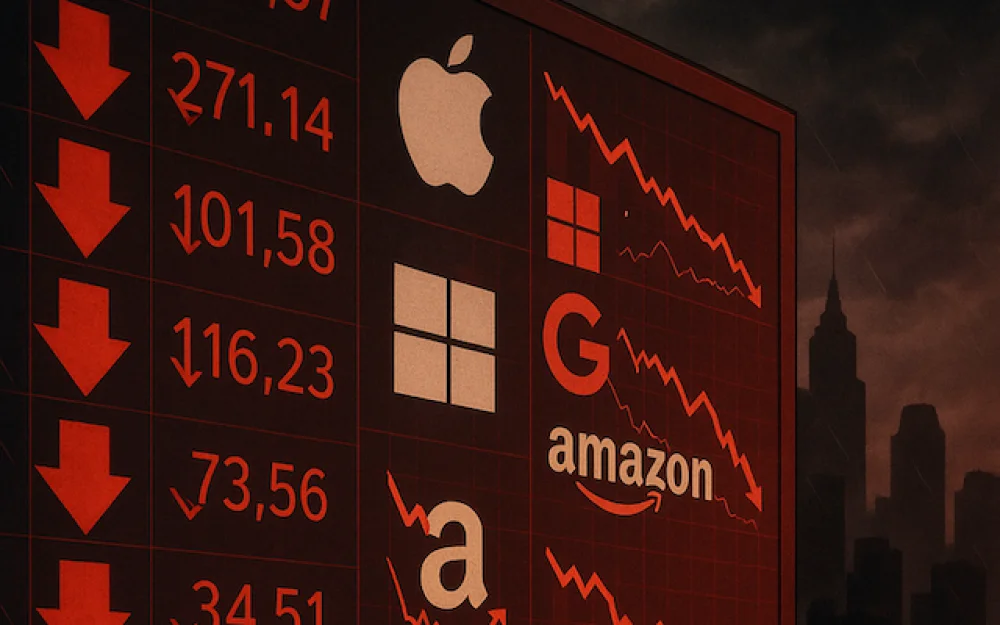
And here’s what we saw at the end of January - early February 2026: cascading sell-offs on Wall Street and in Europe of shares of software companies. In Davos, fund managers with over a trillion dollars under management spoke unequivocally about the prospects for IT companies.
What happened on Wall Street was not a surprise to me. The trading of some leveraged traders alone could not have caused such strong sell-offs, and thus the liquidation of such positions is a consequence, not a cause. The trigger was fundamental - a shift in sentiment among large investors. Retail investors, on the other hand, were caught off guard.
I remember how shaky the markets were at the beginning of the COVID-19 pandemic and how quickly I had to adapt the strategy at "Otkritie Broker", but the volume of daily position liquidations in trading at the beginning of February 2026 surpassed March 2020.
As a result, hedge funds in the US dumped shares of software companies so quickly that their share in portfolios fell to just over 3% - an absolute minimum.
In Europe, for example, by the end of the first week of February, SAP shares had fallen by 16.23% compared to the beginning of the year, and over the last 12 months, their decline reached -27.57%.
If we look at major software companies worldwide, the entire sector has gone down from its annual highs by an average of almost 40%.
Many considered this a verdict for "software without AI" and pointed to the emergence of another AI model from Anthropic as the trigger for what happened on Wall Street at the end of January - early February. Yes, the model appeared, but let me explain how I see the situation.
So what is really happening...
Usually, many conclude: "pure software companies have lost faith, while AI companies are doing great." But this is only part of the story.
The current decline is also a disappointment for investors in the business models of the main neural network providers in the world. The size of the capital investments they have announced, so that customers continue to replace third-party IT solutions with software created using their neural networks, is burning through hundreds of billions of dollars. But for what?
After all, what has happened? There was a market for software, solutions from IT companies. Businesses bought it, there was competition among providers — in some segments of the IT market more, in others — less. But there was a competitive choice.
Then came the neural networks. Yes, with their solutions, vibe coding developed, allowing companies to create IT products for themselves instead of purchasing them externally.
But! There is a problem here on both sides.
The user of public neural networks, vibe coding for the company, increasingly depends on these AIs, with their hallucinations. They do not know who has access, where the information entered during vibe coding is stored, and how reliably protected it is, as well as how to test the software created through vibe coding. These are all significant risks.
And another problem: in fact, the crash in early February on Wall Street and in Europe is not only about the sad prospects for IT companies outside of AI but also about the no less murky prospects for the neural network providers themselves.
Big tech companies, and only in the US, plan to increase their capital investments in AI this year to a level of $700 billion, more than 1.5 times increasing the pace compared to 2025.
If we look at the plans of other players in the world, the AI sector wants to attract more than $1 trillion — this is exactly what is needed to invest.
The model of development built in recent years not only does not pay off, even though the cost of training AI is decreasing a thousandfold. It requires too much money from investors, who cannot abandon all other areas of investment.
Otherwise, it becomes reminiscent of the "tulip mania" that swept the Netherlands in the 17th century when literally everyone rushed to invest solely in one thing — tulip bulbs.
So now global investors cannot invest everything only in chips, their production, data centers, and power plants.
By the way, the collapse of the tulip "bubble" also happened symbolically in February, but in 1637.
The subtlety of the current situation is that most providers of well-known neural networks in the world are private companies. Their stocks are not publicly traded, which means that formally one cannot see investors' disappointment in them.
But it can still be discerned. One prominent indirect sign is the significant correction of Microsoft’s shares.
By the end of the first week of February, they had fallen by 17% since the beginning of the year. This is even against the backdrop of Microsoft being known for its innovative spirit and interest in AI. The company has a partnership with OpenAI, which is developing ChatGPT.
However, the decline in Microsoft’s shares also reflects investors' concerns about OpenAI's business model.
There are deeper signs as well. This includes what is happening in the private credit sector for neural networks, which has kept them financially stable until recently. However, investors are losing faith.
Interest rates for neural network providers on such loans have doubled over the year, while the volume of lending has decreased by more than a third.
And what about the IT market in Russia?
The most important point of development is not the software itself, nor software with the help of public neural networks (vibecoding), nor building public AI.
The future lies with corporate neural networks, where vibecoding will take place within the closed framework of the company. Moreover, all key processes will be tracked using blockchain technology. Even better — in the ecosystem of corporate neural networks of partners, which will be discussed below.
In other words, the future of the IT market and AI solutions lies in developing within the companies themselves. Why is that?
A lot can be said on this topic, but to be brief.
- "Ordinary" companies, outside the IT and AI sectors, already have a clear business model for investors. If a company is not sinking — it is the result of a well-structured corporate strategy.
- Banks and brokers are inherently closer to investors, and corporate strategists are in effective communication with them.
By the way, there is also an understanding that replacing human communication with client-investors and shareholders with AI bots poses a great risk of losing trust, losing connection in financial relationships, where along with rational arguments there is a significant emotional component in client communications.
In fact, I see that the digital age requires more face-to-face meetings. The more "digital" there is in an organization, the more valuable human contact is for building trust. And, of course, a person has the right to communicate with another person, and especially this demand has been felt and continues to be felt precisely when it comes to money and capital.
Of course, in some moments, AI assistants and AI bots may be appropriate, but not in key financial areas, and certainly not where communication is built with Ultra-High-Net-Worth Individuals (UHNWI), that is, with investors with large checks.
- These "ordinary" companies, especially banks and brokers, have a professional approach to finance.
After all, why did many global providers of neural networks rush for loans not from banks, but from companies in the fields of Private Credit and Private Equity?
It's because they can't find common ground with banks. And why? That's just how it turns out.
This is, in general, the plight of many startups in fintech, in the blockchain and cryptocurrency sectors: founders often underestimate the crucial role that inviting a corporate strategist with experience in the most classical financial sector — banks and brokers — plays for their ideas and endeavors.
But professionals are also needed to build long-term funding providers through Private Credit and Private Equity. Underestimating this— and we saw how these sources of funding even for public and widely known neural networks became skeptical towards them.
From corporate linkage of AI+IT to new ecosystems
Therefore, sooner or later, the new trend will be realized: now is the time to create IT solutions and launch neural networks within organizations, and better, over time — new ecosystems that unite several participants.
In Russia, for example, it is optimal to build such linkages: bank + brokerage company + large exporter + large importer + energy company + industrial enterprise for semiconductor manufacturing + data centers for the development of a unified IT+AI ecosystem.
Within such an ecosystem, the first two participants from a financial point of view are key. They can ensure a capital influx. It is important that everyone in this ecosystem is within Russia, which ensures technological sovereignty.


Write comment