
- AI
- A
Fire 40% of the staff due to AI: How bad management hides behind beautiful technologies
Artificial intelligence has such a colossal impact that it changes the world not so much because of its actual capabilities, but because of the possibilities attributed to it. It's like a ghost: we don't see it, but people still fear it.
Its influence is so great that it has become the main tool for mass layoffs, even though it certainly doesn’t deserve this medal.
The great AI layoffs have already begun, and this phenomenon can safely be called “AI camouflage.” Let me explain why all of this is nothing more than mass manipulation of consciousness.
The Time Has Come
The truth is that AI is indeed incredibly powerful and can significantly expand your capabilities. I’m not going to claim otherwise.
But it’s one thing to use it as an assistant, and quite another to use it as an excuse to lay off 40% of the staff in one fell swoop. And that’s exactly what Block did.
On February 27, 2026, Block announced a large-scale wave of layoffs, firing over 4,000 people and reducing its workforce from more than 10,000 to less than 6,000 employees (a reduction of about 40%).
The company, which manages the Square, Cash App, and Afterpay services, presented this move as a strategic reorganization, rather than a response to a short-term crisis, especially considering that the business is currently profitable.
The situation becomes even more interesting when you look at the main reason given by Block: the transition to an “AI-driven” operational model.
According to reports, CEO Jack Dorsey’s message was that the new opportunities presented by AI are changing the amount of work small teams can handle, so the company is reorganizing to more quickly benefit from this productivity growth.
At the same time, the market saw this announcement as a positive signal of efficiency and profitability: since the news broke, Block's market capitalization has risen by 22%.
This is the official version. But I don’t believe for a second that this is what it’s really about, and former employees are openly accusing the company of deceit.
In fact, this is just the beginning of what The New York Times aptly dubbed “AI-washing”.
But how do we know this is a lie?
Playing the AI Card
Listen, when it comes to AI, things don’t necessarily have to be true; people just need to believe in it. AI doesn’t necessarily need to be truly ready to replace half of the employees of a public company.
Top managers who want to implement layoffs just need the public to believe in this possibility.
And nothing proves this better than the situation with programmers. If there’s a profession where such measures could potentially work the fastest, it’s software development.
But this is exactly where the lie starts to fall apart.
The Problem of Reliability
In reality, AI is catastrophically not ready to truly automate most of the work. It makes mistakes too often.
Furthermore, due to the very nature of AI models, where each new prediction is based on the previous one, mistakes accumulate easily. This means that if the model makes a small inaccuracy, it can quickly spiral into deep errors.
Yes, neural networks can self-correct, but this is still a very new and emerging capability that has not yet become a standard.
Therefore, it’s not surprising that most AI benchmarks use success percentages to slightly "smooth" this issue.
A classic example is the extremely popular METR benchmark. It assesses how well AI can perform a long-term human task correctly 50% of the time.
Behind this verbal acrobatics lies a simple fact: we are measuring the ability of models to perform tasks that would take humans hours, even considering that AI fails at them half of the time.
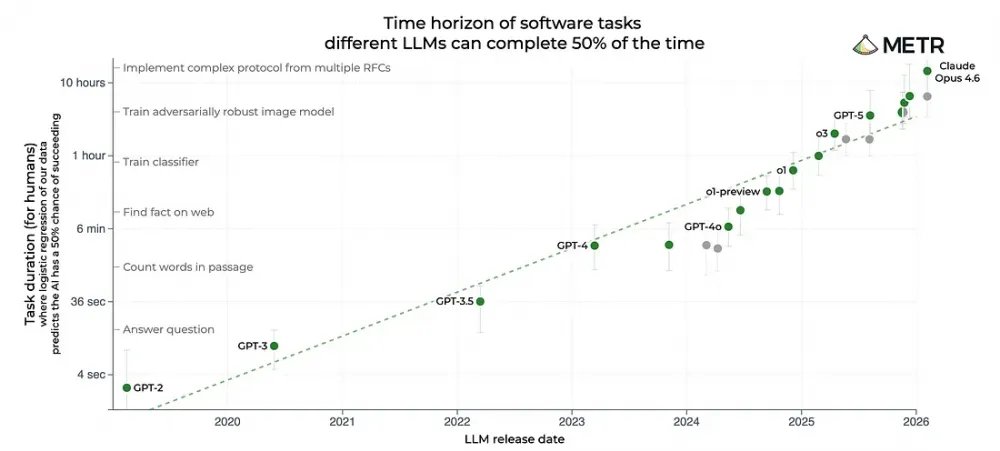
Of course, this is a nice statistic for experts to beat their chests about at presentations. But let’s face it: this is not the technology you can implement in corporations or offer to management without risking being fired.
Even if the probability of success for a task were 90%, the likelihood that AI would perform that task correctly 10 times in a row drops to 34%. And 50 times in a row—down to 0.51% (less than 1%).
In other words, AI is suitable for business implementation only where tolerance for errors is very high. That is, it is mostly useful for iterative work (with a special mention for writing code).
But then the question arises: are programmers as a class really going extinct?
Programmers should have already run out of jobs. Is that really the case?
The company Anthropic, behind some of the most powerful AI models in the world, right now has over 29 open positions for software engineers on its website.
Quite ironic, isn't it?
Overall, the number of job openings for developers continues to rise, despite the fact that another influencer on LinkedIn insists that they have more in common with dinosaur fossils than with the modern job market.
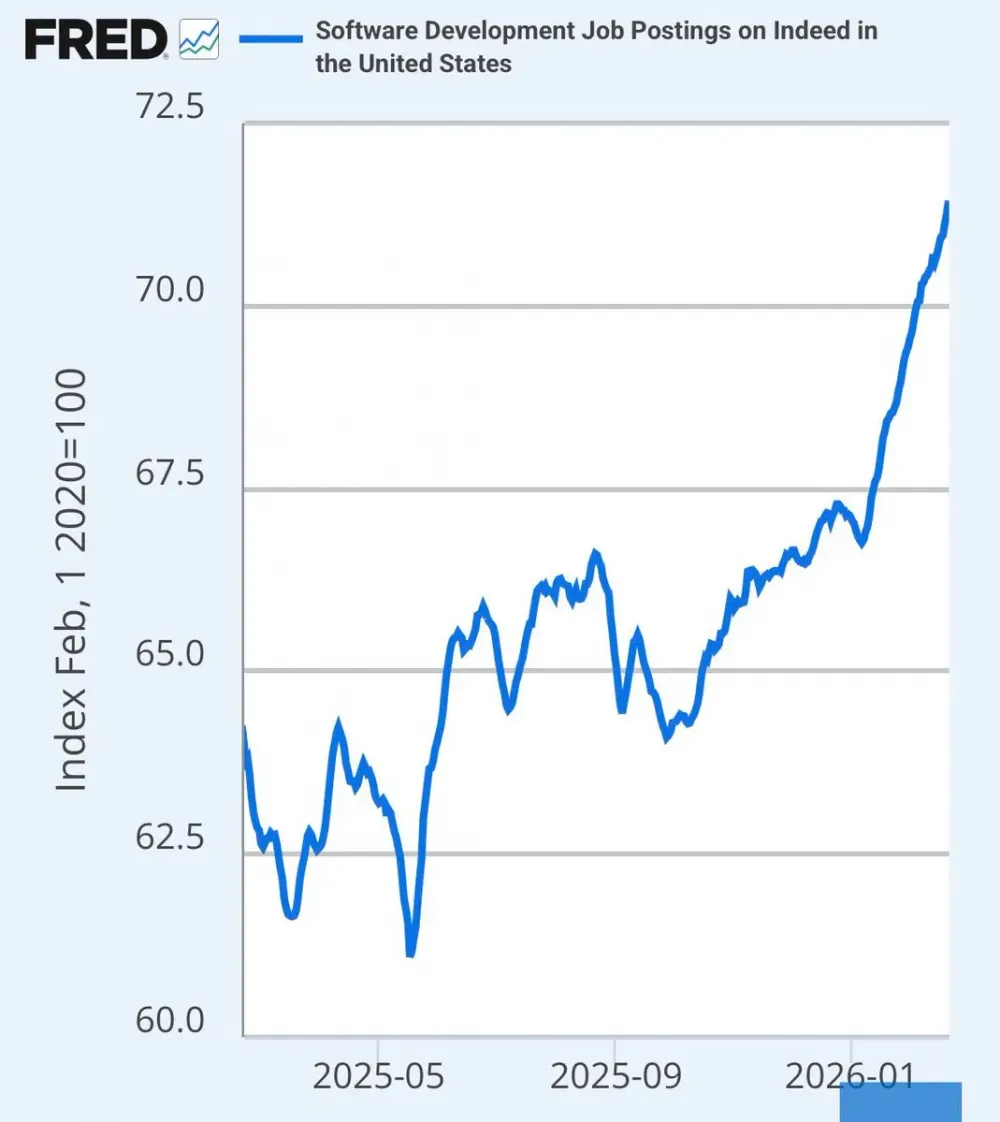
Yes, the data is heterogeneous, and in some industries, the number of job openings for developers is decreasing, but the overall net figure is still going up.
But listen, it’s not even about facts or data. Just work with the models yourself and honestly ask yourself: can they completely replace a live person right now? We both know they cannot.
And if there's one thing I can't be accused of, it's being an opponent of technology. I use AI all the time: for research, for learning, sometimes for automating routine tasks. So I fully understand what it’s capable of and what it’s not.
I even have a personal AI secretary, with whom I communicate through messengers, and who reads my emails. But that’s where my AI automation portfolio ends.
Beyond these tasks, the technology is just not ready yet.
That’s why it seems absurd to me to assume that modern AI models can replace half of the workforce; it’s even laughable to argue about this. I’d go even further and say that AI can't eliminate any job that wasn't already redundant to begin with.
And here’s the main point: AI is being used as an excuse to fire people who, to be honest, weren’t all that necessary to the company from the start.
Interesting fact: from 2019 to 2022, Block increased its workforce almost four times, even though there was no obvious need for it.
But back then, money was "free" — it was the peak of the zero interest rate policy (ZIRP) era. Growing for the sake of growth wasn’t just normal, it was actively encouraged by investors.
That’s why blaming AI today is the height of cynicism. Personally, I have not yet seen a single convincing example of intellectual work where AI demonstrated such stable reliability, independence, and autonomy to justify the complete dismissal of an employee “because of neural networks.”
It is telling that behind the scenes, away from the screaming headlines, AI is very rarely mentioned as the real reason for layoffs.
According to the report by the analytical company Challenger, Gray, & Christmas, only 55,000 out of 1.17 million job cuts (or 4.5%) were directly or indirectly related to the influence of AI.
Given all this, it’s clear that 40% of Block employees would have been fired anyway, even if AI did not exist. Management simply found the “perfect” excuse and took advantage of it.
A much more bitter pill that society will have to swallow is the inevitable realization that some intellectual professions simply produce nothing. They emerged in a sea of corporate chaos and inflated budgets. Such things can only be tolerated in fat times, and those times, apparently, are coming to an end.
Of course, you could argue against me with the undeniable fact that in areas where AI is a powerful tool, employees gain superpowers and can do “more with less.” This is known as productivity.
By the way, about real productivity
If you use AI just to do your old job a little faster, you're still acting as a regular consumer. Becoming a creator – entering that 5% of people who are proficient with AI – requires a fundamental shift in thinking. It’s no longer about asking, “How can this tool perform my current task?” It’s about asking, “How can this tool completely eliminate, scale, or reinvent my entire operational model?”
And to become such a creator, you need the right arsenal. Limiting yourself to just ChatGPT means voluntarily narrowing your possibilities.
The Eternal Promise of AI
The logic of corporations is simple: if every employee can do more with fewer resources, you automatically need fewer employees (unless you're growing so quickly that you need all hands on deck to meet demand).
But if AI is truly a miracle that makes every worker 10 times more efficient, doesn't that mean you should not fire people but give them this tool so they can produce ten times more?
Block is a software company. Even if their current market can't digest new products, they could immediately come up with 10 new markets they could enter with this "productivity maximization" technology.
Instead, they are laying off people. I don't believe in that. In my opinion, the truth lies somewhere in between: AI hasn't yet made every employee 10 times more efficient, but it also doesn't justify mass layoffs.
I understand that business is tough, and companies have to make hard decisions about downsizing. But there's no need to mislead society (and your own employees) with such blatantly fabricated justifications.
Admit your mistake (the fact that you hired too many people in the wave of hype), rather than shifting the blame to a technology that already raises concerns among many.
The truth is that AI is a great argument for freezing hiring, but definitely not for mass layoffs.
I completely understand companies that are scaling back their hiring plans after realizing that their 20-person marketing department is now just as effective as a 30-person department a year ago.
But productivity works both ways: you can use it to reduce costs or to expand the business. And companies are always striving for expansion, or at least for a 50/50 balance.
However, right now we see that AI is being used only for the first. This tells me that the so-called "maximization of productivity" is most likely just a pretty tale that we all believed. And this belief is strong enough to allow companies to conduct purges under the convenient, socially acceptable pretext: "It's not us, it's all AI."
So, if a company uses neural networks as an excuse for your dismissal, there's a very high chance that you are being manipulated. The management is simply trying to improve margin and show nice numbers in the next quarterly report to earn their bonuses (since their salaries are directly tied to stock prices).
And the fact that the stocks have risen despite the sad news of 4000 people being fired speaks volumes. I repeat: what matters is not what is actually happening, but what people believe.
And the truth is that, despite the obvious absurdity of the situation, most people sincerely believe that AI is already making companies so incredibly productive that half of the employees have suddenly become unnecessary.
For top managers, this is just heaven on earth: they improve the margin and at the same time create a reputation as forward-thinking innovators implementing the technologies of the future (exactly what investors want to hear).
And who are investors to doubt when a company fires almost half its staff and continues to thrive?
"It must be all AI!"
However, for an industry expert, hearing this is simply wild. From my daily consulting experience, I know full well that most companies haven't even started seriously implementing AI into their processes. Mostly, it's empty promises and corporate PR.
So, sorry for the bluntness, but this narrative is pure fiction. And the scariest part is that we are only at the beginning of this path.
False AI Layoffs
Artificial intelligence has the potential to bring more benefits than any other technology created by humanity. Perhaps even more than all of them combined. It is already making the world better in many ways that I cannot even count.
That is why the decision of Block to make AI the scapegoat for layoffs must be called dishonest. Especially considering that this will undoubtedly provoke many more similar incidents, seeing how joyfully the markets respond to it.
The great "AI camouflage" is just the perfect screen, allowing top managers not to admit that they have failed in their duties to shareholders and have excessively inflated the staff.
But this screen will work.
Just as throughout history, rulers have repeatedly fabricated false reasons to start large-scale conflicts — which few believed in, but they still achieved their goal — this pretext will also work.
And yes, AI is indeed leading us into the era of "lean companies" that will produce a lot of products with the help of a very small number of people. This will truly force "inflated" corporations to lay off staff. But for this reality to come, there must first be colossal competition (the emergence of a huge number of new startups in all imaginable sectors, which we do not yet observe).
And first, we must survive what I call the "great deflation": when AI, by making many services mass-produced and accessible, will force companies to compete in the only remaining way — by price.
When the game is about lowering prices, prices fall; when prices fall, margins shrink; when margins shrink, people get laid off. And that’s when these layoffs will truly be caused by AI.
But the point is that this is not a story about today. And it won’t be like that for at least a few more years.
Right now, layoffs are the result of poor management. And using AI as an excuse is a disservice to the technology, which should be admired, but instead is starting to cause widespread hatred.





Write comment