
- AI
- A
ML Digest: Autonomous Agents, New Security Standard, and the Inference Race
While the industry debates the "bubble," discussing why the valuation of another startup with a wrapper over GPT-5 is so high, the real sector is building AI infrastructure. We are moving towards services where autonomous agents, not humans, will click buttons in interfaces.
In this digest, we will analyze the details of the most talked-about innovations, why the CEO of Databricks predicts the decline of traditional SaaS, how AMD is catching up to NVIDIA in inference tests, and why agent security is the new top-10 OWASP. Details below!
Databricks: The Era of Invisible Software, SaaS in Question
Ali Godsi, CEO and co-founder of Databricks, recently made a loud statement that AI will soon devalue the very concept of traditional SaaS. Popular media outlets often write such headlines, and there is logic behind it. For decades, companies built "moats" around their products, training millions of specialists to click buttons only in their interfaces, whether it was Salesforce or SAP. But if an AI agent does the work, the interface becomes "transparent." We no longer need specialists for specific programs — we need tools for control and quality data.
But so far, Databricks shows only aggressive growth:
Revenue — reached $5.4 billion (run-rate), showing a 65% year-over-year growth;
AI sector — generated over $1.4 billion, and retention (customer retention) remains above 140%;
New records — Their Lakebase database, created specifically for agents, earned twice as much in the first eight months as the classic Data Warehouse did in the same period in its time.
Ali Godsi specifically emphasizes these numbers to dispel the myth of SaaS destruction: for Databricks, AI does not kill the business, but rather accelerates the consumption of platform resources.
If there are "control buttons," then products that cannot hide their UI behind a quality API for agents may soon become a thing of the past. Against this backdrop, Databricks is in no rush to go public. Instead, the company raised $5 billion in investment at a valuation of $134 billion and opened a credit line for an additional $2 billion. This is a huge "safety cushion" that allows them to build infrastructure without worrying about the stock market and its fluctuations.
InferenceX v2: NVIDIA Blackwell leads over AMD in SOTA modes
A fresh batch of GPU comparison tests has been shown. The key takeaway: AMD has caught up with NVIDIA in simple scenarios and presents strong competition, but in complex production systems, things are not so straightforward—let's look at the nuances.
Rack-scale NVL72 vs. multi-node AMD
The InferenceX v2 benchmark from SemiAnalysis evaluates the performance of chips in real-world architectures where all models are currently running. The research focuses on the latest optimization methods, such as FP4 format and MoE, which are important for inference at the data center level.
NVIDIA's GB200/GB300 NVL72 systems showed a significant leap over the previous generation (H100 baseline). In scenarios using MoE models and the FP4 format, performance increased almost 100 times while maintaining high generation speed (116 tokens per second per user). From an economic perspective, the new Blackwell architecture is also more efficient than Hopper: the advantage in terms of tokens-per-dollar ranges from 10 to 65 times.
First third-party benchmarks of AMD MI355X have been released. In single-node or partially optimized configurations, MI355X delivers comparable or even better performance in terms of performance-to-cost ratio (TCO) against similar NVIDIA systems on FP8—especially with SGLang and without all three advanced optimizations at once.
But as soon as the full modern set of optimization methods is activated (disaggregated prefill + wide expert parallelism + FP4), NVIDIA B200/B300 and GB200/GB300 NVL72 pull sharply ahead. AMD software still cannot handle their simultaneous operation.
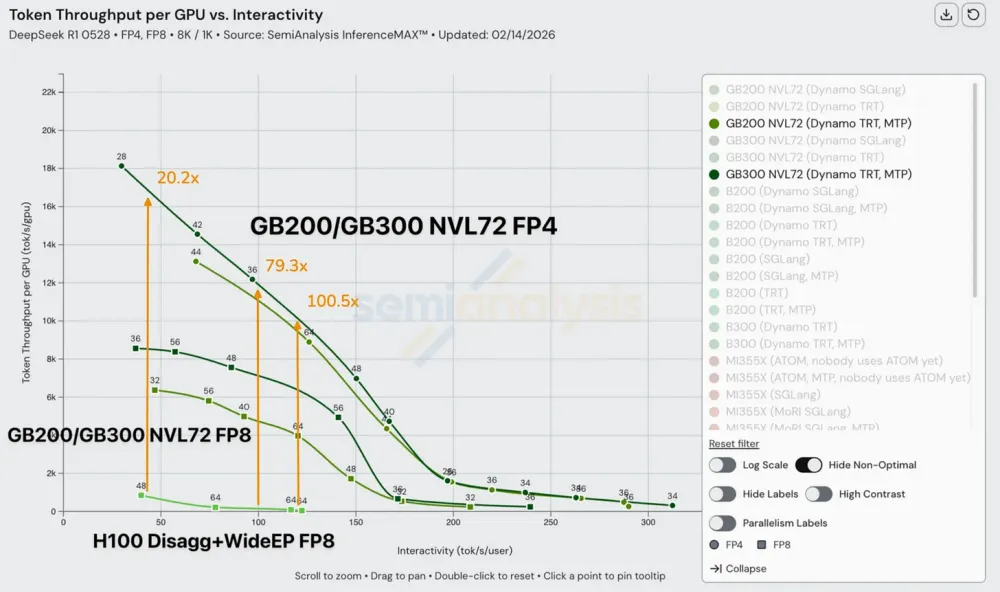
Software and Its Composition
In a short time, AMD has made progress: DeepSeek R1 performance in FP4 mode on the SGLang base has almost doubled in just one month (from December 2025 to January 2026). Currently, the optimized SGLang fork is actively being merged into the main development branch.
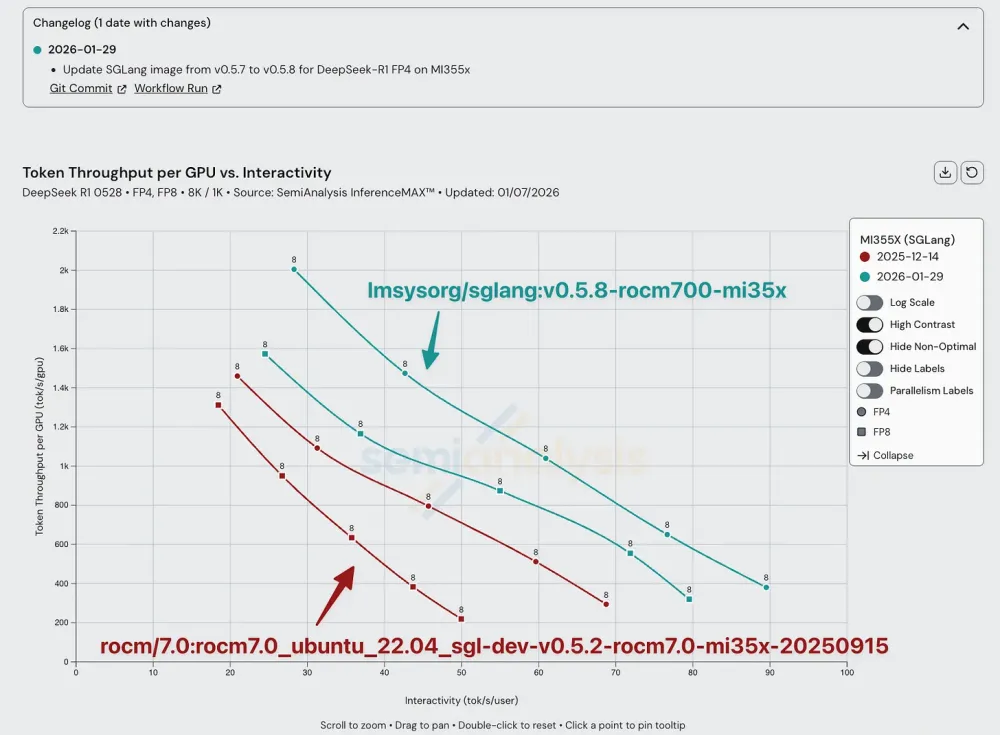
However, the weak point remains the "composition" of technologies: AMD software still cannot handle turning on all key optimizations simultaneously. When attempting to combine FP4, disaggregated inference, and wide-EP — which is exactly how leading providers operate — performance drops sharply. In such complex setups, the real MI355X figures are significantly lower than the theoretical numbers promised.
Looking at the big picture — the balance between response speed and throughput — NVIDIA Blackwell surpasses AMD in both energy efficiency and token generation cost.
Mini-Conclusion
InferenceX v2 shows that AMD is progressing quickly and is already competing for the mid-tier segment. However, when Blackwell NVL72 systems operate with all SOTA optimizations enabled, AMD is not yet a competitor.
AMD urgently needs to improve software compatibility (FP4 + distributed + wide-EP). While the hardware potential is blocked by software limitations, NVIDIA maintains a significant lead in performance and cost for cutting-edge deployments.
AI Agents in Action: Economics, Risks, and the Evolution of Organizational Models
At the end of last year, Axenix presented a comprehensive report. It was fully dedicated to aspects of using AI agents in Russian business. Many companies are now transitioning from simple chatbots to implementing AI systems, so in-depth analysis of profitability came just in time.
The costs of implementation over three years vary significantly depending on the scale. While small businesses can manage with 5–15 million ₽, large corporations start at 950 million ₽. Large businesses typically spend 200–300 million ₽.
Implementing agents in business processes can free up 30–40% of employee working time in functions like procurement, logistics, and customer support.
The main profit is achieved not through savings on labor costs but by reducing the operational cycle (time-to-market) and minimizing errors in supply chains, where the agent can independently recalculate routes or order volumes.
However, there is context and barriers here. The Russian AI agent market currently accounts for about 1.5% of the global market (for comparison: the US share is almost 30%, China’s is 8%). The main driver of growth is Data-driven companies, which are already increasing investments in this direction by 15–30%. However, 60% of companies are still delaying implementation due to a lack of quality data and high inference costs.
The leaders in implementation are retail and fintech, where agents are already starting to act as "smart layers" between fragmented IT systems, automating business processes.
OWASP Top 10: Arize's Compliance Guide
The Arize team adapted the new OWASP Agentic Security Initiative (ASI) security standard to specific observability features: tracing, assessments, and monitoring.
The issue is about protecting not just LLMs, but autonomous systems that call tools and make decisions on their own. The main task here is to close risks at every stage of the agent's operation, from filtering incoming prompts to controlling code generation and access to APIs.
ASI01–ASI03: Control of Goals, Tools, and Accesses
The central threats are goal hijacking through injections (ASI01— Agent Goal Hijack) and abuse of tool permissions (ASI02 — Tool Misuse). To prevent the agent from turning into a tool for attack, Arize offers tracing each step in combination with jailbreaking tests and context validation.
The situation becomes more complicated in multi-agent environments (ASI03 — Identity & Privilege Abuse), where there are risks of identity theft and credential leakage. It’s important to log call parameters and track the agent’s trajectory to spot anomalous cycles or unauthorized actions in time.
ASI04–ASI07: Supply Chains, Code, and Communications
Special attention is given to the security of dynamically loaded components: plugins, MCP servers, models (ASI04 — Agentic Supply Chain Vulnerabilities) — and the risks of remote code execution (ASI05 — Unexpected Code Execution / RCE). Manifest verification during runtime and blocking commands outside the protected "sandbox" is required.
To avoid "memory poisoning" in RAG systems (ASI06 — Memory & Context Poisoning) or message substitution between agents (ASI07 — Insecure Inter-Agent Communication), constant context relevance monitoring and communication graph visualization are necessary. Additionally, Arize emphasizes the importance of semantic analysis of PII in inter-agent dialogues to prevent accidental transmission of sensitive data.
ASI08–ASI10: Failures, Manipulations, and "Rogue Agents"
To prevent cascading failures across the entire chain (ASI08 — Cascading Failures), execution graphs are analyzed to identify patterns linking failures at higher stages with problems at lower stages. Protection against trust manipulation (ASI09 — Agent Trust Exploitation) and the emergence of "rogue agents" (ASI10 — Rogue Agents) is based on monitoring behavioral drift and attempts by the agent to unilaterally extend its authority.
To move systems into production, a checklist is proposed: mandatory tracing of all API calls, setting up basic anomaly monitors, and implementing custom metrics across all ten ASI risk categories.
Kthena: LLM Inference for Cloud Native
The Volcano project under the CNCF umbrella introduced Kthena — an LLM inference orchestrator specifically designed for Kubernetes. The system does not aim to replace popular engines like vLLM, SGLang, or Triton, but acts as a layer and provides management over them.
The main goal of Kthena is to solve four critical production pain points:
low GPU utilization due to inefficient KV-cache management;
the problem of balancing between Prefill and Decode stages;
chaos in managing multiple models;
lack of native integration with Kubernetes primitives.
The Kthena technology stack is based on several innovations. The ModelBooster mechanism allows popular models to be deployed with a single click, and intelligent routing takes into account the state of the prefix cache and the specifics of LoRA adapters. At the same time, nothing changes for the developer — the interface remains familiar and compatible with the OpenAI API.
Cost-Driven Autoscaling is implemented for cost optimization. It analyzes real business metrics and resource costs, scaling the system so that you don’t pay for idle “hardware.” Data within the cluster travels along the shortest path thanks to Topology Awareness (minimizing latency via affinity) and Flow Control, which prevents the entire channel from getting congested and slowing down other tasks — resources are distributed fairly, down to each token.
Benchmark results with long prompts (4,096 tokens) showed that throughput in systems managed by Kthena increased by 2.73 times compared to the standard scheduler. The time to generate the first token (TTFT) decreased by 73.5%. Overall latency (E2E latency) dropped by more than 60%.
The project has already gained support from major players, including Huawei Cloud, China Telecom, and Xiaohongshu, confirming its readiness for deployment in large-scale cloud infrastructures.
AI — the Enemy of Education?
After a detailed analysis of GPU benchmarks, AI intricacies, and inference scaling, it’s time to take a step back and talk about the human factor.
Have you ever wondered how all these technologies are changing our cognitive abilities? There is a popular concern: will LLMs become an "intellectual crutch" that will make us (and especially the younger generation) forget how to think independently?
This topic was dissected in the latest episode of "Today on Retro" by people who see the problem from different perspectives: a professor from St. Petersburg State University, a lecturer from ITMO University (Head of DS), and an MLOps engineer working directly with AI.
The main insight from the discussion: the current anxiety around neural networks is a classic case of déjà vu. Similar predictions were once made about television, calculators, and search engines. If a person doesn’t want to think, nothing will help them, but if they do want to, LLMs will only assist them. Whether it’s about motivation or not, what do you think? Write in the comments.




Write comment