
- AI
- A
Patents for Methods of Interaction with AI: Can a Prompt Be Patented?
Since 2017, when the transformer architecture was introduced, the number of patents in the field of generative AI has grown by more than 800%. There are now over 50,000 patent families in the generative AI sector.
Since 2017 — the moment the transformer architecture was introduced — the number of patents in the field of generative AI has increased by more than 800%. Now there are already more than 50 thousand patent families in the field of generative AI.
Among this array, a specific niche is rapidly growing — patents for methods of interaction with language models. These are structured sequences of prompts, communication interfaces, and methods for managing AI agents. Let's analyze what exactly is being patented, who is doing it, and what business models are being built on this.
Are patents in prompt engineering even real: the case of Recentive v. Fox Corp
In American patent law, for a development to be patented, it must first be proven that it is not just an "abstract idea": it must have an "inventive concept" that transforms the idea into something more.
In April 2025, a landmark decision was made by the appeals court in the case of Recentive Analytics, Inc. v. Fox Corp.
The essence is that the company Recentive had four patents describing the application of machine learning. For example, one of the patents described a method in which:
Parameters of events (location, date, ticket prices, fees, etc.) and target indicators (revenue, attendance, profit) are collected;
A machine learning model is trained on historical data to identify relationships between parameters and goals;
The user inputs their parameters and priorities, and the model generates an optimized event schedule;
When data changes in real time, the schedule is automatically updated to remain "optimal".
It is worth noting that the patents were initially registered by Recentive. Problems began when the firm decided to sue Fox Corp for infringement of rights to these protective documents.
The court considered whether such decisions could be considered patentable at all or if it is an abstract idea without inventive contribution. They noted that:
The machine learning methods described in the patents themselves are general and standard (neural networks, SVM, etc.);
The patents do not claim to improve the AI technology itself, only its application in a new subject area (schedules and broadcast grids).
As a result, it was concluded that applying well-known AI methods to a new task (scheduling) is an abstract idea of "using existing technology in a new environment." Consequently, all four patents were annulled.
This means that, theoretically, "just a good prompt for a good solution" is not patentable (at least in the US). A structured method is needed at a minimum, embedded in a technical system with checks, iterations, and a specific technical result.
It is also important to remember that, for an invention to be patentable, the author must be a person.
Can a Structured Sequence of Prompts Be Patented: Examples
In general, patents on prompts are granted, although they may not always be truly reliable. There is more focus on the practice of describing interactions with AI as a full-fledged method of system operation, rather than just "lucky text." It is not the content of the prompt that is patented, but the algorithm for its generation, verification, refinement, and application of the result.
Rockwell Automation: Patents on Prompt Engineering in Industry
Rockwell Automation is a major American player in industrial automation and digital transformation, with a history dating back to 1903. The company filed a series of patent applications for AI interaction, which were published in 2025.
US20250004428A1 — "Prompt Engineering for AI-Assisted Industrial Automation Device Configuration". Describes a multi-step scheme:
The interface service receives data on the automation system,
generates the first prompt (to determine the type of application),
sends it to the LLM,
receives a response,
generates a second prompt (requesting configuration settings),
sends it again to the LLM.
The result is displayed on the interface and applied to the device. It is planned to be used in industrial automation.
US20250005224A1 — "Prompt Engineering for AI-Assisted Industrial Automation System Design". Similar logic, but for designing the entire automation system: the LLM defines the system category, then suggests a full project data model with the ability to compare.
US20250004450A1 — "Prompt Engineering for AI-Assisted Industrial Automation Device Troubleshooting". A prompt is generated to identify the type of anomaly and immediately develop a solution to resolve this anomaly — based on a trained model and an embedding database (numerical representations of objects).
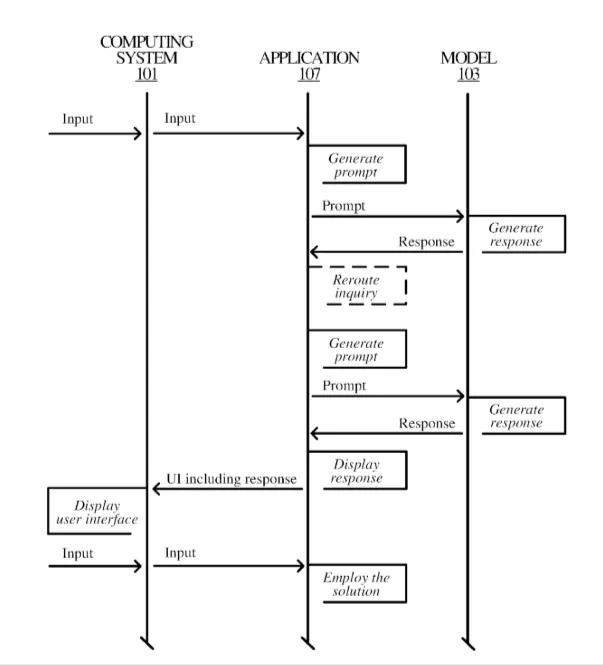
US20250085688A1 — "Industrial Automation Design Environment Prompt Engineering for Generative AI". Describes a system that accepts natural language requests, improves the prompt using contextual data (chat archives, vendor knowledge bases, documentation), and generates industrial control code or an HMI application based on it.
In all these applications, prompting is a component of the engineering system. The generation of prompts is tied to specific data (device configuration, telemetry, project model), and the result is "grounded" in equipment management.
Microsoft: prompt engineering for software development
Microsoft is patenting prompting as part of the development environment and tools. Examples include:
US20250123814A1, published in 2025, "Software Development Language Model Prompt Engineering". The patented system defines relationships between the development context (analysis results, project settings, tool history) and the potential context for the prompt. For each element, a numerical indicator is determined as to how useful certain development information is to include in the prompt.
US20240419917A1, 2024 publication, "Customized Prompt Generation Service for Software Engineering Tasks". A separate service automatically generates prompts for LLMs based on specific tasks — code review, vulnerability detection, test generation. Each task has its own prompt template, into which client data is "inserted".
US20250231763A1, 2025, "Graph-Based Code Representation for Prompt Generation". The described system builds a "map" of the program in the background — like a schematic with blocks, where each block describes a separate code fragment. Then, when a request for LLM is needed, it follows this map and automatically selects only the parts that are relevant to the current task, avoiding overloading the model with unnecessary details.
So, in almost all cases, the patent does not concern the prompt itself, but the automatic program for its generation. Sometimes, these are pre-prepared requests for the neural network, and the main task of the "invention" is to automatically insert new data into them.
Google: Automatic Prompt Generation and Optimization
Google approaches prompting even more abstractly — as an optimization task. Recent examples include:
US20240394545A1 — "Universal Self-Adaptive Prompting" (USP). The patent describes a universal mechanism for automatic prompt construction. It adapts itself to the task and turns a regular user request into an expanded one with examples — this helps the model work more accurately. So:
The system receives a text request that describes the task for the model (classification, extraction, generation, etc.);
The model first generates several candidate answers to this request;
Depending on the task type, the system selects from the candidate answers those that are suitable as "pseudo-demonstrations";
These selected examples are added to the prompt before the original request, and with this extended prompt, the model solves the task again.
US20240311652A1 — "Markup Language for Generative Model Prompting". Describes a special "markup language" for prompts — similar to HTML markup, but for AI queries. The system takes a regular user query, automatically understands what the person wants, and rewrites it into a more neat, structured prompt in this markup language.
The user works in a convenient interface similar to a development environment — there are hints, autocompletion, and ready-made prompt elements that help create "good" queries without deep technical knowledge.
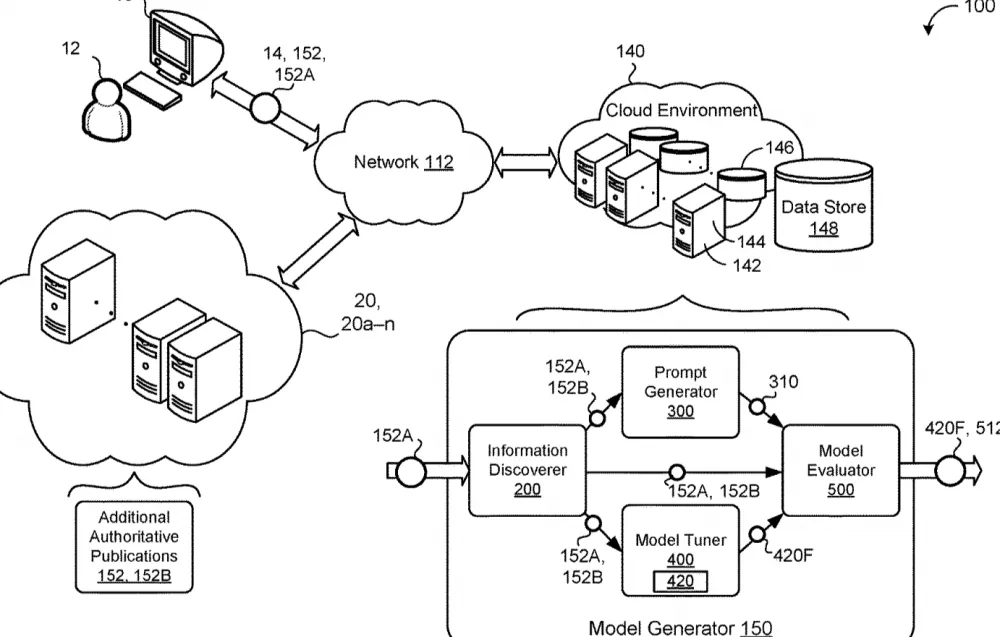
US20250077776A1 — "Golden Prompt Generation Based on Authoritative Publications". Automatic generation of "standard prompts" from authoritative publications on the topic, with additional fine-tuning of the model and checking for threshold errors.
If we generalize the structure of patentable solutions, a "passing" application usually includes:
Algorithmic generation of prompts from the system's context/data (instead of manual input);
At least one verification loop: answer validation, comparison with limitations, error handling, regeneration;
Binding to a technical task: formation, execution of code, agent management.
Often, companies apply well-known solutions to a new task — composing prompts — and with the addition of a tangible technical result, patents become suitable for registration. I will discuss another major branch in patenting in this field in the next article.
About the Online Patent Service:
Online Patent is the number 1 digital system in the ranking of Rospatent. Since 2013, we have been creating unique LegalTech solutions for the protection and management of intellectual property. Register at the Online Patent service and gain access to the following services:
Online registration of programs, invention patents, trademarks, industrial designs;
Application for inclusion in the register of domestic software;
Options for expedited service processing;
Free search in patent, program, and trademark databases;
Monitoring of new applications based on criteria;
Online support from specialists.




Write comment