
- AI
- A
You haven't missed it: why 95% of people are only pretending to know how to use AI
If you open LinkedIn or X right now, you'll most likely be overwhelmed by a ruthless wave of success stories in the AI field.
You will see 19-year-olds creating autonomous agents, marketing agencies claiming to have automated 90% of their operations, and endless threads on "Top 10 prompts to improve your life by 10 times." It seems like AI is moving at the speed of light. A week in AI feels like a decade in the real world.
These constant updates weave a suffocating web of FOMO (Fear Of Missing Out). They create a powerful, panic-inducing illusion: The whole world has mastered AI, and only I am still working like a caveman.
Take a deep breath. You've entered the echo chamber. Real data tells a completely different, and very profitable, story.
The Illusion of "I'm Leading, but Falling Behind"
Recently, a data visualization by researcher Damian Player went viral. He broke down the planet's population of 8.1 billion people based on their actual use of AI:
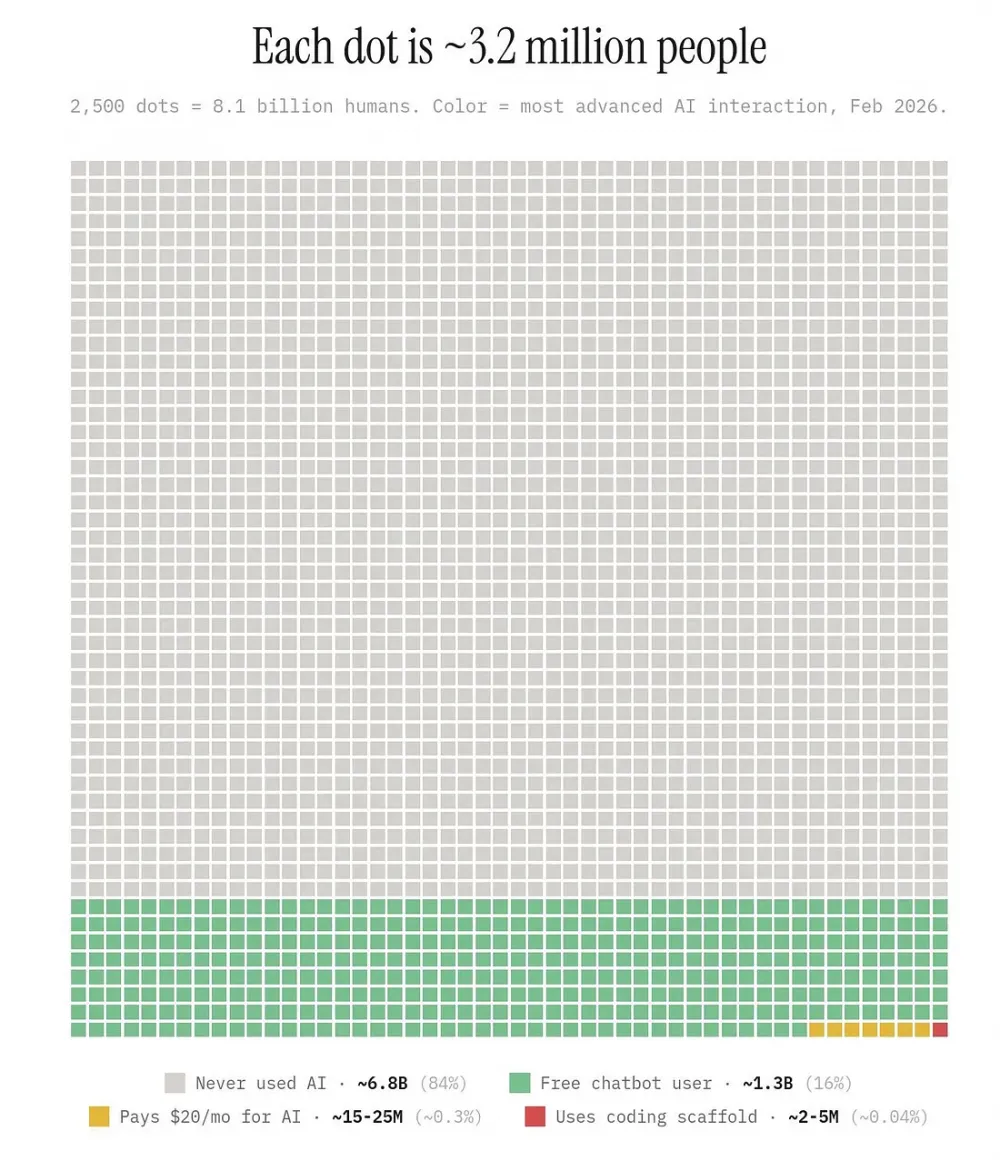
Green Zone (1.3 billion): People who have at least once casually used a free AI chatbot.
Yellow Zone (15-35 million): People who have actually paid for an AI subscription (e.g., ChatGPT Plus or Claude Pro).
Red Zone (2-5 million): People who are actively building, programming, and creating workflows with AI.
Gray Zone (6.8 billion): People who have never touched AI.
If you've ever paid $20 for an AI tool, you're already in the top 0.4% of the planet. If you're creating something with it, you're in the top 0.06%.
We feel like we're falling behind because of the Information Cocoon. You're subscribed to tech innovators, they're subscribed to you, and the algorithms serve you a concentrated dose of cutting-edge breakthroughs. But step outside the tech hubs of Silicon Valley, Toronto, or London. Talk to a local accountant, a middle manager in logistics, or a school teacher. Most of them view AI as a fun toy, not a paradigm shift that changes careers.
The story just repeats itself.
In 2000, after the dot-com crash, people thought the internet was a fad. In reality, it was just beginning. In 2012, people thought e-commerce was "too saturated" for new sellers. Today's giants were built during that era.
The adoption of world-changing technologies always happens much slower than the hype cycle suggests. You haven’t missed it. You’re incredibly early.
Corporate Reality Check: Google’s 2026 AI Report
To prove how early we are, take a look at the recently released February 2026 Google and Ipsos report: The Path to AI Fluency: AI Works for America. (Link to the report)
Surveying almost 6,000 professionals and hiring managers in the U.S., the report cuts through the noise and measures the real, practical implementation at workplaces. The results are staggering and far less optimistic than the tech bros would have you believe.
1. The 5% Reality
While 40% of employees claim they use AI at work, only 5% are classified as "AI Fluent." Around 35% are what the report calls "AI Explorers." These are people who use AI sporadically, from time to time — asking it to write a polite email, summarize a PDF, or quickly draft an idea. They play with the tool, but don't change their actual outcome.
However, the 5% of "AI Fluent" professionals have fundamentally reshaped their workflows. They use AI in over 8 different daily scenarios.
The reward? AI Fluent professionals save, on average, 8 hours a week. That’s an entire reclaimed workday. Moreover, they are 3-4 times more likely to get a promotion, a salary increase, and new career opportunities.
2. Management Desperation
Management is painfully aware of this talent gap. A massive 70% of hiring managers consider AI skills to be "critically important" for organizational success in the next five years, and they are actively seeking them during hiring. They are willing to pay a premium but can’t find the talent.
3. The Great Training Failure
Why is there such a huge gap between the 40% who use it and the 5% who have mastered it? A systemic corporate failure.
Only 14% of employees have received formal AI training from their company.
27% of companies provide tools but don’t offer guidance.
37% provide guidance but don’t offer premium tools.
Only 22% provide both.
Companies treat AI like a magic wand. They buy corporate licenses, hand them out, and expect instant transformation. This is equivalent to dropping a Ferrari in the company parking lot without offering driving lessons.
As a result, 46% of employees learn AI solely through “peer survival networks” — begging a savvy colleague or manager to show them how it really works.
Response to skeptics: "But I use AI every day!"
You might think: “I use ChatGPT every morning to write code or create reports. Doesn’t that make me proficient?”
Not necessarily. You need to understand the 90-9-1 rule of the internet:
90% - Consumers: They read, watch, and take what is given to them. (In AI terms: they use default prompts and accept the first general result).
9% - Engagers: They comment and share. (In AI terms: they make slight adjustments to the result, possibly iterating once or twice).
1% - Creators: They build systems.
If you are using AI only to do your old job a little faster, you are still acting like a consumer. Becoming a creator — the 5% who are truly proficient with AI — requires a fundamental shift in thinking. It’s no longer about asking, “How can this tool accomplish my task?” It’s about asking, “How can this tool completely eliminate, scale, or reinvent my entire operational model?”
And to become a creator, you need the right arsenal. Limiting yourself to just ChatGPT means willingly narrowing your possibilities.
The entry barrier is not technical skills. It is cognitive friction. And that friction is enough to filter out 95% of your competitors.
4-Step Plan to Become Proficient in AI
Organizations are failing to train their people, which means the trajectory of your career is entirely in your hands. If you want to stop feeling anxious and start seizing the enormous financial potential of this era, here's what you need to do starting today.
Step 1: Conduct a rigorous audit of your workflow. For the next three days, write down every task that takes you more than 15 minutes. Categorize them as follows: Data Processing, Content Creation, Decision Making, and Communication. Identify the three main bottlenecks that drain your energy.
Step 2: Create a "micro-system," not a prompt. Stop looking for "magic prompts." Instead, build a repeatable system for one of your bottlenecks. If you write weekly reports, don't just ask the AI to write them. Create a template where you feed raw data, previous reports to preserve voice/tone, and specific constraints. Turn a 3-hour manual task into a 10-minute automated pipeline.
Step 3: Become a hub for your colleagues. Remember the Google data: 46% of people learn from colleagues. Be that colleague. Once you create your micro-system, share it with your team. Give a 15-minute screen demonstration on Friday. The moment you become the "AI translator" for your department, your job security and influence will skyrocket.
Step 4: Shift your focus from competitors to consumers. Stop looking at AI influencers on Twitter who make you feel inadequate. Look at your customers, your boss, and your target market. They crave clarity, speed, and quality. Use AI to serve them better, not to outdo other creators.
Conclusion
The anxiety of expectation is the emotion with the lowest return on investment (ROI) you can experience.
When you feel like you've missed your chance, look at the data. We are standing at the starting line of a decades-long marathon. The masses are distracted by the novelty of technology; the elite are quietly building an unshakable advantage.
Stop consuming. Start building.




Write comment