- AI
- A
Quantum Computing: Between Analogue and Digital towards AGI and Consciousness
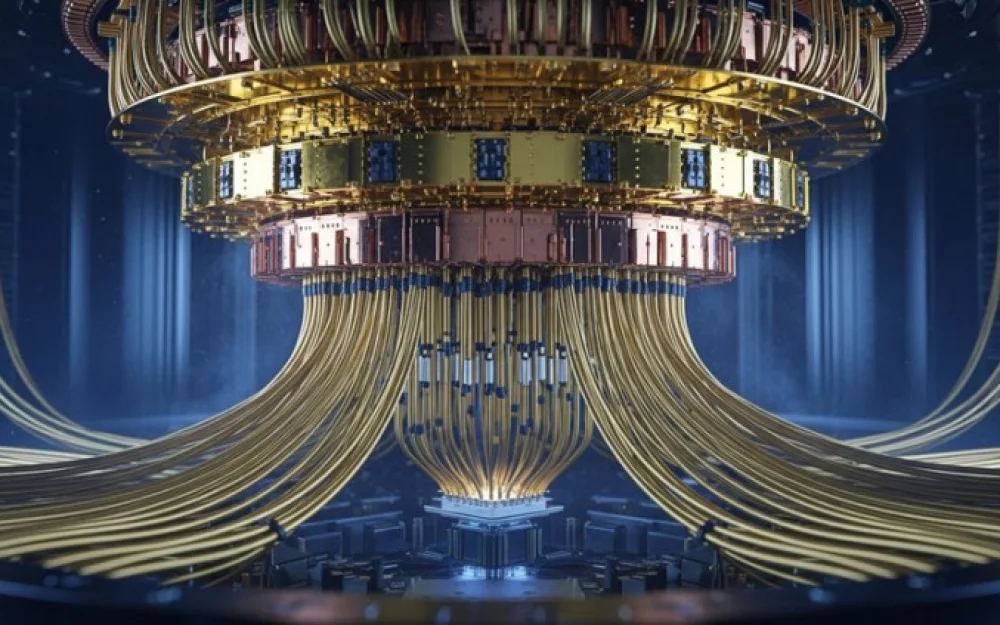
This article is an attempt to explore the concepts of quantum computing, a brief overview of existing quantum computers, and reflections on whether it is possible to create consciousness based on quantum principles.
Quantum: a portion that cannot be divided.
Before talking about quantum computers, it is necessary to understand what a quantum is. Classical physics (Newton, Maxwell) considered most processes continuous. Energy, fields, space – all of this was thought to be infinitely divisible. At the beginning of the 20th century, Max Planck, and later Albert Einstein, discovered based on experiments that this is not the case. Energy in a bound system is emitted and absorbed not continuously, but in discrete portions – quanta. The formula linking the energy of a quantum E with the frequency of radiation ν:
E = h × ν where h is Planck's constant, a fundamental constant.
This is the energy of a single photon – a quantum of electromagnetic radiation. Experiments (photoelectric effect, atomic spectra) show that when light interacts with matter, energy is transferred precisely in these indivisible portions: an atom can absorb one photon (energy hν) or two photons (energy 2hν), but it cannot absorb, say, half a photon. At the same time, the energy of the photon must exactly match the difference between two energy levels of the atom — otherwise absorption will not occur. This is a property of the atom as a bound system.
In quantum field theory, it is considered that everything in the world consists of quanta. Quanta are elementary excitations of physical fields: the quantum of the electromagnetic field is the photon; the quanta responsible for the strong interaction (binding the nucleus) are gluons; the quantum of the gravitational field (hypothetical) is the graviton; the matter particles themselves (electrons, quarks) are also quanta of the corresponding fields.
It is important to understand: a quantum is not a little ball that makes up other balls. In quantum physics, fields, not particle bricks, are fundamental. A quantum is the minimal excitation of its field. You cannot “cut” an electron in half, because that would mean “exciting the field by half a quantum.” That is, field excitations occur only in whole numbers: 1, 2, 3… The concept of the “size” of a quantum in the usual sense does not apply to it.
Qubit: from bit to superposition.
A classical bit can be in one of two states: 0 or 1. It's like a coin lying on a table, showing either heads or tails. There is no third option. A qubit (quantum bit) is the quantum analog of a bit. Its state is a superposition, meaning it simultaneously has both 0 and 1 with different probabilities. In other words, a qubit is like a coin tossed into the air. While it is spinning, it is neither heads nor tails — it is in a superposition of two states. As soon as it lands on the table (measurement occurs), it ends up either as 0 or 1. The outcome is random, and the probability of each result depends on how the coin was tossed.
While in the air, the coin can spin in infinitely many ways — this is analogous to continuity. But the measurement result is always discrete: either heads or tails.
Mathematically, the state of a qubit is written using two complex numbers a and b:
ψ = a · 0 + b · 1
Here, |a|² + |b|² = 1. The probability of measuring 0 is |a|², and the probability of measuring 1 is |b|². The squares of the moduli |a|² and |b|² give real numbers from 0 to 1, which are interpreted as the probabilities of obtaining 0 or 1 upon measurement. If we used simply a², the result could be negative or complex — which a probability cannot be. That is why quantum mechanics uses the squared modulus.
Continuity of superposition.
Here lies a fundamental difference from the classical bit.
A classical bit takes only two values: 0 or 1.
An analog quantity (for example, voltage) can take any value in a continuous range: 0.1; 0.5; 0.73; 0.99…
A qubit in superposition is something in between. You cannot measure it as an analog quantity, because the measurement only gives 0 or 1. But before measurement, its state can be any point in a continuous set, described by the relationship between a and b. It is similar to a coin in the air that could spin at different speeds and angles — each such spin corresponds to its own probability of landing heads or tails. The continuity here is not the value of the result itself, but the set of probabilities from which the outcome is then randomly chosen.
How to visually represent a qubit.
The state of a qubit is conveniently represented on the Bloch sphere. This is a sphere whose surface represents all possible states of the qubit.
The north pole of the sphere is the |0⟩ state (guaranteed 0). The notation |0⟩ (read as “ket zero”) is the standard representation in quantum physics for the basis state corresponding to classical 0.
The south pole is the |1⟩ state (guaranteed 1).
Any other point on the surface of the sphere is a superposition with different probabilities and different phases.
Two coordinates of a point on the sphere (latitude and longitude) fully determine the coefficients a and b (up to a global phase). In spherical coordinates, they are denoted as the angle θ (theta) — it corresponds to latitude and determines the ratio of probabilities to obtain 0 or 1 (at the equator, probabilities are 50%–50%) — and the angle φ (phi) — it sets the longitude, i.e., the phase. The phase does not affect probabilities but is critically important for interference in quantum computations. The interior of the sphere is not used. Qubit states are only points on the surface. This means that the qubit state space is two-dimensional (like the surface of a sphere), but it is continuous: you can smoothly move a point from the pole to the equator, changing the probability ratio.
For a single qubit, the Bloch sphere provides a complete description. But the power of quantum computation emerges when there are multiple qubits. Two qubits can be in a state that cannot be represented as a combination of individual states — this is called entanglement.
For example, the Bell state: |ψ⟩ = (|00⟩ + |11⟩) / √2
In it, the qubits are correlated: measuring the first instantly tells us the state of the second, even if they are spatially separated. Entanglement is the resource that provides exponential growth of computational power with the number of qubits.
For more on the Bloch sphere, you can read for example here: https://habr.com/ru/articles/569996/
How quantum computing works: from physics to parallelism.
Physical implementation: ions, lasers, and a refrigerator.
One of the most common types of qubits is ions in a vacuum trap. Each ion (for example, ytterbium) is held by an electromagnetic field in a chamber with a pressure of 10⁻¹⁰–10⁻¹¹ mbar to prevent collisions with residual gas atoms.
Its states |0⟩ and |1⟩ are two internal energy levels.
Control. To put the ion into a superposition, a laser pulse is directed at it. The duration and power of the pulse determine which exact superposition the qubit will transition to.
Measurement. To measure, a laser of a different frequency is directed at the ion. If the qubit was in the state |0⟩, it starts to glow (fluoresce). If it was in |1⟩, it remains dark. The detector records the presence or absence of light.
Key parameters.
The qubit can maintain a superposition without distortion for only a limited time—coherence time (for ion qubits, this is in seconds and minutes). The operation accuracy (fidelity) must be at least 99.9% so that errors don't accumulate. To achieve this, qubits are cooled to temperatures close to absolute zero: from 10 millikelvins (−273.14 °C) to 4 kelvins (−269.15 °C).
How this leads to computations: quantum parallelism.
Classical parallelism is when many processors work independently.
Quantum parallelism is different: a register of n qubits can exist in a superposition of 2ⁿ states. One operation is applied to all these states simultaneously. For n = 30, this results in a billion options per clock cycle.
But for real computations, we need not just qubits, but logical qubits, protected from errors. Creating one logical qubit may require tens or even hundreds of physical qubits. Therefore, today's systems with 70–250 qubits are at the stage of demonstrating "quantum advantage"—finding the first practically significant problems where they can surpass classical supercomputers.
Important limitation: the result we can read is only one, randomly chosen. Therefore, quantum computers are effective for tasks where something needs to be found among a vast number of options (search, optimization, factorization), but not for tasks that require calculating all options individually. Quantum computers today: accuracy and the number of qubits. Modern quantum computers are built on several physical platforms. The key characteristic that determines whether useful computations are possible on them is the operation accuracy (fidelity).
What do these numbers mean:
The accuracy of single-qubit operations on leading platforms (superconductors, ion traps) has already reached 99.9–99.99%. Two-qubit operations are the main bottleneck. The best results are achieved by ion traps (IonQ - 99.99%, Quantinuum - 99.7%) and superconducting systems (Google - 99.86%, Rigetti - 99.5%).
Qusets are seven-level quantum systems, each of which can store information equivalent to approximately three qubits (2³ = 8 states). In the Russian 72-qubit processor, 26 calcium ions work as qusets, which in total gives the equivalent of 72 qubits (26 × 3 = 78, but due to incomplete use of levels or other technical features, the equivalent is 72).
D-Wave Advantage2 is a quantum annealer specialized for optimization tasks. It operates differently from universal quantum computers, so the accuracy of its operations is measured by other criteria. The Advantage2 implements more than 4400 qubits, 20-fold connectivity between qubits, and its coherence time has been doubled compared to the previous generation. The need for high accuracy: For a quantum computer to become fault-tolerant and capable of executing long algorithms with error correction, two-qubit operations must have an accuracy of at least 99.9%. This has only been achieved by a few systems (IonQ, Quantinuum, Google, Rigetti). Most systems, including Russian ones, are still in the process of improving accuracy.
Sources
[1] Google Quantum AI. Willow Spec Sheet. 🔗 https://quantumai.google/static/site-assets/downloads/willow-spec-sheet.pdf
[2] Tianyan Quantum Group. Zuchongzhi 3.0. arXiv:2512.10504, 2025. 🔗 https://arxiv.org/html/2512.10504v1
[3] Rigetti. Rigetti Computing Launches Next-Generation 36‑Qubit Quantum Processor. 2025. 🔗 https://www.rigetti.com/news/rigetti-computing-launches-next-generation-36-qubit-quantum-processor
[4] IBM Research. Shallow entangled circuits for quantum time series prediction. Nature Scientific Reports, 2025. 🔗 https://research.ibm.com/publications/shallow-entangled-circuits-for-quantum-time-series-prediction-on-ibm-devices
[5] Quantinuum. Setting the Benchmark: Independent Study Ranks Quantinuum #1 in Performance. 2025. 🔗 https://www.quantinuum.com/blog/setting-the-benchmark-independent-study-ranks-quantinuum-1-in-performance
[6] IonQ. Accelerating Towards Fault Tolerance: Unlocking 99.99% Two-Qubit Gate Fidelities. 2025. 🔗 https://www.ionq.com/blog/accelerating-towards-fault-tolerance-unlocking-99-99-two-qubit-gate
[7] Russian Quantum Center. The first quantum computer based on kusepts has been created in Russia. December 29, 2025. 🔗 https://rqc.ru/article/the_first_kusept-based_quantum_computer_in_russia
[8] MSU. Press Release: 72-Qubit Quantum Computer on Neutral Atoms. 2026.
[9] QuEra. Aquila - 256-Qubit Quantum Computer. 🔗 https://www.quera.com/aquila
[10] NIU MISIS. Scientists at NIU MISIS Created a 16-Qubit Quantum Computer. 2026. 🔗 https://misis.ru/university/news/science/2026-02/10325/
[11] D-Wave. Advantage2 - Quantum Computing System. 2025. 🔗 https://www.dwavesys.com/solutions-and-products/systems/
Quantum Computing: Analog or Digital?
At first glance, a qubit is an analog quantity. Its state is described by continuous complex numbers and can be anywhere on the Bloch sphere. In this sense, a quantum computer is closer to an analog one than a digital one.
But there are three fundamental differences that make it a hybrid.
Input - discrete. The task that the quantum computer solves is encoded in the state of the qubits through digital control signals. We set the initial state of the qubits, choose a sequence of operations – all of this happens in a discrete, digital world.
Computation - continuous. During the computation, the qubits are in superposition, and their state can be anything. A quantum operation is a rotation of this state, which can be performed with any degree of accuracy. There are no discrete “steps” between values.
Output - again discrete. To read the result, we measure the state of the qubits. Measurement is not just reading, but a collapse of the wave function into one of the basis states (0 or 1). The result of the measurement is a classical bit.
The Price of Quantum Acceleration.
Digital data is encoded into the probability amplitudes of qubits. During computations, we work with continuous amplitudes and phases, which is what provides quantum parallelism. However, when measuring, we lose information about the phases — only a single random bit result remains. This is not a "bug," but a fundamental property of quantum mechanics, which limits the class of problems where a quantum computer provides an advantage. If we could read phase information directly without destroying the superposition, it would mean that we could obtain the full quantum state of the system, not just a random bit. For a system of n qubits, this is 2ⁿ amplitudes and 2ⁿ phases — that is, an exponential amount of information in a single run. Many quantum algorithms would give the exact answer without repetitions, and problems like molecular simulation could be solved in a single step. But this is impossible not because of imperfect instruments, but because of the law of quantum mechanics, which is our best model of the micro-world to date: measurement changes the state. Phase information exists only in superposition; as soon as we try to extract it, the superposition collapses. Therefore, a quantum computer will always output bits, not continuous values.
An analog system outputs a continuous value, which can be measured with any desired precision. A qubit always gives a discrete result when measured: 0 or 1. The continuity of its state is accessible only "internally," during computation, but the output we get is a classical bit.
It is this property—continuity inside, discreteness outside—that makes the qubit such an unusual object. It combines the flexibility of an analog system with the stability of a digital one: computations can use the full richness of continuous states, but the result can always be read as a bit. In this sense, the qubit is a hybrid that is neither purely digital nor purely analog. It represents a third way, opening new possibilities for computation. As Richard Feynman, one of the developers of quantum computing theory, said: “Nature isn’t classical, dammit, and if you want to make a simulation of nature, you’d better make it quantum mechanical, …” (Feynman R. Simulating Physics with Computers. International Journal of Theoretical Physics, 1982, Vol. 21, pp. 467–488).
A quantum computer is not a replacement for digital or a return to analog. It is a third path, where the discreteness of input and output is combined with the continuity of computation. It is precisely the combination of discrete control and continuous dynamics that gives quantum algorithms their power—while simultaneously imposing fundamental limitations: the result cannot be read without losing information about phases, and the computations themselves require isolation from the outside world, otherwise the quantum state is destroyed.
Quantum computing and consciousness.
To avoid confusion, let’s immediately define two concepts.
Intelligence is a functional ability: solving problems, recognizing patterns, planning, adapting to new conditions, using language. Computers do this excellently.
Consciousness is the presence of subjective experience—what it is like to be a system, the sense of presence, of being, the unity of perception (“I” as the center of experience). The question of whether a digital AGI can have consciousness has already been discussed in a previous article [https://habr.com/ru/articles/1010604/]. Here we are interested in another question: can a quantum computer possess consciousness?
A quantum computer operates on superposition, entanglement, and interference. During computation, qubits exist in continuous states—this is closer to an analog nature than a digital one. But at the input and output, there are discrete bits. Can such a system possess subjective experience? If consciousness requires the continuity of a physical process, then a quantum computer is closer to this than a digital one.
Is a little continuity enough?
The continuity of computation in a quantum computer exists only “inside,” until we measure. The input and output are discrete. Consciousness, if it is continuous, probably requires continuity “through and through”: from input to output, without breaks. A quantum computer gives us islands of continuity surrounded by discreteness. Is that enough for consciousness? We do not know. Perhaps consciousness requires continuity both at the level of perception and at the level of action. Or maybe it is enough to have continuity of the internal process, even if the boundaries are discrete. There is no answer yet.
Can a quantum computer be a carrier of AGI?
AGI (artificial general intelligence) is a system capable of solving a wide range of tasks at the human level or above. It is about intelligence, not consciousness. A quantum computer can be a platform for AGI if scaling and error-correction problems are solved. But would such an AGI be conscious?
What we know about the connection between quantum processes and consciousness.
The question of whether a quantum computer (or any quantum system) can possess consciousness has two opposing groups of arguments: those that indicate a possible connection, and those that cast doubt on it.
Arguments “for”: quantum theories of consciousness.
Roger Penrose consistently defends the position that consciousness is non-computable. This means that no digital computational system (von Neumann type, operating according to classical information rules) can generate consciousness, no matter how complex it is. However, this does not imply that consciousness cannot be linked to physical processes—it's just that these processes must go beyond what can be described as digital computation. Together with Stuart Hameroff, he develops the "Orch-OR" (Orchestrated Objective Reduction) hypothesis, according to which quantum processes in neuronal microtubules may be the physical mechanism that realizes the non-computable aspects of consciousness. It is through quantum mechanics that Penrose and Hameroff believe the nature of consciousness can be explained.
As early as 1981, Richard Feynman laid the philosophical groundwork for quantum computing, pointing out that classical computers cannot efficiently simulate the quantum nature of reality. Although Feynman did not speak about consciousness directly, his thesis that quantum processes cannot be reduced to classical computations leaves room for hypotheses that consciousness (if it requires non-computable processes) might be linked to the quantum nature of reality.
Arguments "against": consciousness requires stable, copyable states.
David Chalmers, who introduced the concept of the "hard problem of consciousness," formulates it as follows: "The easy problems are, ultimately, a matter of explaining behavior, what we do. The brain handles these tasks remarkably well. But the hard problem of consciousness is subjective experience. Why, when all this is happening in this scheme, does something feel like anything? How do 86 billion neurons interacting inside the brain, combining together, produce the subjective experience of mind and world?" In an interview with The Irish Times, he adds: "There are systematic reasons to believe that any purely physical explanation of consciousness will fail. Neuroscience will give us excellent explanations for the easy problems and behavior, but to get to consciousness, some additional ingredient will always be needed." Chalmers does not claim that quantum effects are unnecessary, but emphasizes that consciousness cannot be reduced to physical processes of any kind—whether classical or quantum.
Thomas Nagel, in his famous article "What Is It Like to Be a Bat?" (1974), points out the fundamental irreducibility of subjective experience: "Even if we can imagine all of this, it only tells us what it is like for me to be a bat, or for me to behave like a bat. It doesn't tell us what it is like for a bat to be a bat." Nagel argues that there is a subjective character to conscious experience that is not captured by physical descriptions of the brain or observable behavior. This challenges any physical theory of consciousness, including quantum theories.
The study by Emily Adlam, Kelvin McQueen, and Mordechai Wegel from the Institute for Quantum Studies at Chapman University (2025) goes further and shows that a purely quantum system cannot be an agent – meaning it cannot build a model of the world, compare alternatives, and choose the best action without stable, replicable states. Agency in their work refers to the system's ability to satisfy three minimal conditions:
Building a model of the world: the ability to form an internal representation of the external environment.
Evaluating alternatives: the ability to use this model to analyze the consequences of various actions.
Choosing the best action: the ability to reliably choose and perform the action with the maximum expected utility.
The authors argue that a purely quantum system cannot possess agency because it lacks what they call "classical resources" – stable, replicable states that emerge during the process of decoherence (the transition of a quantum system to classical):
Replicability: the ability to create copies of information (world models) to analyze alternatives. This is directly prohibited in quantum mechanics by the no-cloning theorem.
Preferred basis: the presence of stable states that are not destroyed by interaction with the environment. In the real world, such structures emerge during decoherence.
Comparison and selection ability: linear quantum dynamics cannot single out one option and execute it without a classical structure that provides a preferred basis.
The key conclusion: agency arises not in a purely quantum system, but at the boundary between the quantum and classical worlds - where quantum states decohere into stable, replicable classical structures that allow the system to act purposefully. What does this mean for a quantum computer? If the Penrose-Hammeroff hypothesis is correct, a quantum computer could, in principle, model such processes, but to do so, it would need to operate with the same physical effects (quantum coherence in an environment similar to a cell), which is currently unattainable.
However, the work of Adlam and co-authors raises a deeper question: even if such effects could be reproduced, could a purely quantum system acquire agency without stable, replicable states? The researchers' answer is no. Agency requires such states. This does not mean that a quantum computer cannot be part of a conscious system. But if consciousness requires agency, then it cannot be a purely quantum phenomenon. It is not denied that it could arise at the intersection of the quantum and classical - where quantum information "crystallizes" into stable classical forms.
Conclusion
We currently do not have a theory that links consciousness with quantum computational architecture. But we can assert: AGI (intelligence) on a quantum computer is possible in principle - it is a question of engineering. Whether such AGI would be conscious is unknown. This depends on what consciousness is, and whether it requires continuity, analogism, or something else that a quantum computer lacks. A quantum computer is closer to analog continuity than digital, but its continuity is "chunky." Is this enough for consciousness? If consciousness requires not just continuity, but also a specific substrate (for example, ion dynamics), then quantum systems based on ions may be closer to the goal than superconducting or photonic systems.
The study by Adlam and colleagues (2025) does not contradict the existence of quantum effects in biology—such as quantum coherence in photosynthesis or the proposed quantum mechanism of navigation in birds. It argues that for agency (the ability to build a model of the world, evaluate alternatives, and make choices), quantum coherence alone is insufficient—stable, copyable states (classical resources) are also required. Photosynthesis and bird navigation precisely show that quantum effects can exist within the natural environment without generating agency. If consciousness requires agency, then quantum coherence alone is insufficient—it also requires stable, copyable states. At the same time, consciousness itself may have nothing to do with quantum effects. The question of whether quantum processes are necessary for consciousness remains open.
List of mentioned sources:
Penrose R. The Emperor’s New Mind. Oxford University Press, 1989.
Penrose R. Why new physics is needed to understand the mind. 2016.
Hameroff S., Penrose R. Consciousness in the Universe. Physics of Life Reviews, 2014.
Feynman R. Simulating Physics with Computers. International Journal of Theoretical Physics, 1982, Vol. 21, pp. 467–488.
Chalmers D. The Conscious Mind. 1996.
Chalmers D. Interview in The Irish Times, 2018.
Nagel T. What Is It Like to Be a Bat?. The Philosophical Review, 1974.
Adlam E., McQueen K., Wegel M. Agency requires classical resources. Chapman University, arXiv:2510.12345, 2025.
Write comment