- AI
- A
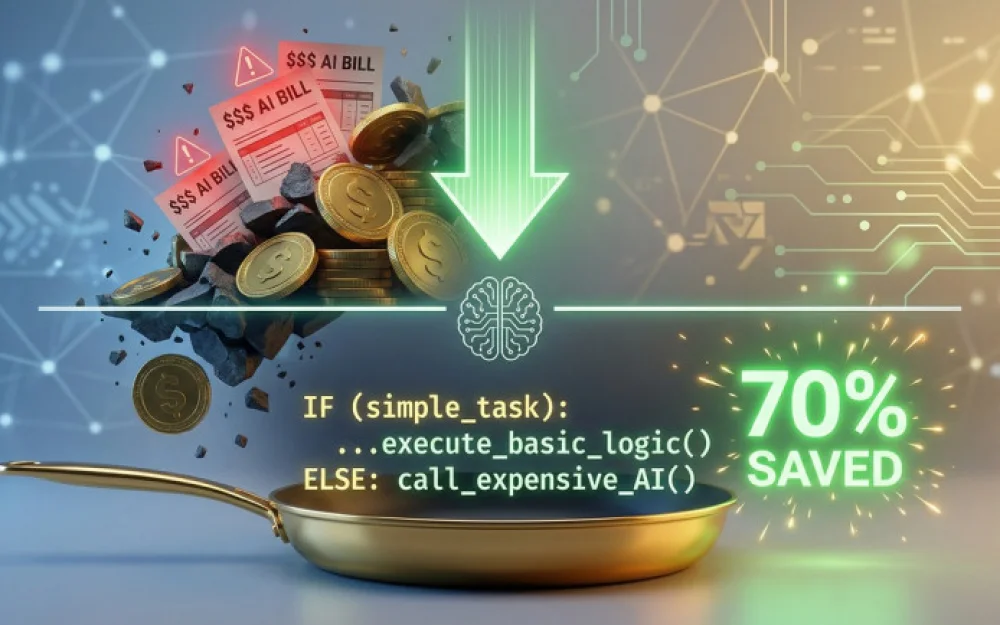
How I Reduced AI Costs by 70% with Three Lines of Logic
My AI agent costs me $20 a month. Just three months ago, the same load cost over $200. Not because I optimized prompts or wrote a clever caching system. But because I stopped believing that expensive models are a necessity.
Here’s the full story: from the Claude Max subscription to API calls and to the model that does everything for a fixed monthly fee. Plus routing strategies for those tied to token payments and wanting to cut the bill in half or more.
Phase One: free ride ($0, and then everything)
When I started building Arya, my AI agent for social media, I ran everything through Claude Code on the Claude Max subscription. I was already paying $100/month for this plan because I use Claude every day for development. Running Arya on top of that cost me nothing. The agent was essentially free, running on a subscription I would be paying for anyway. Only occasionally did it hit limits, which was annoying but not fatal.
Then Anthropic updated the Terms of Service. The subscription could no longer be used for AI agents and automated systems. Makes sense. Their pricing model assumes a human at the screen, not a bot making hundreds of calls per day. Arya was exactly the use case they wanted to exclude.
The subscription remained; I still use Claude Code every day. But Arya could no longer run on it. Now I had to pay separately for API calls on top of the existing subscription. The agent went from being free to an extra expense I hadn’t budgeted for.
Phase Two: API and bill shock ($200+/month)
The obvious move was to switch to API plans for actually consumed tokens. Claude Sonnet at $3 per million input tokens. Opus at $5. Not cheap, but tolerable for a solo project. At least, that’s what I thought.
The problem with pay-as-you-go is that the cost is unpredictable. The agent doesn’t just write tweets. She reads feeds, researches topics, drafts content, edits it, fact-checks, formats content. One morning session can burn 250,000 tokens just on research before a single word is written. And overall, OpenClaw devours tokens ravenously.
The first full month on the API cost over $200. On some days, the agent encountered edge cases, triggered a chain of reasoning, and consumed 10 times the usual token budget. A retry after an unsuccessful API call doubled the consumption. The scaling of costs was nonlinear and unpredictable.
For a solo developer with a side project, $200/month for AI is not cheap. I needed to find more affordable models that could handle the load without sacrificing quality.
Phase Three: Hunting for a Model
I started testing alternatives. The criteria were simple: ability to write long texts, follow complex instructions, maintain a consistent voice, and cost significantly less than Claude API.
Kimi K2.5 via OpenRouter became the first serious candidate. A model from Moonshotai costing about $0.45 per million tokens. A huge price drop compared to $3 for Claude. The quality turned out to be surprisingly good for content tasks. Kimi handled tweet drafts, research summaries, and article plans. Not on Claude’s level in reasoning, but 80% of the quality for 15% of the price.
My agent worked with Kimi K2.5 for several weeks. Monthly expenses dropped to $40-60. A huge improvement, but still variable. Some weeks $10, others $20.
And then I found MiniMax. MiniMax M2.5 offered something the others didn’t: a subscription model. About $20/month for a generous usage limit. No pay-per-use. No variable costs. A fixed monthly fee that covered the entire load.
The quality was impressive. MiniMax M2.5 handled everything I gave it: tweet drafts, long articles, content research, feed analysis, following instructions. For my needs, the output quality matched what I got from much more expensive models.
Current Setup: $20/month for everything
Today, Arya operates on MiniMax M2.5 as the primary model with Kimi K2.5 as a fallback. In practice, the fallback almost never kicks in. MiniMax handles 95%+ of all requests.
MiniMax recently released version 2.7, which further improved reasoning and following instructions. The subscription price remained the same. My agent became smarter without additional costs. This is the advantage of the subscription model: improvements are free.
Full breakdown of monthly expenses:
Component | Cost |
|---|---|
MiniMax M2.5 Subscription | ~$20 |
Kimi K2.5 fallback (OpenRouter) | ~$1-2 |
TwitterAPI.io (feed collection) | $5 |
Contabo VPS (server) | $6.36 |
Total | ~$33 |
This is the full cost of a production AI agent that monitors social media, writes content, manages the blog’s promo schedule, and reports to me daily on Telegram. Compare it to the $200-400+ I would spend on Claude API.
When subscription is not an option: model routing
Not everyone can switch to a subscription model. If your load exceeds subscription limits, if specific model capabilities are needed, or if you have enterprise infrastructure, you’re tied to pay-per-use. This is where model routing comes into play.
The concept is simple: don’t send every prompt to the most expensive model. Direct simple tasks to cheaper models and complex ones to the more expensive ones.
Cascading routing sends the prompt first to the cheapest model. If the result doesn’t meet the quality threshold, escalation to the next model. Stanford's FrugalGPT demonstrated up to 98% cost reduction while maintaining GPT-4 accuracy. The trade-off is latency: complex tasks require multiple API calls.
Classification-based routing uses a lightweight classifier to predict which model is needed for each task. RouteLLM by LMSYS achieved 85% cost reduction on MT Bench while retaining 95% GPT-4 performance. On other benchmarks, savings were lower (35-45% on MMLU and GSM8K), but still significant.
Rule-based routing. The simplest approach, works well for solo developers. Three rules cover most cases:
If the prompt is shorter than 500 tokens and concerns simple formatting or data extraction, direct it to the cheapest model
If the prompt involves code generation or complex analysis, direct it to the flagship model
Everything else goes to a mid-tier model
But right now, I just send everything to MiniMax.
AWS Bedrock offers Intelligent Prompt Routing as a managed service, automatically selecting the cheapest model that meets your quality threshold. Their testing showed an average saving of 30%, up to 63% on RAG loads. If you're already on AWS, this is a low-effort option.
Main lesson: don't settle for the familiar
The pricing landscape for models in 2026 is vast. Premium models like o1 and Claude Opus charge $15-25 per million tokens. Efficient models like GPT-4o-mini and Gemini Flash cost $0.15-0.60. Subscription models like MiniMax offer a fixed price, which bypasses the token game altogether.
Most developers choose one model and often get stuck with it. They send every prompt to GPT-4o or Claude Opus because it’s reliable. It's like driving a sports car everywhere, even though a Honda will get you where you need to go.
My journey from $200/month to $20/month wasn’t about clever engineering. It’s about questioning the assumption that I need expensive models. I don’t. MiniMax M2.5 handles my production load at a fraction of the cost. The quality difference for my use case is negligible.
Before building a routing system, ask a simpler question: do you really need an expensive model? Test a cheap alternative under real load. Perhaps 90% of your tasks don’t require frontier capabilities. The remaining 10% can be handled by an expensive model on demand.
The goal isn’t to optimize AI costs. The goal is to stop overpaying for capabilities you don’t use.


Write comment