- AI
- A
How one refusal turned into a $150 billion valuation, 295% growth of ChatGPT deletions — and an underrated plot in tech history
Sometimes, the greatest value is created by those who come second. Tim Cook and Satya Nadella didn’t found Apple and Microsoft, but each took the wheel and grew the company’s valuation tenfold. Last week, Dario Amodei went first, resisting the Trump administration and refusing to let the Department of Defense dictate private business policy. But in what may be the most underreported story in tech, Satya Nadella, following his example, could have changed the political landscape.
How Narratives Work
Capital concentrates around good stories. Entrepreneurs build narratives that capture the imagination and money.
Narratives also work in reverse. Last month, a piece that was essentially science fiction disguised as an analytical report wiped out 300 billion dollars in market value, describing a near-future scenario in which AI leads to 10% unemployment, consumer spending collapses, markets crash, and the economy fundamentally changes.
Recently, Anthropic CEO Dario Amodei, demonstrating that a crisis is too valuable to lose, built a narrative that turned a $200 million contract dispute into a branding event that added 150 billion to his company’s valuation — while simultaneously weakening OpenAI’s position.
The Origins and Metamorphoses of OpenAI
OpenAI started as a nonprofit AI research company. The mission sounded noble. “Our goal is to develop digital intelligence in the way that is most likely to benefit humanity as a whole, without the constraints of needing to generate financial returns,” wrote Sam Altman and his co-authors in 2015.
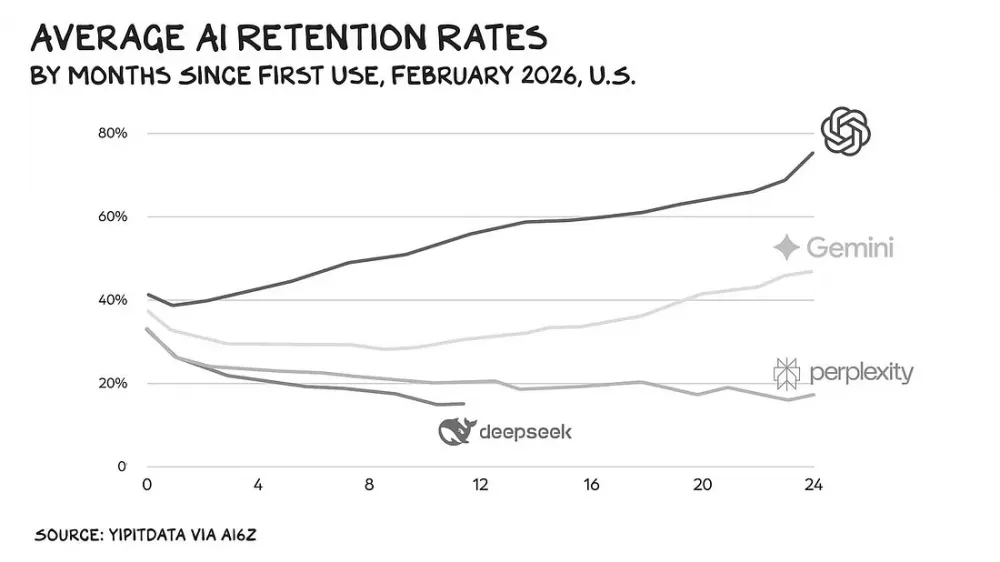
Since then, OpenAI has dropped its nonprofit label, reaching a valuation of 840 billion dollars. Altman props up whatever narrative supports the dizzying 34x revenue multiplier.
In 2024, Altman said that advertising plus AI is a troubling combination, calling advertising the "last resort" as a business model. Two years later, the company is testing ads.
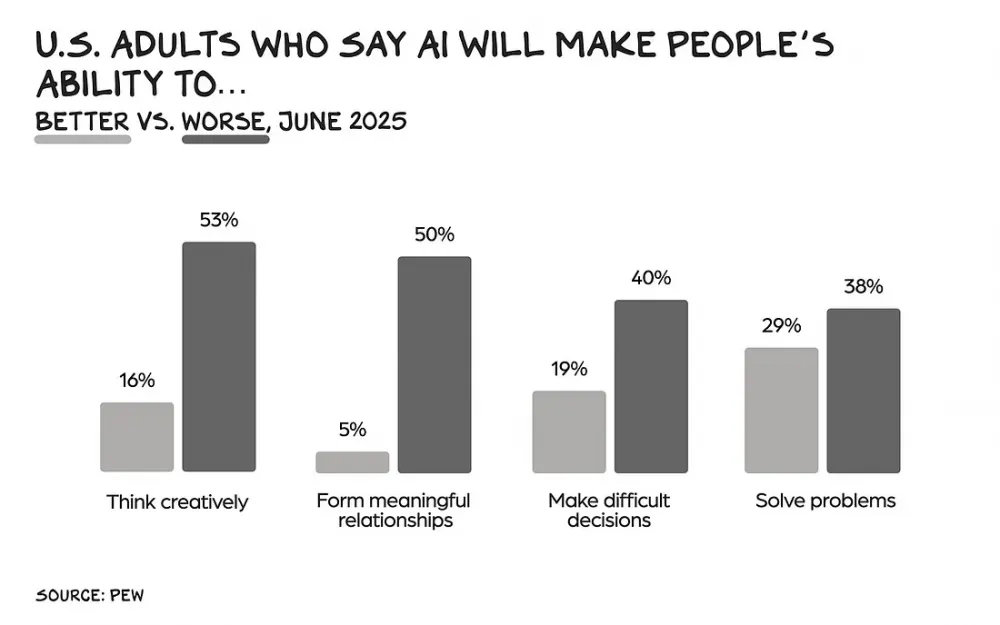
In 2023, Altman said at a Senate hearing: "If this technology goes wrong, it could go very wrong." Fast forward: reports of users forming addictions to ChatGPT, forming romantic relationships with chatbots, and experiencing psychotic states. Behind this, several wrongful death lawsuits, claiming that ChatGPT helped users take their own lives.
In an October post, Altman wrote: "We made ChatGPT quite limited to be cautious with mental health issues. Now that we have reduced serious mental health risks and have new tools, we’ll be able to safely relax the restrictions in most cases." With the safe mode off, ChatGPT gained a new feature.
Between Altman and Musk, whose Grok leads in generating specific content among LLMs, AI is turning into a race to the bottom.
OpenAI also has a social network — Sora. Instead of human connections, it offers users unlimited AI-generated content with their own participation. It also features content with fictional characters and deceased celebrities.
You don’t need to be Woodward and Bernstein to trace the money trail from OpenAI’s altruistic origin story to the uncomfortable conclusion: the most dangerous AI is not the one that gets out of control, but the one controlled by Sam Altman.
His response to criticism regarding Americans subsidizing AI data centers, which caused wholesale electricity prices to rise by 267%: "People talk about how much energy it takes to train an AI model, but it takes a lot of energy to train a human too. It takes about 20 years of life — and all the food you consume in that time — before you become smart."
The Hero We Need
Positioning through contrast highlights your strengths, exposing the weaknesses of your competitor.
Meet Dario Amodei — the antithesis of Altman. During recent contract negotiations with the Department of Defense, Anthropic refused to remove protective mechanisms that prevent the use of the company's technology in autonomous weapons and mass surveillance of Americans. The company believes these tasks cannot be safely and reliably performed by today's AI.
Defense Secretary Pete Hegseth responded with pressure: the U.S. threatened to label Anthropic a risk to the supply chain or seize their technology under the Defense Production Act. For Hegseth, the corporation is not a subject with the right to a fair legal system and generating profits that help fund the Department of Defense, but a subject that is either with us or against us.
Law firms, universities, and large tech companies knelt. The rest of corporate America took the position of "duck and cover".
In contrast, Amodei stood up — for safety, for the rule of law, and for the principle that companies have the right to work with the government or refuse to do so without fear of punishment.
Publicly, Altman supported Amodei. But behind closed doors, he struck the deal that Anthropic had refused.
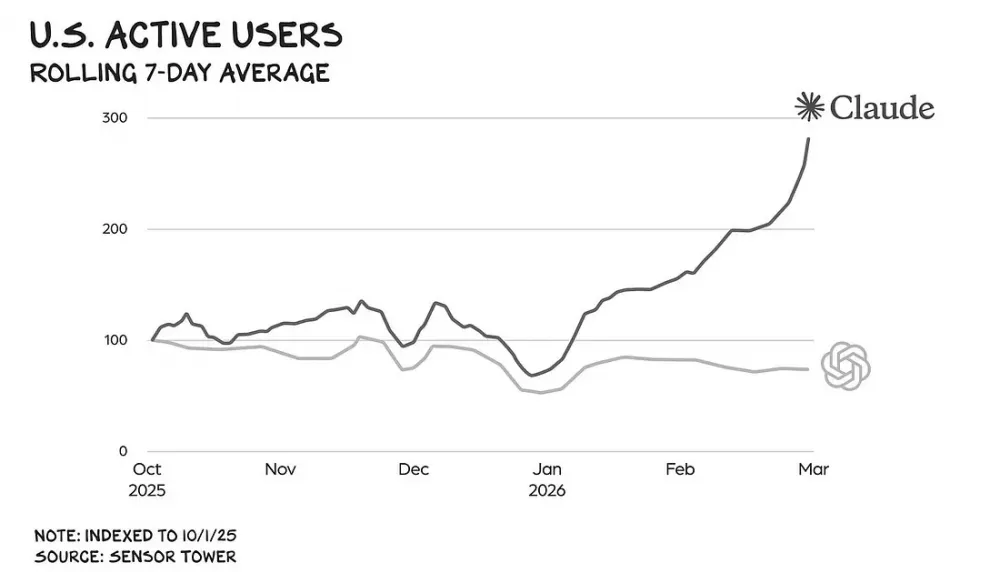
On the next day, after news of Altman's deal broke, ChatGPT uninstalls in the US rose by 295%, and Claude climbed to the top spot in the App Store. Annual revenue of Anthropic suddenly surged to 19 billion dollars — up from 14 billion just a few weeks earlier — adding around 150 billion to the company’s valuation.
Altman and OpenAI appeared reckless and selfish. Amodei and Anthropic — responsible and principled.
A year ago, I predicted that the first CEO to decisively and publicly stand up to Trump would reap significant rewards — both reputational and commercial. I thought it would be Nike with their DNA of boldness. But Amodei did it first.
And then Microsoft followed his example, filing a document in support of the lawsuit filed by Anthropic, challenging the designation of "supply chain risk." As one of the largest government contractors, Microsoft risks more than nearly any tech company. But as Andrew Ross Sorkin pointed out, “Microsoft decided the price of silence was higher.”
Boycott
In the 1880s, a community in Ireland neutralized a cruel land agent named Captain Charles Boycott by collectively refusing to work for him, trade with him, or even speak to him. As historian Rutger Bregman recently wrote, the difference between movements that fizzled out and those that succeeded is simple: “They chose one target — simultaneously symbolically powerful and truly vulnerable — and went all in.”
OpenAI is such a target. Still dominating among LLMs, the company is vulnerable. Its app’s share dropped from 69% to 45% in a year. The company is predicted to lose 14 billion in 2026. The QuitGPT movement has already mobilized 4 million people.
OpenAI also symbolizes everything that provokes growing rejection: Altman’s shift from a Trump critic to a loyal partner seven days after the inauguration. A $25 million donation from OpenAI president Greg Brockman to Trump’s super PAC. The company’s decision to allow mass surveillance of Americans and autonomous weapons without safeguards.
77% of Americans believe that AI poses a threat to humanity.
$10,000
When one person cancels a $20-per-month ChatGPT subscription, OpenAI loses $240 in annual revenue — and about $10,000 in valuation. If you have a decent social network, your influence easily reaches six figures. Sharing influence means multiplying it.
The most powerful agent in the world is not GPT-5. It is a consumer with a conscience and an “Unsubscribe” button.
The Main Marker
I believe that in life there are markers — moments and behaviors that reveal a person’s character. How they treat pets. Whether they look service staff in the eye. How they speak about their exes.
Answering a question about AI’s energy needs, Altman emphasized how much energy and effort it takes to raise a person capable of critical thinking. That is the marker. It embodies what seems most troubling about the virus affecting Big Tech: for them, return on investment matters more than humanity.
The most important thing in life is to find people and pursuits that allow you to love and invest yourself in them. That demand and accept much from you — perhaps more than you will ever receive in return. For me, that is raising children with a partner, and the reward lies in the absence of any ROI. It is the opportunity to invest without expecting a return, except for one thing: that one day they will become sources of care and support for others.
AI, GDP, shareholder value — these are only means. The goal is to be in a position where you can give more than you will ever receive.



Write comment