- DIY
- A
Concentration Generator/Power Supply
Today, we will talk about another interesting method of generating electricity — concentration-based, where electricity can be extracted from the difference in ion concentration in a liquid medium.
This method is interesting because there is a large amount of the most well-known liquid solvent and the basis of life on Earth — water, which can be used in another useful way for humans…
First, it should be mentioned that since the discovery of electricity, humanity has developed a large number of methods to generate it, where, for example, a number of sources operate based on the difference in electric potentials of different metals, which, when immersed in an electrolyte, cause the generation of an electric current. The greater the potential difference, the more current can be generated, with the negative electrode remaining intact and the positive one being destroyed (dissolved).
If anyone is not aware, we recently discussed an interesting system option for preventing corrosion based on this principle.
However, the practical implementation of such an electricity generation principle involves the physical destruction of one of the electrodes, which immediately imposes limitations, as the relatively low cost, limited availability, and difficulty of extracting metals makes us think about cheaper and more widespread sources (if we’re talking about various types of galvanic elements) — what could be simpler and cheaper than solutions with different salt contents?!
It should be noted here that, from now on, we will consider the principle of creating specific generators/cells as one of the potentially promising sources of electrical power, which has not yet been fully utilized in global practice.
It is believed that the foundation of all ideas that later developed for the practical use of solutions of different concentrations lies in the work of British physicist and chemist Richard Edward Pattle (R.E.Pattle), who, in his works of the 1950s*, substantiated the practical possibility of using solutions of different concentrations beneficially.
His most famous work, which is considered to have "started it all," was published in 1954 in the journal Nature, under the title «Production Of Electric Power By Mixing Fresh And Salt Water In The Hydroelectric Pile» ("Production of electricity by mixing fresh and salt water in a hydroelectric plant").
But to understand the essence of his invention, we need to dive a little into chemistry… For this, let's assume we wanted to dissolve ordinary table salt — NaCl — in distilled water, and accordingly, we poured it into the water.
During this process, the crystal lattice of the salt breaks down (dissociation), and it splits into positively and negatively charged "ions": Na+ and Cl-.
Thus, as a result of simply dissolving table salt in water, we get an amazing, and one could even say wonderful, thing — a natural mixture of charges of different signs! (Not exactly, but exaggerated, for the sake of our further understanding, we can put it this way).
Why the salt originally consisted of these charged particles: As we already mentioned, the components of the salt formula are the "ions" Na+ and Cl-, which implies that during the chemical reaction when this sodium salt was originally formed, chlorine took one electron from sodium. Thus, the initially neutral sodium atom received a positive charge (because there is a shortage of negatively charged electrons, which automatically means a shift to a positive charge), while chlorine, having gained an extra electron (i.e., acquiring an additional negative charge), becomes negatively charged.
And as we know, opposites attract, so these atoms form a bond with each other — that is, a crystal lattice is formed, consisting of initially non-neutral atoms, which are called ions.
Being placed in a solvent, i.e., water, breaks the bond between these "under-atoms," and the crystal lattice collapses, resulting in a natural "soup" of positive and negative charges and solvent.
By the way, an interesting point — there are specially designed compounds created by scientists called "ionic liquids" (for example BMIM-PF6, EMIM-TFSI, etc.), where there is no solvent, and the liquid itself consists exclusively of charges (i.e., ions).
It’s funny that scientists, designing such liquids, aim to select positive and negative ions that are so incompatible with each other that they simply cannot form a crystalline lattice at room temperature, and, essentially, represent a "melt that retains a liquid form at room temperature."
Interesting properties of such liquids include their inability to evaporate, as well as excellent electrical conductivity — which is not surprising, since they essentially represent "concentrated charges," if you may…
By the way, continuing this topic slightly for educational purposes, it can be noted that if the solvent evaporates, the salt will necessarily gather again into a crystalline lattice. Interestingly, if desired, this bond can be permanently broken!
And how do we break it? :-) Very simply: you need to take an extra electron from one and give it to another (to restore, so to speak, fairness) — and an electric current passed through the solution will help with this!
Now, it seems everything makes sense why, at one electrode, when an electric current passes through an aqueous solution of table salt, metallic sodium will form (although nothing good comes of this, and the metallic sodium immediately decomposes in water), and at the other — gaseous chlorine…;-)
But that was just a small digression for better understanding, from which we need to take away only one single thing: we are dealing with a solution of charges, which is neutral but can be polarized — that is, if desired, these charges can be sifted through a kind of "sieve" and spread apart, after which they can be connected by a "bridge" — that is, using some conductor to organize a path for electric current, on which we can place our useful load!
Before we begin the discussion, it should be noted that the first two methods have something in common — in them, something tends to move by itself from one reservoir to another:
In the first case, it is water (it tends to flow from the less salty reservoir to the more salty one, in order to dilute it);
In the second case, these are ions — they tend to move from the saltier zone to the less salty one).
The osmotic method is the simplest: essentially, it is just a simple mechanical creation of pressure.
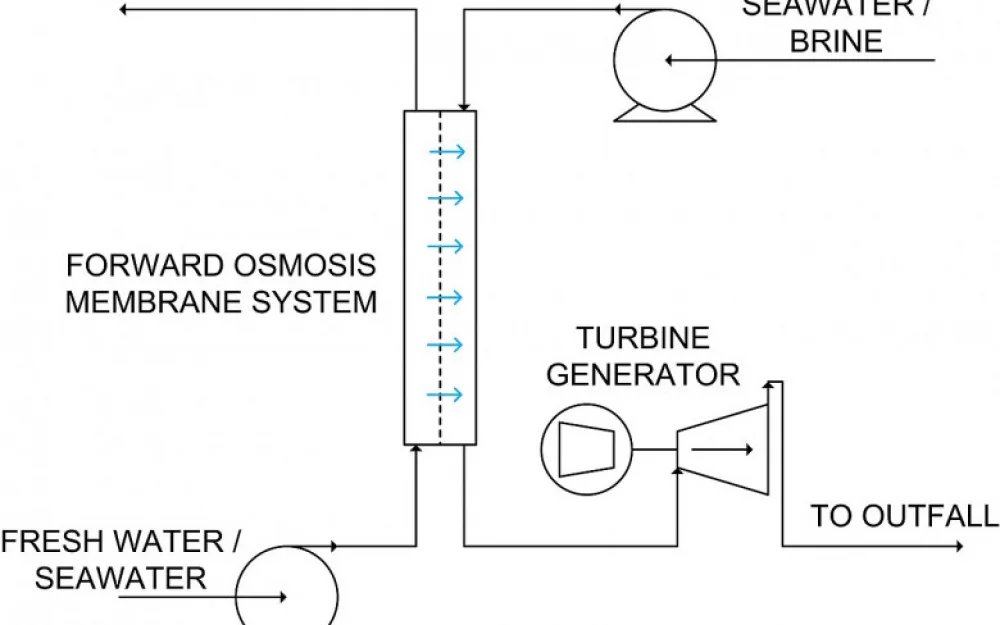
The schematic of such a setup looks roughly like this:
As can be seen, seawater is supplied to one part of a reservoir divided in half by a membrane, while the other part of the reservoir is filled with clean water.
As mentioned above, the clean water tends to cross into the reservoir with salty water, resulting in increased pressure in the salty half, where this pressurized water is fed to a turbine, which mechanically drives an electric generator.
This method of generating electricity is not a theoretical concept — in 2009, an experimental plant of this type was launched in Norway, which subsequently reached a capacity of 25 MW/h (although the project was shut down in 2014 due to high costs, it demonstrated the theoretical possibility in practice):
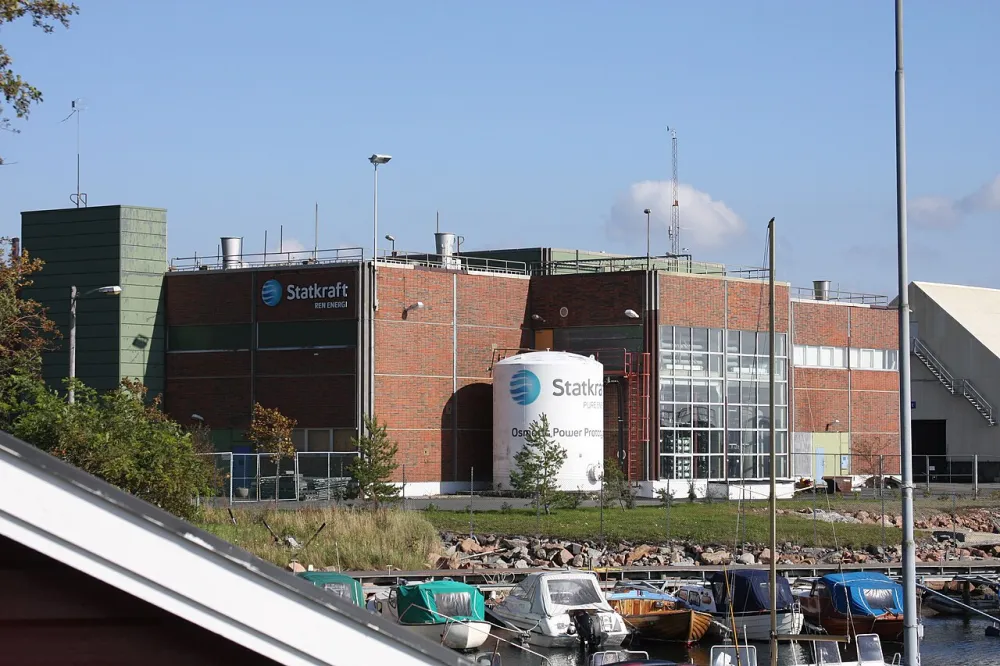
The plant developed water pressure around 3 bar, although the technology’s potential could reach much higher (up to 15 bar).
Presumably, the reason for the project’s termination was the not entirely technically perfect membranes used, as the development of such membranes is still ongoing, and even now, it cannot be said that the issue has been fully resolved.
Reverse electrodialysis is a much more interesting technology from the point of view that here there is no creation of mechanical pressures and bulky installations — instead, pure charge separation is used.
In implementing this principle, an assembly of alternating electrodes, membranes, and containers with highly saline and fresh water is used.
As far as I could find here (by the way, the article itself is also quite interesting, so you can read it), very simplified, the setup looks as follows:
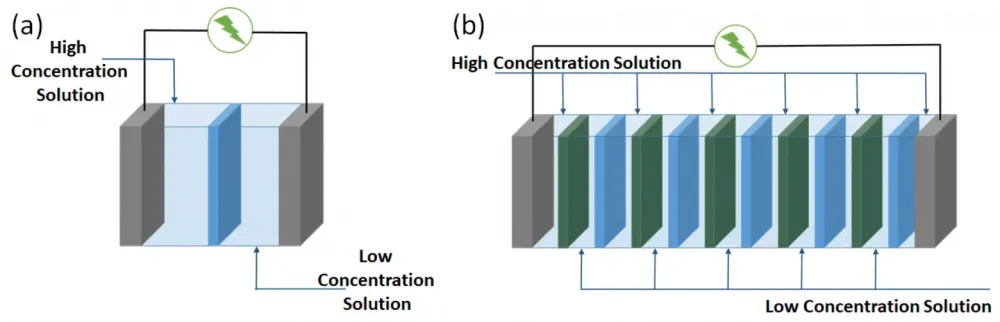
The essence is as follows: from the reservoirs with salty water, ions with positive and negative charges tend to move into the fresh water reservoir.
But on their way are membranes: one membrane allows only positive charges to pass (cation exchange membrane), and the other only negative charges (anion exchange membrane).
Thus, it turns out that the reservoirs with salty water constantly lose charges of one sign, that is, each of these reservoirs becomes polarized.
Next, by connecting electrodes to a plate in the reservoir, it can be used as a power source pole!
And so that ions constantly flow into the fresh water, the fresh water containers are continuously flushed with a stream so they don’t become saline…
A generator of this type is also not a concept, because in the Netherlands, in 2014, a test installation of this type, at 50 kWh, was launched, information about which can be found here.
The most recent (in terms of development; laboratory-tested in 2009) among membrane methods is the capacitive method, which consists of connecting electrodes to a relatively weak current source, after which they are immersed in a saline electrolyte, resulting in their surface being covered with ions of the opposite sign that neutralize the electrode’s charge.
Next, the power supply is turned off, the electrodes are removed from the salt water and immersed in fresh water, where a voltage arises between them — since they are covered with charges extracted from the salt water — now a useful load can be connected to the electrodes…
It has been found that collecting charges (by applying a supply voltage in salt water) requires much less energy than extracting it in fresh water (there is no "perpetual motion" here :-) and a more detailed description can be found here).
In summary, it can be said that sometimes even completely unexpected paths can be useful, being not fully utilized by humanity, and using salt and fresh water is one of them, which, by the way, is considered one of the most environmentally clean methods, and this is natural: it simply uses natural resources that would in any case mix, and here humans try to extract benefit from it. For example, by installing a membrane power plant where a freshwater river flows into the sea…



Write comment