- Hardware
- A
Five Mini PCs of May 2026: Panther Lake, RTX 5080 and External Graphics Support
Mini PCs are no longer just small office computers. In spring 2026, several models were showcased, including a system with RTX 5080, computers with new Intel Panther Lake processors, and even an option with external graphics card connection via PCIe 5.0. Some of them are already barely distinguishable from regular desktop PCs in terms of capabilities.
At the same time, they look completely different. One manufacturer tries to fit maximum power into a three-liter chassis, another makes a computer the size of a palm, and a third experiments with interfaces that were previously rarely seen in devices of this class. Let's take a look at what's new in recent months.
ECS LIVA Z15 Plus and LIVA Q4 — two mini PCs based on new Intel® Wildcat Lake and Twin Lake
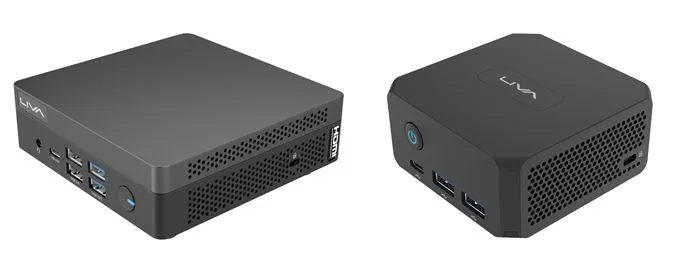
ECS has unveiled two new compact systems. The senior model, LIVA Z15 Plus, is built on Intel Wildcat Lake processors, while the miniature LIVA Q4 uses more energy-efficient Twin Lake chips. Despite sharing a brand, these are completely different computers in terms of size and capabilities.
The LIVA Z15 Plus is notable primarily for being one of the first systems on the Wildcat Lake platform with a built-in NPU for local AI processing. The LIVA Q4 is significantly simpler, but its dimensions are only 75 × 75 × 35 mm. It features up to 16 GB of memory, a built-in storage drive, a 2.5 GbE network port, and the ability to connect multiple monitors.
LIVA Z15 Plus specifications
processor: Intel® Core® Series 3 (Wildcat Lake);
AI accelerator: up to 40 TOPS;
RAM: not disclosed;
storage: not disclosed;
network: not disclosed;
ports: USB-C, USB-A, 3.5 mm audio.
LIVA Q4 specifications
processor: Intel® N150 or Intel® N250 (Twin Lake);
RAM: up to 16 GB LPDDR5-4800;
storage: 128 GB eMMC;
network: 2.5 GbE, Wi-Fi;
ports: USB-C 3.2 Gen2, 2× USB-A 3.2 Gen2, 2× HDMI, USB-C for power;
cooling: passive;
dimensions: 75 × 75 × 35 mm.
Both models were showcased ahead of Computex 2026. As of late May, the manufacturer had not yet disclosed pricing or availability.
ASUS ROG NUC 16 — gaming mini PC with RTX 5080
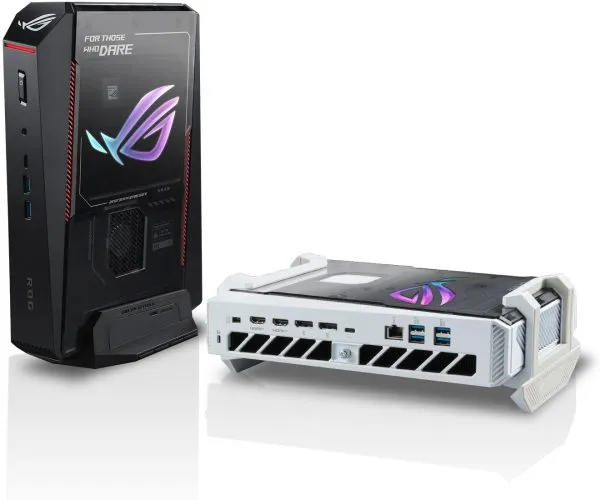
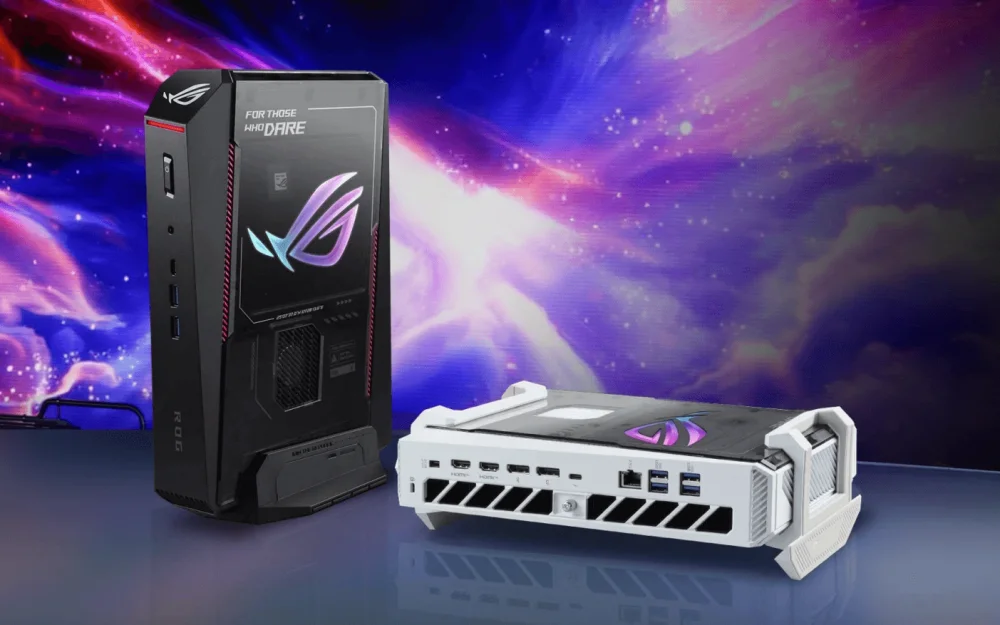
ASUS continues to develop its line of gaming mini-PCs and has introduced the ROG NUC 16, one of the most powerful compact systems in this format. The body is small, but inside, there's quite powerful hardware. This includes Intel® Core® Ultra 9 290HX Plus chips and graphics cards up to GeForce® RTX 5080 Laptop, depending on the model.
In the new device, ASUS has reworked the cooling system and increased the thermal headroom compared to the previous generation. The computer supports up to 128 GB of RAM, multiple SSDs, Wi-Fi 7, and output to several monitors up to 8K. In addition to gaming, the manufacturer emphasizes local AI tasks: the top configuration with RTX 5080 provides up to 1334 TOPS of performance for working with neural networks.
Specifications
processor: up to Intel® Core® Ultra 9 290HX Plus;
graphics card: up to NVIDIA® GeForce® RTX 5080 Laptop (16 GB GDDR7);
RAM: up to 128 GB DDR5-6400;
storage: PCIe 5.0 and PCIe 4.0 NVMe SSD;
network: Wi-Fi 7, Bluetooth 5.4, 2.5 GbE;
video: HDMI 2.1, DisplayPort 2.1, Thunderbolt 4;
display support: up to five 4K or two 8K;
case: about 3 liters;
colors: black and white.
The ROG NUC 16 was presented in May 2026. The exact prices depend on the configuration, but top versions with Core® Ultra 9 290HX Plus and RTX 5080 are not cheap — over $4000.
MINISFORUM M2 and M2 Pro — two mini-PCs on Intel® Panther Lake
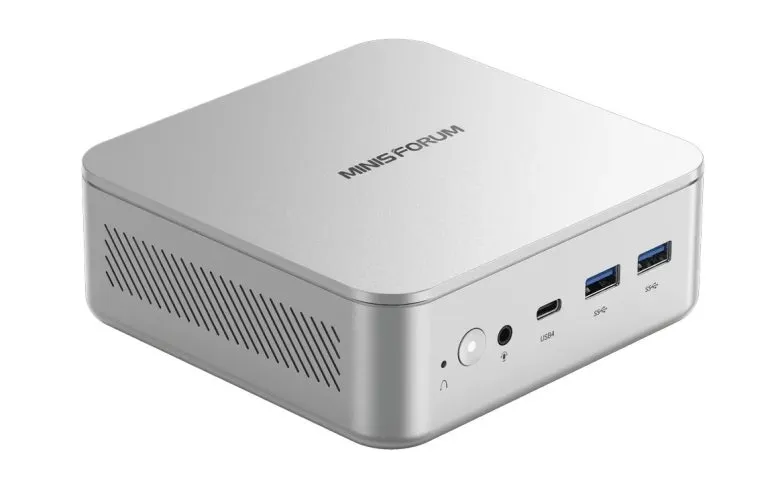
MINISFORUM has already unveiled two systems based on the Intel® Panther Lake platform, but so far only the lower-end model has reached customers. The standard M2 has gone on sale, while the more powerful M2 Pro, which the company first showcased at CES 2026, is still listed as an upcoming product.
Despite their similar names, the difference between the two is quite substantial. The M2 is equipped with the Core® Ultra 7 356H processor with 4-core Xe3 graphics, and is designed for everyday work, development, and local AI model inference. Inside, it has two memory slots, two SSD slots, Wi-Fi 7, and two 2.5 GbE network ports. The M2 Pro is set to receive the significantly more powerful Core® Ultra X9 388H with Arc B390 graphics and up to 180 TOPS of AI performance, but its sales have not launched yet.
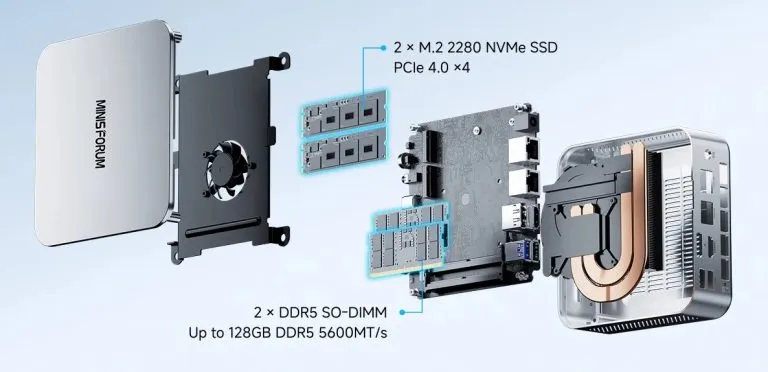
M2 Specifications
processor: Intel® Core® Ultra 7 356H (Panther Lake);
graphics: Intel® Xe3 Graphics (4 cores);
AI accelerator: up to 50 TOPS NPU, up to 90 TOPS total;
RAM: up to 128 GB DDR5-5600;
storage: 2× M.2 2280 PCIe 4.0 x4;
networking: Wi-Fi 7, Bluetooth 5.4, 2× 2.5 GbE;
ports: USB4, 3× USB 3.2 Gen2, USB 2.0, HDMI 2.1, DisplayPort 1.4, audio;
dimensions: 130 × 127 × 50 mm;
cooling: active.
M2 Pro Specifications
processor: up to Intel® Core® Ultra X9 388H;
graphics: Intel® Arc B390;
AI performance: up to 180 TOPS;
RAM: up to 96 GB LPDDR5X-9600;
platform: Intel® Panther Lake.
The MINISFORUM M2 is already on sale starting at $575 for the barebone version without memory and storage. A configuration with 32 GB of RAM and a 1 TB SSD costs around $1039. For the M2 Pro, the company has not yet announced either the price or the start date of sales.
GPD BOX — mini PC based on the Intel® Panther Lake platform with an external graphics card slot
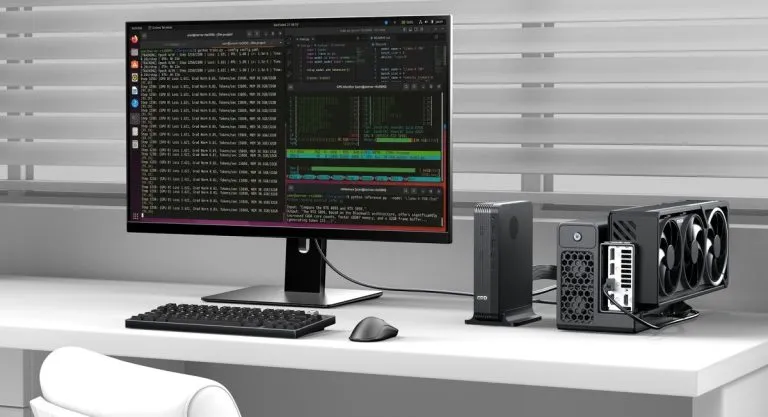
GPD is primarily known for its handheld computers and gaming consoles, but now the company has decided to enter the mini PC market. The new GPD BOX has been equipped with Intel® Panther Lake processors and looks like a regular compact computer, until you start looking into the details. The main feature of the model is support for the MCIO 8i interface, which allows connecting external graphics cards and other devices via the PCIe line with much higher bandwidth than OCuLink or USB4.
Depending on the configuration, either a CoreTM Ultra 7 356H or a more powerful CoreTM Ultra X7 358H is installed inside. Interestingly, the MCIO 8i port is only available in the version with CoreTM Ultra 7 356H. The higher-end model focuses on the more productive built-in Arc B390 graphics, while the lower-end variant allows connecting an external graphics card via the PCIe 5.0 x8 interface. For a mini PC with a volume of less than a liter, this is a very unusual solution. Also provided are two slots for SSDs, up to 64 GB of LPDDR5X memory, and a built-in 160 W power supply.
Specifications
processor: Intel® Core® Ultra 7 356H or CoreTM Ultra X7 358H (Panther Lake);
graphics: Intel® Graphics (4 Xe) or Intel® Arc B390 (12 Xe);
AI performance: up to 180 TOPS;
RAM: 32 or 64 GB LPDDR5X-8533;
storage: 2× M.2 2280 (PCIe 5.0 x4 + PCIe 4.0 x2);
network: 2× 2.5 GbE, Wi-Fi 6E, Bluetooth 5.3;
ports: 2× USB4 v2, 4× USB 3.2 Gen2 Type-A, HDMI 2.1, DisplayPort 2.1, audio;
additional: MCIO 8i (PCIe 5.0 x8, only for versions with CoreTM Ultra 7 356H);
power supply: built-in GaN, 160 W.
As of the end of May 2026, GPD has revealed the device's specifications, but has not yet announced the price or the start date of sales.
MSI Cubi NUC AI+ 3MG — mini PC on Panther Lake
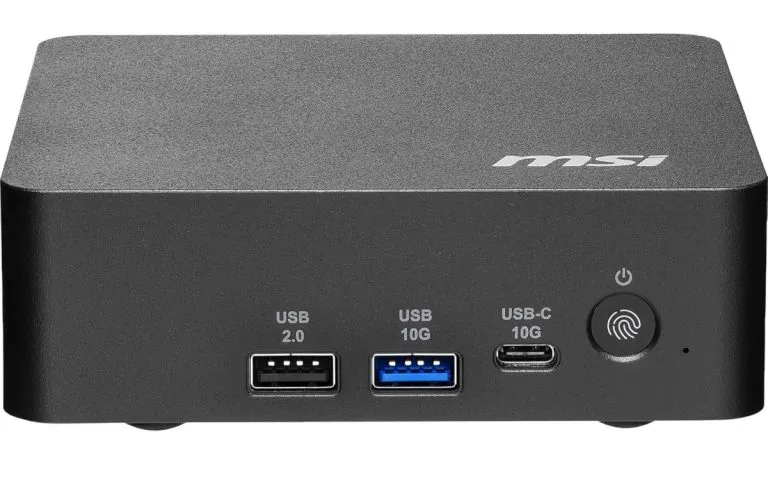
MSI Cubi NUC AI+ 3MG is one of the most compact computers based on the new Intel® Panther Lake processors. The case with a volume of only 0.51 liters easily fits behind a monitor or on the edge of a desk, but in terms of capabilities it is already a full-fledged desktop PC with support for modern interfaces, fast networks, and local AI tasks.
Unlike many compact systems, no corners were cut on peripheral connectivity here. The computer comes with two Thunderbolt 4, two HDMI 2.1 and two 2.5 GbE network ports. It supports up to four monitors, has two DDR5 memory slots, and a fingerprint scanner integrated into the power button. Higher-end versions are equipped with the CoreTM Ultra 9 386H processor, and the entire platform delivers up to 100 TOPS of AI performance.
Specifications
processor: Intel® Core® Ultra 5 322 / Core® Ultra 7 355 / Core® Ultra 9 386H (Panther Lake);
graphics: Intel® Graphics (Xe3);
AI performance: up to 100 TOPS;
RAM: up to 96 GB DDR5;
storage: M.2 NVMe SSD;
networking: Wi-Fi 7, Bluetooth 5.4, 2× 2.5 GbE;
ports: 2× Thunderbolt 4, 10 Gbps USB-C, 10 Gbps USB-A, USB 2.0, 2× HDMI 2.1, audio;
display support: up to 4 monitors;
security: fingerprint scanner, TPM;
dimensions: 120 × 115 × 38 mm;
case volume: 0.51 L.
Sales launched in April 2026. The barebone version with the Core® Ultra 7 355 costs around $689, while the variant with the Core® Ultra 9 386H costs around $809. Fully configured versions with memory, SSD and Windows can cost up to $1670.
![From Virtual Hands to AI for Survivalists: Curious Open Agent OSes [and One Hardware Project]](https://cdn.tekkix.com/imgs/2026/05/habrcom/big/ce0b1057616faed51cd8b9f3b2b9.webp)

Write comment