- Hardware
- A
A million dollars earned in a student dormitory
For my first college break, inspired by Satisfaction75, I created a device I called Dissatisfaction65 — a 65% wireless keyboard.
I don’t remember exactly why, but after making several wired keyboards, I wanted to try building a custom wireless one. To implement wireless connectivity, I chose the Adafruit 32u4 Bluefruit LE microcontroller, because the open-source QMK keyboard firmware specifically supported Bluetooth with this board. The resulting device looked great, but its performance was terrible. Due to input lag, it was almost impossible to use, and despite the huge battery, it only lasted a few days on a charge.
Companies like Logitech and Apple make wireless keyboards with low latency and long battery life, so I knew this wasn’t the limit. For the next two months, I immersed myself in the world of wireless microcontrollers and custom keyboards. Almost immediately, I realized that hobbyists go for Nordic chips, and the Pro Micro form factor rules this space. During my research, I found three microcontrollers whose developers tried to combine these two technologies: BlueMicro, nRFMicro, and BLE-Micro-Pro1.
Board | Retail price | Form factor | Open Source |
|---|---|---|---|
BlueMicro | — | Too large | Yes |
nRFMicro | — | Yes | Yes |
BLE-Micro-Pro | ~$40 | Yes | No |
Due to BlueMicro’s form factor, I wouldn’t have been able to build most Pro Micro keyboards, as they would interfere with each other. BLE-Micro-Pro was quite expensive, closed-source, and only sold in Japan. nRFMicro turned out to be the closest fit. At first I decided to modify nRFMicro to suit my needs, but soon realized my goals were too ambitious, so I started from scratch.
The Birth of nice!nano
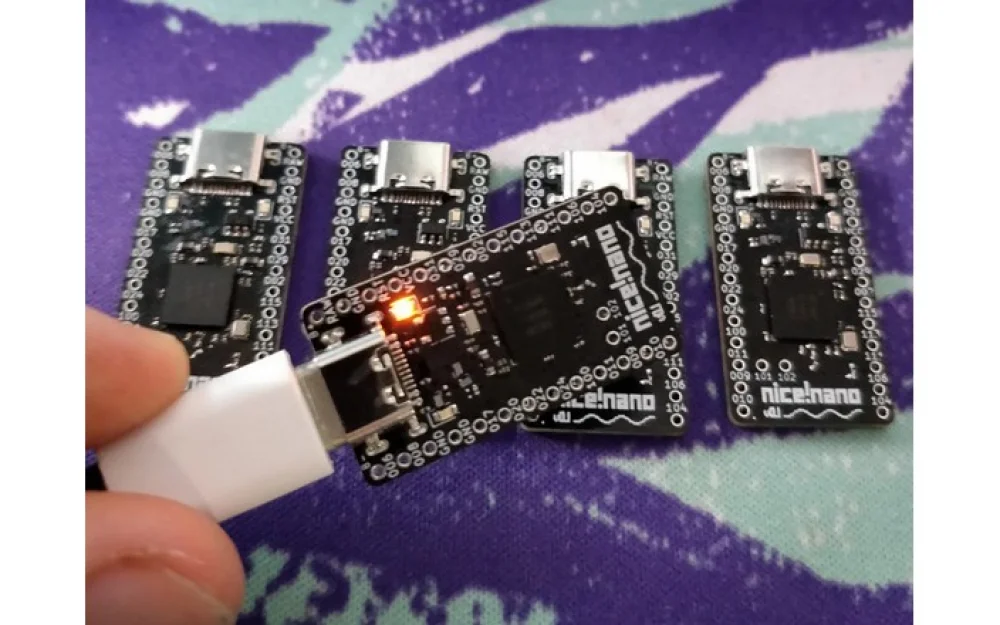
That very weekend (yes, I designed the entire device over the weekend) when I created nice!nano, I only left my desk to sleep, and went to the dining room three times to get food. The room only had me, KiCad, Nordic Infocenter2, nRFMicro wiki, and the Adafruit nRF52840 Feather schematic. I developed the schematic, put together the bill of materials, designed the PCB and laid out the traces. The end result was the thinnest nRF52840-based board compatible with Pro Micro.
Over the next week I brainstormed a name for it and looked for PCB manufacturers. The name is taken from my online handle, Nicell. I wanted to continue Pro Micro's "sized" naming tradition, so I came up with "nice!nano". I placed the stylized pixel art logo over the antenna. After reaching out to several PCB manufacturers, I found out the cheapest option was around $100 for five units. That was a pretty significant sum for me, and the design could very well have turned out to be flawed, but after a few days of careful checks, I went ahead and placed the order3.

A few weeks later the boards were delivered to me. I was both excited and terrified that they wouldn't work. When I plugged in the first one, I closed my eyes and tensed up. To my surprise and relief, it worked! Over a couple of weeks I built Lily58 keyboards using these boards and launched a modified version of QMK. During testing it turned out the board can last several weeks on a 110 mAh battery. For comparison: the Dissatisfaction65 only lasted a few days on a 2500 mAh battery, meaning power efficiency had improved by more than a hundredfold. Elated, I posted about my fully wireless Lily58 on Reddit, and it gained quite a lot of popularity.
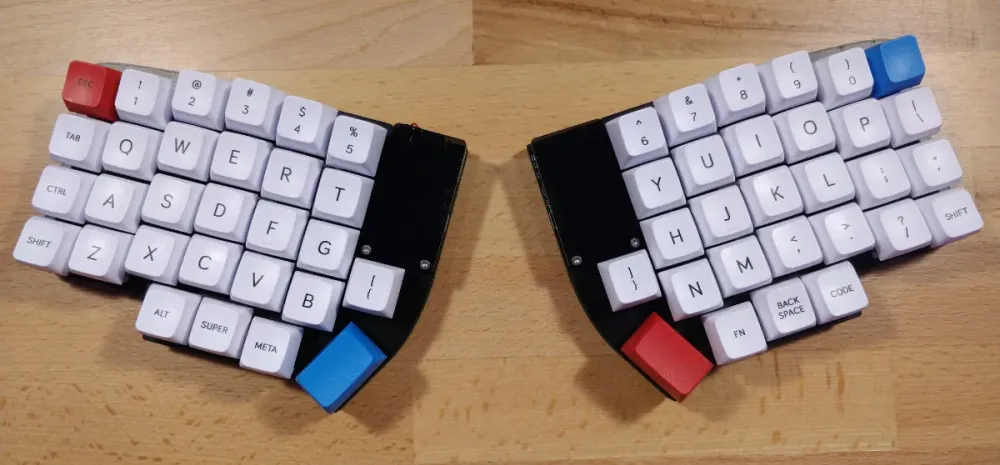
Over the next few weeks, my tiny Discord server turned into a fairly large community passionate about innovations in the wireless keyboard space. I gauged user interest in a group buy, made a few more improvements to nice!nano, and by mid-June was ready to arrange the purchase of a large batch.
Group buys are terrible
I was in college and couldn't afford to front the cost of buying a thousand nice!nano units, so I launched a group pre-order. At the time, I set a minimum order quantity of 200 units, otherwise the purchase would not be profitable, and a maximum of a thousand, since I wasn't sure I could handle a larger volume. I set a one-month deadline for order collection. In the end, it wasn't even open for a full day.
The pre-order launched on June 20 at 11 AM US Central Time. Literally within minutes, I hit the minimum order threshold for the purchase. I remember sitting in my childhood bedroom (thanks, COVID) and watching orders roll in on the Shopify dashboard. It was an incredible feeling. All thousand nice!nano units were sold in just seven hours, marking the end of the group buy. Over the next two months, I collected all payments and, with the help of my family, shipped orders to more than four hundred addresses.
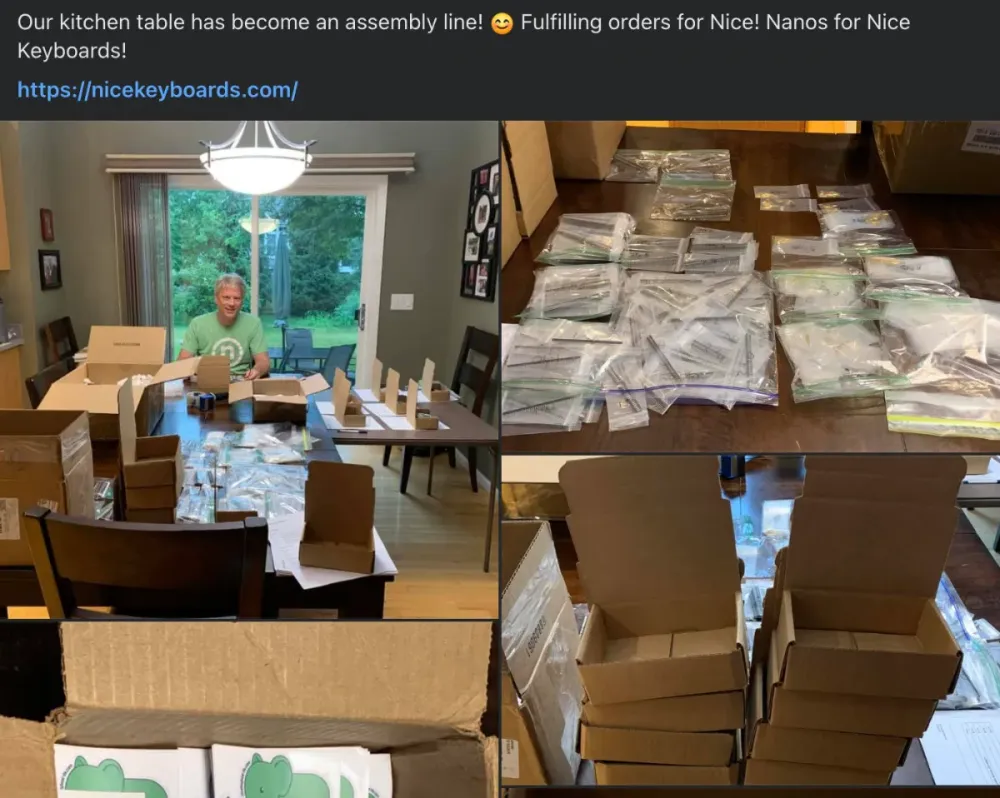
You might be wondering: if the group buy was such a success, what's so terrible about it? It was extremely stressful to hold so many people's money before I had even received the physical units. What also scared me was that PayPal held half of the group buy funds for a while at one point. At the time, group buys were rife with controversy in the mechanical keyboard community: organizers often stole money, and projects took an extremely long time to fulfill. When I see popular stores that are supposed to have capital running group buys, I just shake my head. Shortly after that, I decided I would never run a group buy again.
ZMK
Let's rewind a couple of months: I was waiting for the manufacture and delivery of my order, but I was still missing a key part of the ecosystem: a decent firmware. I was weighing several options, but none satisfied me. Then I got in touch with Pete Johanson, who, by chance, was just working on a firmware for wireless keyboards based on the modern Zephyr RTOS.
I quickly sent Pete a few pre-production boards for him to experiment with. Shortly after, he managed to get an early version of ZMK running on the nice!nano, and we set out to create a new firmware, primarily aimed at wireless devices and low power consumption. By early 2021, a small community led by Pete had created an extremely high-performance, full-featured firmware for wireless keyboards.
Growing
In 2021, I dove headfirst into growing my small business. My supplier network expanded worldwide, nice!nano were flying off the shelves, and I could barely keep up with restocking, while the ZMK community continued to grow and strengthen. Other popular boards based on ZMK started appearing, many inspired by the nice!nano, or at least using my published schematics.
Everything looked wonderful, but I noticed that most of my suppliers didn't have all the parts needed for a wireless build, or their builds focused on wired microcontrollers. I decided I could do something new in this space.
Becoming a Supplier Myself
I was still attending school in person, so I knew I couldn't run an online store full-time. Fortunately, by the end of 2021, my parents decided to retire, and my father said he wanted to find something to do. In 2022, together we founded Typeractive — a keyboard shop primarily focused on wireless devices.
I created a 3D interactive configuration tool that lets customers assemble all the parts and kits they need, specifically designed for wireless PCBs. The convenience of this process brought us huge success, and by 2025 we had become one of the largest split keyboard stores. Typeractive does far more than just sell those, but that's a topic for a separate post.
Cloned Twice!
In 2023, nice!nano was cloned — not once, but twice. Two copies with different designs showed up on Taobao, and shortly after that they migrated to AliExpress and even into my suppliers' stores. It shook me up a little at first, but in the end I figured out there's basically nothing you can do about it.
To be clear, these are proper clones. I think competition is normal, but these new boards were advertised as nice!nano, and came preloaded with exactly the same firmware I used for nice!nano, so when connected the board is identified as nice!nano. If the manufacturers had at least put together their own firmware (it's open-source!) and didn't use the nice!nano name in their product listings, I would say it's all fair game.
Seeing my product get cloned gave me mixed feelings. As everyone knows, imitation is the sincerest form of flattery, but it made me furious that they were profiting off the success of my work. In the end though, their products turned out to be mediocre, and nice!nano sales kept going at a steady pace. This is probably partly because the largest custom wireless keyboard store didn't fill all their warehouses with them. Thanks, Typeractive!
A Million-Dollar Product
I have to admit the post's title is a little clickbaity, but if you've read this far, it probably worked. Yes, I designed nice!nano in my dorm bedroom, but my journey took many years. As of right now [translator's note: as of March 2025] over 50,000 nice!nano units have been sold by various online stores around the world, generating over a million dollars in revenue. I still find it hard to wrap my head around that fact, but I'm incredibly grateful. Yes, I put in tons of work, but I have to admit that well-timed luck played a major role too. The growing interest in wireless keyboards and the lack of suitable options in the DIY space created the perfect environment for nice!nano to thrive.
While writing this post, I took an incredible trip down memory lane. nice!nano has had an enormous impact on my life, and that would never have been possible without the countless people who helped me along the way. I'd like to mention those whose help was absolutely invaluable:
Joric (creator of nRFMicro)
Pierre Constantino (creator of the BlueMicro board and firmware)
Pit Johansson (author of ZMK)
Mike and Pam (my parents)
Thank you all. It's been incredibly joyful to see all the custom keyboards built on top of nice!nano or expanding on its ideas. The community keeps growing, and I'm glad nice!nano remains a big part of it.
Notes
I intentionally left links to each repository in the state they were in when I was able to study them in early 2020.
While writing this article, I found out that Nordic Infocenter shut down. RIP.
Sometimes I laugh at how scared I was back then to make a $100 purchase. In hindsight, that turned out to be an extremely cheap R&D investment.

![From Virtual Hands to AI for Survivalists: Curious Open Agent OSes [and One Hardware Project]](https://cdn.tekkix.com/imgs/2026/05/habrcom/big/ce0b1057616faed51cd8b9f3b2b9.webp)
Write comment