- Network
- A
How the Schapp and Edelkrantz Semaphores Anticipated ARQ, Integrity Control, and Binary Code, and What Kulebina Has to Do with It
Hello, tekkix! My name is Alexey, and I work with wireless technologies.
During the New Year holidays, lazily flipping through the channels on the TV, I stumbled upon a modern interpretation of "The Count of Monte Cristo." It was just at the moment when the main character was operating an optical telegraph. I had heard about this amazing device in my networking technology course back in university, but it didn’t leave any impression on me at that time. Well, a telegraph is a telegraph, just optical: something there signaled and showed. But the live picture in the film intrigued me, and I decided to firmly delve into this topic. And, of course... I forgot.
The second time the optical telegraph reminded me of itself was on Habr — in this article. I think the authors, like me, were inspired by watching the film 😊 Out of curiosity, I began to study this topic, and I was pleasantly surprised. It turns out that optical telegraphs laid many fundamental rules for information transmission: here are the traffic transmission rules, data integrity control, binary system, and even the pseudo-implementation of the ARQ protocol. All this would be realized much later and described in the works of Claude Shannon, but the starting point is right here — in the optical telegraph.
A Journey into History
Ancient Methods of Visual Signaling
The history of visual information transmission over distances dates back to ancient times. The ancient Babylonians may have used towers (including the Tower of Babel itself) for optical telegraphy. The Chinese used bright fires lit along the Great Wall of China to send urgent messages over distances.
In ancient times, sentinels, noticing the approach of an enemy, would light signal fires that the next post could see from several kilometers away, thus transmitting information in a chain. However, these primitive systems could only convey a very limited amount of information (usually binary signals: the enemy is approaching or not).
In 1684, British polymath Robert Hooke presented a detailed design for a visual telegraph system to the Royal Society. The project was motivated by military considerations following the Battle of Vienna in 1683. However, Hooke's system was never implemented in practice.
In 1778, an early optical telegraph using lights was built to establish communication between the Paris and Greenwich observatories. However, this system had serious limitations in reliability and information capacity. The true development of the optical telegraph is associated with the name of Claude Chappe.
Claude Chappe and the Invention of a Practical System
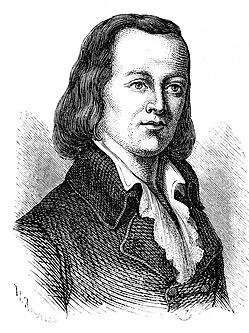
Claude Chappe (Claude Chappe, December 25, 1763 - January 23, 1805) was born in Bruillon in the Sarthe department of France, into a family of civil servants. He was educated at the Lycée Pierre Corneille in Rouen and initially prepared for church service, but lost his position during the French Revolution.
His uncle was the astronomer Jean-Baptiste Chappe d'Auteroche, famous for his observations of the transit of Venus across the Sun's disk in 1761 and 1769. During Claude's youth, he was inspired by reading his uncle's journal about a Siberian journey, which awakened his interest in the physical sciences and, in particular, telescopes.
Claude and his four unemployed brothers decided to develop a practical system of semaphore relay stations, a task proposed in ancient times but never realized.
The First Successful Experiment (1791)
In 1791, Claude Chappe conducted his first successful experiment with his assistant (and brother) René Chappe. The testing took place between the towns of Bruillon and Parcé at a distance of about 16 kilometers. Officials in Bruillon selected a message to be transmitted, and René Chappe sent it to Claude Chappe in Parcé, who had no prior knowledge of the message.
The message read: “Si vous réussissez, vous serez bientôt couverts de gloire” (If you succeed, you will soon be surrounded by glory).
This proved the concept: information could indeed be transmitted through a chain of visual signals. Later, Claude Chappe realized that he could dispense with synchronizing clocks and use the synchronization system itself for transmitting messages.
Government Support
Claude's brother - Ignace Chappe (1760-1829) - was a deputy of the Legislative Assembly during the French Revolution. With his help, the National Assembly supported the proposal to build a relay line from Paris to Lille over a distance of 230 kilometers (about 143 miles).
On March 3, 1792, Claude personally described the capabilities of his system to the National Assembly of France. He explained that messages could be sent almost 80 kilometers in about 40 minutes. This was revolutionary, as a courier on horseback required days or weeks to deliver a message over such a distance.
On August 4, 1793, the National Convention approved the budget for the construction of the first operational telegraph line between Paris and Lille, using the Chappe system. Despite the war, political turmoil, and technical challenges, construction progressed quickly.
Technical Design of the Chappe Telegraph
Structure and Components of the Station
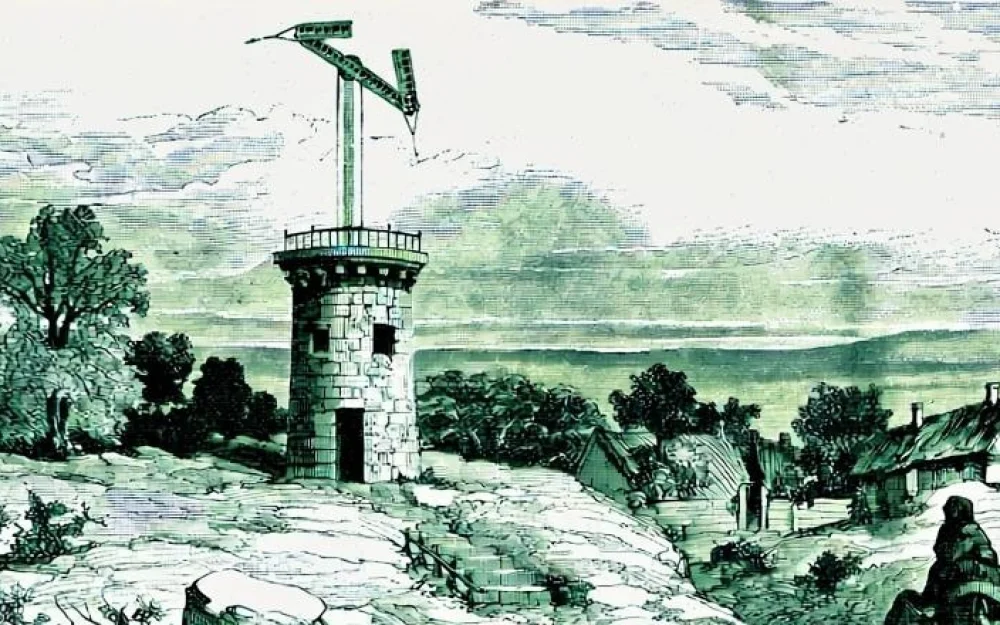
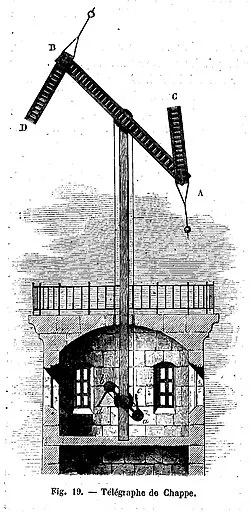
A typical optical telegraph tower of Chappe consisted of the following main parts:
1. A 7-meter tall mast - sky blue (for better visibility and contrast against the sky), with a ladder for access to moving parts and maintenance.
2. Regulator (main beam) - a black main horizontal beam measuring 4.60 m × 0.35 m, rigid and immovable relative to the mast, serving as the base for mounting the moving indicators.
3. Two indicators (moving wings) - black rotating wings measuring 2 m × 0.30 m, attached to the regulator with hinges. These wings could assume various angular positions, forming signals visible from a distance.
4. Counterweights - gray metal weights that balanced each indicator, facilitating their movement.
5. Shutters (fixed blinds) - fixed horizontal slats with gaps on the regulator and indicators, designed to reduce wind resistance and improve visibility from afar under different lighting conditions.
6. Manipulator (control system) - a system of ropes and pulleys in the working area at the base of the mast, which the operator used to control the signal. The manipulator replicated the state of the signaling mechanism in miniature, allowing operators to see what they were doing without climbing the tower.
7. Two telescopes - installed in wooden housings, fixed and focused on neighboring towers (located within sight). The telescopes had magnifications ranging from 30× to 65×, depending on the distance between the towers. Each telescope was constantly aimed at one of the neighboring towers, eliminating the need for adjustment for each message.
Positioning System and Coding
Main movements of the indicators:
Each of the two indicators could take seven main angular positions relative to the horizontal plane of the regulator:
45° (diagonally up-right)
90° (vertically up)
135° (diagonally up-left)
225° (diagonally down-left)
270° (vertically down)
315° (diagonally down-right)
Folded position (the indicator is folded along the regulator, effectively invisible)
Regulator:
The regulator itself (main beam) could take four main positions:
Horizontal
Vertical
Diagonal (two variants)
Total number of signals:
This gave: 7 positions of the first indicator × 7 positions of the second indicator × 4 positions of the regulator = 196 different positions.
However, to reduce errors in practical operation, not all 196 positions were used. In the final system, only 92 signals for message transmission were employed, while the remaining positions (particularly the diagonal positions of the regulator, visible at the final station) were used for confirmation of receipt and error signals.
Coding and Information Transmission
Shapp developed a revolutionary coding system with the help of his cousin Léon Delone, who had coding experience gained while working at the French consulate in Lisbon.
Coding dictionary:
Instead of coding individual letters, Shapp created a dictionary of 9999 code entries, each assigned a numerical code word. The dictionary included:
Frequently used words and phrases (with the shortest codes)
Numbers (1—9): coded with one signal
Numbers (10—99): coded with two signals
Numbers (100—999): coded with three signals
Numbers (1000—9999): coded with four signals
For example, the word "homme" (man) was encoded as 43-51 in the dictionary used in Savoy in 1809.
Code transmission process:
To transmit a word or phrase from the dictionary, the operator had to transmit the corresponding numerical code word using ten basic signs (corresponding to the digits 0—9):
The operator set the telegraph to the position corresponding to the first digit of the code
The operator of the neighboring station confirmed the visual perception of the signal
After confirmation, the operator moved to the next position
Code group separator:
To clearly separate one code group from another, the last sign of each group was shown with one of the unused indicators, slightly turned away from the regulator. Thus, the total number of signals used (including control signals) was twenty.
Control signals (control codes)
The system included a set of specific control signals for synchronization and error handling:
Fourteen basic control signals:
Speech/Activity — initiating message transmission. In the French code, there were two separate signals: one for messages initiated from Paris, and one from the periphery (as almost all lines ended in Paris).
Attention - confirmation of receipt of the activity signal.
Error - signaling an error in reception.
Repeat - request to repeat the message (added by Chappe in 1809).
Wait - indication of the need for intermittent transmission (added in 1809).
Word Delimiter - for separating code groups.
Closing - completion of transmission.
8-14. Additional signals for controlling flow, transmission speed, and synchronization.
These control signals are notable for anticipating many modern concepts from computer communication protocols developed nearly two centuries later.
In fact, each section "tower–tower" operated in a simplified stop-and-wait mode:
The transmitting station displays a figure.
The receiving station, having confirmed that the configuration is correctly recognized, acknowledges it with a reverse signal or by moving to the next position.
In case of an error or doubt, a special combination "repeat" is sent - the previous symbol is transmitted again.
If we draw a direct analogy with textbooks on computer networks:
The semaphore symbol is the "frame".
A set of service figures are the protocol flags and control codes.
Visual verification of neighboring stations is a primitive integrity check and delivery confirmation (ACK/NACK) at each hop.
Computational Overloads and Network Expansion
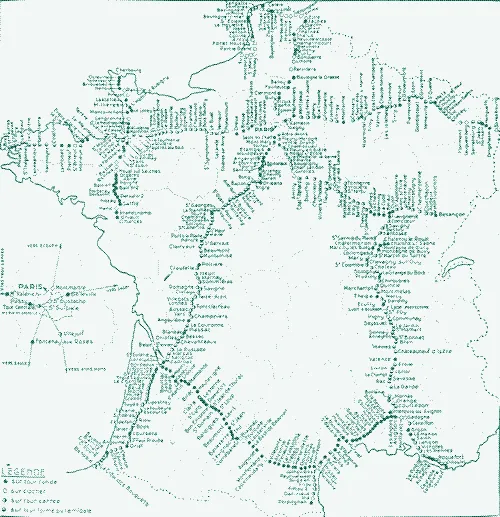
By 1823, the Chappe network had reached grand proportions: over 550 stations and 5000 kilometers of aerial telegraph lines covered all of France. Messages that previously took days or weeks for delivery were now transmitted in minutes.
However, as the network expanded, a problem arose: traffic became increasing, and the system was overloaded. Chappe constantly worked on improvements and encoding to enhance efficiency and reduce transmission time.
Swedish System - Edelcrantz's Shutters (Edelcrantz Telegraph)
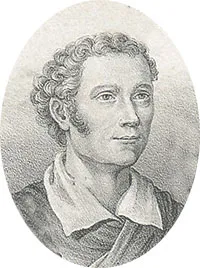
At the same time that the French were developing the Chappe system, Finnish-Swedish inventor Abraham Niclas Edelcrantz (1754-1821) was independently developing his own optical telegraph system.
Edelcrantz was a member of the Royal Swedish Academy (chair 2) from 1786 to 1821 and a librettist for the Royal Theater, later serving as a private secretary to King Gustav III.
Technical Design:
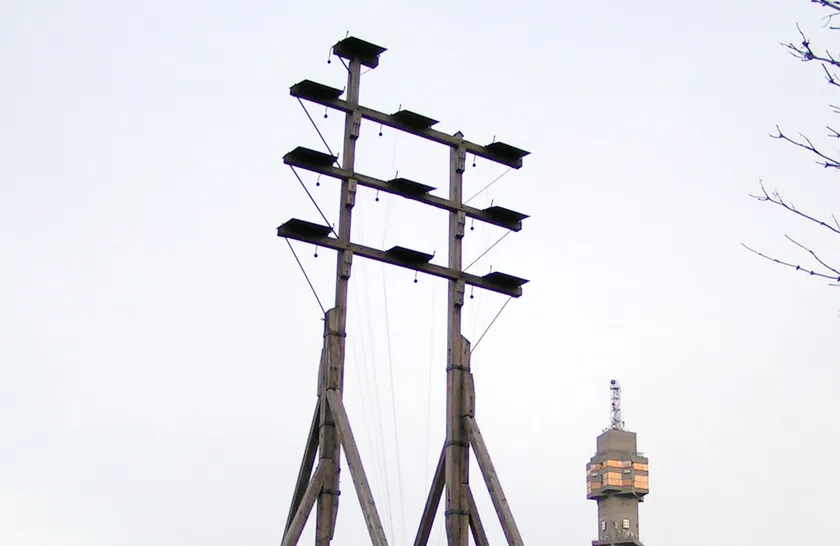
Unlike Chappe's movable arms, Edelcrantz's system was based on ten folding iron shutters (hatches), each of which could be in one of two states:
Visible state (= 1): the shutter is turned to be clearly visible from a distance
Invisible state (= 0): the shutter is positioned on its edge, not visible from a distance
The combinations of the shutter positions were transformed into numbers, which were then decoded using code dictionaries into letters, words, and phrases.
The Edelkranz system is remarkable in that it predated the modern binary code of computers with its ones and zeros. It was one of the first practical implementations of the concept of binary logic almost 150 years before the advent of electronic computers.
The Edelkranz system was nearly twice as fast as the French Chappe system, making it more efficient for operation. The first official demonstration took place in 1794 when Edelkranz sent a poem dedicated to the Swedish king on his birthday from the palace in Stockholm to Drottningholm, where the king was located.
Kulibin's Optical Telegraph
Interestingly, there is also an intriguing thread in our domestic history. Shortly before her death, Catherine II specifically asked Ivan Petrovich Kulibin to work on the device of an optical telegraph. Kulibin created his version of the telegraph, the "long-distance signaling machine." In design, it was similar to European semaphores: a chain of stations with masts and rails that received different positions according to a conditional code.
But in details, Kulibin went further:
Encoding syllables, not words. For Chappe and many of his followers, the basis of the code was words and phrases; for Kulibin - syllables. This provided a more flexible and compact code and effectively allowed arbitrary texts to be transmitted, rather than just a pre-prepared "dictionary." At the same time, crypto-resilience increased: for an outsider observer, the sequence of syllables was harder to read than a ready-made phrase.
Working both day and night. The mast was equipped with a lantern with reflecting mirrors, allowing transmission during dark hours and even in light fog.
Well-thought-out mechanism design. Sources mention Kulibin's independent solution to all design challenges - from mechanics to code and demonstration model for the Academy of Sciences.
In network terms, Kulibin proposed:
a more "general" and expressive level of representation (syllabic code instead of phrase-based);
an expanded physical layer (operation not only in daylight but also in nighttime/foggy mode).
The invention was demonstrated to Catherine II, who showed interest, as did the Academy of Sciences, but there was no money for a real line. The model was sent to the Kunstkamera, and thereafter Russian practice followed the "French" path.
In conclusion
With the advent of the era of electric telegraphy, which offered even greater speed of information transmission, the need for optical telegraphy disappeared. However, Chappe's system introduced a number of concepts that remain relevant in modern communication systems:
Data encoding - using numerical codes to represent letters and words
Delivery confirmation (ACK) - a mechanism for verifying the correct receipt of each signal
Error correction - systems for detecting and retransmitting erroneous messages
Flow control - "wait" and "repeat" signals for synchronization
Communication protocols - a strict definition of the sequence of operations and control signals
Studying historical documents of Chappe and Edelkranz has shown that they developed mechanisms that were rediscovered in modern computer network design nearly two centuries later.



Write comment