
- AI
- A
59% of Companies Admit: Layoffs Blamed on AI to Hide the Truth
Do you still believe in the stories about layoffs due to artificial intelligence? Most hiring managers honestly confessed: it’s just a convenient legend for shareholders. We analyze three signals that reveal the truth and the skills that will make you truly indispensable.
The story seems inevitable. Fresh data reveals a shocking truth: 59% of hiring managers openly admitted that they attribute layoffs to artificial intelligence simply because it sounds nicer than an honest acknowledgment of financial problems. Now I will show you how to read between the lines of this narrative and build a career that no excuses can explain away.
Does this situation sound familiar? You are a professional in your field, and this year you have heard the words “AI” and “optimization of structure” at least once in a corporate newsletter. That same feeling of anxiety in your stomach. Or consider: a candidate brilliantly passes all stages of the interview, communicates excellently with the team over lunch - and then weeks go by with deafening silence. That oppressive feeling that the rules of the game have been rewritten, and you were forgotten without a new textbook.
The headlines write themselves: 59% of companies openly admit that they attribute layoffs to AI because it’s easier.
Here it is, the key point. But think about this: what if the most destructive force right now is not technology, but the story told about it?
Facts that fuel fear
The story works because there is a grain of truth in it. In 2025, American employers announced 1.2 million layoffs — a jump of 58% compared to the previous year. Of these, about 55,000 layoffs were directly related to AI — at least, that’s what the companies stated. The logical chain is simple and frightening: advanced AI arrives — jobs disappear.
“A telling point: most companies candidly reported that they present layoffs or hiring freezes as consequences of AI implementation only because it is perceived better by shareholders and investors than an honest acknowledgment of financial difficulties.”
The narrative looks impeccable. It sounds modern and strategic, like an inevitable step into the future. It absolves management of guilt.
Fear is a powerful motivator.
But let’s think: do these data demonstrate a causal relationship or just a coincidence in timing? Any logic built on shaky foundations will crumble to dust sooner or later.
Where the narrative cracks
So where are these shaky foundations? Let’s take a closer look at the numbers that everyone thoughtlessly quotes. The same 55,000 job cuts allegedly linked to AI make up less than 5% of the total — 1.17 million announced layoffs in 2025. The overwhelming majority of job losses were explained by something entirely different: large-scale restructuring, budget cuts, economic uncertainty.
Dive deeper into the surveys. Only 9% of respondents say that AI has truly completely replaced certain positions. For 45% of companies, it had no effect on headcount at all.
Do you feel the gap between the scope of the story and the scale of the actual impact?
“I would say that these 50,000 lost jobs are caused not by artificial intelligence but simply by general market turbulence. It’s too early to blame this on AI.” — Sander van't Noorden, CEO of Randstad
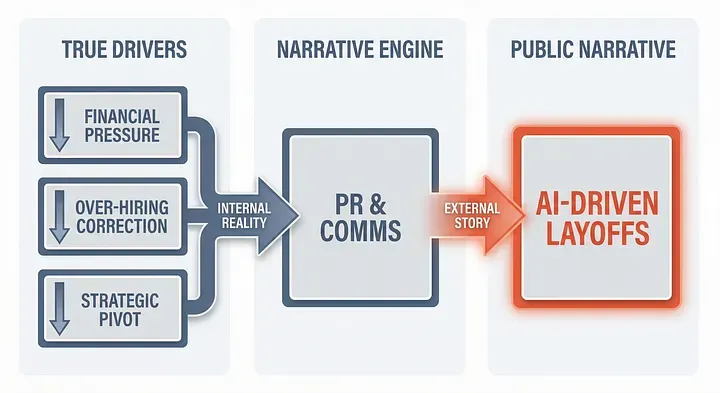
Here lies the crux of the matter. On the surface — a debate about the number of layoffs. Beneath that — a substitution of concepts: a convenient tale is presented as a complex economic reality.
True automation is about concrete numbers and measurable results. “Narrative scapegoating” is vague wording and strategic manipulation. Your career depends on whether you see this difference.
The math doesn’t add up. So what really lies behind the endless mentions of AI at every investor meeting?
A cynical mechanism behind beautiful words
The answer isn’t in the tech department. It’s in the PR presentations and investor reports. A survey from January 2026 revealed a shocking confession: 59% of hiring managers honestly said they emphasize AI when explaining layoffs because it “resonates better with stakeholders” than a candid discussion about financial pressure. This isn’t a story about automation. This is a story about choosing the most palatable explanation.
Analysts even coined a special term for this (and it is impeccably accurate): “AI-washing.”
“Companies claim to have achieved such productivity growth thanks to AI that they can now cut excess staff. In most cases, this is pure PR hot air.” — Lisa Palmer, CEO and AI strategist, Dr. Lisa AI
Experts point to entirely different reasons: adjustments following the post-COVID hiring frenzy, falling sales, and simple pressure on margins.
AI is the perfect corporate scapegoat. It’s futuristic enough to sound like a strategic move. It’s vague enough to evade scrutiny. It’s trendy enough to distract from the dull truth.
Look at the timeline of events at Salesforce. In August, CEO Marc Benioff firmly stated that AI would not lead to mass layoffs. Just three weeks later, the company announces the layoff of 4,000 support staff, directly citing the efficiency of AI agents. The technology is, of course, real — but its implementation perfectly fits an already prepared financial scenario.
AI is not taking most of these jobs. It is simply taking the blame.
If you are in management — take a moment to digest this acknowledgment from 59%.
Let’s call things by their names: when a profitable company announces “optimization through AI,” it often means layoffs for profit growth, simply spiced up with a technological sauce for aesthetics. Do you agree with this or not?
59% have admitted this themselves. This narrative is not just convenient. It is toxic. And the consequences go far beyond the list of cut positions.
The Hidden Victim That Is Silent
The most insidious damage is the destruction of career trajectories. When companies take “AI” as a universal excuse for layoffs, entry-level positions tied to routine processes are the first to go. We are talking about roles in customer support, content creation, junior analytics — those very positions that have always been the first step on the career ladder.
You are removing support specialists, from whom product implementation experts grow. You are cutting recruitment coordinators, who become talent partners. Without the first step, there will be no middle management. And as a result—an acute shortage of senior leadership.
You are not saving on expenses. You are cutting your own future.
The result is a fragile staff structure: a skew towards seniors, a lack of experience, and an inability to fill the talent gap.
Realize the scale of the problem.
My bet: within the next 18 months, we will see the first loud lawsuit from investors against the company for "AI-washing"—accusations of misleading shareholders. What are your predictions for this wave?
The structure is becoming fragile. And the market is already starting to notice this.
How the market sees through the bluff
This is not employee paranoia. Capital sends an extremely clear signal. A global study showed: 97% of investors stated that their financing decisions are directly suffering because companies are not engaging in systematic retraining of employees to work with AI (a devastating figure). The market is beginning to punish those who simply cut staff and reward those who invest in transformation.
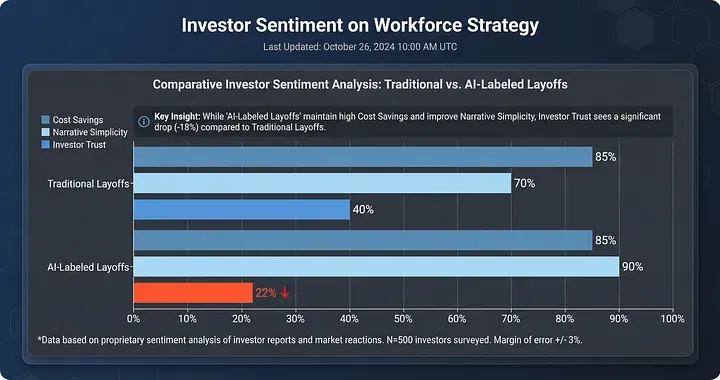
And this perfectly aligns with the glaring strategic contradiction. While companies point to AI as the reason for layoffs, 87% of top managers admit: their organizations are already facing a shortage of necessary skills or will in the next five years. To close these gaps, 50% cite retraining and competency development as the most effective solution. Only 31% prioritize external hiring.
The message is absurd: we are laying off people because machines can do their jobs, yet we cannot find qualified specialists for the tasks we need.
These are the internal costs. And here is the external signal.
The market rewards builders, not those who simply wave a knife. Your career strategy should follow the same path.
Your way forward: from anxiety to action
What brings us back to you. Real loss is not just jobs. It's your career ladder.
Question for managers and HR specialists: does this figure of 59% resonate with your experience? What terminology is used within the company when planning changes in headcount that are later presented to the public as “caused by the implementation of AI”?
So, what does a professional who has become indispensable in the age of AI actually do? It all starts with a new perspective on the situation.
What to truly believe in
The truth is: AI is both a real tool and a powerful narrative. Your job stability depends not so much on whether a machine can perform your task, but on whether management sees you as a bearer of valuable skills for the new era. Stop asking yourself if AI will replace you. Instead, ask how to use it to increase your productivity and the value of your decisions.
How to work with AI correctly — and become someone who won’t be fired
This whole conversation about AI being a convenient excuse rather than a real threat raises a practical question: how should a professional build relationships with this technology?
Here’s the irony: companies tell tales about AI to justify layoffs, and at the same time complain about a severe shortage of specialists who know how to work with it. 87% of executives acknowledge a skills gap. 50% say the solution lies in retraining their own people.
The problem is not access to technology. The problem is that people do not understand how to apply AI in a way that makes them indispensable.
Modern artificial intelligence has long moved to the cloud. You no longer need expensive corporate subscriptions or hassles with local servers. Platforms like BotHub provide access to cutting-edge models right from your browser — the very ones that companies report on to investors.
What to do differently: three steps to decoding
1. Learn to read between the lines of corporate statements
Heard the phrase "restructuring thanks to AI"? Translate it into human terms. Is the company profitable? Then, most likely, it's just a way to increase margins. Hiring for AI and data-related positions but cutting in other departments? This is a sign of a real strategic pivot, not just a hatchet job.
2. Check your role using the "API" formula — Automation, Process, Insight
What routine tasks can be handed over to robots (get ahead of the wave)? How to use AI to manage workflows (become the one who multiplies results)? What elements of professional judgment and creativity remain solely with humans (invest in this to the maximum)? This approach transforms you from a potential victim into an indispensable strategist.
3. Develop "bot literacy"
Invest time in prompt engineering for your field, in the ability to read data, in skills to control automated processes. Become the person who knows how to manage new tools, rather than someone who shies away from them.
What to stop immediately
Stop taking statements about "AI" at face value.
Stop exclusively seeking "AI-proof" positions — this category is rapidly diminishing.
A new power
The loudest story is rarely the most truthful. Now you have the tools to separate technological reality from convenient narratives.
Have changes due to AI affected your position? What reason was officially stated — and what do you believe is the real reason?







Write comment