- AI
- A
How OpenAI Plans to Take Over Google's $260 Billion Ad Market
Advertising is already following you everywhere. It's on your TV, phone, in the subway car – even on the fold-down table in the airplane and on the escalator.
Now it will soon appear in your chatbot as well. OpenAI announced last week that it will start selling ads in ChatGPT.
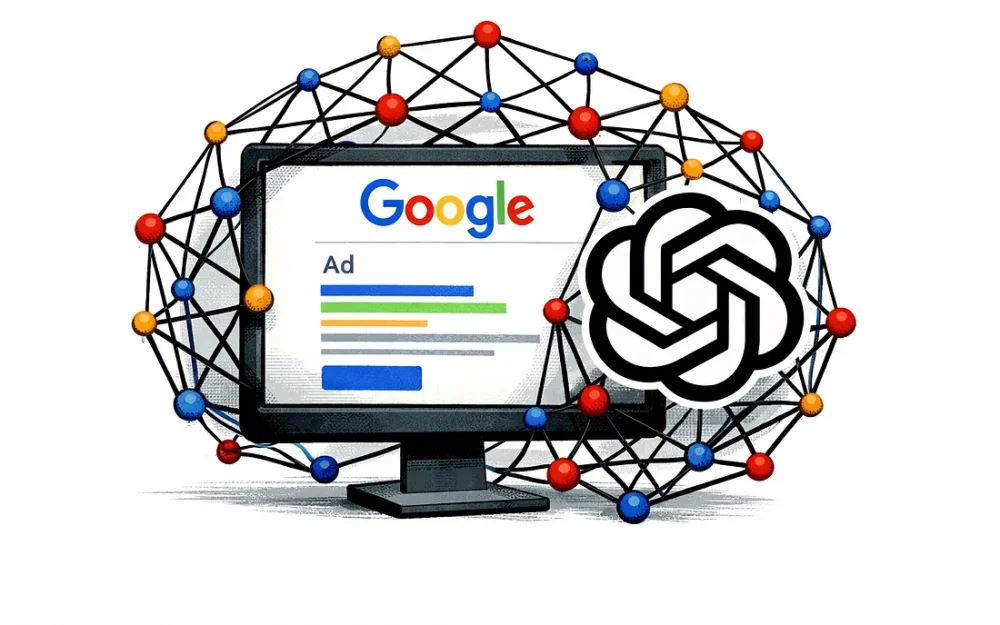
This move opens up a potentially huge revenue source for OpenAI – and poses a colossal threat to the world-dominating advertising empire of Google.
Here's why.
ChatGPT, sell me a toaster
For years, OpenAI resisted the temptation of advertising and kept its chatbot mostly open to the world. For the company, this worked out great.
Offering a massively valuable product for free turned out to be quite popular, unsurprisingly. ChatGPT now has around 900 million active users per month.
Of these, 95% use the free Free or basic Go plan, meaning they either pay $8 a month for the service or pay nothing at all.
Providing cutting-edge AI to one-tenth of humanity, however, is exquisitely expensive: OpenAI expects to burn $115 billion in the next few years.
To raise such funds, OpenAI needs to prove that it can monetize its vast army of free users. Advertising has traditionally been a way to earn from non-paying eyes.
Indeed, in its statement, OpenAI confirmed that its advertising will initially be limited to Free and Go users. It will appear below organic responses and will be clearly labeled as advertising.
The company states that the content of the ads will not determine the responses given by ChatGPT – if you ask it for a toaster recommendation, for example, it will not enthusiastically write about a brand of toasters that happens to be an advertising partner.
But if you ask the bot how to fix a broken toaster – and it turns out that your current appliance is beyond repair – ChatGPT may present you with paid replacement ads.
Enhanced Mailbox
Showing contextual ads alongside organic search results is hardly new: this has been Google's business model for decades, and it brings the tech giant hundreds of billions a year.
What differs is how OpenAI can target its ads.
Targeting ads to specific users is challenging. Google has traditionally done this by collecting vast amounts of data about all of us and then mining insights from that data about what we might buy.
In some cases, it's clear what ads Google should display. If you're searching for "flights to Aruba," you're likely going to Aruba, and the company can profitably show you a billion ads for Aruba hotels, car rentals in Aruba, and the like over the next few months.
But more than half of Google queries are "navigational." These are purely transactional phrases that people enter into the search engine to find something else. Even more queries are short and ambiguous.
Looking at my own recent Google search history, for example, I entered queries like "Sonicare skip slow start," "Rancho San Ramon Community Park," and "which lesser-known American celebrities are popular in Japan."
Good luck determining what ad to show me based on that.
In contrast, when people interact with ChatGPT, they tend to do so at length. The average "session" with the chatbot lasts, reportedly, 12 minutes and 24 seconds.
This is long enough to exchange a significant amount of information. And all that information gives the bot a clear idea of what the user wants – or what they might buy.
In a recent conversation with ChatGPT, for example, I had a detailed discussion about whether a specific board was pressure treated and how that might affect my ability to use it in a laser cutter.
From our long conversation, the bot now knows the exact project I am working on (a mailbox replacement). If advertising were active, it could use this context to try to sell me all sorts of related things: better wood, metal bases for mailboxes, construction glue, and so on.
And it gets even better. ChatGPT knows that I am building a mailbox. But with its Memory feature, it remembers from our previous conversations the exact model of my laser cutter, where I live, and much more about me.
This could potentially allow the bot to show me ads not just for wood, but for wood that works in my laser cutter; that will hold up well in the California climate where I live; and that will be easy for me to work with, given my extremely limited patience and woodworking skills.
Understanding context is a key advantage of ChatGPT in advertising. And this same advantage makes working with AI so powerful for any tasks. Services like BotHub allow you to experiment with various language models, each of which understands context and remembers information about you in its own way.
A shot through the nose
OpenAI's exquisite understanding of its users' needs means that it can likely sell advertising in ChatGPT at premium prices. And since so many people use the bot, its potential advertising market is enormous.
This makes OpenAI a colossal threat to Google – the dominant player in the digital advertising market.
The search engine processes about 8.5 billion queries per day. Since the average person searches on Google about four times a day, this means that Google Search likely has around 2.5 billion active users.
This is roughly three times the user base of OpenAI. But OpenAI is still growing aggressively. Again, the company's users spend significantly more time with ChatGPT than Google users do with their search engine: 12 minutes compared to a mere five seconds on a Google search.
The combination of a massive audience and high engagement time – plus a huge amount of data for targeting – means that OpenAI has all the tools it needs to quickly threaten Google's advertising dominance.
And there is a precedent for how a new player in the advertising world can rapidly gain traction. In 2019, Amazon had only $12.63 billion in advertising revenue. But by 2024, that figure grew to $56.21 billion and continues to rise. And this is with a much smaller number of users than OpenAI.
Make no mistake. OpenAI's statement is a shot across Google's bow.
The company says its advertising program is still in a testing phase. But ChatGPT was also in a testing phase when the company launched it.
This OpenAI product has completely changed the fabric of the digital world, altering how artificial intelligence is created and sold. OpenAI's advertising could soon do the same with how it is monetized.



Write comment