- AI
- A
Top 5 Free AI-Powered Speech Transcription Tools
Imagine: you had an hour-long interview, recorded an important meeting, or finally captured that brilliant idea that came to you while driving. And then the real "fun" begins. Sitting down and manually converting all of this into text, rewinding the recording over and over again. One minute of audio turns into five minutes of work, and an hour of recording eats up an entire evening.
Sound familiar? Just a couple of years ago, this was an unavoidable routine that journalists, students, marketers, and really anyone who had to work with voice suffered from.
But neural networks have turned this game upside down. Today, artificial intelligence transcribes audio faster than you can finish your coffee. Moreover, it doesn’t just produce a jumble of words, but correctly places punctuation, distinguishes speakers, understands accents, and even handles background noise. Technologies that just recently seemed like science fiction are now available to everyone: upload a file, press a button, and receive a ready-made text.
However, there is one nuance. There are so many transcription services that choosing the right one has become a quest in itself. Some work perfectly with the Russian language, others only with English. Some are free but come with limitations, while others cost as much as a streaming subscription but deliver almost perfect results. Some can transcribe in real time, while others require file uploads and a few minutes of waiting.
We tested and compared the most popular neural networks for transcription so you don’t have to waste your time on this. We’ll analyze the pros, cons, prices, and not-so-obvious features of each service. Let’s go!
How will we test?
For the test, we took a small excerpt from a cartoon about Buratino and ran the same fragment through different transcription services to compare the results under identical conditions: we’ll see who conveys the words and meaning more accurately, how the neural networks handle punctuation, whether they manage live dialogues, and how they cope with changes in intonation.
Turn left and look at this person. This is the former street performer Carlo. He is the most dangerous person for our entire tribe. And what makes him so dangerous to us? Because he rarely eats, and when he does, he eats everything down to the last crumb. So there’s nothing to be had here.
Let’s go!
BotHub

The first in our review is BotHub. This is a platform that provides access to a whole set of neural networks, but we are currently interested in a specific model for transcription: assembly-ai-best based on AssemblyAI.
What do the developers promise? A speech recognition accuracy of 92.5% and support for as many as 99 languages. Sounds impressive, but it's worth noting that the main focus is still on the English language. If you're working with English-language content, the service will perform at its best. It also handles Russian, but the results may require a bit of refinement.
Where AssemblyAI truly impresses is in its additional features. Apart from basic audio-to-text transcription, the neural network can automatically label speakers, extract key topics from the conversation, determine the emotional tone of the voice, cut out profanity, and remove background noise.
Model specifications:
Max. response length: 4,096 tokens
Context size: 4,095 tokens
Prompt cost: $8,250 per 1M tokens
Now about the money.
Transcribing one minute of audio costs about 45,800 tokens. Simple math suggests that the bonus will be enough for 6.5 minutes of transcription. It's not much, of course, but it's quite enough to test the recognition quality on your files and decide whether to invest further. So let's grab the bonus and give it a try!
Testing
Response
Turn left and look at this person. This is the former organ grinder Carlo. For our entire tribe, he is the most dangerous person. And why is he so dangerous to us? Because he rarely eats, and when he does eat, he consumes everything down to the last crumb. So there’s nothing to be gained here. Turn left and look at this person. This is the former organ grinder Carlo. For our entire tribe, he is the most dangerous person. And why is he so dangerous to us? Because he rarely eats, and when he does eat, he consumes everything down to the last crumb. So there’s nothing to be gained here.
The text matches the original word for word, without a single error, omission, or distortion. All proper names, specific vocabulary, and interrogative intonation have been correctly recognized. The only thing to note is the absence of punctuation marks (periods, commas), but this is more of a feature of the output format rather than a recognition error. In terms of the purity of transcription of Russian speech - not bad!
Riverside

Next on our list is Riverside. And here it is worth noting the serious technological foundation: the service is built on OpenAI Whisper, one of the most advanced speech recognition models to date. The developers claim an accuracy of up to 99%, support for over a hundred languages, and even understanding of regional accents. Ambitious? Yes. Whisper under the hood inspires confidence.
The platform can distinguish up to seven participants in a dialogue, each of whom is assigned their own label. The number of speakers is specified before processing begins, and then the neural network automatically assigns lines to the appropriate people. However, there is a nuance: if participants speak simultaneously, interrupt each other, or voices overlap, the result may be compromised. In such cases, it will be necessary to manually correct the transcription. But to be fair, this is a common issue with almost all transcription services.
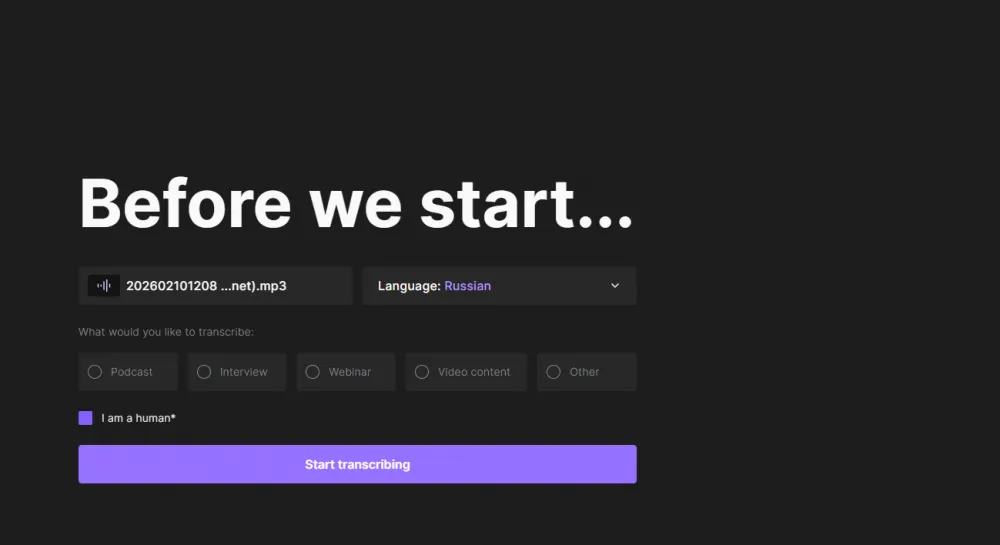
The finished text can be downloaded in two formats: regular TXT with speaker markup or SRT for subtitles. The second option is especially useful for those who work with video content and want to quickly add subtitles to clips without fussing with timecodes.
There is also a built-in editor. It allows you to work with the text and media file simultaneously. It sounds simple, but in practice, it’s real magic: you delete an unnecessary phrase from the transcript, and it automatically disappears from the audio or video recording. This means you can "edit" the recording directly through the text, without any video editing skills. For podcasters, interviewers, and content creators, this is simply a find.
The platform supports the upload of not only its own records made within the service but also third-party files in popular formats: MP3, WAV, MP4, MOV. Everything works directly in the browser, as well as through a mobile application, so there is no need to install additional software.
Testing
Answer
The former organ grinder Carlo is the most dangerous person for our entire tribe. And why is he so dangerous to us? Because he rarely eats, and when he does, he eats everything down to the last crumb. So there’s nothing to live off here.
Despite using the powerful Whisper, the service made several unfortunate errors and even ate the beginning of the text. The first phrase about turning left and the mention of a person completely disappeared, and the former organ grinder turned into something else, which indicates problems with recognizing phonetically similar words. At the same time, it is worth noting that Riverside did a decent job with punctuation and intonational separation of sentences, placing punctuation marks more accurately than the previous participant in the review. But serious manual editing is clearly unavoidable here.
Teamlogs
The third service in our selection is Teamlogs. And the first thing that pleases when switching to the site is the completely Russian-language interface. We upload a file, and the service instantly determines the duration of the audio. You can immediately select the recognition language (Russian and English are pinned for quick access, others are also available) and enable speaker identification.
There are also no problems with file formats. Teamlogs accepts MP3, WAV, MP4, MOV, M4A, MKV, AVI, and OGG. Essentially, you can throw almost anything here, and it will be processed without additional conversions.
Now about the bonuses. After registration, you will receive 15 free minutes of transcription. This is already quite enough to not just poke buttons but to really process a small recording and assess the quality.
Testing
Answer
Turn left. THE END And look at this person. This is the former street performer Carlo. He is the most dangerous person for our tribe.
What makes him so dangerous for us?
Because he rarely eats. And when he eats, he finishes everything down to the last crumb. So there's nothing to scavenge here.
On one hand, the service did not lose the beginning of the phrase like Riverside, but on the other hand, it added a strange artifact in the form of the word "THE END" right in the middle of the sentence, which clearly indicates a technical failure during audio processing. Additionally, the neural network made a gross lexical error, replacing "eats" with "finishes," which distorts the meaning of the original phrase. The punctuation is generally correct, including the question mark, however, the chaotic use of uppercase and lowercase letters (for example, "And" after a period and the lowercase "what" at the beginning of the sentence) spoils the overall impression. Despite the convenience of the interface and the availability of free minutes, the text after Teamlogs requires careful proofreading!
GigaChat

Another strong player in the market is GigaChat, a multimodal development from the Sber team. This service is based on a complex ensemble of neural networks, including ruGPT-3, FRED-T5, and ruCLIP, with the visual part handled by Kandinsky. In the updated version 2.0, released in March 2025, users gained access to three modifications: MAX for the most complex calculations, Pro for creative and analytical tasks, and Lite for quick everyday work. This flexibility allows you to choose a tool for specific goals, whether it's simple transcription or deep content analysis.
The technological superiority of the model is confirmed by benchmark results. In particular, the GigaChat 2.0 MAX modification shows impressive results in the MMLU test in Russian, scoring 80.46 points, which allows it to surpass even serious foreign solutions like Qwen 2.5. For the user, this means not just mechanical sound recognition, but a deep understanding of context, which is important when transcribing recordings.
In terms of voice work, GigaChat offers not just audio-to-text translation, but a full-fledged ecosystem. The built-in smart document editor allows users to upload files and immediately interact with them after recognition: highlighting fragments, asking the neural network to shorten long phrases, correcting errors, or even completely rewriting the text in a different style. The presence of voice input and powerful audio processing algorithms makes the service a versatile assistant for those who value speed and accuracy when working with Russian-language content.
Testing
Response
Turn left and look at this person. This is the former organ grinder Carlo. For our entire tribe, he is the most dangerous person. And what makes him so dangerous to us? The fact that he rarely eats, and when he does, he eats everything down to the last crumb. So there's nothing to scavenge here.
GigaChat showed perhaps the most exemplary result among all tested services. Unlike previous neural networks, it was the only one that did not stumble on the word "eats," preserving absolutely all parts of the sentence, including introductory constructions and proper names. It is also worth noting the work with punctuation and formatting. At the moment, this is the best result in terms of clarity and correctness of the transcription of Russian speech.
Whisper
Completing our selection is the legend of the transcription world - Whisper from OpenAI. Perhaps no speech recognition model has made as much noise in the industry in recent years.
A crucial nuance: you cannot just poke around on the OpenAI Whisper website. There is no cozy window where you can drop a file and wait for the result. The model is available via API for developers, and the most daring can run it locally on their own graphics card. Want to try the most powerful version? Then make sure you have at least 12 GB of video memory. If such luxury is not at hand, there is a simpler way: OpenAI has uploaded the model to Hugging Face, where anyone can play with it.
Under the hood of Whisper is a transformer-class neural network with an "encoder-decoder" architecture, trained on a colossal array of audio data. And when we say "colossal," it's not an exaggeration. It's about 680 thousand hours of audio from open sources.
Its multilingualism deserves special attention. Whisper supports around 99 languages and, conveniently, does not require prior indication of the language of the recording. The model determines this on its own during the recognition process. Uploaded an interview where the speakers switch between Russian and English? Whisper will handle it.
Testing
Response
Turn left and look at this person. This is the former organ grinder Carlo. For our entire tribe, he is the most dangerous person. What makes him so dangerous for us? The fact that he rarely eats, and when he does, he finishes everything down to the last crumb. So there’s nothing to be gained here.
In summary
In conclusion, it’s worth reminding that we should still be cautious in placing unconditional trust in neural networks. They make mistakes, fantasize, and sometimes surprise us in unexpected ways. They are not bad, but only as assistants, no more. Algorithms can speed up routine tasks, simplify the complex, inspire, and save time. The main thing to remember is that behind all these technologies, it's us.
So trust, but verify. And don't forget, you are the one directing all of this in the right direction!
Thank you for sticking to the end! Now it's your turn. Tell us which neural networks have already made their way into your bookmarks? Maybe we forgot about some service? Let's fill this list together!






Write comment