- DIY
- A
"Sweet" overdrive for romantic blues and beyond
Hello, tekkix! Today we will examine and listen to a custom guitar overdrive effect pedal created by an unknown craftsman.
It is built on a very original scheme Honey Bee Overdrive and has a significantly wider range of possibilities than most of the classic options we are used to.
Love Story
In June 1999, Swedish engineer and electric guitar enthusiast Björn Jul founded a guitar amplifier repair workshop in Stockholm, taking on the most complex cases that his colleagues had refused.

Many specialists in equipment repair often just want to get paid for quickly fixing some widely available model, whose schematics, design, and typical faults are well known, and for which spare parts are easily accessible.
It must be said that they are right in their own way: they need to feed their families, and at the same time not deprive themselves of their favorite activities, so that there is enough both financially and in terms of time for the latter.
Björn Jul turned out to be one of those lucky ones for whom all the above components of life did not conflict, but formed a synergy.
Guitar electronics was not just a way to earn money, but a beloved activity, in which he was supported by his wife Eva. Björn particularly enjoyed studying rare old amplifiers, while Eva enjoyed helping her husband in their aesthetic restoration, and later in the artistic design of his developments.
Already in the following year, 2000, Björn presented three innovative pedals at the industry exhibition The Great Scandinavian Guitar Show!
This is what happens when loved ones do not interfere but help each other in their hobbies and ventures. One can only wish that such a spirit of mutual respect and joint creativity prevails in every family on this beautiful planet.
Source of Inspiration
Reviving vintage electric guitars, effect pedals, and amplifiers is always very interesting. I know this from my personal experience. And I'll let you in on a secret: the next article will be dedicated to one such wonderful instrument. Write in the comments if you recognize the model or manufacturer.

However, true gems are rare, and even among them, far from every antique inspires the creation of some new product. It so happened that the second half of 2001 was not the most "productive" for Bjorn and Eva in terms of developments. And they really wanted to bring something truly strong to the exhibition in 2002.
A good friend of Bjorn saved the day — a talented guitarist and frontman of the band Broken Filters, as well as the director of the Stockholm recording studio Rhythm Ace Recordings named Grönius von Schnabelstein-Daniken.

He brought a tube combo amplifier Tremoverb S6422TR, released in 1965 by the American company Supro, for repair. This unjustly overlooked brand of musical equipment boasts a rich history that traces its roots back to the very foundation of the beautiful multifaceted world of stage guitar.
How it all began
In 1920, a talented violinist John Dopera, who moved with his family from Slovakia, opened a workshop for the production and repair of string musical instruments — primarily violins and banjos — in Los Angeles. The USA at that time was experiencing a flourishing of entrepreneurship, inventiveness, as well as music and theatrical arts.
Innovation was in high demand, and it often happened that it was not the inventor who sought out the capitalist, but rather the latter who approached with a request to develop a new product that would help advance his business to a qualitatively new level. Especially if the businessman was himself an inventor and understood how valuable and promising this was.
In 1925, such a case occurred. None other than George Beauchamp, whom we know as the co-founder of Rickenbacker and the inventor of the Hawaiian electric guitar type "Frying Pan." came to Yan.
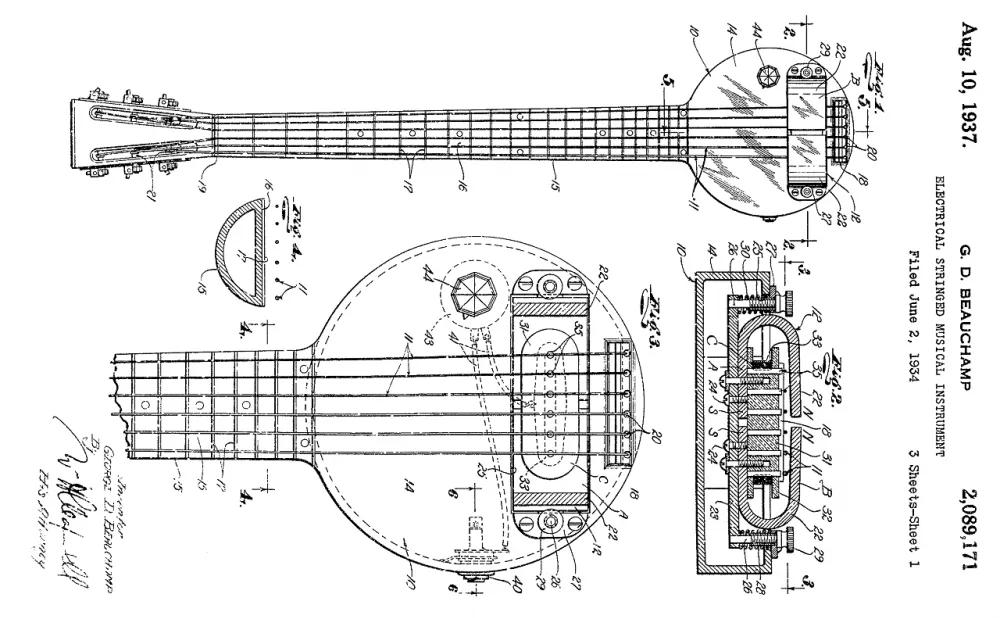
This was the world's first mass-produced electric guitar called Rickenbacker Electro A-22. It was cast entirely from aluminum alloy, after which hardware with an electromagnetic pickup and strings were installed. The guitar had 23 frets without a radius and a scale length of 22.5 inches. There was also a 25-inch version with 25 frets called A-25.
However, even before attempts to electrify musical instruments led to the appearance of the electric guitar, George Beauchamp was looking for ways to increase the volume of guitars mechanically. He was not only a musician but also a vaudeville producer who wanted to sound large stages as effectively as possible.
In a symphony orchestra, the same part on the same instruments is played by several musicians. However, each of them requires a salary, plus additional expenses if it comes to touring. The louder one musician plays, the greater income both he and his producer can earn.
Metal Instead of Wood
For good cooling of a computer processor, a radiator with a large surface area and adequate airflow is necessary, but that’s not all. The system must have excellent thermal conductivity, and this concerns not only the material of the radiator but, first and foremost, the most critical element—the thermal contact between the processor crystal and the heat-dissipating element pressed against it.

Good thermal paste is needed, without which even the most advanced cooling system cannot demonstrate its effectiveness. The same applies to the transmission of energy from the vibrations of the string to the surrounding air.
The best mechanical contact is required throughout the chain from the strings to the sound-producing surfaces, minimizing the conversion of vibrational energy into heat. But that turned out to be insufficient.

Centuries ago, violin makers figured out how to tune the elements of the instruments they created to specific notes. When the body of the violin resonates with the string, it takes a greater power from the latter, providing unexpectedly high volume for the sound of the small wooden instrument.
Metal strings, as opposed to the old gut or today’s polymer ones, have a higher quality factor, which enhances the efficiency of resonant energy transfer of vibrations. But what happens if we also replace the wooden sound-producing element with a high-quality metal one?
Good means well
On March 11, 1929, George Beauchamp filed a patent for the invention of a resonator acoustic guitar with a single metal cone. Patent number US1808756A was issued to him on June 6, 1931.
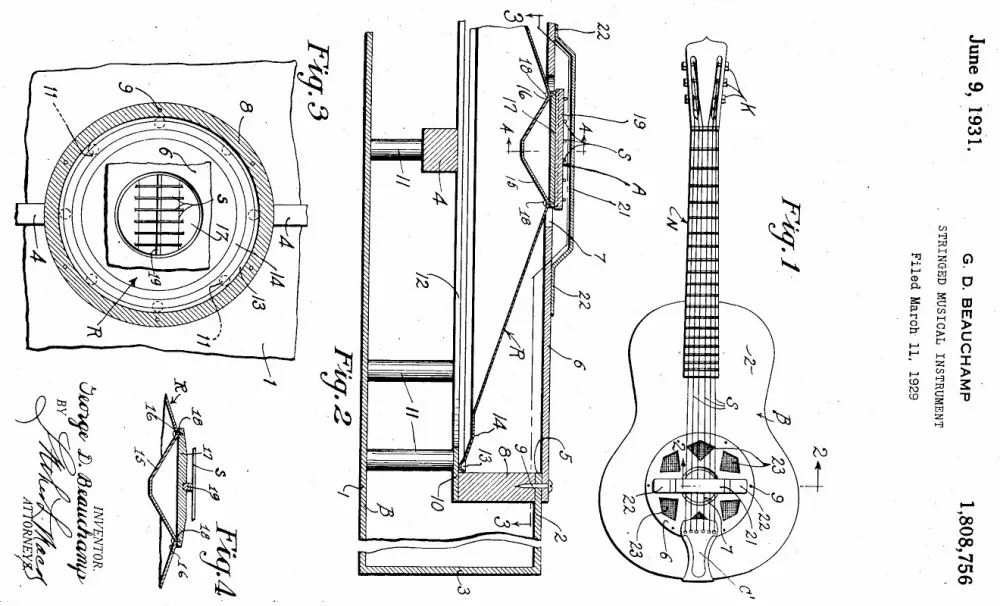
In fact, this development was created even before 1925, when John Dopyera improved his design at Beauchamp’s request, equipping it not with one, but with three aluminum cones.
In 1927, two inventors registered the company National String Instrument Corporation in Los Angeles, producing resonator guitars with metal and wooden bodies.

The following year, four of John’s brothers — Rudolph, Emil, Robert, and Louis Dopyera — suggested he combine their capital and start their own company. It was named Dobro, which is not only an abbreviation of Dopyera Brothers, but also a word meaning good and well in many Slavic languages.
However, this created technical and legal problems for John, as the patents for both types of resonant sound sources — single-cone and three-cone — belonged to the National company.
The talented luthier found a way out by simply flipping the cone over and equipping it with a spider-like structure, in the center of which the guitar bridge was mounted. The patent application for the brother's invention was filed on February 1, 1932, by the more enterprising Rudolph, since John was more interested in creating musical instruments than in business matters.
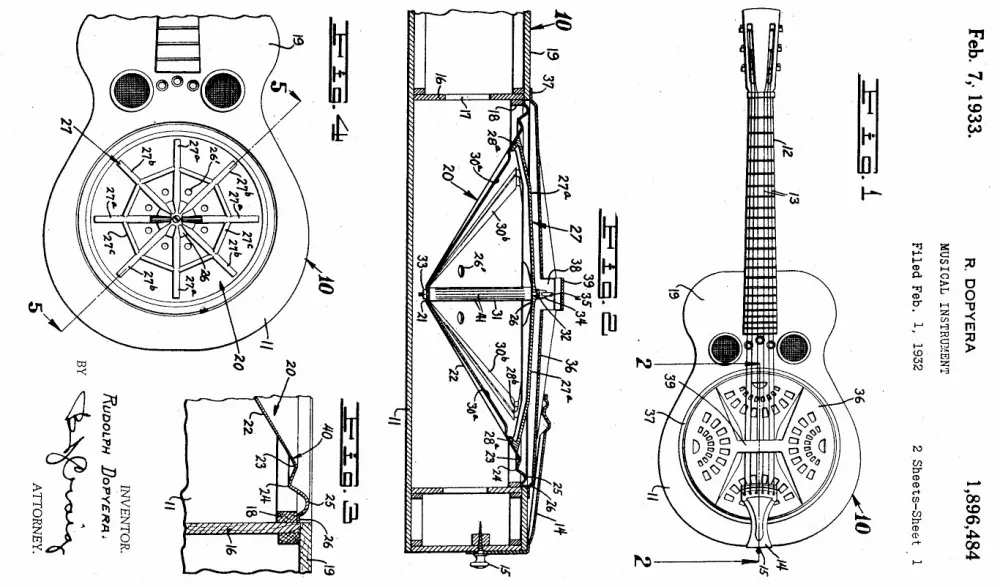
Since then, resonator guitars have gained worldwide recognition, made a huge contribution to the development of music, especially in the bluegrass (English tumbleweed), style, and they are most often referred to by the word Dobro, which has become generic, like the brand names Xerox, Kodak, Kulman, Watman and Aqualung. Please leave comments on what other examples can be given in this regard.
Subsequently, the Doper brothers acquired the National company and merged it with Dobro, while Boshams along with Adolf Rickenbacker became the founders of the Ro-Pat-In Corporation, the name of which was an abbreviation of ElectRo-Patent-Instruments. Later, the company was renamed Rickenbacker.

The enterprising brothers moved to Chicago and in 1940 founded the company Valco, one of whose activities became the production of tube amplifiers for musical instruments under the brands Airline, National, Oahu and Supro. And 15 years later, the very Supro Tremoverb S6422TR combo was born.
Meanwhile, John Dopera remained in Los Angeles, continued to engage in his favorite work, registered more than forty patents, and lived to be 94 years old. He did not amass a vast fortune, unlike his brothers with their strong business acumen, but he was truly happy.
Fortunate Mistake
It was a small five-watt combo amplifier weighing only nine and a half kilograms, equipped with a ten-inch speaker brand Mojotone, and that particular unit sounded very bad even after addressing the obvious faults.
In fact, the hidden reason for the unsatisfactory sound was a winding short circuit due to insulation failure in the power amplifier's output transformer. However, Bjorn Jull learned about this only after several sleepless nights spent tinkering with the amplifier and its circuitry.

This circuit is simple and contains nothing supernatural, however, in this amazing case, it played a role how exactly it is drawn. An overtired person might think that the three cascades on triodes, depicted in the upper right corner, are covered by frequency-dependent global feedback.
In fact, this is just a driver for a spring reverb on two triodes V1 and V2 with subsequent amplification of the output signal by an electromechanical delay line through a triode V3.
Through a 470-kilohm resistor, this signal enters the input of the power amplifier in the lower right, mixing with the signal from the single-stage preamplifier in the upper left through the volume and tone controls.
The second part of the nine-kilogram five-watt combo includes a half-wave rectifier for the anode supply with a four-stage filter to smooth out ripples, as well as a simple tremolo built on a dual triode.

This is a quite common circuit for classic tube tremolo. The left triode serves the harmonic oscillator generator with three phase-shifting RC networks, while the right one shunts the 240-volt line of the anode power supply, which powers all amplification stages except for the two final ones—the power amplifier and the driver for the mechanical delay line of the spring reverb.
Honey Overdrive
After replacing the blown output transformer, Bjørn Juul successfully completed the repair of the combo amplifier, enchanted by its vintage sound, after which he began developing a circuit for an overdrive pedal that could replicate this sound.
Bjørn implemented a frequency-dependent global feedback circuit that he envisioned in the Supro Tremoverb S6422TR combo. And strangely enough, this circuit actually worked in the overdrive pedal.

Compared to the familiar guitar overdrive circuits based on a single operational amplifier, here two feedbacks have been added from the output of the hard clipping section on the back-to-back diodes D1 and D5. These are the circuits R11C10 and R13C12.
We can also observe a unique tone control scheme on the variable resistor RV1. Its left section is involved in the lower leg of the main negative feedback divider of the operational amplifier through the resistor R8, while the right is in the source circuit of the field-effect transistor Q1.
By turning the slider RV1 to the right in the diagram, we boost the rise of the upper frequencies after overload, while simultaneously weakening the roll-off of the lower frequencies before it, and vice versa.
This creates a quite “natural” tone adjustment with a wide range of pleasant sounds in all positions of the knob “Nature”. Apparently, that is why the author named it that way.
Looking and Listening
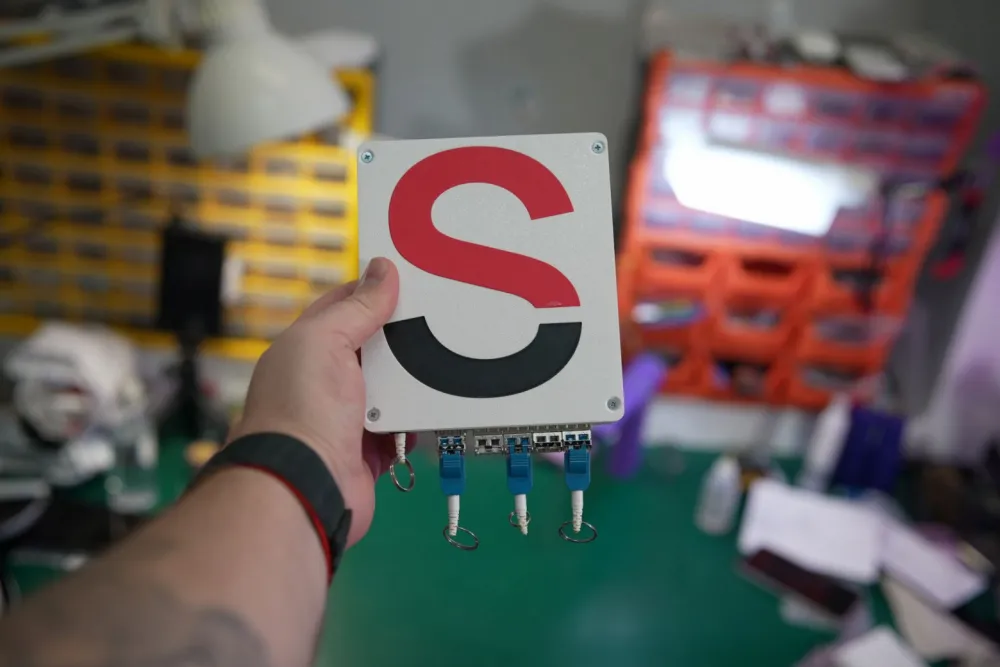
The homemade device uses a factory universal footswitch board and connectors with a black solder mask that I couldn't identify. It resembles a DIY platform from the St. Petersburg workshop Universe Zen. Perhaps this is it, just an old version. Please comment if you know.

The effect circuit is mounted on a breadboard and generously covered in hot glue from a gun. It's hard to say why this was done, but the pedal works perfectly and delights with its sound, as well as its dynamic response to sound extraction.
The “magical” Nature knob truly works wonders, allowing for a variety of distortion structures or simply adding interesting nuances to a clean sound. At the beginning of the video, an interesting-sounding interaction of “bee” overdrive with a phaser is shown.
Strangely enough, this genius pedal can be useful in any genre of guitar music, including extreme metal, if plugged into the input of a high-gain amplifier channel or a suitable distortion.




Write comment