- DIY
- A
A Few Interesting Facts About Ultrasound
Many things have existed in nature for a long time, however, when people discover them, they often come up with quite curious new uses for them — and ultrasound is no exception.
Despite being fairly well studied at this point (by scientists), it still contains a number of hidden possibilities for ordinary people, which are little known to the general public...
Ultrasound refers to vibrations that exceed the range of human hearing, that is, above the 20 kHz threshold.
Ultrasound has been known to humanity for quite some time, although it should be noted that the term "ultrasound" itself appeared relatively recently — the exact date is unknown, but it is believed that the term originated around the turn of the 19th to 20th century, when the prefix ultra ("beyond") was first used by physicists and experimenters of the 19th century in their experiments with the limits of sound perception.
However, ultrasound as a phenomenon was discovered much earlier — it is believed that the first observer of ultrasound in nature was the Italian biologist Lazzaro Spallanzani, who, back in 1794, during his experiments, discovered that bats navigate not with their vision, but using a sound that is inaudible to the human ear*.
*According to modern understanding, bats do indeed use echolocation while hunting, and they can both hear and emit high-frequency sounds that reach up to 200 kHz — and, let's say, the "working sound range" of a specific bat depends on its species.
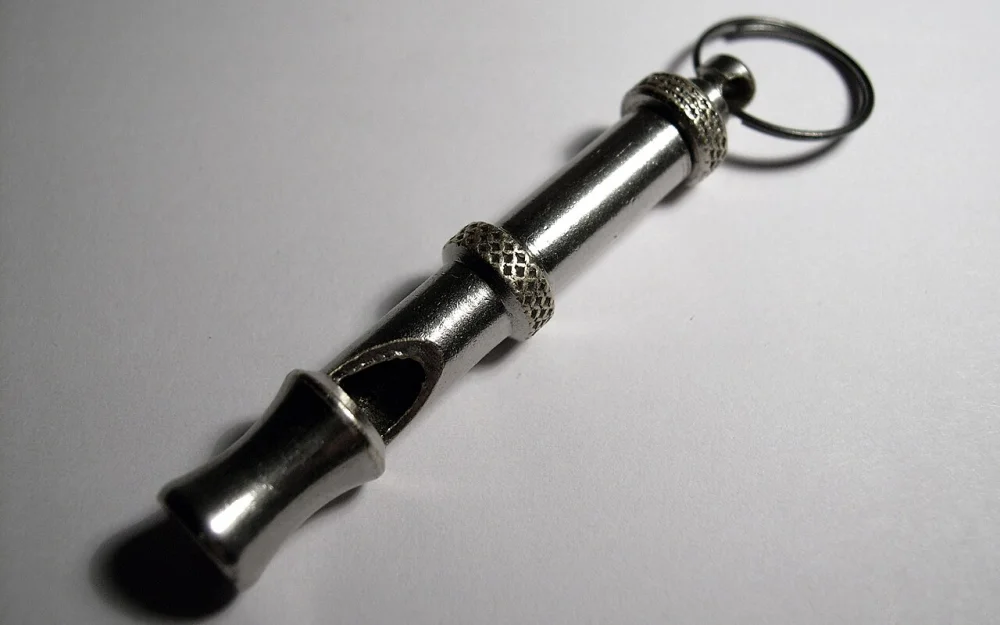
The first attempts at practical applications of ultrasound began in the 19th century, and since then, a very curious and simple invention has come down to us — the dog whistle, which emits ultrasound, audible to dogs (and some other animals), and can be used for communication with them, for example, in training:
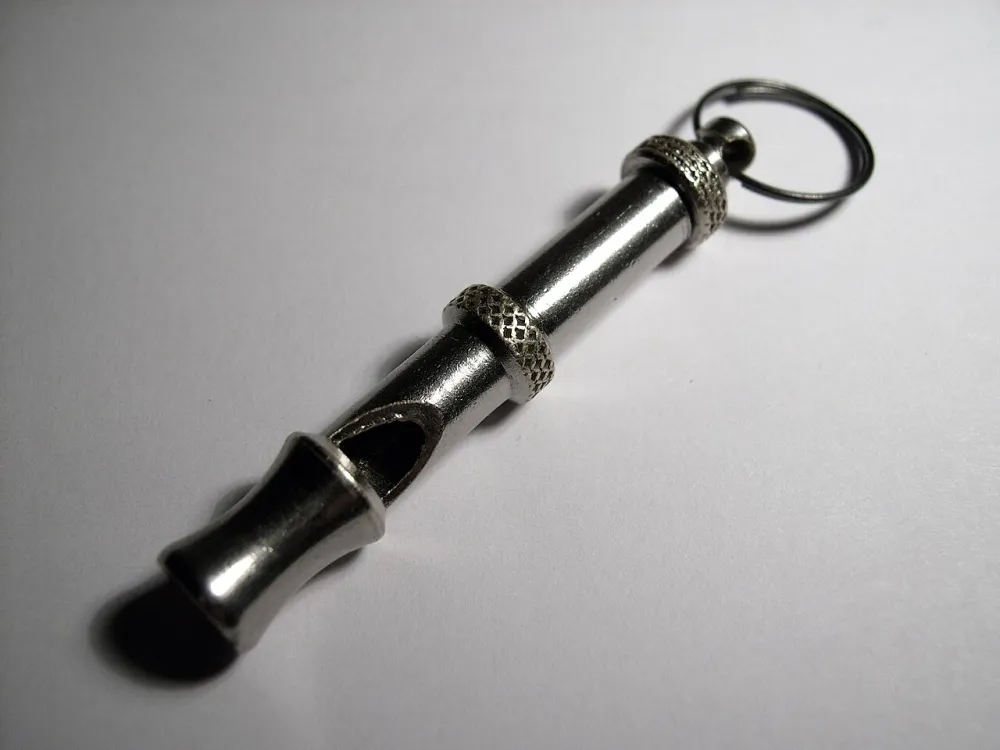
Interestingly, some models of whistles (for those interested) for 3D printing, can be found here. It's hard to say how well they work, but the fact is there... :-)
Nevertheless, the widespread use of ultrasound in practice began only in the 20th century — technical echolocation, non-destructive material testing, welding (for example, welding the straps on well-known medical masks — achieved by briefly pressing the ultrasonic emitter of the strap to the mask, where high-frequency vibrations cause heat (from friction) and weld the materials together), and a number of other applications...
We will not aim to explore all possible and impossible uses of ultrasound, limiting ourselves to just the most interesting ones, in my opinion.
And let’s start, perhaps, with one of the most curious applications of ultrasound (due to its practical applicability)...
But first, it’s probably worth reiterating that there is nothing "magical" about ultrasound — it’s just high-frequency vibrations that propagate through different mediums, where air (or gaseous) medium is just one of them, while vibrations can also propagate in denser materials — such as ceramics, metals, and a whole range of others — from which the possibility of practical application arises.
One of the such applications involves the use of the magnetostriction effect, which is the change in the physical dimensions of objects under the influence of an alternating magnetic field:
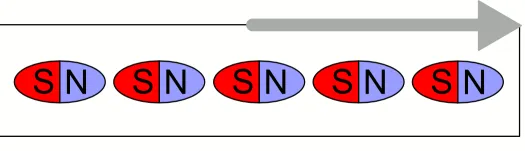
As noted, this effect is observed in all materials, but in some (alfer, nickel, perpendur), it can be particularly strong.
From the point of view of practical application (as well as the accessibility of the material), it is interesting that a fairly obvious magnetostrictive effect is also demonstrated by ferromagnets, which means the possibility of using fairly accessible components to create amateur devices — one of which is cylindrical ferrites, for example, for radio receiver coils.
In the video below, it is clearly visible how, under the influence of a magnetic field at the resonant frequency, there is a sharp increase in oscillation amplitude and the dispersion of a drop of water lying on the end of a cylindrical ferrite:
As can be seen, the magnetostriction effect allows the material (ferrite) to change its physical dimensions at a very high (ultrasonic) frequency, which can be put to useful use.
For those interested, a description of how to assemble a similar device can be found here.
The magnetostriction effect of ferrites is, of course, curious, but for us, practical application is more important, isn’t it? ;-)
And such an interesting option could be a rather unexpected thing: ultrasound helps to solder together objects that are normally unsolderable.
For example, how about this: soldering a piece of glass and a copper wire together?! Moreover, interestingly, without any flux!
Interestingly, the capabilities of the technology are quite broad and allow joining any metals (for example, those that normally require complex fluxes, or even cannot be joined at all), as well as various ceramics, glasses with metals, or glasses with each other!
Below, in two videos, the pre-soldering of the surface is shown — using a factory soldering iron:
And using a transducer from an ultrasonic bath (homemade device; see from 13:06):
It seems that, observing such a wide range of transducer options, with which the effect of tinning and soldering can be achieved, there is an interesting possibility to use cheap ferrite rods (which we considered above) to create the same kind of soldering iron.
Yes, most likely, their performance will be lower, but it seems that such a possibility also exists...
Before talking about this next method, it should be mentioned that recently a rather amusing trend has been spreading on the internet, going by the original names “Butter Run” (“Масляный Забег”), “Churn and Burn” (“Whip and Burn” — a loose translation).
The idea is that runners who do outdoor fitness take with them a zip bag or a small container filled with heavy cream (more than 30% fat), add a pinch of butter, then seal it and run their distance with it.
As a result, due to the vibrations from running, the butter gets churned — that is, the cream turns into a lump of butter! :-)
It is believed that this trend was started by a pair of runners (a guy and a girl) from Oregon, USA.
According to averaged data, it is known that for successful butter churning, the distance should be at least 8–10 km, or about an hour of continuous running.
There’s no slacking off here — it immediately shows how well you ran! :-D
It all looks something like this:
And here, it clearly shows how far you need to run — the guy conducted such an interesting test:
Thinking about all this, a rather strange and astonishing idea came to my mind: you could significantly speed up the butter churning process by using an ultrasonic bath!!!
A quick search showed that apparently I’m not the only one who had such a strange idea :-D and scientists are also interested in this question.
The results of scientific research on this topic show that ultrasonic treatment can indeed significantly reduce the time needed to churn butter, while also increasing its firmness!
Thus, if you are worried that you might be sold fake butter instead of natural butter in a store — you know what to do… :-D
And finally, one of the most interesting and impressive experiments, which is also simple: the appearance of light in a liquid when exposed to ultrasound — this phenomenon is called “sonoluminescence” (since the 1940s) and can be observed in a wide range of liquids, even ordinary water can be used for this.
The core of the effect is the cavitation bubble(s), which, during their collapse, emit a bright flash of light, bluish in color, where the process of bubble growth and collapse can be schematically depicted as follows (left to right):

This process looks approximately like this:
The phenomenon was first discovered during the experiments of the 1930s by scientists H. Frenzel and H. Schultes, who, conducting experiments in a dark room to study cavitation and applying ultrasound to water, found that a bluish glow appeared within the liquid.
*Since bubble collapse occurs at high frequencies, for example, with an ultrasound frequency of 30 kHz, the collapse and growth of the bubble occurs at a rate of 30,000 times per second, so the human eye is unable to distinguish individual flashes at such a high frequency and, therefore, sees the averaged light from many flashes, subjectively perceived as “glow.”
It was found during the experiments that the glow occurs only if gases are dissolved in the water, while completely degassed water (such as boiled water) does not exhibit such properties.
By analyzing the spectrum of the observed glow, the scientists found that it is continuous, meaning it represents a full rainbow, with a peak in the ultraviolet region — such a continuous spectrum (characteristic of heated bodies) immediately led them to hypothesize that the nature of the observed glow is thermal.
Despite the initial assumption, many theories were proposed later, ranging from electrical (the creation of a potential difference and discharge) to the proposed observation of chemical reactions occurring impulsively and emitting light, as well as the aforementioned thermal theory.
Later, the list of theories even expanded to include a proposed thermonuclear reaction! However, the latest version (from the early 2000s) has not been confirmed (but it caused a lot of noise and debate).
At the moment, the most widespread theory is the thermal one, which suggests that the primary source of the observed light is the supersonic (faster than the speed of sound) collapse of the walls of a cavitation bubble, inside which there is an extreme heating of gases, up to 20,000 K (measured temperature; which in degrees is 19,727°C), during which the gas transitions into plasma, emitting a light pulse.
By the way, there is a lot of interesting information regarding the mechanism of sonoluminescence at the link above, so if anyone is interested, feel free to read…
Thus, the observed glow can be an indirect sign of cavitation, and it will be rather dim and hard to distinguish....
However, for those who want a simpler and brighter glow, I accidentally discovered another quite interesting option — quinine in some carbonated drinks is a powerful phosphor and glows very brightly when exposed to ultraviolet light. Although this is no longer ultrasound. :-) But still interesting:



Write comment