
- DIY
- A
Sieve as a Hypothetical Container for Liquid Substances
We all know water is the source of life, and since ancient times people have sought to settle near water sources.
However, the duality of the situation lies in the fact that, on the one hand, people have always sought water, and on the other hand, they have always tried to get rid of it! :-)
That is, they always tried to find a way to protect themselves from the wetting action of water, to eliminate its impact on the body, since its high heat capacity actively cools the human body, and if in hot regions this gives a certain joy, then on most of the Earth's surface, such wetting is fraught with health problems.
And, as you probably already begin to suspect, today we will talk about hydrophobic materials and ways to artificially create water-repellent conditions!
From the depths of the centuries, the story of an ancient Roman virtuous woman - the «vestal», whose duty was to maintain a constant inextinguishable flame, which, according to legend, served to protect the city, has come down to us.
At some point, the fire went out, and she was accused of it happening through her fault, where to confirm her innocence, the woman allegedly called upon invisible forces to help, which were supposed to help her prove her rightness, for which she went with a sieve to the Tiber River, filled it with water, carried it and poured it at the feet of the judges - that is, she performed an incredible action, impossible by its nature:

Since then, in various ancient paintings depicting women, they can often be seen standing with a sieve in their hands - as a physical symbol of chastity and innocence:

However, the legend itself raises many interesting questions, where one of the key ones is probably the possibility of carrying water in a sieve.
Since, by and large, this issue is far from idle - after all, the majority (one might even say, the overwhelming majority) of the materials that humanity uses to protect itself from the weather (especially clothing) are woven and, in essence, represent the same sieve, where the fabrics themselves differ only in density, type of weave and type of threads.
That is, if it were possible to find a way to make fabrics waterproof, it would greatly help humanity to survive!
The issue did not arise yesterday - recall at least the famous "macintosh", a name that has become quite нарицательное (idiomatic), which entered everyday life in the 19th century with the invention by Scottish chemist Charles Macintosh of a special rubberized fabric from which waterproof cloaks and coats were made at the beginning of the 19th century:
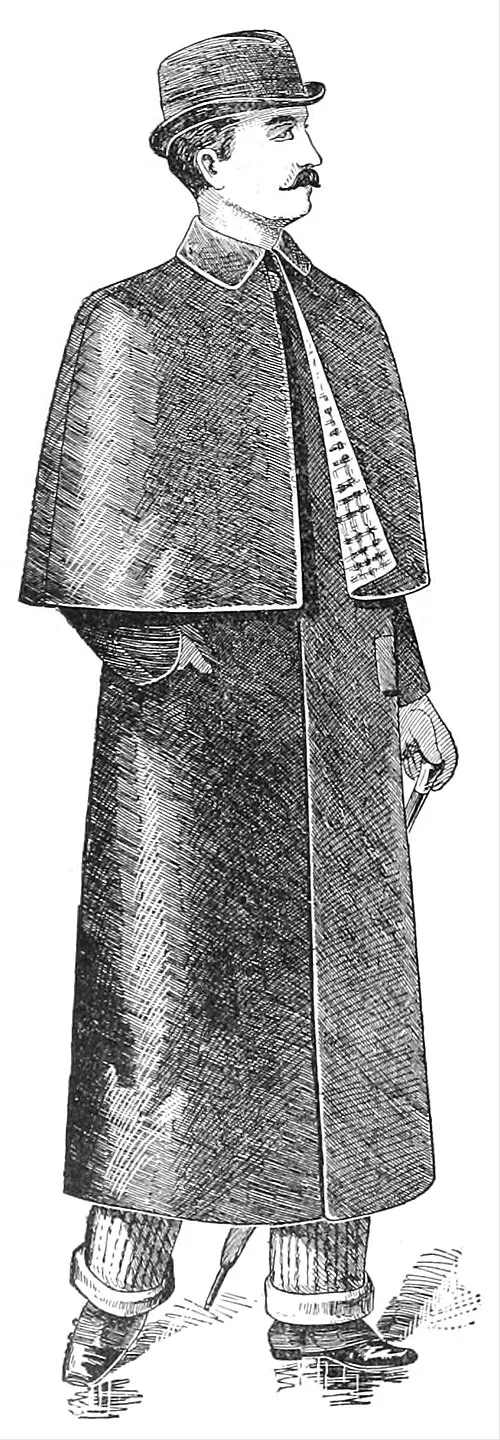
The discovery was made quite by accident when the chemist spilled rubber on the sleeve of his jacket, where, after it had hardened, he found that the sleeve no longer got wet.
Nevertheless, the invention was imperfect: due to the use of natural rubber, the fabric reacted strongly to the weather - simply put, in the sun and in warm weather the rubber softened, glued the folded parts of the fabric together, and also emitted an unpleasant odor; in cold weather, it stiffened and had a tendency to crack.
The problems were somewhat mitigated only by the mid-19th century with the invention of vulcanization, which, however, did not eliminate the problems inherent in this type of clothing:
Complete impermeability to moisture - and this, accordingly, is a real "water bath" with any active movement due to sweating;
All the same stiffening in the cold and softening in the heat, up to burning the skin.
So, as we can see, this was not a solution to the problem at all, but only, in a sense, a "small alleviation of the issue"…
By the way, if we look a little deeper into history, we will see that this Scotsman's invention is not unique — he simply applied old knowledge known to humanity in a new way! Specifically: we all know that since ancient times, a method of "tarring" the bottom and hull of sea vessels has been practiced — that is, simply put, coating them with heated tar, which protected the wood in aquatic environments from destructive water exposure.
Thus, drawing some intermediate conclusion, we can note for ourselves that, for some reason, some substances "attract" water, while others "repel" it, which can be usefully applied, for example, as we have seen, by impregnating water-absorbent materials with waterproofing agents.
And, by the way, jumping ahead a little, it can be said that the words "attract" and "repel" are as appropriate as possible here, since they precisely reflect the essence of what is happening. But we will get to everything in order… ;-)
There is a very interesting field of science called "surface phenomena", which deals with the physics and chemistry of interacting substances and objects, and where when examining occurring phenomena at the micro level, everything observed looks, on the one hand, amazing, and on the other — banally to the point of being impossible! :-)
We are not looking at various surface phenomena for the first time, and in previous articles we learned that, for example, when two objects with a crystal lattice (for simplicity of consideration) rub against each other, their surfaces are, as it were, planes laid out with balls (atoms), where when one surface moves over the other, there is a sort of alternation of "climbing to the tops of the balls" — "falling into the grooves between them", where the size of the balls accordingly determines the size of the grooves between them, and, consequently, the force of friction!
Lubricant, roughly speaking, works in such a way that it is a substance with smaller atoms, and when lubricant is smeared between two rubbing surfaces with a crystal lattice — essentially, "the holes between the atoms of the rubbing surfaces are filled with small balls (lubricant atoms)"!
The end result is something like "road works at the micro level" — the rubbing surfaces level out relative to each other and slide without climbing up peaks or falling into dips. That's a rather interesting fact…
However, this is a somewhat mechanistic example that simplifies the picture, and a much more relevant example for us would be friction between molecular surfaces, such as polymers, where the lubricant binds firmly to the surface. Since such surfaces usually contain polar molecules (that is, parts of the molecule itself have a distinct charge due to an excess or deficit of electrons), if you select the lubricant correctly (also consisting of polar molecules or even neutral atoms), you can make the lubricant literally stick tightly to the surface via electrostatic forces (since opposite charges attract — in the case of polar molecules, or induced polarity in the case of lubricant atoms and surface molecules).
Thus, it turns out that each surface is densely covered with lubricant, and a layer of unreacted lubricant remains between them, so friction essentially occurs between layers of lubricant, and the surfaces do not touch each other at all (and friction, accordingly, drops almost to zero)...
Very recently, we learned that such attractive forces between substances at the micro level can be very significant — for example, ordinary lubrication with soapy water, say of a glass surface, makes it easy to cut glass, because the surfactant in the soapy water is drawn into the microcracks (that is, the gap between atoms) with tremendous force and speed, exerting pressure on the crack walls of more than 1000 atmospheres and thus multiplying the small force applied by a person many times over!
Thus, based on all this, we can say that the task of reducing wettability (i.e., roughly speaking, the "stickiness" of objects) lies in the area of reducing surface energy — as science calls it.
That is, creating conditions such that the surfaces, or at least one of them, are such that they practically cannot (or cannot at all) attract molecules/atoms of the target substance — that is, they are as electrostatically neutral as possible.
In literature, when discussing this issue, they usually refer to some "wetting angle" — which essentially denotes the degree to which a drop spreads across a surface depending on the magnitude of electrostatic attraction forces between substances:
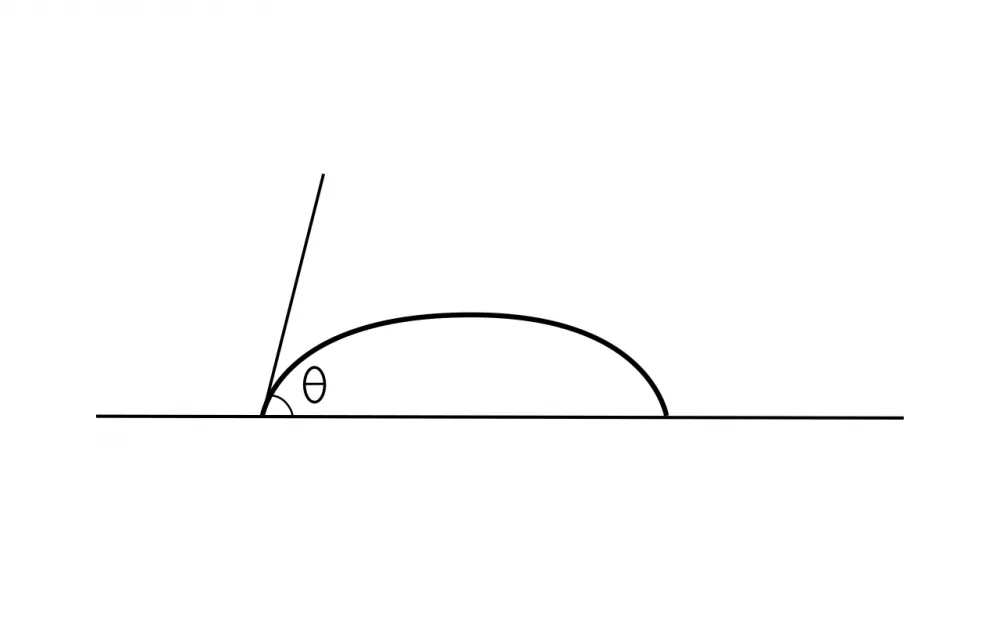
Thus, in general, when solving this task, one should strive for the angle to be 90°.
How to achieve this?
The fight against wettability can be conditionally divided into two directions:
1 direction: as one would logically assume (and this is true) — one of the most common directions is actually reducing surface energy, which is achieved either by creating a surface from a material with low surface energy (less common), or by treating the surface with an external substance that reduces its energy (more common).
If you look at the composition of widely used water-repellent sprays, it is easy to see that their composition mainly contains two components: organosilicon compounds (i.e., silicones — in cheaper options) and fluoropolymers (in more expensive cases).
The relative cheapness of the former and the relative expensiveness of the latter are determined by production technology, as the former are easier to manufacture.
If anyone is interested, I found a certain rating of water-repellent products in spray form here — it may be useful to someone.
2 direction: as we found out, the main force affecting wetting is electrostatic, and based on this, one could also hypothesize that simply moving two interacting surfaces away from each other will significantly reduce the electrostatic interaction forces between them as well.
In fact, this is exactly what is observed in living nature, fully confirming the hypothesis: the leaves of many plants and the surface of insect bodies are covered with such microrelief that simply minimizes the interaction of surfaces with each other, moving them a certain distance apart.
What's more, interestingly, nature uses this phenomenon both for completely repelling water and for repelling and retaining it at the same time!
For example, let's look at the picture below:
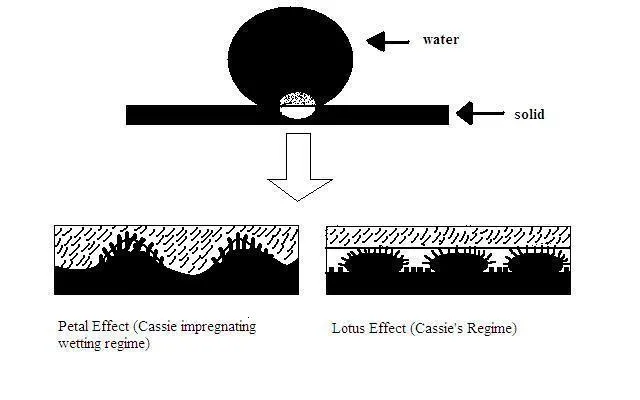
On the left is a rose petal, which, as can be seen, contains microfolds and nanofibers, and on the right is a lotus leaf, entirely covered with outgrowths and microfibers.
Correspondingly, their behavior also differs: the rose on the left both repels water and retains it at the same time — as a result, the water drop almost retains its spherical shape.
I have not found any explicit descriptions of this, however, according to my assumptions, this mechanism can serve to reduce water evaporation (after all, roses are "land plants") by reducing its spreading; and at the same time, the entire surface structure serves to hold water so it does not roll off (we reduced evaporation, and now we need to preserve the water).
On the right, you can see the exact opposite case: the leaf of the water lotus, whose surface structure is fully aimed at repelling water (I assume this naturally follows from the aquatic nature of the plant, where there is more than enough water for it, and on the contrary, it needs to get rid of it).
Rough calculations show that it is enough to move the surfaces apart by a distance of several nanometers for the force of their mutual electrostatic attraction to become so small that it can be neglected — which is exactly what we see in nature.
It is curious that if you refer to the link above where I shared a rating of water-repellent products, you can see in the description of some of them that, among other things, they «create a microsurface structure», which is presumably achieved through the self-organization of the mixture’s components as they dry, forming this microsurface structure.
Thus, what we have here is a sort of hybrid approach between the first and second options: both chemical neutralization of surface energy, and physical separation of surfaces from each other…
By the way, this hybrid approach can be reproduced extremely easily on your own! You’ll never guess how! :-D
All you need to do is blacken the surface with an ordinary candle! What happens as a result: paraffin combustion byproducts will coat the surface with «greasy soot» (which itself has minimal surface energy), and on top of that, the soot settles on the surface not as a smooth coating, but as a microrelief, so this coating demonstrates surprisingly strong water repellency!
However, like other methods, for example, the treatment of mesh or net-like structures was tested in the video below:
Rubbing with cooking fat (3:40);
Rubbing with olive oil (4:33);
Coating with water-repellent spray (9:33);
Coating with soot (5:34, 9:12);
Coating with wax (6:08, 8:54).
As we can see, all these methods work great (even though they look quite strange in the process!) and let you «carry water in a sieve» just fine!
And what’s interesting, for example, in the case of the soot coating, according to my estimates, the hole diameter was around 2 mm, which in no way prevented the water from being held successfully! Amazing!
Looking at all this, I got the idea that it would be very interesting to make clothing, almost out of mesh, that would ventilate perfectly and wick moisture away from the body, while at the same time successfully holding water — for example, rain! Theoretically, this thing would be epic, head and shoulders above membrane technologies! «Leaky umbrella» or «mesh clothing» — what do you think? :-D
As far as I could find out, this idea did not only occur to me and is fully in line with current scientific trends — for example, interesting materials made of fine woven meshes (mesh size does not exceed 125 microns, with this class of materials called Hydrophobic Mesh) have already been developed, and they are impregnated with fluoropolymer materials directly during production.
As a result, as the manufacturers themselves claim, a very affordable and efficient material is obtained, which is cheaper than any membrane technology, and it removes moisture evaporated from the body in gaseous form much more efficiently than any membrane (which is not surprising, it's just a mesh after all!), and at the same time, due to almost complete non-wettability, it does not allow moisture from outside to penetrate:
I want to say that while reflecting on all this, I came up with a rather striking idea of how hydrophobicity could also be implemented (and theory says that this is feasible), in a way no one has done before. ;-) So...
Some time ago we learned about such an interesting effect called electrowetting, and saw that it is used quite widely in a wide range of fields.
This is especially clearly demonstrated in microfluidic technologies in the field of medicine and biology: a large array of metal electrodes at the bottom and a transparent electrode on top (applied directly to glass) allow manipulating liquid droplets in a very wide range, creating miniature reactors where reagents are separated and mixed.
For demonstration purposes, this can even be presented in the form of a kind of computer game (although this is just a demonstration show, the essence of which is much deeper):
In a similar way, microfluidic chips are created for the medical field, soldered into a board and containing a complex system of microtubes and reactors, which allow performing complex blood analysis, virus detection, etc. in just a few minutes.
That is, from this we understood that with the help of electricity, liquids can be manipulated very easily!
Now let's assume that two grids of insulation-covered electrodes are located at a small distance from each other — for example, where the distance is the same as the cell size.
Next, you probably already figured it out: we apply supply voltage to both of these grids — and we create a capacitor! O_o
Where the liquid tries to seep through the lower grid — but cannot do so! Why? Because it is also polarized and is attracted to the upper grid! O_o
There is no short circuit, practically no current, and only the negligible self-discharge current of the capacitor remains! O_o
Voilà: electrically controllable hydrophobicity!
Now let's assume that these two grids are made in the form of microgrids integrated into the surface of clothing — and such clothing acquires the property of hydrophobicity, and it does not fade over time!
Just make sure to charge the batteries on time,
if you don't want your underwear to get wet! :-D
And now watch your fingers, because it can get even cooler: let's assume one grid is shifted relative to the other, by one electrode.
Why is this needed? Here's why: thanks to this, we create a standing wave in the liquid by applying supply voltage to the grid electrodes in such a way that the maxima and minima of the standing wave are located exactly opposite the grid holes (this is achieved by selecting the frequency of the supply voltage).
The picture below is somewhat exaggerated; in reality, everything between the electrodes is filled with liquid and only the waves in it oscillate:
The picture above was drawn a little earlier, and after thinking about it some more, I realized that it is not even necessary to shift the grids relative to each other — everything works perfectly fine just by selecting the frequency of the supply voltage!
What a standing wave is (if anyone forgot) is shown in the picture below, with a black line:
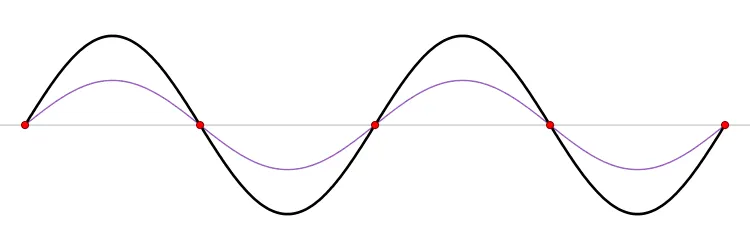
What do we get in the end? Instant water spraying from the holes! O_o
And even more: water, the moment it hits the mesh surface, instantly sprays out! (it's a raining man… well or whatever it's called… :-D).
Not bad, right? ;-)
A quick search shows that nothing like this exists at the moment, and this idea of mine is quite an innovation... :-)
© 2026 LLC «MT FINANCE»


Write comment