- Gadgets
- A
NexPhone — a smartphone with three operating systems. What is this wonder?
The idea of a single device for all occasions has been in the air since smartphones became powerful enough to rival laptops. Just think of the Motorola Atrix with its dock that tried to turn a phone into a computer-like device, or Ubuntu Edge from Canonical—an ambitious project promising both Android and a full-fledged Linux in one body. Microsoft went its own way with Continuum in Windows 10 Mobile, allowing Lumia to connect to a monitor and run desktop applications. Samsung continues to develop DeX, where flagship Galaxy devices provide a desktop mode.
The problem always boiled down to architecture. ARM processors in smartphones didn't get along well with classic Windows, while Linux on mobile devices often existed in containers or emulators, and a full desktop required separate hardware. Enthusiasts installed custom firmware, but for the average user, it remained too complicated. Ultimately, most simply accepted the situation: phones for communication and entertainment, laptops for work. And now, in January 2026, Nex Computer, known for its NexDock docking stations, has decided to surprise everyone by releasing its own smartphone — the NexPhone. This device, out of the box, supports Android, runs Debian, and even allows rebooting into Windows 11. Let's take a look at what it offers and how it works.
By default, the NexPhone runs on clean Android 16 — without unnecessary software, featuring a lightweight NexOS interface. In regular mode, it is simply a mid-range smartphone: calls, messaging, navigation, everyday apps — everything works quickly and without surprises. However, if more is needed, Debian can be launched directly from Android as a separate application with hardware-accelerated graphics. This is not a stripped-down terminal “for show,” but a full Linux environment with windows, a terminal, a package manager, and access to the common file system.
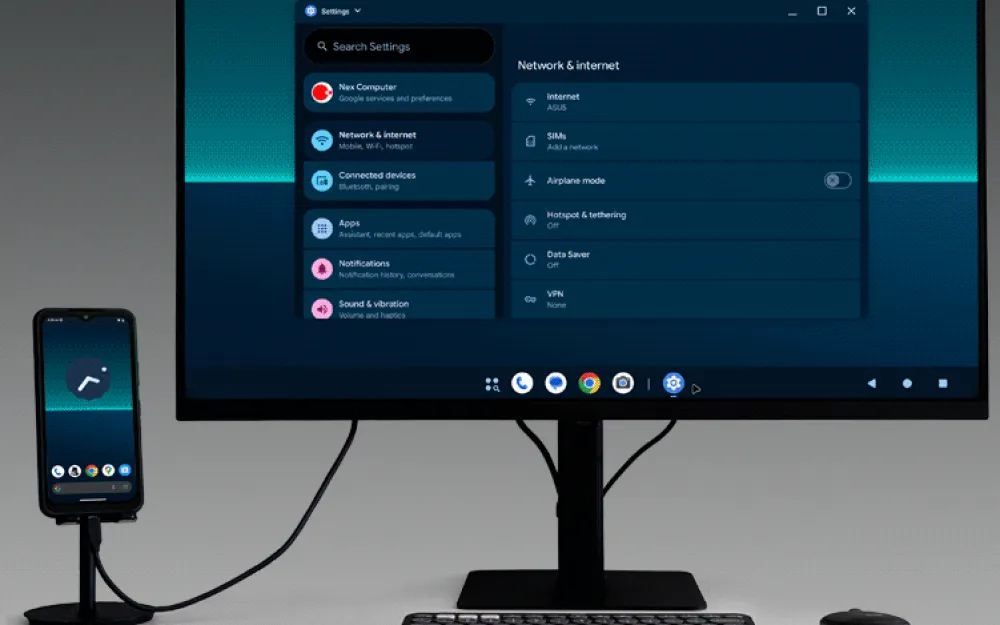
When connected to an external monitor, Linux expands into a normal desktop interface. At this moment, the smartphone effectively turns into a working computer: you can write code, work with documents, or engage in administration without feeling like you're inside an emulator or a mobile compromise.
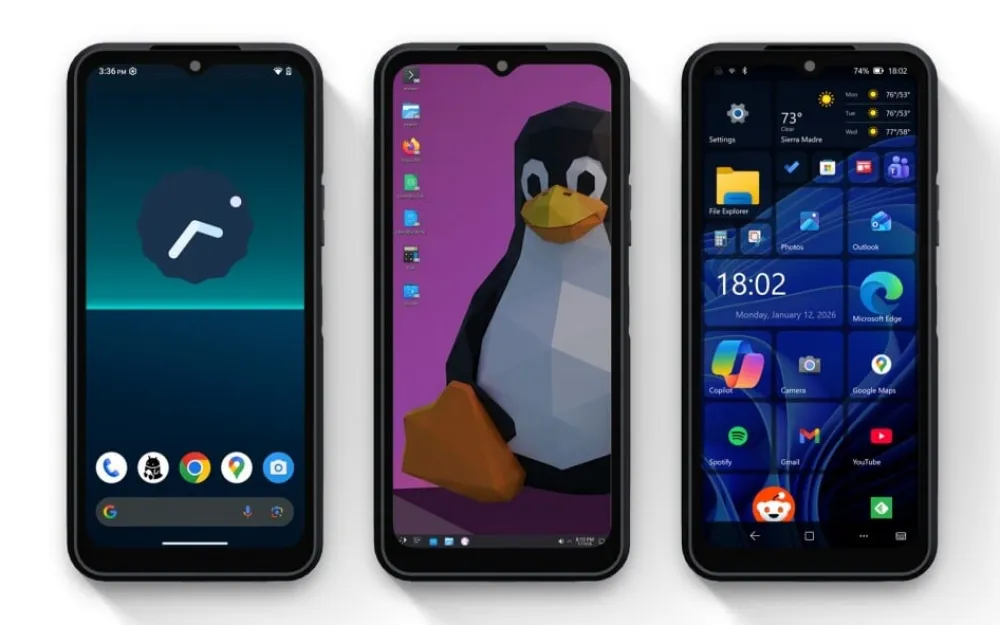
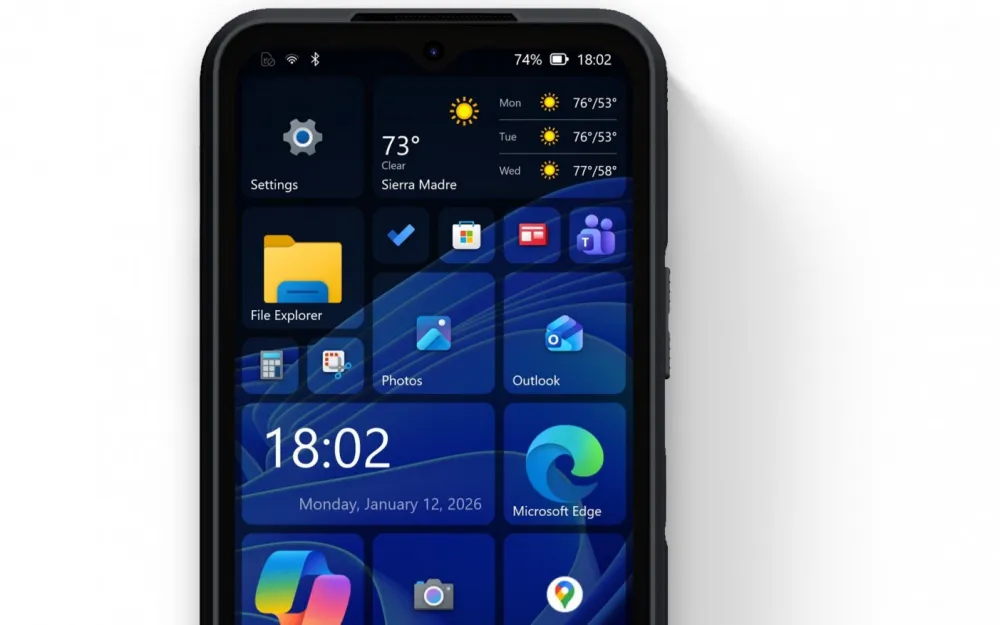
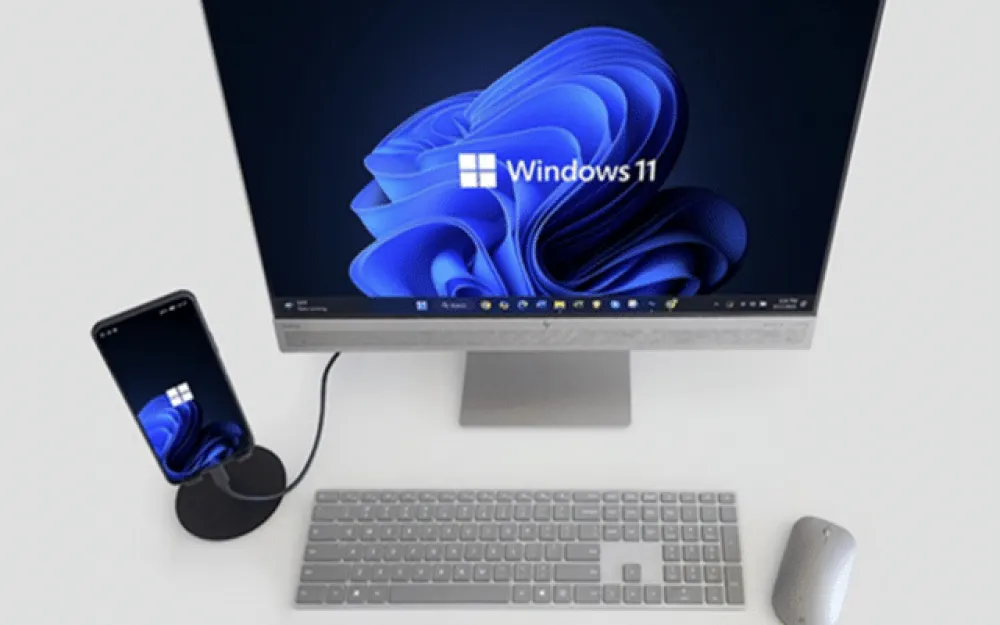
For those who are tied to the Microsoft ecosystem, the NexPhone features dual-boot with Windows 11 on ARM. The system is selected at boot time, and in this mode, the device is perceived not as a smartphone, but as a compact PC. On the built-in screen, the interface is adapted for touch control—large elements, simplified navigation, reminiscent of the approaches from the Windows Phone era.
When connecting an external display, keyboard, and mouse, Windows expands into the familiar desktop environment. You can run Office, Edge, development tools, and lightweight applications without emulation or virtual machines. This mode is made possible by the fact that the processor used is officially compatible with Windows 11 on ARM, and installing the system does not require workarounds or non-standard modifications.
The package comes with a multi-port USB-C tekkix hub, allowing you to charge the device while connecting peripherals. The company also offers its own NexDock docking stations if you want a full laptop form factor. The transition between modes is well thought out: disconnect from the monitor—you return to mobile mode, reconnect—you continue from where you left off. This is not a scenario where one system launches another within itself through emulation or heavy virtualization: Android and Windows run directly on the hardware, while Linux runs with direct access to graphics and the file system.

Selectel Mobile Farm
Start testing on real devices in 2 minutes—from anywhere.
Try it
The NexPhone hardware is a solid mid-range device with a focus on reliability and durability. At its core is the Qualcomm QCM6490—a chip originally intended for industrial devices and the Internet of Things, but with performance close to the Snapdragon 778G. It's not the latest option, but Qualcomm promises updates until 2036 for all three systems. The power is sufficient for office tasks, programming, or web surfing. However, it is not designed for heavy gaming or complex video editing.
The body is plastic with a rubberized coating, available only in dark gray. The device is hefty at 256 grams and 13.1 mm thick, but it's fully protected: IP68/IP69K for dust and water, plus military standard MIL-STD-810H for shocks and extreme conditions. The 6.58-inch display has a resolution of 2408×1080 and a refresh rate of 120 Hz, covered by Gorilla Glass 3. The 5000 mAh battery lasts a couple of days in mobile mode and supports wireless charging.
The cameras are average by today's standards: a main 64 MP on a Sony IMX787 sensor, a 13 MP ultra-wide, and a 10 MP front camera. Connectivity is up to par—5G, Wi-Fi 6E, Bluetooth 5.2, NFC. The bootloader is open, allowing experimentation with firmware.
Developers clarify: when booting Windows 11, the smartphone does not function as a phone. This system runs in a separate OS mode, rather than on top of Android, so incoming calls and messages are not handled during this time. For this reason, the NexPhone is positioned not as a universal smartphone replacement, but as a secondary device—work or desktop. In short, it's for those who spend a lot of time in front of a monitor and use their mobile as a compact PC.
Many ideas that seemed revolutionary ten years ago have not yet been widely realized. Samsung DeX exists, but it's still Android in a desktop wrapper. Apple keeps Continuity within its closed ecosystem. Here, there is true freedom: three different systems on one hardware. Of course, questions remain: how stable everything works in practice, whether 256 GB is enough for multiple OSes, and how the battery life holds up in desktop mode. Full reviews will appear closer to the release.
If the company delivers on its promises for support, NexPhone could become a hit in the enthusiast niche and for those tired of carrying multiple gadgets. Not for everyone — most will still choose a flagship from Samsung or Apple with top-notch cameras and performance. But for developers, experimenters, or people who often work at a desk, such a versatile tool looks very appealing. The price is $549. Not too much, really. Deliveries are set to begin in the third quarter of 2026, with shipping promised worldwide.
In an era when smartphones have long outstripped many old computers in power, the idea of one device instead of all seems natural. NexPhone is perhaps the boldest implementation of this idea in recent years. Would you consider getting such a smartphone, or do you think the gadget is unnecessary? Share your thoughts in the comments, it's interesting to know what you think.






Write comment