- Gadgets
- A
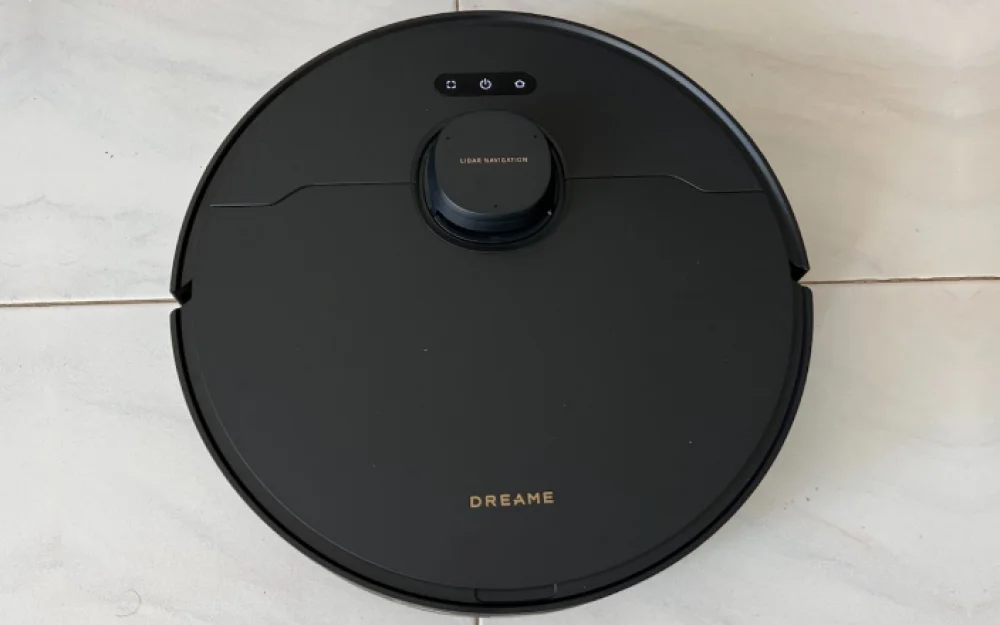
Dreame L40s Pro Ultra: a robot vacuum that lets you forget about cleaning. Personal experience
I continue the series of posts about robot vacuums. They have long ceased to be a curiosity: technological evolution has turned the chaotic rolling machines that get stuck under sofas and in wires into full-fledged powerful cleaning units. And I know what I'm talking about, as I bought my first robot vacuum from iRobot in 2008. Back then, I bought two at once - a dry and a wet one, Roomba and Scooba. Since then, I've regularly updated my "fleet."
The latest device from iRobot is the Roomba 896. It worked honestly for several years, handling its duties well. But with each passing year, it became more obvious: technology has advanced far ahead, while iRobot, the manufacturing company, is falling behind. I wanted something super modern. For a while, I looked at the Roborock Saros Z70 with a manipulator that picks up everything that is out of place. But I was reluctant to spend one and a half thousand euros. In the end, I chose the Dreame L40s Pro Ultra — one of the most advanced models available today. After a couple of months of use, I will share my experience.
Unboxing and First Impressions
The box arrived solid; it was immediately clear that something big and probably cool was inside. The self-service station for the robot takes up a lot of space, but without it, the whole idea of a premium model loses its meaning.

The package includes everything necessary: the device itself, a base with tanks for 4.5 liters of clean water and four for dirty, several bags of 3.2 liters, spare mops, a side brush, and a bottle of concentrated cleaning solution. There was nothing to buy additionally for starting.

The robot itself looks solid: its weight is about 4.2 kg, height 103.5 mm — standard for models with lidar. On top, there's the familiar "tower", and in front, a camera. Below is the dual DuoBrush, which, according to the manufacturer's promise, does not get hair tangled (spoiler alert: true), and two rotating mops. The station is tall, almost 60 cm, with a transparent compartment for the bag and a washing tray.

The connection went smoothly. The Dreamehome app found the device instantly and immediately offered to scan.

In just over twenty minutes, the robot walked around the apartment, created an accurate map of the house, and marked the carpets. It also inferred the purpose of each room (kitchen, bedroom, etc.). It was extremely interesting to observe this exploration of new space.
Even at this stage, the difference with iRobot was noticeable: no chaotic driving, everything was methodical and predictable.

The ultrasonic carpet sensor activated immediately: as soon as it drove onto the pile, the mops (or cloths, I’m not sure how to translate that in this case) lifted by 10.5 mm, and the power increased. A small detail, but it shows how well thought out everything is here.
Navigation and obstacle avoidance
It is one of the most reliable among household robots, and this is well felt during real cleaning. The lidar is responsible for the accurate mapping of the space: the robot quickly scans the area, clearly understands the shape of rooms, walls, corridors, and immediately builds a logical route. It does not drive "by feel" and does not dart around—everything is planned in advance, so the cleaning proceeds in smooth passes, almost without unnecessary overlaps.
The front camera is not needed for overall navigation but specifically for dealing with obstacles. The robot recognizes small objects on the floor—cables, socks, toys, bowls, shoes—and in most cases, it carefully navigates around them. Compared to older models, the difference is huge: there are almost no jams. I can say this with confidence—I have tried many vacuum robots over the years.
Even if it gets caught on something, it usually frees itself without manual intervention. A couple of times the robot got tangled in a curtain (it ran into it, part was lying on the floor, the fabric is very thin, so it wound around the brush). It could not untangle itself from it, which it reported pitifully in the app, saying it needed help.
The thresholds of about four centimeters are passed confidently — the lifting system works stably, without long attempts and swaying. It's even surprising… Moreover, this is not all: the company’s developers recently proposed a robot with "legs" that help it climb stairs quickly. As for my model, it is extremely useful in apartments with transitions between rooms or between tiles and parquet.

There are also no problems in the dark. The lidar does not require light, and for the camera, a backlight is turned on, so the night cycles go smoothly: the robot does not suddenly start stomping in one place or getting confused in familiar areas.
An additional plus is the logic of continuing cleaning. If the area is large and the battery is running low, the robot returns to the base, charges, and returns exactly to the same spot, rather than starting the room over again. It may seem like a small detail, but it is these little things that create the feeling that the system is already "mature."
When comparing to the era of random movement and primitive sensors, the difference is colossal. Here, almost nothing is missed, time is spent rationally, and manual intervention is rarely needed. For me, this is just the level where navigation stops being a topic for discussion — it simply works.
There is also another point. If desired, you can connect to the camera remotely while on vacation or a business trip. And check if everything is okay at home. From the robot's app, you can "ask" it to travel around the house. And this is a really cool feature. It also has a microphone and speaker, which serves as a means of communication with household members. Who knows — maybe someone is not answering the phone.
Cleaning
Here it is worth dividing into dry and wet modes for a proper comparison.
Dry Cleaning
The maximum power is 19,000 Pa — a figure that sounds impressive. And it is justified; at maximum, the device picks up everything: dust, fur, crumbs, even small pebbles at the entrance. Recently, I had a strong wind, and the veranda was covered with dirt, small gravel, and other debris. The vacuum handled it without any issues.
The side brush automatically extends near walls, the ultrasonic sensor instantly reacts to carpets and increases the power. The mops lift up so as not to touch the fabric.

The dust container inside the robot is small, but the station empties it into a 3.2-liter bag after each cleaning — it needs to be changed every one and a half to two months. Compared to iRobot, the vacuum is almost silent. On carpets, however, it is noisier due to higher suction. But when it moves around on the floor, it is hardly noticeable. It also makes sounds when cleaning the mops.
There are also nice little features: recognizing particularly dirty areas prompts the robot to clean those spots multiple times. As a result, carpets become noticeably cleaner, and dust stops accumulating in the corners. The mechanical cleaner manages to remove it with its side brush.
Wet cleaning and self-service
This model shines the most during wet cleaning. Instead of an ordinary cloth, it uses two rotating attachments that press firmly against the floor and not only wipe the surface but actually clean the dirt. One of them extends to the side and gets almost close to the baseboards and furniture, so the characteristic streaks along the walls practically disappear.
The docking station does all the dirty work for you. The attachments are rinsed with hot water, detergent is added if necessary, after which they are thoroughly dried with warm air. The tray in which this happens is also cleaned automatically. As a result, there’s no dampness or unpleasant odors.
The volume of the tanks is sufficient for several full cleanings, so there’s no need to run around with canisters after each run. When the robot finishes a combined cleaning, the floors look significantly better: fresh tracks disappear after one pass, while dried stains are removed at most after two passes. Different parameters can be set for different rooms: in some places, the water supply can be increased, while in others, only a light wipe is needed.
By the way, if necessary, the robot can leave the mops at the station and go vacuum the room instead of washing. It does this, for example, when the water in the tank runs out.
Comparison with iRobot Roomba 896
The Roomba 896 belonged to an era when navigation was based on random wandering, and wet cleaning was virtually nonexistent. Everything depended on how well the robot stumbled upon dirt and whether it could return to its dock. Dreame, on the other hand, offers a completely different approach: full autonomy, hot washing, smart recognition — all of which transforms cleaning from a routine task into a process that requires almost no attention.
The Roomba 896 was a typical representative of its time — around 2017. It featured the AeroForce system, rubber rollers, a power of about 1700 Pa, a HEPA filter, and a basic app with scheduling. Its battery lasted for an hour of operation, and the dustbin held 0.6 liters, which had to be cleaned manually. This was sufficient for home use.

But navigation was a lottery. The robot moved around the house randomly (it did have an algorithm, but it was imperfect), often bumping into the same spots, sometimes missing areas, and getting stuck under furniture. It did not build maps. It returned to its dock via infrared signals but would occasionally get lost. Everything required attention: cleaning after each cycle, manual route control, and separate floor washing.
The Dreame L40s Pro Ultra represents a different era. Its power is ten times higher, featuring lidar and 3D scanning, precise maps, and route planning. It has a good brush that rarely tangles anything (though it can happen). And of course, it offers full wet cleaning with hot washing and drying. The 5200 mAh battery provides a couple of hours of operation in quiet mode, and the station is fully autonomous. The robot returns to it without fail — it has never gotten lost.
The app offers detailed settings, voice control, and statistics. Transitioning from the 896 model feels like a generational shift — from a system that required constant supervision to an assistant that handles almost everything on its own.
What Could Be Better
Even the Dreame L40s Pro Ultra has weak points, and some of them surface not in reviews but in everyday use. It’s worth starting with the station. It is genuinely large: almost 60 cm tall and noticeably deep. You can’t place it just anywhere; you need to plan where and how you will position it. Not everyone will be able to fit it into their interior.
Noise is another point. In normal modes, it is quite tolerable, but at maximum power, especially on carpets, the robot becomes noticeably loud. It's not critical, but there's another nuance. Over time, hair wraps around the right wheel (specifically the right one, don't ask me why, I don't know). Because of this, it starts to spin with effort, a characteristic rumble appears, and the overall noise level sharply increases. And here comes the problem — you can only remove everything from the wheel by taking it out. To do this, you need to unscrew a couple of screws from the bottom of the robot. It wouldn’t be a big deal, but mine is under warranty, and I don't want to disturb the sticker covering one of the screws. So, I have to use tweezers and small scissors, which takes time.
This is not an isolated case — the problem repeats itself. There is a solution (periodic disassembly and cleaning of the unit), but nobody warns about this out of the box, and for a premium model, it’s frankly strange.
The robot generally handles obstacles well, but very thin objects — shoelaces, ultra-thin cables, threads — are still at risk. Sometimes it tries to drive over them, occasionally pulling them underneath itself, which increases the chance of wrapping around the wheel or brush. It's not critical, but you can't call the system perfect.
The app works reliably, without crashes or glitches, but the interface is overloaded with settings. For an experienced user, this is a plus, but beginners often find it difficult at first to understand where everything is hidden and what each parameter is responsible for. I would like a simpler basic mode without unnecessary options.
And of course, the price. This is clearly a premium segment. For its price, it can do a lot, but some compromises — especially with the wheel and noise — are felt more strongly precisely because the model is not cheap. Overall, the system is very good, but not without minor, annoying nuances that only surface with prolonged use.
So what in the end…
I sit in the office working for many hours and hardly hear when the robot starts cleaning the house, when it washes its mops and self-cleans the dustbin. But the result is noticeable. I step out — the floors are always clean, stains, even if they appear, disappear quickly. Programming the device for periodic cleaning takes a couple of minutes, it’s all quite simple.
iRobot also has planning. But the robots themselves are noticeably lower in class and also noisier. Unfortunately, I can't compare them with others: as I mentioned earlier, I have only encountered this manufacturer.
Am I satisfied? Yes, very much. I believe that the robot is worth its money, although I was reluctant to spend it on him. But what can you do, one has to pay for all good things. Well, that's all for now. I would like to hear which robots you have in your home or office and how satisfied you are with them. Write in the comments - let's discuss!





Write comment