- Security
- A
What is happening with quantum blockchain: studying patents
Decentralized blockchain and cryptocurrencies have barely found their place in the legal field when technological progress threatens them. The foundation of many blockchains' operation and security relies on how difficult it is to perform large-scale mathematical calculations for their hacking. But what if all these calculations are within the capability of quantum computers?
Methods for breaking cryptography using quantum computers are not yet functional, but a name and strategy for them already exist — “Harvest Now, Decrypt Later” or “collect now, hack later.”
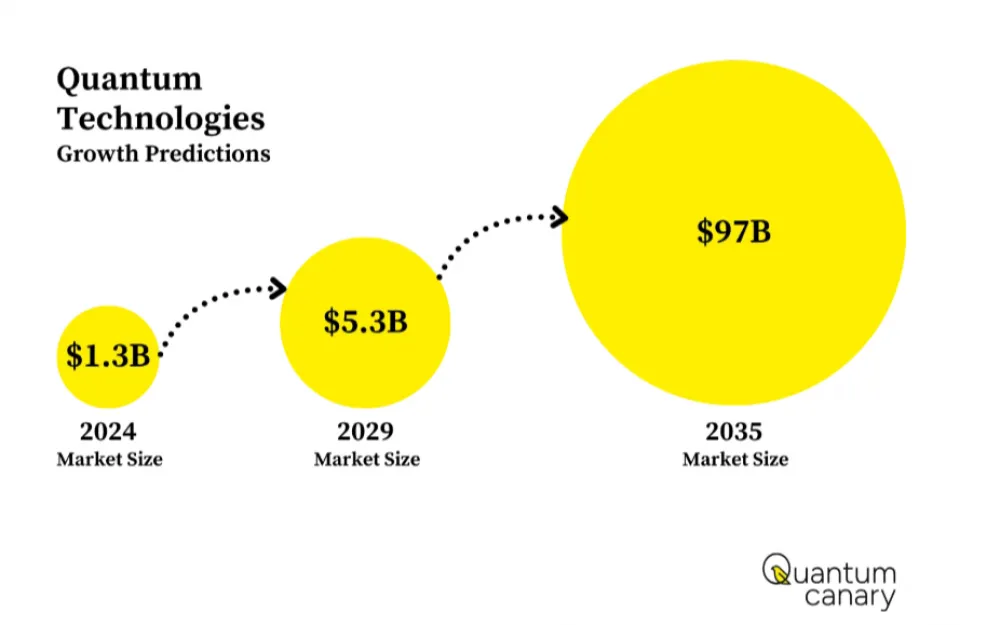
2026 is already being referred to as the year of quantum security. The industry is preparing to transition to quantum-secured technologies. It is believed that the next 5-10 years will determine whether blockchain will continue to operate or become too dependent on the speed of progress in quantum computing.
The solution is becoming quantum blockchain — we explain what this technology is, who is working on it, and what its prospects are.
Quantum Blockchain: Essence and Brief History
When discussing “quantum blockchain,” several approaches are meant, which are often confused.
Blockchain Protected by Quantum Cryptography
This is the most practical option for the next 10-15 years. This means that the basic structure of the blockchain remains classical, but instead of traditional encryption algorithms, one of two options is used:
Quantum-resistant classical algorithms. For example, patent US12476816B2 from 2023 essentially describes a regular blockchain, but "rewritten" using post-quantum cryptographic algorithms and specifically designed for storing audit logs (records of events and changes), rather than just transactions;
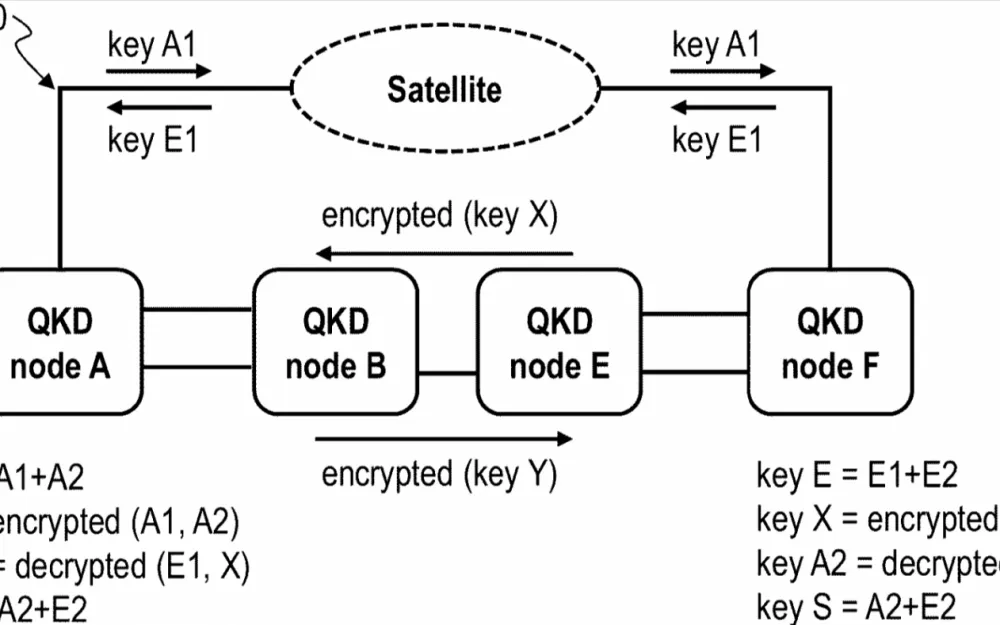
Quantum Key Distribution (QKD). This involves work on securing the paths for transmitting cryptographic keys. It is assumed that they will be transmitted using the quantum properties of photons. According to the laws of quantum mechanics, any attempt to intercept or measure the state of a photon will change it, and both parties will immediately notice this.
There are also patents for the second one. Among the recent ones is a patent for a quantum key distribution method from Airbus SAS, published in 2025. And a patent for quantum key distribution for processing data within a data center — the application is from 2021, but it was published only in 2025.
Fully Quantum Blockchain
This is a theoretical concept proposed by Russian scientists — Alexey Fedorov and colleagues from the Kurchatov Institute in 2017.
The idea is that the entire system — from key distribution to data verification — utilizes quantum phenomena. At its core is quantum entanglement. This is a quantum mechanical phenomenon where the state of one particle instantaneously correlates with the state of another, even at a distance.
So, very roughly speaking, if blocks are encoded in such a way that they behave like time-entangled photons, attempts to alter any previous block will lead to a collapse, and this measurement can be instantly detected. As a result, while blocks in a classical blockchain cannot be changed due to the laws of mathematics, blocks in a quantum blockchain are protected by the laws of physics.
QKD aims to create an ideal, physically secure channel and then use it anywhere. The concept proposed by Fedorov is to build a blockchain such that its most vulnerable aspects—signatures and authentication—are immediately implemented using quantum communications, making the blockchain quantum-ready.
Fedorov's team holds a Russian patent RU2755672 titled “Method for secure storage and updating of data in a distributed ledger using quantum communication networks” from 2021. They have tested a prototype of this concept on Gazprombank's networks.
In global practice, there are various patents that are close to Fedorov's concept but do not describe it exactly.
Patents like US10708046B1 describe systems in which photons are used as carriers of keys and then integrated into blockchain signatures. The focus is on resistance to quantum attacks through quantum cryptography, rather than on the blockchain itself in relation to quantum communications.
The patent US11477015B1 from Rigetti & Co describes a chain where the blocks themselves can contain quantum states (not just classical data), and the updating of the state of the register is linked to operations on a quantum processor;
Some Chinese patents like US11438149B2 on “MDI-QKD in tree networks” describe the infrastructure for quantum communication and key distribution but do not directly associate it with blockchain.
A full-fledged quantum blockchain requires a quantum network connecting all nodes, which at the current level of technological development is a purely hypothetical scenario. Researchers compare such a blockchain to a time machine — because it needs entanglement in time, not space. So in practical terms, the industry is focused on the first approach.
How they plan to secure the blockchain
In leading and most practical methods of securing the blockchain, we can highlight:
Quantum Key Distribution (QKD)
Two parties exchange cryptographic keys using quantum photons. That is, each photon encodes a bit of the key through a quantum state, carrying information. If someone tries to intercept a photon, its state will change, and the parties will be notified about it.
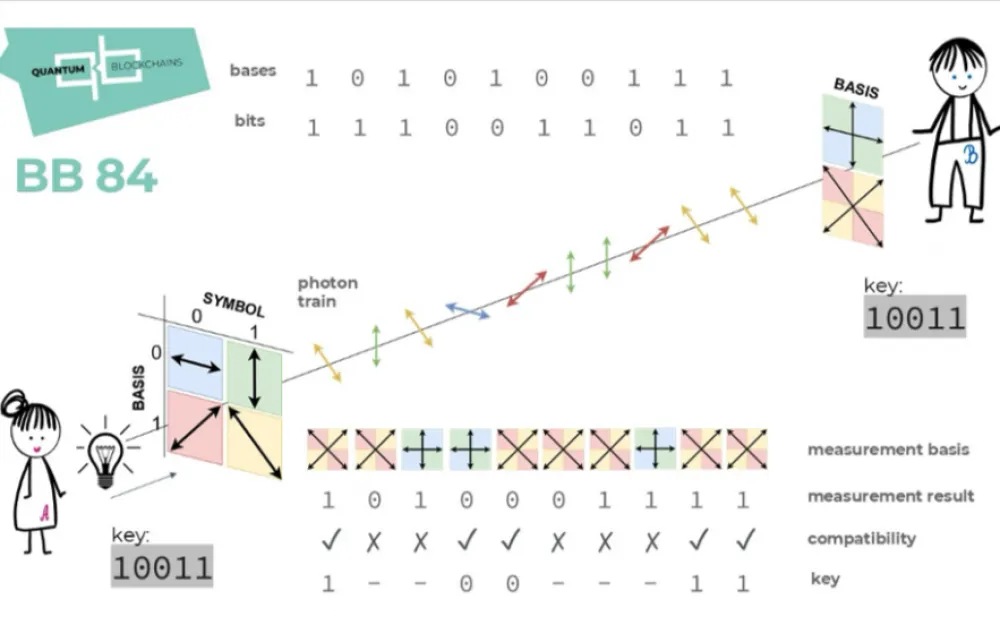
For example, the technology is described in a patent for a quantum key-based blockchain network and method for secure data transmission (US20240430080A1). It is implied that due to the fundamental properties of quantum states:
the impossibility of exact cloning;
the inevitable "disturbance" of the state upon interception;
true quantum randomness,
the system will be much more secure. Theoretically, the outcome will be resistant to any computational device, not just classical computers. A similar idea, but with a more step-by-step implementation plan, is described in patent US12219052B2. There are also patents for devices to implement such networks. For example, US20240007277A1 on "Network device for quantum key distribution and method of QKD network operation."
The main problem is that QKD requires either direct fiber optics for data transmission or a satellite communication line between nodes. This is economically impractical for a global network with thousands of nodes.
Quantum Cryptography (Post-Quantum Cryptography, PQC).
These are classic algorithms that are mathematically resilient to attacks from quantum computers. They are based on the complexity of problems that even quantum algorithms cannot solve. In simple terms, this is a complication of the existing blockchain model. Currently, this is the most scalable solution:
NIST has already standardized the first PQC algorithms in August 2024. ML-KEM (Kyber) for key exchange, ML-DSA (Dilithium) and SLH-DSA (SPHINCS+) for digital signatures. In April 2025, a fifth algorithm was added — HQC (Hamming Quasi-Cyclic).
There is already suitable hardware. For example, here is a 2023 patent for a “Secure Processor for Post-Quantum Cryptographic Algorithm CRYSTALS-KYBER.”
Here are some examples of patents in this direction:
US12368581B2 for “System and Method for Cryptographic Processing Using Tabular Transformation of Arithmetic Values.” Application from 2023, for systems protecting against side-channel attacks.
US20250007693A1 for “Method and Device for Reducing Performance Overhead Associated with Using KYB Technology for Secure Key Exchange.” This application is also from 2023, from Intel, the system aims to optimize performance for quantum protection.
US12309263B2 for Post-Quantum Cryptography for System Protection. IBM's 2021 patent describes a specialized environment for running PQC on edge devices (IoT, mobile nodes).
The advantage of PQC is that the algorithms operate on classical computers and can be integrated into existing infrastructure without the need for hardware replacement. The downside is that this approach makes keys significantly larger, which also increases the size of the blocks themselves, reduces processing speed, requires more energy, and overloads the system.
Quantum Random Number Sources
True randomness is critically important for cryptography. Quantum effects (such as photon splitting on a semiconductor) provide the unpredictability that classical generators do not guarantee. Random numbers are used for generating keys and during consensus in blockchain.
Among the examples of patents is US12015705B1, a 2021 patent from Google for "Verified Generation of Quantum Random Numbers for Cryptographic Applications."
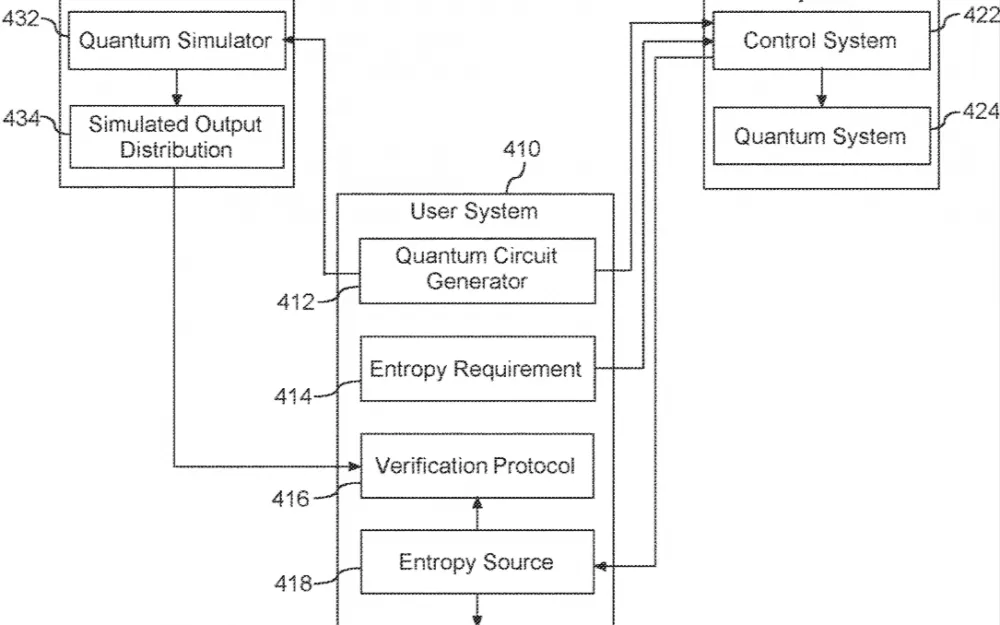
The technology can be used for generating private keys, selecting validators in Proof-of-Stake consensus, and other aspects.
We will discuss key companies and countries developing quantum blockchain in the next article.
Online Patent is the number 1 digital system in the Rospatent ranking. Since 2013, we have been creating unique LegalTech solutions for the protection and management of intellectual property. Register at the Online Patent service and gain access to the following services:
Online registration of programs, patents for inventions, trademarks, industrial designs;
Application for inclusion in the register of domestic software;
Options for expedited service processing;
Free search across patent, program, and trademark databases;
Monitoring of new applications based on criteria;
Online support from specialists.






Write comment