- AI
- A
Notion launches Custom Agents. Why this is an important signal for the AI agent market
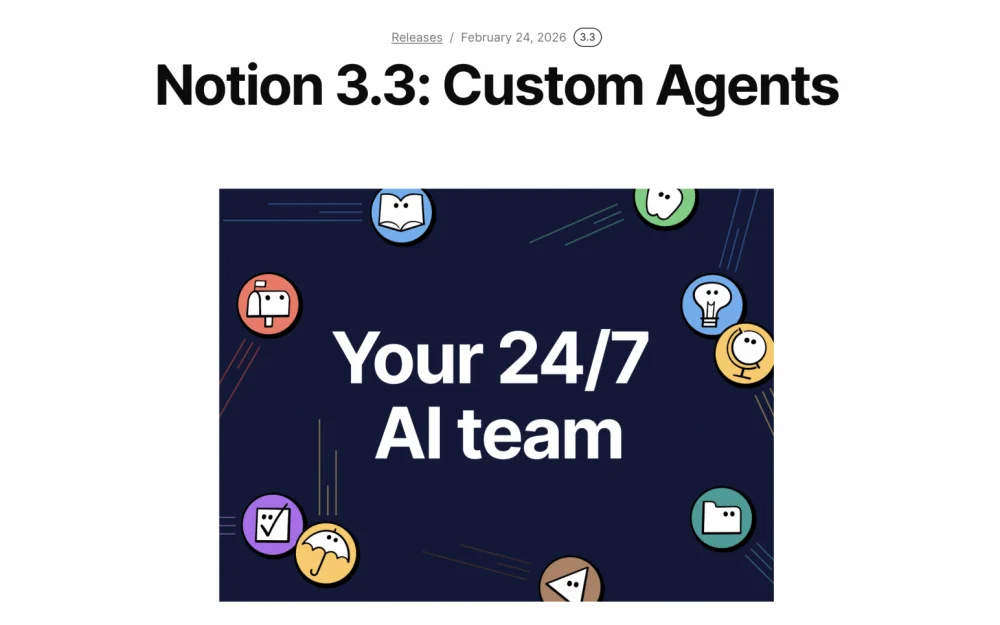
Notion has launched custom AI agents that work according to schedules and triggers, and behind this release lies a much more significant shift. It seems we are entering an era where AI is no longer just an on-demand chat but becomes a permanent digital assistant working in the background 24/7.
Notion introduced Custom Agents - autonomous AI agents that do not operate like a regular chatbot, but in the background: on a schedule, triggered by events, and according to predefined scenarios. According to the company, early testers have already created over 21,000 agents, and within Notion (careful, not working in Russia) there are currently 2,800 active agents working around the clock.
From a practical point of view, the idea is simple: the user describes the task in plain language, sets the trigger condition. For example, every Monday at 9:00 or when a new message appears in a specific Slack channel - and then the agent performs the required work automatically. It can process incoming requests, write reports, redirect tasks, and answer frequently asked questions. Notion specifically emphasizes that these agents operate autonomously and around the clock, without constant manual requests.
It is also important to note that this is not a closed tool within a single service. Custom Agents work together with external systems: Notion has integrations with Slack, Mail, Calendar, and through MCP with Linear, Figma, HubSpot, Ramp, Wiz, Stripe, GitHub, Intercom, Amplitude, Attio, and Sentry. This means the agent can be integrated into an already existing workflow.
You can try Custom Agents for free until May 3, 2026.
Notion has Guides on Custom Agents in Notion
How to set up a Custom Agent in Notion can be found here
The most interesting part is not the release itself, but rather who exactly is starting to use such tools on a mass scale. The audience of Notion is not only developers. It includes designers, managers, operational teams, students, marketers, and content creators. If autonomous agents are starting to take root with this audience, it's already a good sign that the market is shifting, and AI agents are no longer a tool for techies, but a common productivity tool.
Real cases of implementing custom agents in Notion
Notion provides real-life examples. Ramp (fintech) already has more than 300 agents working, and one of the most notable is the internal Product Q&A Oracle, an agent connected to Slack that answers employee questions about the product and its development. They have also implemented systems for analyzing feedback, routing creative requests, and preparing daily AI digests.
Another case concerns Remote, a company that helps businesses hire employees worldwide. According to Notion, this company’s custom agents helped the IT team save 20 hours per week: they automatically analyze requests, correctly distribute them in more than 95% of cases, and handle over 25% of requests themselves.
So, it’s no longer just about showcasing capabilities, but about practical benefits—less manual routine, faster processing of typical requests, and less strain on support and operations teams.
What will the AI Agents market look like?
At the same time, the release of Notion is interesting because it touches on a broader trend. We see that the market is quickly moving from simple assistants to systems that work continuously, rather than waiting for someone to formulate a new query each time. Essentially, the user gets not just AI in a chat window, but a digital executor with a specific area of responsibility.
Against this backdrop, another trend is also growing—personal agents that work not within a single service, but for you personally. The most notable example is OpenClaw. A video on how to deploy it on free hosting was shown in this post. And Moonshot AI recently launched Kimi Claw—a cloud version with 24/7 operation, 40 GB of storage, and 5,000+ skills without complex server setup.
That is, the difference becomes: agents of Notion work within the Notion team, while a personal agent works for you through email, calendar, files, messages, and your habits. Therefore, many lean towards creating and implementing their own personal agent, which already knows your style, context, and preferences. But there's also a double-edged sword here: the more useful the agent is, the more it knows about you and your work. Thus, with the boom of personal agents, questions about security, access, and corporate restrictions are growing. Here's a good example of the same OpenClaw here.
In general, the trend is such that every service, team, and individual now has their own permanent agents that work in the background. The question is no longer whether these agents are needed, but where they will live: inside corporate platforms, or will everyone have their own personal agent on top of all services at once?
What conclusions can be drawn from Notion's release?
In my opinion, the main takeaway from the release is this: agents are no longer a niche tool for enthusiasts, but are becoming a normal part of work processes. Until now, most mass AI products were built around a simple logic: a person enters a chat, asks a question, and receives an answer. Custom Agents introduce a different model: you set up the scenario once, and then the AI performs the work itself, in the background, on a schedule or triggered by an event.





Write comment