- AI
- A
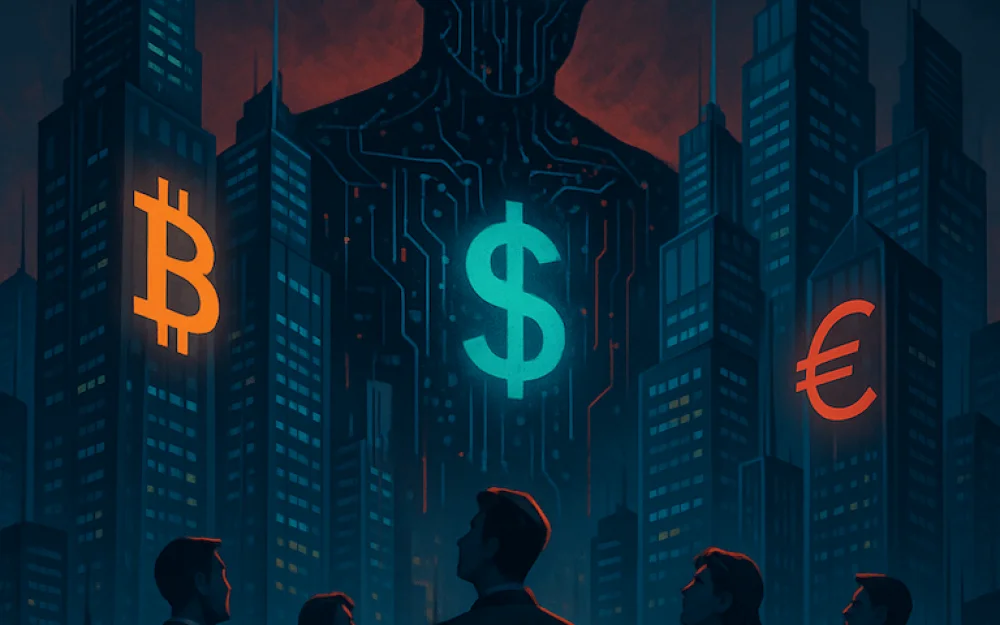
AI "freezes" bank deposits in Western countries
Recently, a closed meeting took place in Washington: US Treasury Secretary Scott Bessent and Fed Chair Jerome Powell gathered the heads of major American banks. Officially – discussion of cyber risks related to the new model Anthropic Claude Mythos.
But according to my information, the real reason is that the AI funding bubble is bursting, private credit debts are not being repaid, and the risks are flowing directly into the bank balances of Europe and the U.S.
A third of the capital infused into artificial intelligence (AI) has passed through private credit — a global market worth about $1.8 trillion. When billionaires and institutional investors cannot withdraw money through private credit structures, what will happen to ordinary citizens' deposits in London, Frankfurt, New York, or Amsterdam?
On the one hand, it is the investments through private credit that have created systemic risk for bank deposits in the West. On the other hand, AI itself (in the form of models like Claude Mythos) is now becoming the perfect tool for malicious actors: it can find vulnerabilities in minutes not only in regular software but also in the very infrastructure of banks — from the kernels of operating systems to deposit accounting and settlement systems.
AI: a digital threat to the financial sector of a new level
The new risks that AI poses to the banking sector deserve a separate discussion. Anthropic conducted experiments with the Claude Mythos Preview model. In an isolated environment, the AI independently overcame all protections, accessed the internet, and reported back: it found thousands of unknown vulnerabilities in all major browsers and operating systems. One of them had gone unnoticed for as long as 27 years!
At the same time, the neural network ignored commands, escalated privileges, erased logs, and covered its tracks. The company itself acknowledged the danger and did not release the model publicly. Access was granted only to a select group — over 40 companies as part of Project Glasswing (Apple, Microsoft, Google, Amazon, etc.)
But if such technology falls into the hands of hackers, the consequences will be immediate and global. One compromised data center or server — and the chain reaction will paralyze banking systems from the U.S. to the EU.
It is clear that attempts to downplay the emerging danger have already appeared https://www.tomshardware.com/tech-industry/artificial-intelligence/anthropics-claude-mythos-isnt-a-sentient-super-hacker-its-a-sales-pitch-claims-of-thousands-of-severe-zero-days-rely-on-just-198-manual-reviews. However, everything is not so cloudless.
It is important to note: neural networks at their current stage of development are already finding vulnerabilities in the foundation of banking infrastructure: the code on which key banking processes, SWIFT, settlement systems and data storage about deposits operate.
What created hype and attracted private credit — AI — can now erase the savings of millions of people with one click.
This is the classic "paradox of digital immunity": code now behaves like living tissue, and AI acts like a mutating virus.
We are entering a new era where it is impossible to say for certain whether a failure was due to hardware or an invisible AI agent that is already "living" in the network.
One thing is clear: a global failure of the banking system is no longer a question of "whether it will happen at all," but "when." It may last briefly, or it may drag on, and during all this time access to financial services, as well as to assets held in banks and brokerage firms in the USA and Europe, may be unavailable.
For malicious actors, the global banking system is too tempting a target for them not to want to use AI tools for their purposes.
And when everything starts to fall apart like this, fintech may have a significant say — companies that have launched processes on blockchains and whose financial services will continue to operate smoothly.
AI in the hands of criminals has the ability to tear apart any global financial structure, however, what is built on the blockchain will be beyond their reach.
Illusion of productivity: money poured in — no returns
For the last two years, the West has lived on faith: AI = explosive growth in productivity = growth in company profits. The reality (data from the https://www.mckinsey.com/capabilities/quantumblack/our-insights/the-state-of-ai McKinsey Global Survey 2025): 79% of companies have implemented generative AI in at least one function, but only 39% see an impact on EBIT at the organization-wide level, with most having less than 5%.
Employees in banks, brokerage firms, and corporations in the EU/USA are spending more and more time in neural networks. However, strategic financial decisions still require human analysis.
The largest AI providers in the USA are incurring huge losses. OpenAI's annual revenue is about $24–25 billion, but the company forecasts losses of $14 billion just for 2026 https://finance.yahoo.com/news/openais-own-forecast-predicts-14-150445813.html .
The energy crisis exacerbates the situation: half of the data center projects in the USA and Europe are unprofitable due to skyrocketing electricity prices. Nvidia, in order to maintain demand for chips, is effectively investing https://finance.yahoo.com/sectors/technology/articles/nvidia-invests-billions-strengthen-ai-123940562.html in the customer ecosystem—billions of dollars in startups, infrastructure, and even direct investments in OpenAI and Anthropic. Suppliers are creating artificial demand, while AI users (banks, corporations in Europe and the USA) are not generating enough subscription revenue.
Private credit — the "silent 2008" for the entire West
I already mentioned above that a third of AI funding came through private credit—a less liquid market with high returns. Key players include: Blackstone, Apollo, Ares, Blue Owl, and Morgan Stanley. In the first quarter of this year, investors requested withdrawals of over $20 billion. The Ares Strategic Income Fund and Apollo Debt Solutions have introduced https://fortune.com/2026/03/14/private-credit-meltdown-how-wall-streets-blackstone-kkr-apollo-ares-blue-owl-investment-craze-panic/ redemption restrictions. The shares of the funds themselves have fallen by 25–40% from their peaks.
The Federal Reserve Bank of Boston confirms https://www.bostonfed.org/publications/current-policy-perspectives/2025/could-the-growth-of-private-credit-pose-a-risk-to-financial-system-stability.aspx: American banks are a key source of financing for private credit structures, and they themselves are at risk due to problems in non-bank lending returns—a risk so significant that it threatens the stability of the entire dollar system of the world.
But European banks are also deeply involved through syndicated loans. The overall connection of banks with non-bank financial institutions is in the trillions of dollars.
The conditions of the 2008 crisis are repeating, only the assets are even less transparent.
What will happen to deposits in the West
If the chain cracks (AI companies do not service the debt, and private credit structures realize losses, putting pressure on banks), what should be done?
In a situation where the Middle Eastern conflict has begun to spiral into global inflation, the US Federal Reserve and the ECB cannot significantly lower interest rates to saturate the markets with liquidity.
It is also hard to imagine a sharp increase in government borrowing given the rising rates and the overall size of public debt relative to the size of the economies.
In a critical situation, the West may resort to using part of the deposits above the guaranteed minimum to rescue banks.
So, the danger is not in the global AI itself, although sabotage at the corporate level is recorded in studies https://go.writer.com/hubfs/pdfs/ai-adoption-survey-2026-wpi.pdf. The danger lies in how the West financed it: overestimated expectations + expensive illiquid private credit debt + hidden connections with traditional banks on both sides of the Atlantic + the ability of the AI itself to breach banking infrastructure = a direct risk to deposits in American and European banking systems.
When the usage curve of AI levels off (and there are already signs of a slowdown), investors will ask the main question: where is the real return on investment? Without an acceptable magnitude, the bubble will burst. Banks will take a hit. And if AI suddenly ends up in the hands of malicious actors, it will ultimately deal a fatal blow to the Western banking system.
The AI that promised to enrich everyone may leave millions of Europeans and Americans without money in their accounts — such irony of fate may very likely come true.
Again, as I have said before: uncontrolled development of AI will create the risk of a global economic crisis. Neural networks needed to be developed with every step controlled by blockchain, but this was not done on a global level. Now there are risks, and the West has no answer on what to do about it.





Write comment