- DIY
- A
Private Home Automation Architecture: KNX, Modbus, Node-RED and Sprut.Hub
Standard solutions are convenient — it’s hard to argue with that. Pick KNX for example, and everything works according to a clear established scheme from there: there is abundant equipment, standard solutions have been refined over a long period of use, the software is user-friendly, and the interfaces look neat. Problems usually start when the client receives the cost estimate.
This article is about exactly such a project. The property is a two-story private house with an area of 300 m² in the Bright Park cottage community near Kazan. The client wanted to automate almost all of the house's engineering systems, integrate them into a single interface, and connect them to voice assistants.
The following were supposed to be included in the system:
lighting control;
control of motorized blinds and garage doors;
heating control (radiators and underfloor heating);
ventilation, humidification, and ducted air conditioning control;
intercom (door entry) and internal intercom;
multi-room audio;
control of projection zones (home theater);
indoor and outdoor video surveillance.
The integrator, ARTEN Company, prepared a commercial proposal based on the KNX standard. The client liked everything except the cost. Automation costing 1.5–2 million rubles for equipment alone did not fit the construction budget at all.
Then the integrator revised the system architecture. The room panels from Akubela, which the client especially liked, were kept. All other equipment and software was replaced. As a result, the system was able to fit within the budget.
Additional photos
Solution architecture
In the end, the integrator assembled a hybrid architecture:
Wiren Board controller connects all smart home equipment. It operates simultaneously as a tekkix for devices, KNX gateway, and server for the software in use;
Akubela Hypanel Lux panels serve as the system's user interface;
Node-RED acts as a bridge between KNX devices — panels and wireless sensors — and the rest of the system;
all home control logic, as well as integration with Apple HomeKit and Yandex Alice, is implemented in Sprut.Hub.
Both Node-RED and Sprut.Hub run directly on the controller.
As a result, the cost of equipment decreased to approximately 400,000 rubles, while the system's functionality was practically on par with the initial version. Now we will take a closer look at exactly how the project was implemented.
User Interface
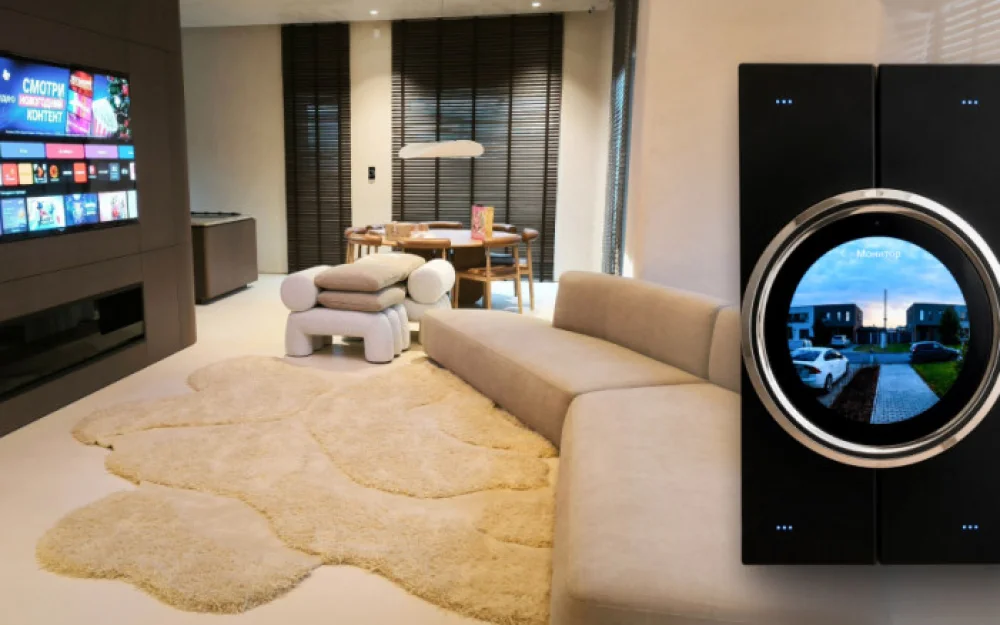
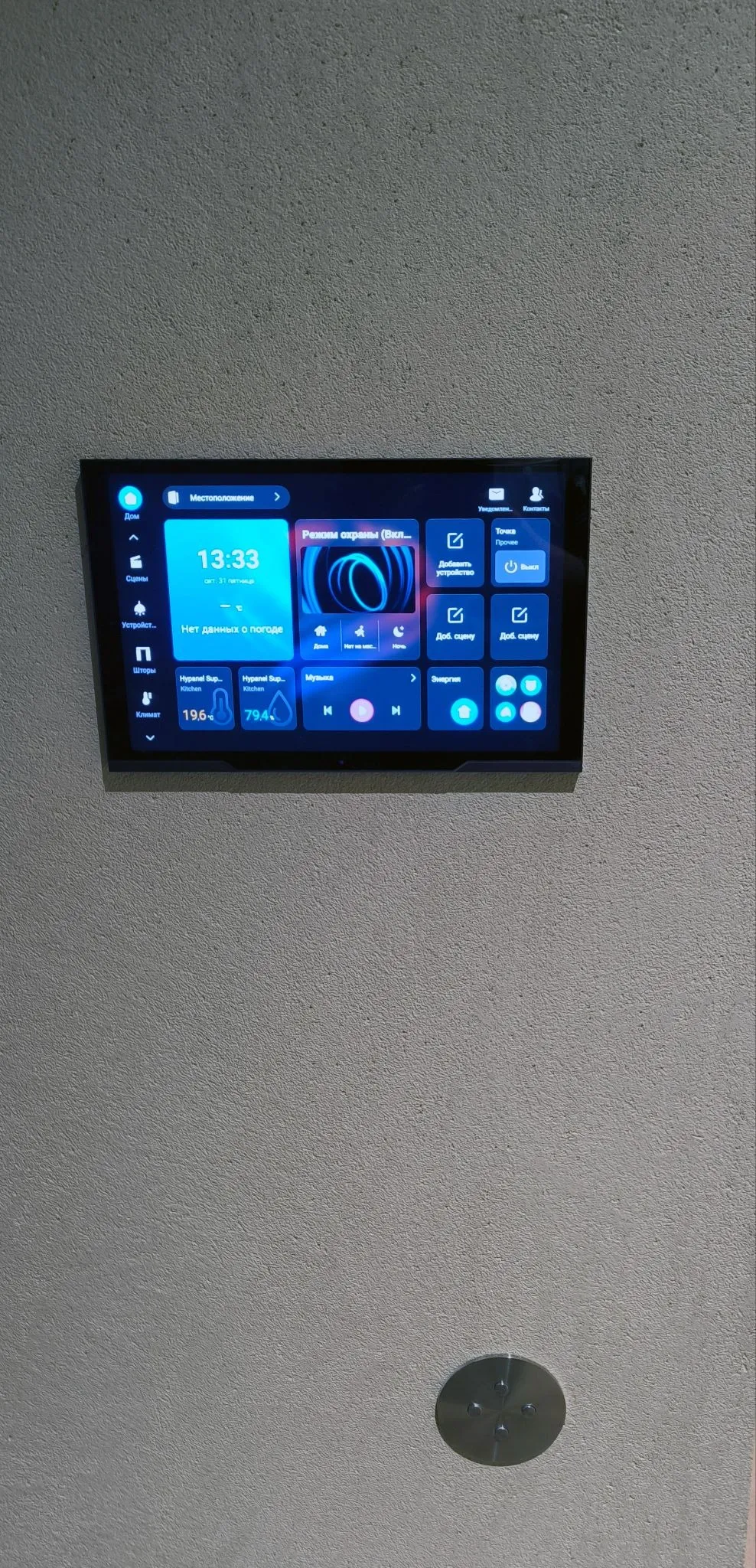
As we already mentioned, the customer liked the Akubela panels, so they were also retained in the new system architecture. KNX panels Akubela HyPanel Supreme and Hypanel Lux Piano are used in the project.
One of the HyPanel Supreme panels acts as the central node of the Akubela ecosystem: cloud services, web interface, and intercom operate through it. The remaining panels receive the required interface elements directly from it via LAN.
The second HyPanel Supreme panel and the HyPanel Lux Piano panels in the rooms serve as KNX sub-gateways. Each of them transmits its set of devices and functions to the central system: lighting, climate control, blinds, and other subsystems. After that, HyPanel Supreme combines all devices into a unified control interface via Akubela's web configuration.
In addition to the touchscreen, the panels are equipped with physical buttons and air temperature sensors. They perform multiple functions at once: they operate as a room thermostat, lighting and blind controls, intercom monitor, and air conditioner remote control.
Panels are configured using the standard method for KNX devices — via KNX ETS. For each function — lighting control, blinds, and climate control — the integrator created virtual devices and corresponding KNX group addresses.
Additional photos
Automation equipment
The system is based on a Wiren Board controller and input/output modules. All main engineering systems of the house are connected to them:
light fixtures and LED strips — via relay modules and dimmers;
blind drives — via relay modules;
heating circuit actuators — via optocouplers;
underfloor heating sensors — via an analog input module;
air conditioners — via ONOKOM MD3-MB-B gateways;
Breezart 1000 FC Aqua ventilation unit — via Modbus TCP.
Push-button switches are connected to the inputs of relay modules and dimmers. The modules have built-in direct input-to-output control, so lighting continues to work even without the controller's involvement.
To interact with KNX panels, the WBE2-I-KNX module is used. The KNX driver and service run on the controller, ensuring data exchange with KNX devices.
Logic and system integration
The integrator considers Sprut.Hub one of the most convenient tools for building automation logic, so all project logic is implemented on it. The Sprut.Hub interface is mainly used for system configuration and tuning, so it is made as functional as possible.
From the perspective of Akubela panels, a full-fledged KNX automation system operates in the house. This was achieved using Node-RED, which acts as an integration layer between KNX devices and the rest of the system.
Group addresses created during panel setup in KNX ETS are automatically bound in Node-RED to specific automation devices — Wiren Board relay modules, dimmers, and Modbus devices of the climate system.
Flows that link the following components are implemented in Node-RED:
Akubela panels;
Wiren Board devices;
air conditioner gateways;
ventilation unit;
software thermostats.
For example:
a light on command from a KNX panel controls a Wiren Board relay channel;
changing the thermostat setpoint from the panel is sent to the Sprut.Hub heating control algorithm;
equipment status is sent back to the Akubela panel interface.
Sprut.Hub is also used for integration with cloud services. Integration with Apple HomeKit and Yandex Alice is implemented via it.
As a result, the user can control all systems both from Akubela panels, and via voice commands or mobile applications.
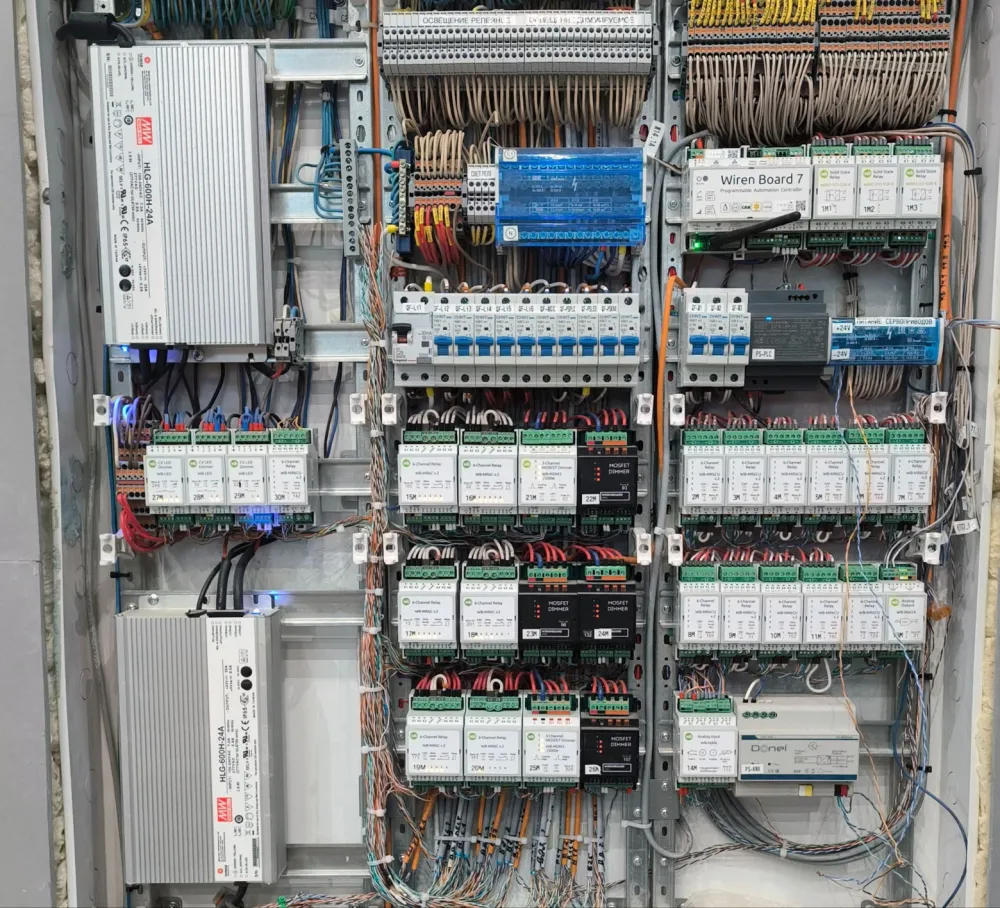
Automation Panel
Wiren Board Module | Quantity | Functions in the system |
1 | Automation system controller. Node-RED and Sprut.Hub run on it. Provides integration with Akubela KNX panels, Breezart ventilation units, and ONOKOM air conditioner gateways. | |
3 | Optorelay modules for controlling heating manifold actuators. | |
3 | Dimmers for LED strips for decorative and architectural lighting. | |
6 | Three-channel dimmers for adjusting the brightness of main lighting groups. | |
12 | Relay modules for controlling blind actuators. | |
6 | Relay modules for controlling lighting groups and blind actuators. | |
1 | 0–10 V analog output module for controlling the speed of underfloor convector fans. | |
1 | Analog input module for underfloor heating temperature sensors. |
Lighting and Blinds
The integrator built the lighting and blind control system using a radial wiring scheme. All lighting group cables run to the automation panel. Cables from push-button switches are also routed there.
Wiren Board modules that control loads are installed in the panel:
6 relay modules WB-MR6C v.2 — control of non-dimmable light fixtures;
6 three-channel dimmers WB-MDM3 — control of dimmable light fixtures;
3 WB-LED modules — control of LED strips and niche lighting.
As a result, the system controls:
36 non-dimmable lighting groups;
18 dimmable lighting groups;
12 LED backlight lines.
The house is equipped with 31 motorized blinds. Relay modules WB-MR6C v.2 and WB-MR6CU v.2 are used to control them. Each drive requires two relay channels: one controls upward movement, the other controls downward movement. When power is supplied to the corresponding line, the motor starts rotating in the required direction.
This circuit requires protection against simultaneous activation of both directions. If power is supplied to the "up" and "down" lines at the same time, it can damage the motor or the drive's control electronics.
The integrator solved this problem at the module level itself. Mutual channel blocking can be set in their settings: when one channel is activated, the module automatically blocks activation of the second. This eliminates command conflicts even if there are errors in automation scenarios.
Blinds are grouped by room and house facade. The user can:
control a single blind;
control all blinds in a room;
open or close all blinds in the house.
Several scenarios are implemented in the system.
"Night" scenario. When night mode is activated, the system closes the blinds on the first floor.
"Leaving Home" scenario. The system closes the blinds on the first floor, turns off the lighting, and switches the climate control to energy-saving mode.
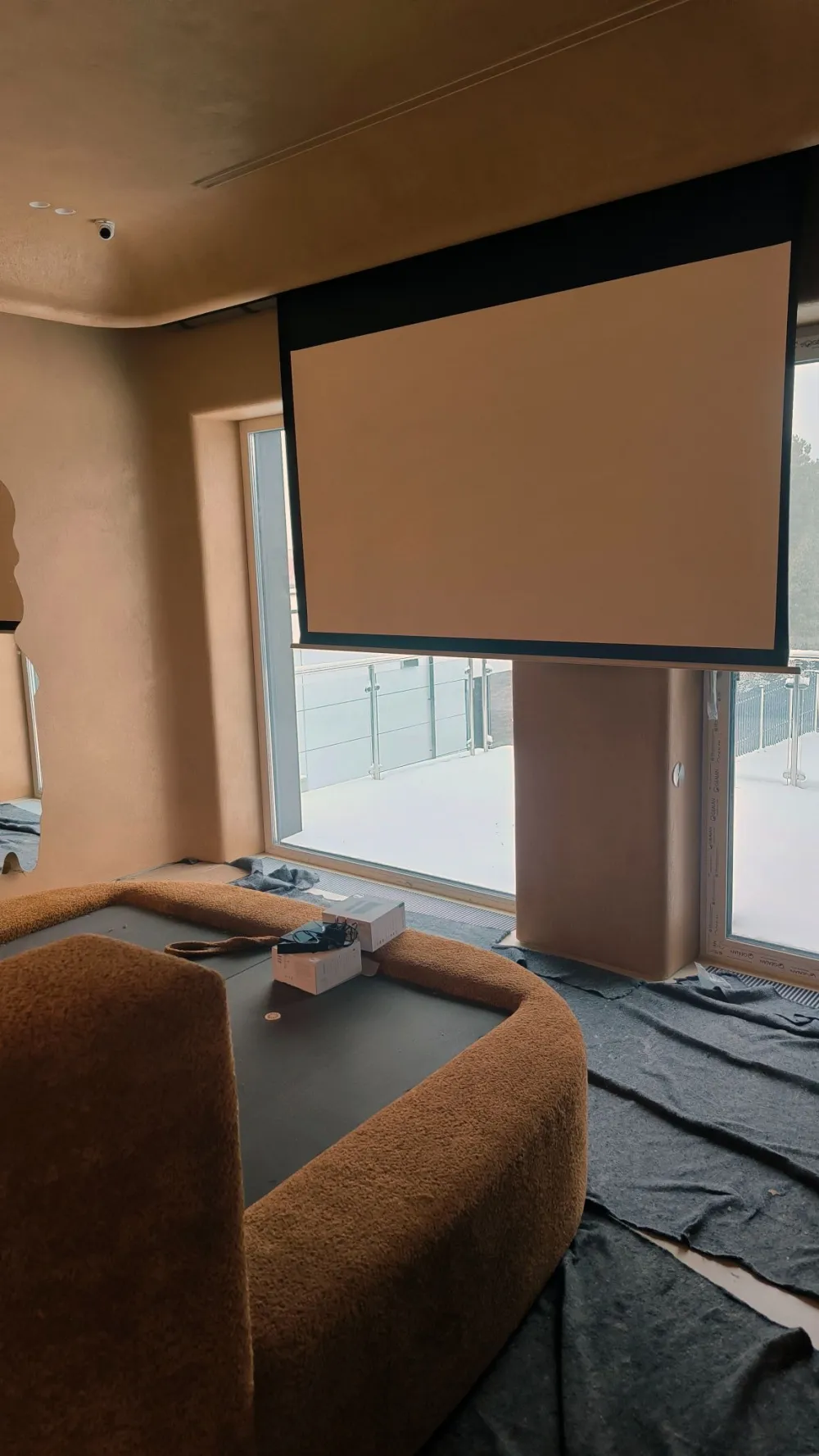
"Movie" scenario. There are projection zones in the house. When viewing mode is activated, the system lowers the blinds in the room, turns off part of the lighting, and turns on the multimedia equipment.
Additional photos
Underfloor heating and convectors
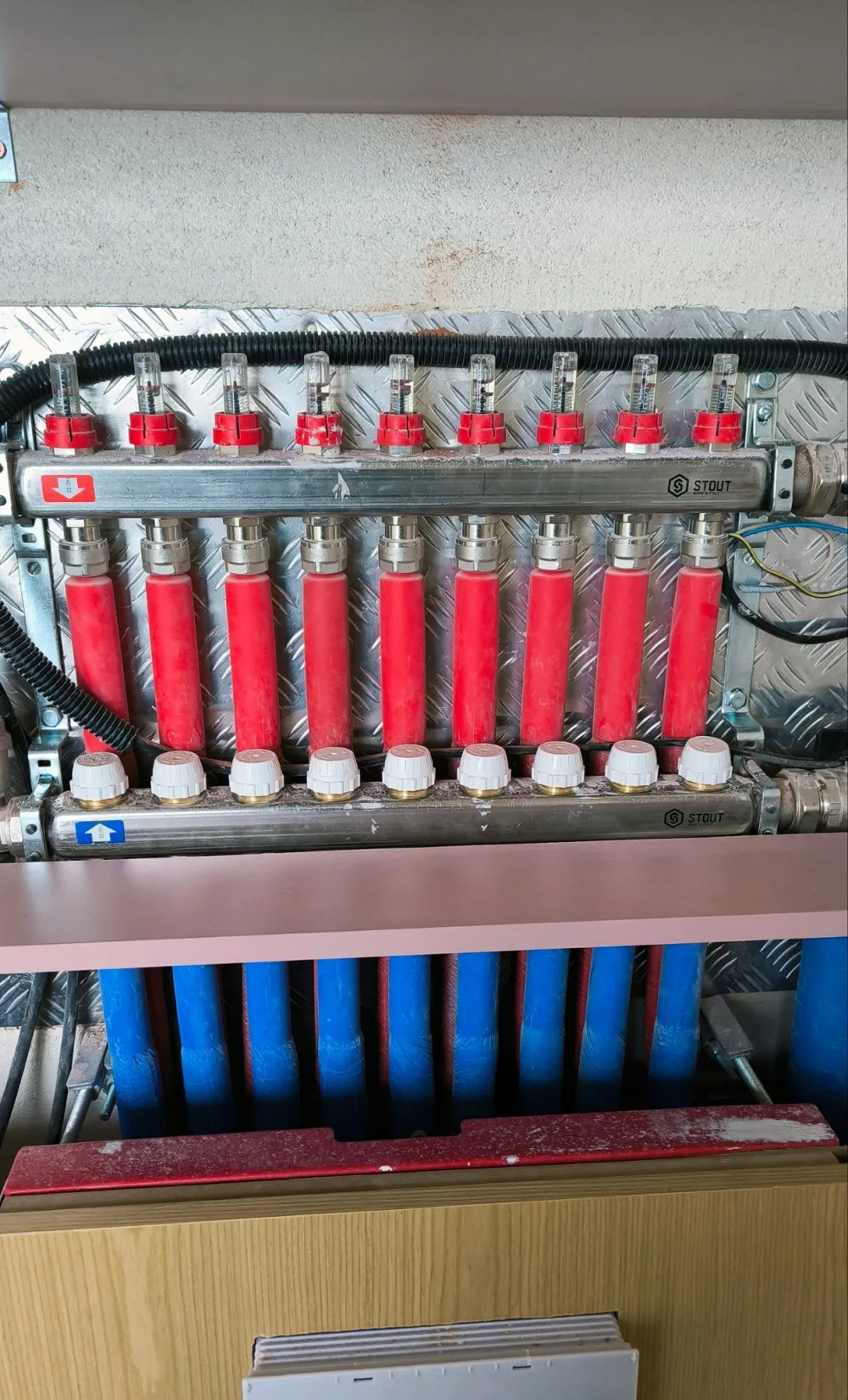
The house's heating system is built on a manifold layout — each heating device (convector or underfloor heating circuit) is connected to a manifold.
A 24V thermoelectric actuator valve is installed on each manifold branch. The actuator opens or closes the supply of heat carrier. The actuators are grouped by zones and connected to the WBIO-DO-SSR-8 module. One channel controls a group of actuators.
Air temperature in rooms is measured by sensors built into the Akubela Hypanel Lux Piano panels.
Underfloor heating temperature is measured by sensors embedded in the screed. They are connected to the WB-MAI6 analog input module.
The control algorithm is as follows:
Akubela → KNX → Node-RED → Sprut.Hub → Wiren Board → WBIO-DO-SSR-8 → actuators
Akubela panels transmit temperature readings via KNX. Virtual thermostats in Sprut.Hub compare them with the setpoint and generate control commands for the actuators. Then the controller manages the heating circuits via the WBIO-DO-SSR-8 modules.
The controller compares the air temperature with the setpoint and opens the corresponding heating circuit if necessary. Additionally, the system monitors floor temperature to avoid overheating the floor covering.
In-floor convectors with fans are used in the living room and kitchen area. Fan speed control is implemented via the WB-MAO4 analog output module using a 0–10 V signal.
When the valve of the corresponding circuit is opened, the controller turns on the fan at the set speed. After the valve is closed, the fan is turned off. By default, the system uses low rotation speed to limit noise levels in the room.
Ventilation and air conditioners
The house is equipped with a supply and exhaust ventilation unit with air humidification, and several ducted air conditioners. All equipment is connected to the controller via Modbus.
The supply and exhaust unit is built on the basis of Breezart 1000 FC Aqua. It also includes:
the humidification section Breezart 1000 Humi Aqua P;
the zone VAV controller JL208;
the control panel JLV135.
The standard Breezart controller manages the fans, heating, and humidification.
For integration, the JLV135 control panel is used, which acts as a Modbus TCP gateway. The Wiren Board controller accesses the unit’s parameters via Modbus TCP through it.
Users can turn the air handling unit on and off, adjust its capacity and the temperature of the outgoing air. These functions are available through the interface of Akubela panels.
To cool the air supplied to the rooms, duct air conditioners Kentatsu are used. These devices use their own internal control protocol, so the integrator installed Modbus gateways ONOKOM MD3-MB-B. They are connected to the air conditioner indoor units and convert their control protocol to Modbus.
Through this interface, the system accesses the main parameters of the air conditioners and can control their operation.
As a result, the house’s climate infrastructure has the following structure:
Breezart 1000 FC Aqua → JLV135 → Modbus TCP → Wiren Board
Kentatsu → ONOKOM MD3-MB-B → Modbus RTU → Wiren Board
Additional subsystems
In addition to engineering system automation, the house has video surveillance, Akuvox intercoms, multi-room audio, and projection zone control.
A system of internal and perimeter video surveillance is installed on the property. The cameras operate as an independent security system, but their interface is integrated into the Akubela Hypanel Lux panels. Users can open the video stream from a specific camera directly on the panel without using a separate application.
The Akuvox intercom system is also integrated into the Akubela panels. They function as internal intercom monitors and support the intercom function between rooms. When the intercom is called, the signal is sent to the panels in the house, after which the user can talk to the visitor and open the door.
A multi-room audio system with five zones has been installed in the house. Each zone can play music from its own source. Akubela panels are used as control interfaces: they allow you to start playback in the selected zone, select the signal source, and adjust the volume.
The multi-room system is also integrated into automation scenarios — for example, music can start playing at the same time as a lighting scenario or relaxation mode.
In addition, the house has two zones with motorized screens and projectors for watching movies and presentations. These devices are also integrated into the automation system: you can lower the screen, turn on the projector, or activate the "Cinema" scenario we described earlier via the panels.
Conclusion
In this project, integrator "ARTEN" built an automation system based on a hybrid architecture. Actuator equipment is connected directly to Wiren Board modules, user interfaces are implemented on Akubela panels, and software integration is handled by Node-RED and Sprut.Hub.
This approach allows combining equipment from different manufacturers into a single automation system without being tightly bound to a single protocol or ecosystem. At the same time, the integrator managed to preserve the functionality of the original KNX project and significantly reduce the cost of the equipment.
Write comment