- Hardware
- A
Another manifestation of RAM shortage: Raspberry Pi returns to "four"
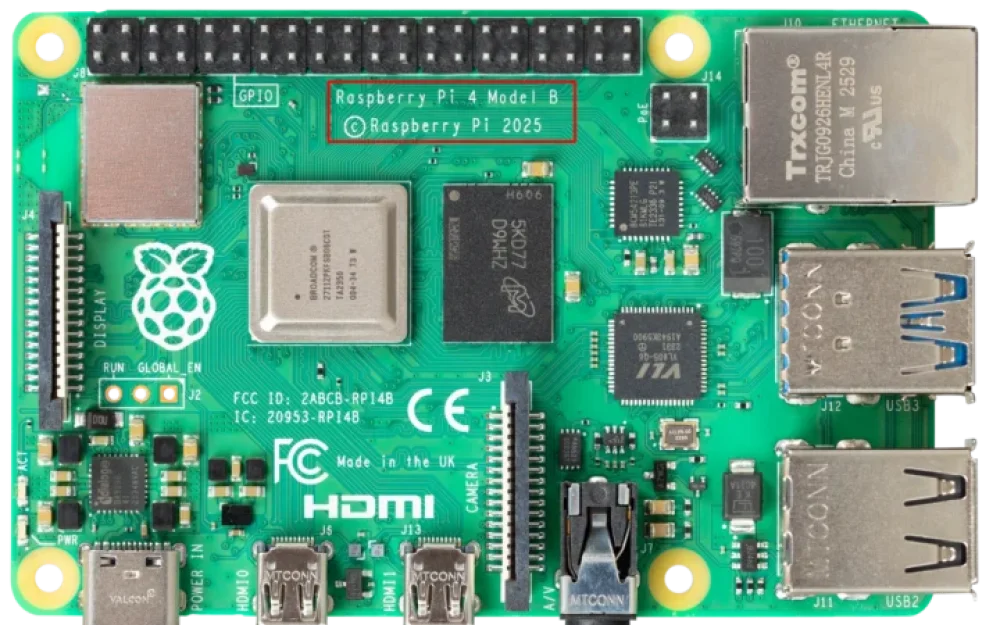
Raspberry Pi of different generations - a single-board computer that has survived, quite successfully, several serious crises: pandemic component shortages, global logistics issues, and the emergence of worthy competitors.
Despite everything, these green boards have been flying off the shelves for years like hotcakes. They have become the foundation for home servers, retro gaming, educational kits, and even industrial solutions. The reason for such resilience is simple: a successful balance of capabilities, an open ecosystem, and a price that has remained affordable for most for a long time.
However, in recent years, the situation has begun to change. Prices have risen, and production volumes have decreased, not least due to the component shortage. The consequences were felt quickly. In early 2026, the Raspberry Pi Foundation announced the return of a modified version of the fourth model, originally released in 2019. The new revision uses two separate memory chips instead of one larger capacity package. This decision was a direct result of problems in the RAM market: rising prices and unstable supply made the previous configuration economically unfeasible.
What is happening in the memory market
The demand for RAM chips has been growing for several years, but in 2025-2026 it reached a new level. The main driver is artificial intelligence: large companies are building huge data centers, purchasing server modules with dozens of gigabytes onboard. Manufacturers like Samsung, Micron, or SK Hynix have shifted their production capacity to focus on high-density options—16, 32 gigabytes and more in a single package. As a result, lower-capacity modules that previously went into consumer electronics, including single-board computers, have been overshadowed.
The problem has been exacerbated by the fact that a single 8 GB chip now often costs more than two 4 GB chips combined. However, neither is always available in the quantities needed by corporate buyers. The Raspberry Pi Foundation pointed this out as a key reason for its actions. Similar difficulties have arisen for manufacturers of laptops, smartphones, and even gaming consoles. The effect has been particularly noticeable in the single-board computer niche—they have always been positioned as a budget entry into the world of hardware and programming. And suddenly, it became not quite budget-friendly, quite the opposite.
Another negative factor is the supply chains, which have not yet fully recovered from the pandemic. Geopolitical risks, logistical disruptions, and market speculation have all compounded each other. As a result, even basic models that previously seemed very affordable have started to rise in price. This is already the second increase in a relatively short period, and it has hit enthusiasts hard, for whom the Pi remained a symbol of accessibility.
How the foundation is trying to control the situation
In February 2026, developers announced a price increase for models with two gigabytes of RAM and above. The version with one gigabyte was left unchanged—presumably to maintain a minimal entry threshold for schools and beginner electronics enthusiasts. However, the forecasts for the memory market remained unfavorable, and a simple increase proved insufficient.
Then the foundation's engineers decided to make a technical change. They took the circuit board of the old Raspberry Pi 4, which was already considered outdated after the release of the fifth version, and added a second memory chip to the back side. Why? This move allowed them to use lower-capacity chips, which are easier to find and purchase under current conditions. The modified board was designated as revision 1.5 and went into production alongside the other versions of Raspberry Pi 4.
This decision gave the foundation more freedom when purchasing memory. According to them, in practice, performance is almost the same—only in certain scenarios can there be slight deviations due to component layout. For the new revision, it is enough to update the bootloader to the version from January 2026, after which the board works like a regular Raspberry Pi 4.
Technical Details of the Modification
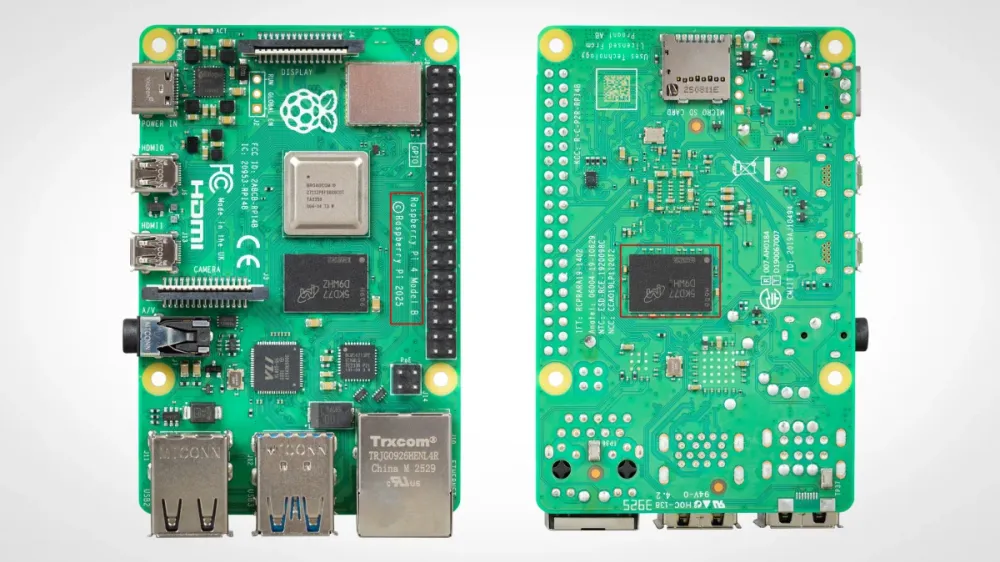
If you compare photos of the classic Pi 4 and the new revision, the difference is immediately noticeable. On the front side, everything is familiar: Broadcom BCM2711 processor, standard ports, GPIO connector. But on the back side—previously it was almost empty; now there is a second black square of LPDDR4 chip and several passive components around it.
In the system, the board is recognized as Raspberry Pi 4 Model B Rev 1.5— from a software perspective, it is still the same fourth model, without any new hardware features. All key components remain in their usual places, and the changes only affected the memory subsystem. The main difference is that, for example, the eight-gigabyte version is now made up of two chips of four gigabytes each. According to engineer James Hughes from the foundation, in practice, this has almost no impact on performance: in specific tasks, the metrics may differ slightly one way or another, but there is no noticeable difference in real working scenarios.
For the Raspberry Pi lineup, this is the first case where the RAM is placed in two separate chips — previously, a single package was always used. This step is not typical in itself and clearly shows how acute the issue of memory supply is. For users, however, the changes are almost imperceptible: it is enough to update the bootloader, and the board operates just like a regular Raspberry Pi 4.
Prices and availability now
Price increases have affected all models with memory capacities of 2 GB and above. In February 2026, the recommended price for the Raspberry Pi 4 with 2 GB has risen to approximately $55–60, the 4 GB version to $75–85, and the eight-gigabyte version has approached $115–125. Thus, the higher configuration has increased in price by almost one and a half times compared to pre-memory crisis levels and is now close to the price range of more powerful alternatives. The foundation directly links this to the rising cost of DRAM.
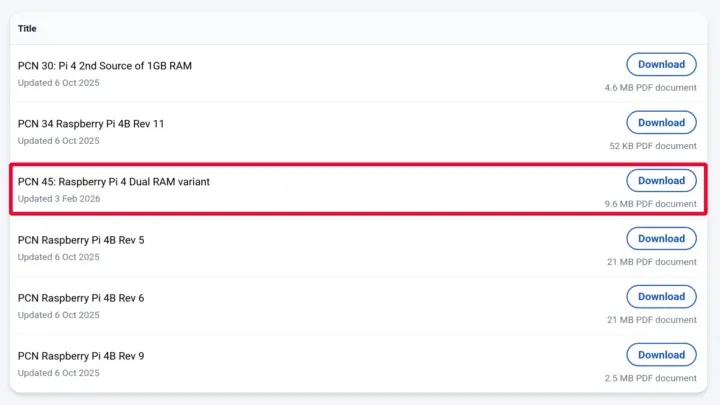
The modified version with two memory chips is sold at the same increased prices and does not stand out to the buyer. The logic behind this step is internal: it is easier for the foundation to purchase two 4 GB chips than one 8 GB chip, as such options are more frequently available and cheaper. As a result, by February 2026, the Raspberry Pi 4 with 8 GB of RAM has effectively entered the price range of powerful mini-PCs. In the case of the Raspberry Pi 5, the situation is even tougher: the version with 16 GB of RAM has exceeded the price category in which the platform has traditionally been perceived as a relatively affordable mass solution.
Moreover, manufacturers from China offer cheaper alternatives and often with more modern hardware. It is possible that the foundation is already working on the next generation of Raspberry Pi; such rumors appear regularly. However, in practice, they currently have to squeeze the maximum out of the architecture from 2019. Overall, the situation is not great, so we are awaiting stabilization in both prices and production volumes.
![From Virtual Hands to AI for Survivalists: Curious Open Agent OSes [and One Hardware Project]](https://cdn.tekkix.com/imgs/2026/05/habrcom/big/ce0b1057616faed51cd8b9f3b2b9.webp)
Write comment