- Hardware
- A
How and why Intel prefers data centers while reducing consumer chip production
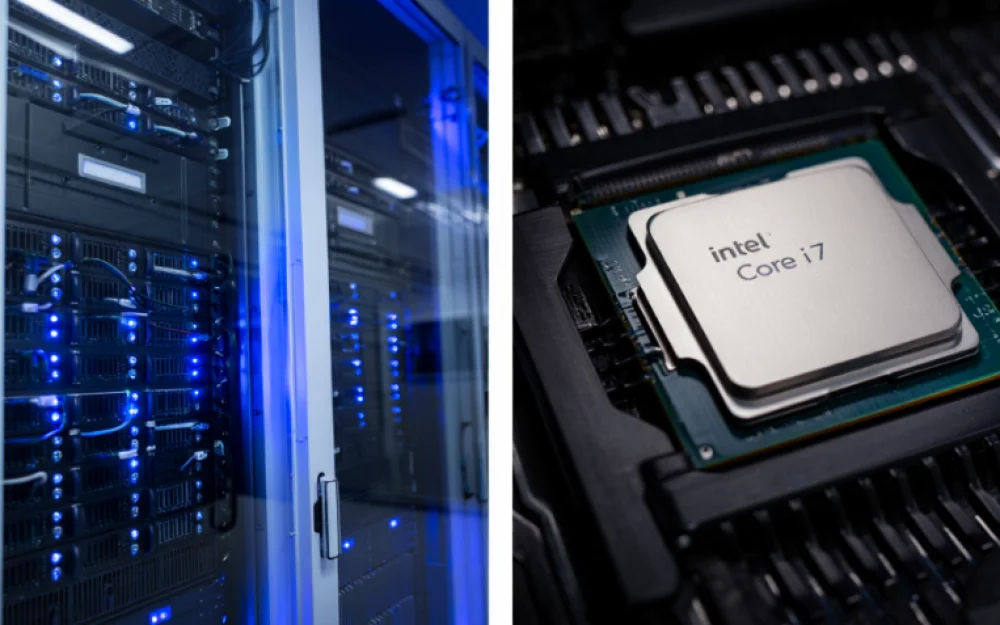
The semiconductor industry often surprises with unexpected twists. One can recall the crypto boom or the sharp increase in laptop demand during the pandemic and the subsequent component shortages. Now, there’s another surprise. In January, while summarizing the fourth quarter of 2025, the company acknowledged that due to explosive demand for server processors, it has to adjust factory operations, clearly prioritizing Xeon production for data centers.
Consumer chips, specifically their production, have suddenly taken a back seat. And this seems strange: the personal computer market had just begun to revive after a long decline — seemingly the perfect time to strengthen the client direction. In this article, we will explore how this came to be, why the emphasis has shifted to servers, and what this means for those who buy or assemble regular computers.
What happened
The main driver of change has been artificial intelligence: the demand for computations for large models has increased so sharply that the market simply couldn't prepare for it. Cloud companies like Amazon, Microsoft, and Google began to rapidly scale their server infrastructure. Xeon processors fit well into the new conditions: originally designed for heavy multithreaded tasks, they, in conjunction with modern accelerators, became the basis for machine learning infrastructures.
At the earnings conference, Intel's CFO David Zinsner explained: just six months ago, the company expected a decrease in demand from major customers and adjusted its processor production accordingly. But instead of a decline, the demand for them surged sharply. It turned out to be impossible to quickly ramp up production — building and launching new factories takes years, and the ability to accelerate the process is limited, especially since Intel's own chip production division is still losing money.
The solution was quickly found: the production capacities that were previously used for consumer Core processors have now been switched to server Xeon. At the same time, the changes hardly affected the premium Core Ultra line: they bring in more profit, and manufacturers of expensive laptops had already pre-booked volumes. The segment that immediately felt the changes was the mass market. In January 2026, Intel announced the phased discontinuation of several twelfth-generation Alder Lake processors: order acceptance will last until mid-year, and deliveries will end in 2027.
The problem affected not only processors. High-performance HBM memory is almost entirely going to the server segment, and the corporate market for fast SSDs has also faced a supply outflow. According to TrendForce, in 2026, data centers will receive more than 70% of all hi-end memory produced. This is despite the fact that new production capacities are being introduced more slowly than demand is growing. In this situation, Intel found itself particularly vulnerable due to its own process limitations.
At the same time, Intel does not plan to completely exit the client market. Management has repeatedly emphasized: the company does not intend to abandon the PC and laptop segment. But when production capacities are constantly lacking, the choice of priorities becomes obvious — what brings in more money and has predictable demand is produced first.
Consequences for the personal computer market: shortage or opportunity for AMD?
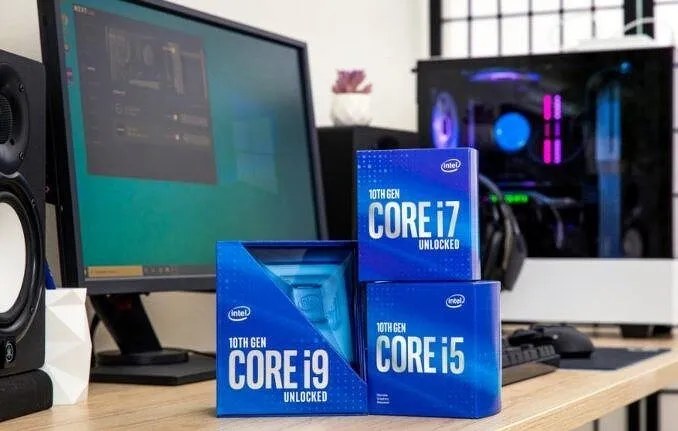
For the average laptop buyer or desktop builder, a rather bleak picture is emerging. The mass segment — computers under a thousand dollars, where Intel traditionally held strong positions — has suffered the most. Already in the first quarter of 2026, shipments of budget and mid-range Core processors have noticeably declined. The selection of ready-made devices is narrowing, and prices for what remains in stock are gradually creeping up — roughly following the same pattern that recently occurred with RAM and storage devices.
Large vendors like Lenovo, Dell, and HP are simply restructuring their lines under the influence of new factors. In the premium segment, everything is also relatively calm — thanks to Core Ultra. However, the mid-range and budget segments are struggling — they have to use old stock or switch to other platforms.
Against this background, a window of opportunity has opened for AMD. The company’s situation with production capacities looks calmer: server processors Epyc remain in demand, the release of Ryzen for regular computers continues at previous volumes, and there are no public statements about resource redistribution. It turns out that the company now has every chance to strengthen its position in the personal computer market. According to Mercury Research, by mid-2025, AMD's share in desktop systems reached a record 32%, and if the shortage of Intel processors drags on, this figure could rise even further.
Intel promises that the situation will change soon — the company will gradually increase the production of consumer chips. However, so far, data centers remain a priority.
It’s not all that simple
At first glance, it all seems like a typical reaction to a sharp increase in demand: the company directed resources where they are currently needed most. But a closer look reveals that it’s not just about the current boom. This strategy highlights the problems that have accumulated at Intel over the years.
Producing modern processors requires enormous costs. New technologies, factories, and equipment cost billions of dollars. Intel has been trying for many years to close the gap with TSMC, investing large amounts in its own developments, but this is not easy. The company’s manufacturing division, which was designed as a separate chip production business, remains unprofitable and weighs down financial results. Meanwhile, the personal computer market is behaving unpredictably: after a sharp rise during the pandemic, there was a long decline, and recovery is slow and without clear jumps.
The server segment, in this sense, looks more reliable — first stable growth due to cloud services, and now artificial intelligence is adding fuel to the fire. Large orders, better margins, lower risks. But there are pitfalls here as well: if the pace of AI development suddenly slows down (and such cycles have happened repeatedly in technology), one might be left with empty hands. That is, with an oversupply of server capacities and weakened positions in the consumer segment, which still accounts for a significant part of the revenue.
For now, Intel is trying to maneuver. New technology processes like 18A are starting to show results, premium client chips are being released on schedule, partnerships with major clients are strengthening. But such a production pivot is not just a response to unexpected demand; it is quite a clear signal: resources in the semiconductor industry are still in short supply.
In the coming months, the market for regular computers may change significantly: there may be a shortage in the budget segment, Intel processors will become more expensive, and AMD will have a chance to capture more of the audience. All of this is a direct consequence of the sharp increase in demand for computing for artificial intelligence, which is currently influencing manufacturers' decisions.


![From Virtual Hands to AI for Survivalists: Curious Open Agent OSes [and One Hardware Project]](https://cdn.tekkix.com/imgs/2026/05/habrcom/big/ce0b1057616faed51cd8b9f3b2b9.webp)
Write comment