- Hardware
- A
Chess Game of Architects: Arm Breaks 35-Year Neutrality for Its Own AI Processors
Imagine a motorsport engineering office that, for thirty-five years, has designed flawless engines for the entire Formula 1 grid but has never raced its own car. British Arm Holdings has been such an absolute "Switzerland" of Silicon Valley for decades. It has been the invisible foundation of computing, selling intellectual property and architecture licenses to everyone from Apple to Qualcomm and Nvidia. No physical manufacturing, just perfect blueprints.
But the evolution of technology has broken these rules. While neural networks were relatively simple, their task was limited to generation: producing text, writing code in a chat window, creating an image. For this kind of mathematics, graphics accelerators (GPUs), where AI effectively resides, were ideal. However, as models mature, they become smarter. Simply answering questions is no longer enough — they begin actively using external tools to perform dozens of user tasks.
To fetch real-time data, run heavy scripts in isolated environments, and manage third-party programs, AI needs a fast executor. This executor is the central processing unit (CPU). And the more complex AI agents become, the more urgently they require ultra-powerful processor logic to operate their tools.
Seeing the explosive demand for classical logic, management realized that selling concepts alone was no longer enough. On Tuesday, at the "Arm Everywhere" conference in San Francisco, architects put aside the compass and took to silicon.
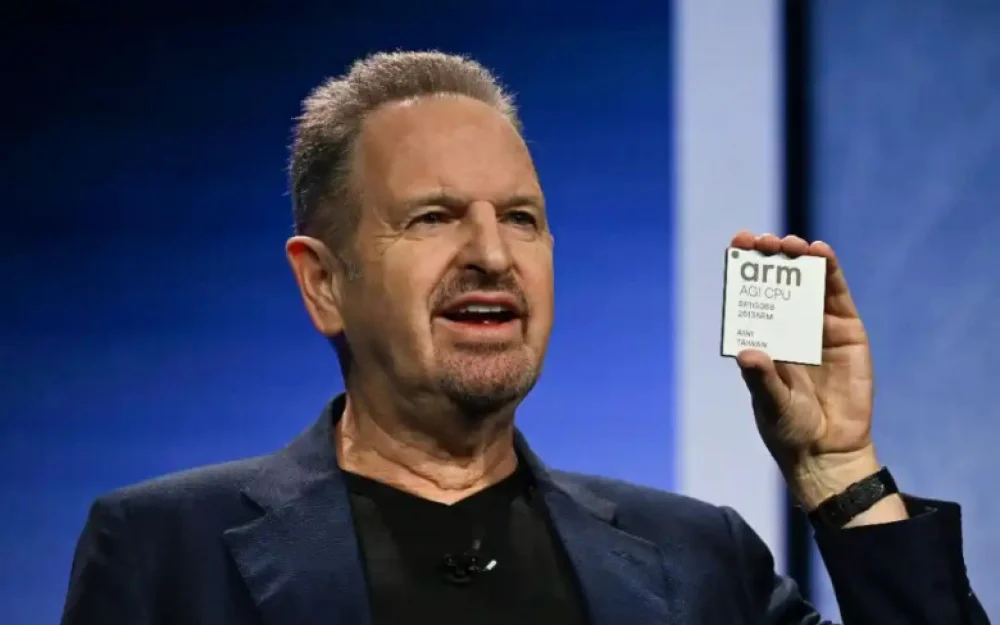
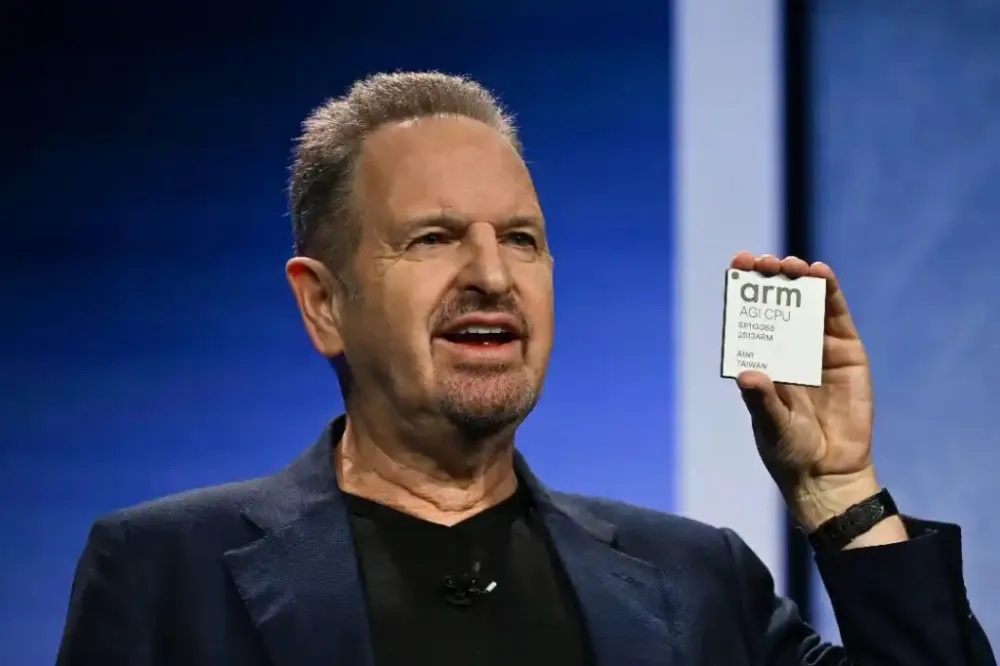
CEO Rene Haas introduced AGI CPU — Arm’s first fully proprietary, ready-to-install server chip. Calling this business model shift “a defining moment for the company”, Haas effectively proclaimed the end of the neutrality era.
To descend from the architecture level to real silicon, Arm has set up three engineering labs. A $71 million investment in this project in Austin and a mobilized army of 1,000 engineers are currently preparing the “AGI CPU” for mass production in the second half of the year. Wall Street instantly recognized the scale of this transformation.
As soon as the markets understood that the designer was taking a piece of the physical “hardware” market, Arm’s stock soared by 20%, and its market capitalization broke the historic mark of $155 billion. Investors welcomed the hard pragmatism: Arm made an aggressive bet on the chip market directly, no longer wanting to remain in the shadow of its own customers.
Anatomy of the Mind: Why AI Agents Need “Hands”
Arm’s direct bet on the finished chip market is not just a change in business model, it’s a demonstration of raw computing power. By introducing the “AGI CPU” to the stage, the company delivered a direct technical blow to classical architectures. Under the hood of the new processor, there are 136 Neoverse V3 cores printed using the 3-nanometer process at Taiwanese TSMC factories. This power has a perfectly pragmatic justification.
Traditional cloud data centers have relied on central processors for decades. When the neural network boom hit, the industry rushed to build specialized AI clusters, where one CPU was often responsible for managing data between eight GPUs. The era of agent AI breaks this narrow specialization, forcing the market to restore balance in favor of CPUs.
If the GPU is the brain of the neural network, generating meaning and making decisions, then the CPU becomes the tools and “hands” of the AI agents. Without a powerful processor, the agent AI remains a brilliant but completely paralyzed thinker.
Descending from the heavens of pure concepts to the earth of physical production, Arm faced the relentless laws of thermodynamics. To power this 136-core machine, engineers had to embed a 300-watt thermal design power (TDP) into the processor. This is a colossal figure for Arm’s architecture, which has historically been renowned for energy efficiency in mobile devices. The server racks of the future will literally blaze from computational density.
Such extreme power consumption is necessary for Arm to achieve twice the performance per rack compared to traditional x86 solutions from Intel and AMD. The company didn’t just release its chip — it gave the market the ability to double the performance of AI tools in the same physical data center space.
First Blood: Mark Zuckerberg’s Bet
The first buyer to decide to rely on this phenomenal density was Meta*. Mark Zuckerberg didn’t accidentally claim the status of debut client for the “AGI CPU.” His corporation is making a major bet on Llama — an open AI ecosystem.
One thing is to create a language model in a closed laboratory, and quite another to deploy billions of autonomous AI agents that will daily search for products, book tickets, and write code for WhatsApp*, Instagram*, and third-party developers worldwide.
For such a task, Arm’s architecture provides the highest density of cores per square centimeter of silicon. As a result, Meta* gains the ability to deploy processor “hands” for its AI agents with maximum density per server rack.
Seeing the creator of the largest social network integrate Arm silicon, other tech giants lined up for the new processor as well. The official waitlist already includes OpenAI, Cloudflare, SAP, and South Korea’s SK Telecom. The industry coldly confirmed the new density standard with their budgets.
A $25 Billion Bet
The fight for such a market means that the era of gentleman’s agreements in microelectronics has officially ended. At the “Arm Everywhere” presentation, Nvidia CEO Jensen Huang appeared in a pre-recorded video with warm and diplomatic congratulations. But behind this routine smile lies a cold understanding of the new reality. By bringing the “AGI CPU” to market, yesterday’s neutral partner delivers a direct blow to Nvidia’s own ambitions,
which is currently trying to impose its own server processors on the market for full control over data centers. A former ally has turned into a dangerous competitor.
The hidden conflict with Nvidia is just a symptom of the global collapse of the rules of the game. The launch of a ready-made chip from Arm creates yet another breach in the Silicon Valley market division system.
For many years, the scheme was unshakable and comfortable for everyone: some designed the basic architecture, others fabricated the silicon, a third group assembled graphics cards, and a fourth wrote software for all of it.
In the AI era, these boundaries are rapidly blurring. Developers of social networks and search engines, such as Meta* and Google, are designing their own AI accelerators. And the eternal designer Arm, which collected royalties for its blueprints, is launching large-scale deliveries of its own hardware. There is no longer “Switzerland” and no neutral territories. In the race to build the physical infrastructure for agent AI, everyone now competes with everyone else.
And in this new, extremely harsh ecosystem, trillion-dollar capitals will go only to those who can not just draw the blueprint of a future mind, but also provide it with the most efficient physical processors.


![From Virtual Hands to AI for Survivalists: Curious Open Agent OSes [and One Hardware Project]](https://cdn.tekkix.com/imgs/2026/05/habrcom/big/ce0b1057616faed51cd8b9f3b2b9.webp)
Write comment