
- Security
- A
How the method of quantum key distribution on sidebands was born and grew
LLC "SMARTS-Quanttelecom" is engaged in the development and implementation of quantum key distribution systems aimed not at laboratory experiments but at real telecommunications infrastructure. At the core of our solutions is the method of quantum key distribution on sidebands of phase-modulated optical radiation KRKBC - subcarrier wave QKD. Today, this approach is used in pilot and industrial quantum networks in the Russian Federation. However, the method itself did not arise yesterday - its history spans more than twenty years and begins with the work of Russian and foreign scientists from the mid-1990s.
Authors — Kynev S.M., Egorov V.I.
LLC "SMARTS-Quantumtelecom"
This article opens a series of publications dedicated to the SCW-QKD method and its evolution — from the physical idea to practical telecommunication technology. The first part is historical in nature and is devoted to the emergence and establishment of the approach: from the early work of Yu. T. Mazurenko on frequency division and interference of optical fields to research aimed at scaling the method and its application in network architectures.
The second article in the series will discuss the physics and mathematical description of SCW-QKD, including the models of quantum states used, implementations in systems with discrete and continuous variables, as well as possible generalizations of the method for various transmission scenarios, including open space.
The concluding article will be dedicated to the practical development of the method in Russia — from laboratory prototypes created at ITMO University and their testing, to industrial quantum key distribution systems "QUALION", developed and implemented by LLC "SMARTS-Quantumtelecom" as part of university, urban, and backbone quantum communication networks.
Quantum Cryptography at the Turn of the Century
By the end of the 1990s, quantum cryptography had already established itself as an independent scientific field. The BB84 and B92 protocols were thoroughly developed theoretically and repeatedly demonstrated in laboratory conditions. However, when attempting to transfer these schemes to real fiber-optic communication lines, fundamental engineering limitations quickly became apparent.
Polarization protocols turned out to be sensitive to random changes in the polarization state in optical fibers, which required either active compensation or the use of specialized fibers. Phase schemes based on interferometers, in turn, imposed strict requirements on the stability of optical paths and needed complex systems for thermal and mechanical stabilization, especially as the length of the communication line increased.
Against this background, significant interest was raised by two-pass (plug-and-play) quantum cryptography schemes proposed in the mid-1990s. Their key feature was that the quantum signal traveled through the same communication line in both directions, which allowed for automatic compensation of phase and polarization distortions that accumulated in the fiber (Fig. 1).
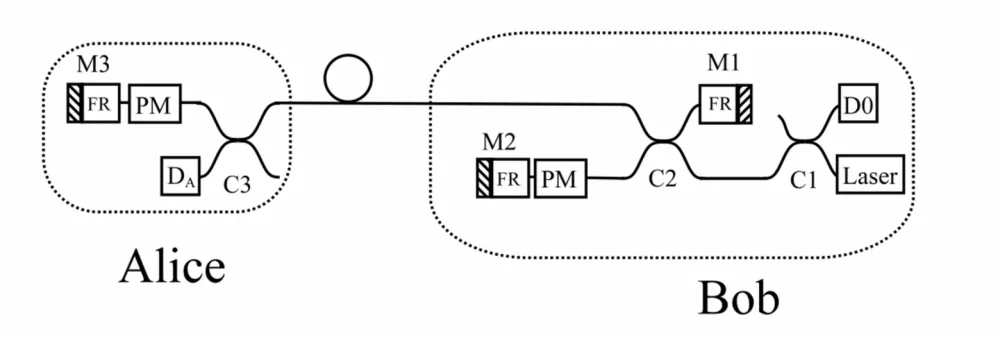
In a typical plug-and-play implementation, the transmitter and receiver form an asymmetric system in which optical pulses generated on Bob's side are reflected from a remote mirror node at Alice's side and returned back through the same fiber. This makes the interference conditions on the receiving side significantly less sensitive to external influences and parameter drifts of the line. An additional confirmation of the practical appeal of the two-pass architecture was the emergence of the first commercial quantum key distribution systems based on it. In particular, such a principle was implemented in a number of industrial solutions by ID Quantique, including the Clavis2 system, which gained popularity in the late 2000s. These developments demonstrated that plug-and-play schemes could be developed into finished products and used outside laboratory conditions, primarily in a point-to-point mode over limited distances.
Despite the obvious advantages at the level of laboratory demonstrations, the two-pass architecture had fundamental limitations. The presence of back-propagation of quantum radiation significantly complicated protection against active attacks and hindered the scalability of such systems in network and backbone scenarios. Furthermore, the bidirectional nature of transmission imposed constraints on the operating clock frequency: until the complete passage of the pulse through the communication line was finished, launching new quantum pulses was impossible due to dead time and illumination from synchronizing signals. In practice, this limited key generation frequencies in two-pass systems to values on the order of tens of megahertz. In contrast, in one-way schemes, the frequency limitation is mainly determined by the gate opening time and the dead time of single-photon detectors, without the need to wait for a bidirectional passage of the signal.
Thus, by the end of the 1990s, there was a stable demand for one-way quantum key distribution methods that maintain resilience to instabilities in the fiber-optic medium, while also being compatible with telecommunications infrastructure and allowing for further scalability. It was in this context that alternative approaches began to emerge, focused on unidirectional transmission and the abandonment of extended interferometers.
The work of Yu. T. Mazurenko and the birth of the idea
One of these directions became research in which the rejection of spatially separated interferometric schemes was compensated by the use of the frequency structure of optical radiation.
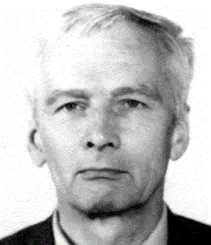
Thus emerged the works of Yuri Tarasovich Mazurenko (Fig. 2), dedicated to frequency division and interference of optical fields as they propagate through the same communication line. Initially, these studies, which began in the mid-1990s, were not oriented towards quantum cryptography as such, but rather focused on fundamental issues of interference and the stability of optical systems in real fiber-optic channels. However, the results obtained laid the physical foundation for the method that later became known as “quantum key distribution on the sidebands of phase-modulated radiation.”
Frequency Division as an Alternative to Interferometers (1994–1995)
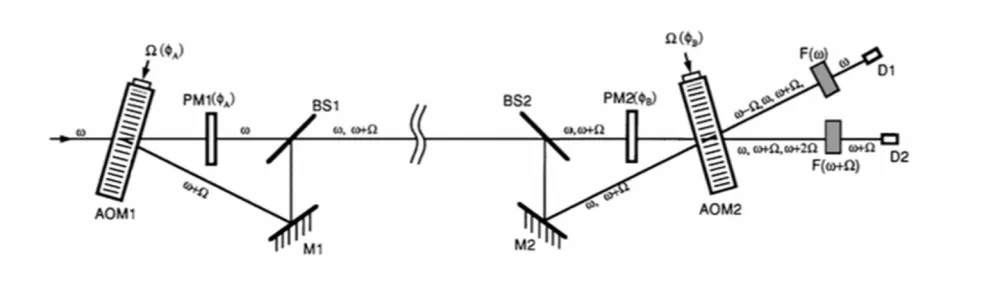
One of the key prerequisites for future QKD systems was the work of P. S. Sun, Yu. T. Mazurenko, and Y. Feynman, published in 1995, which proposed a single-channel long-range interferometer with frequency division of optical waves. In this scheme, optical fields with different frequency shifts were generated from a single source, then transmitted through the same fiber-optic channel, and ultimately interfered at the receiving end with high visibility.
The fundamental difference of this approach from classical interferometric schemes was the abandonment of spatially or temporally separated arms. The interfering components propagated along the same communication line and, therefore, experienced identical phase and polarization distortions caused by external influences and instabilities of the fiber. This ensured high interference stability without the need for active compensation of channel parameters (Fig. 3).
It is important to emphasize that this work has not yet addressed quantum cryptography. Nevertheless, it has been demonstrated that the frequency structure of the optical signal can serve as a full degree of freedom for interference, equivalent to spatial or temporal. This conclusion later became fundamental for transferring the idea to the field of quantum information transmission and, ultimately, for the formation of the QKD method.
Transition to QKD at Side Frequencies (1998–1999)
The transition to quantum cryptography systems in the frequency spectrum was made in the late 1990s when Yu. T. Mazurenko, together with J.-M. Merolla and J.-P. Godefroy, proposed using phase modulation of continuous laser radiation for transmitting quantum information. The main ideas of this approach were outlined in works from 1998–1999 dedicated to quantum information transmission using a subcarrier (side) frequency. (Mazurenko Yu. T., Merolla J.-M., Godefroy J.-P. Quantum information transmission using subcarrier frequency. Application to quantum cryptography // Optics and Spectroscopy. — 1999. — Vol. 86. — Pp. 181–186.)
Unlike the previously considered interferometric schemes, in this approach, interference was realized not between spatially or temporally separated optical paths, but between the spectral components of the same signal. The fundamental architecture of such a quantum information transmission system, including phase modulation of the optical carrier and subsequent detection of side frequencies on the receiver side, is shown in Fig. 4.
The optical carrier was subjected to phase modulation with a small modulation depth, resulting in the formation of symmetric side frequencies in the radiation spectrum. The spectral structure of the phase-modulated signal, which underlies this approach, is shown in Fig. 5. The amplitude of the side components could be chosen such that the average number of photons in them during the bit transmission interval became significantly less than one, allowing them to be used as carriers of quantum information.
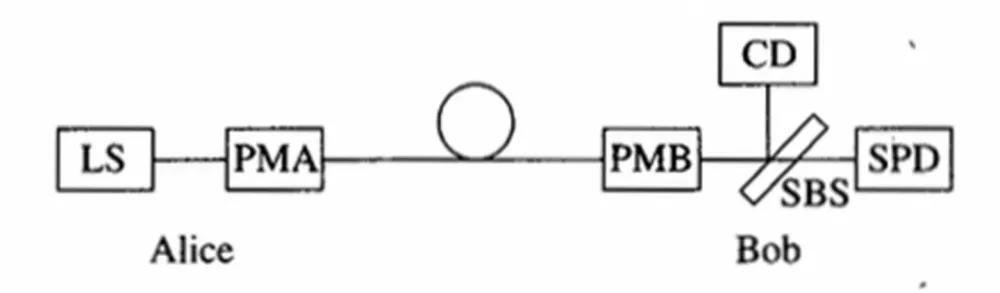
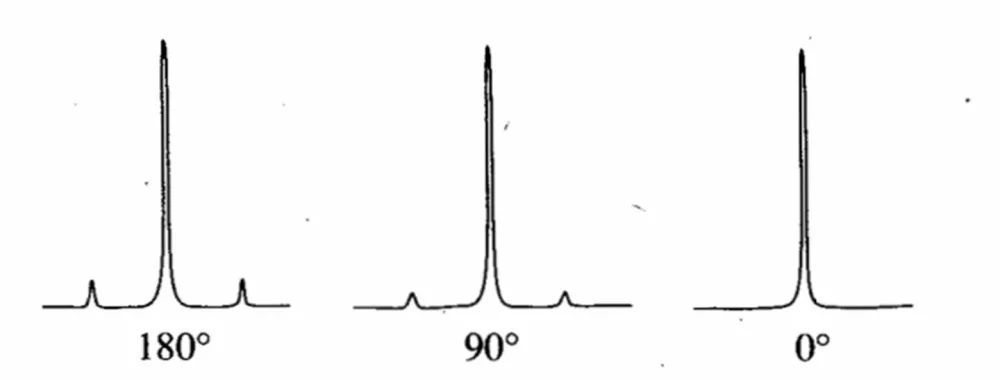
Information coding was performed by controlling the modulation phase, and detection was achieved through the interference of side frequencies on the receiver side. It is fundamentally important that the carrier and side frequencies were generated by the same laser source and propagated together through the fiber-optic communication line, ensuring their identical sensitivity to phase and polarization distortions of the channel.
As a result, a unidirectional method of quantum information transmission was implemented, where resilience to instabilities of the communication line was achieved not through a two-pass architecture, but through the internal spectral coherence of the signal. This approach laid the physical foundation for the method of quantum key distribution on the side frequencies of phase-modulated radiation.
Experimental demonstration of quantum interference (1999)
The physical feasibility of the proposed method was experimentally confirmed in 1999 in works published in the journals Physical Review Letters and Optics Letters. In these experiments, the interference of the sidebands of phase-modulated optical radiation in the single-photon regime was demonstrated, which was a key condition for the application of the method in quantum cryptography.
The experimental setup was based on a unidirectional optical communication line with phase modulation on the transmitter side and synchronized phase modulation on the receiver side. The optical carrier and sidebands were generated by a single laser source and propagated together through a fiber-optic channel, after which interference of the spectral components occurred on the receiving side. The schematic diagram of the experimental setup is shown in Fig. 6.
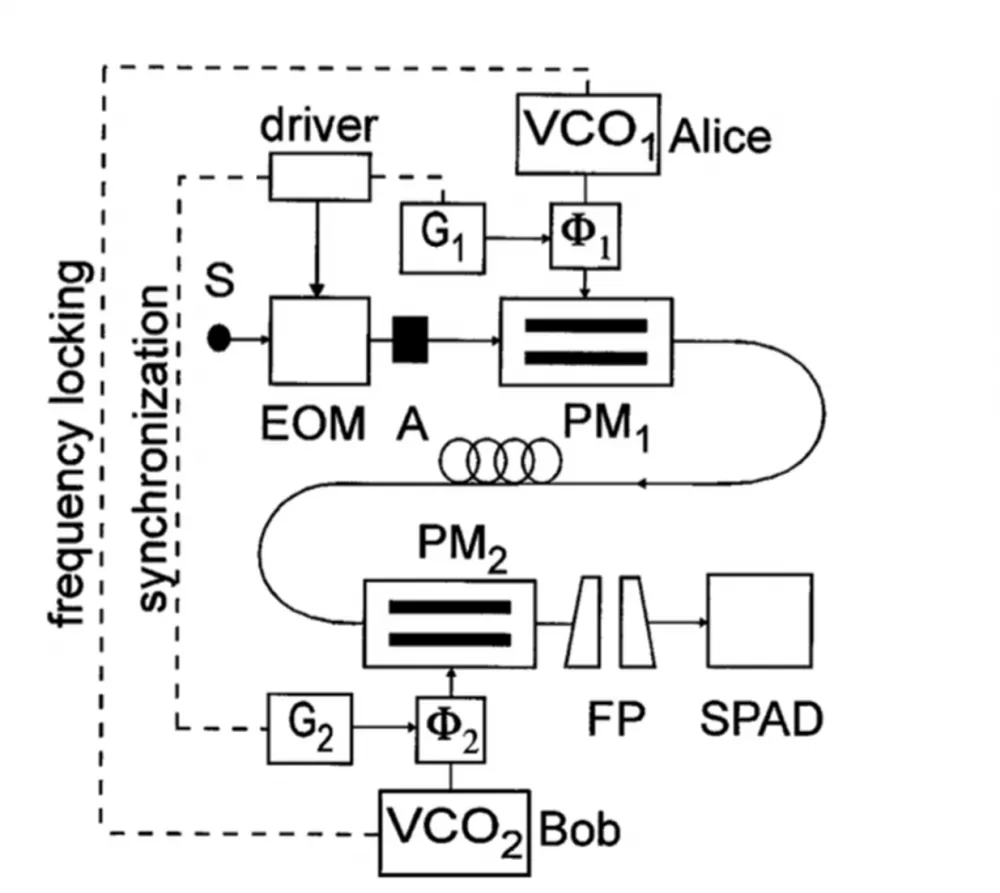
To quantitatively assess the interference properties of the system, the photon count rate was measured as a function of the phase difference between the modulators of the transmitter and receiver. The obtained dependencies demonstrated a pronounced interference pattern with high visibility, which persisted even at an average number of photons significantly less than one. The characteristic experimental dependence of the count rate on the phase shift is shown in Fig. 7.
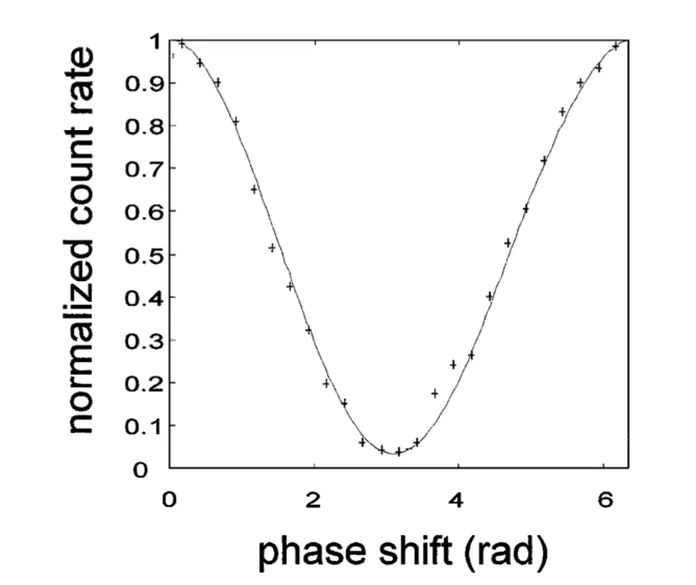
The demonstrated interference of side frequencies in quantum mode showed that the spectral components of phase-modulated radiation can serve as coherent quantum states suitable for encoding and detecting quantum information. This experimentally confirmed the possibility of implementing quantum key distribution without the use of extended interferometers and two-pass schemes, which fundamentally distinguished this approach from most existing implementations at that time.
Quantum Cryptography on Side Frequencies and Spectral Multiplexing
The experimental demonstration of quantum interference of side frequencies in 1999 definitively confirmed the physical feasibility of the quantum key distribution method based on phase-modulated optical radiation. However, at this stage, QKD remained essentially a "point-to-point" solution focused on transmitting a single quantum channel over one optical carrier.
The further development of the method was no longer related to fundamental questions of interference, but rather to tasks of scaling, spectral efficiency, and integration into existing fiber-optic networks. A natural question arose: is it possible to use the frequency degree of freedom not only for stable transmission of one quantum signal but also for parallel distribution of several independent quantum keys within one optical infrastructure.
A significant contribution to solving these problems was made by a group of Spanish scientists led by J. Capmany, who consistently developed the concept of subcarrier multiplexed QKD (SCM-QKD) in the context of microwave photonics and passive optical networks. In their works from the early 2010s, the QKD approach was rethought as an element of a multi-level network architecture that allows the simultaneous use of frequency and spectral multiplexing and is oriented towards multi-user key distribution scenarios.
In these studies, the method of quantum key distribution on side frequencies was first considered not only as a physical mechanism but also as a scalable network technology, potentially compatible with WDM-PON architectures and hybrid optical access networks. Most of the solutions examined were related to laboratory and pilot configurations, leaving the question of their scalability in terms of distance and losses open.
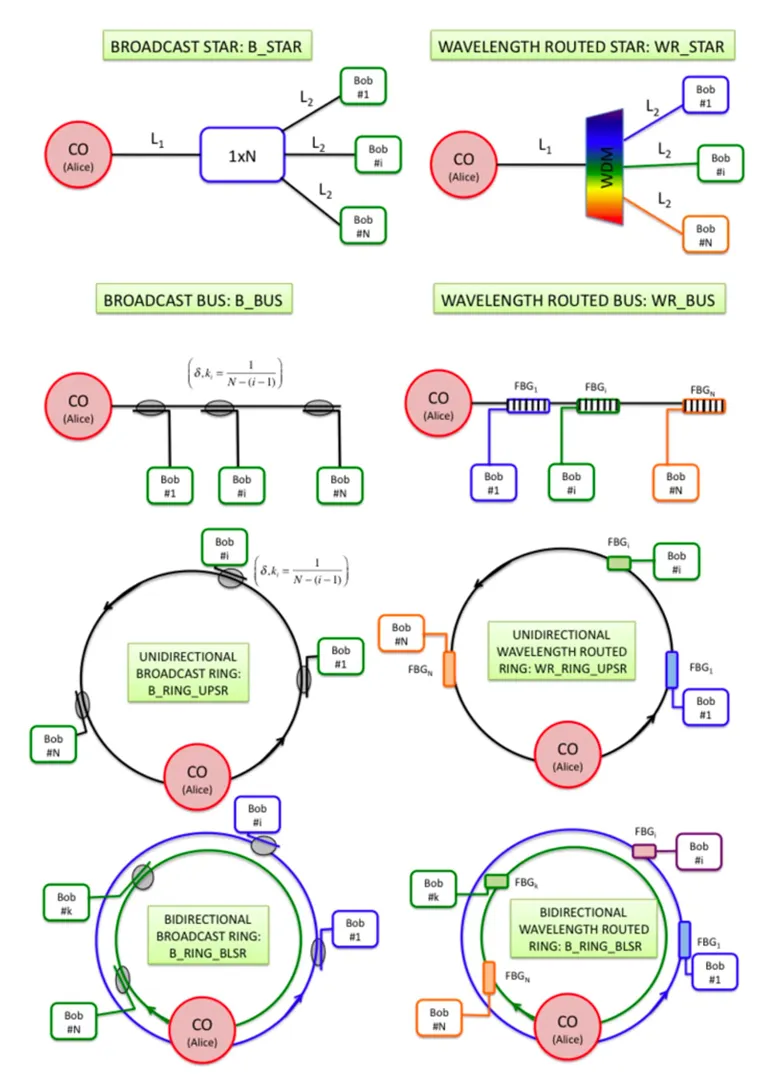
The theoretical analysis examined various topologies of passive optical networks — "star", "bus", and "ring" — in terms of losses, spectral efficiency, and the possibility of parallel distribution of quantum keys. It was shown that spectrally routed architectures have significant advantages over broadcast schemes, as they do not require power splitting among users and scale better in terms of the number of quantum channels (Fig. 8). Thus, it was demonstrated that spectrally routed architectures have the best characteristics in terms of losses and achievable key distribution rates.
The next stage involved experimental work, where parallel transmission of several independent quantum keys was demonstrated using radio frequency sidebands within a single optical wavelength. In these experiments, each side frequency encoded its own quantum channel, while the total key generation rate scaled with the number of sidebands, and the quantum error remained at a level acceptable for practical applications (Fig. 9).
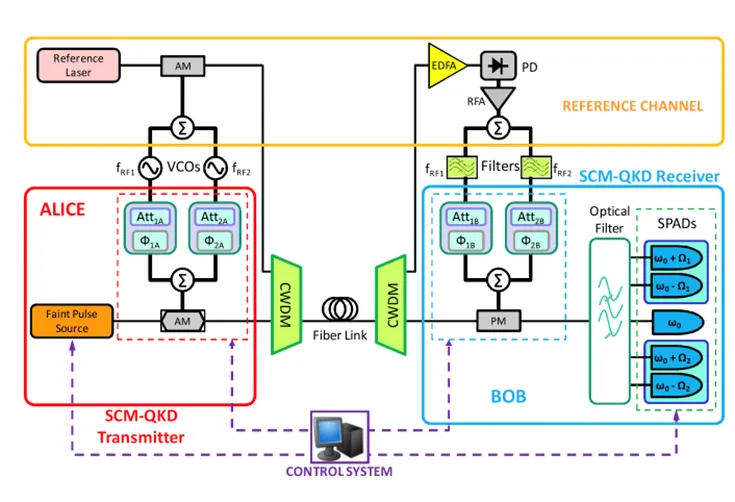
In the works of the group H. Kapmani, SCM-QKD was first systematically examined as an element of a multi-level network architecture that allows simultaneous use of frequency and spectral multiplexing and is compatible with existing access network infrastructure. These studies marked the transition from quantum systems in a "point-to-point" mode to multi-user quantum networks and laid the groundwork for further practical implementations of the method.
Comparison of Key Stages in the Development of SCM-QKD
To visually compare the main stages of the development of the quantum key distribution method using side frequencies, Table 1 presents a comparison of early works that laid the physical foundations of the approach and subsequent studies aimed at its scaling and network application.
Table 1. Comparison of Key Stages in the Development of SCM-QKD
Characteristic | Works of Yu. T. Mazurenko et al. (1995–2001) | Works of H. Kapmani (2009–2012) |
Main goal | Demonstration of the physical principle | Scaling and network application |
Encoding | Phase modulation, one pair of side frequencies | Multiple pairs of side frequencies (SCM) |
Type of system | Point-to-point | Multi-user, networked |
Interference | Between side frequencies of one signal | The same, with parallel channels |
Multiplexing | Absent | Multiplexing of multiple side frequencies + WDM |
Working with PON | Not considered | Detailed theoretical and experimental analysis |
Compatibility with classical traffic | Limited | Demonstrated experimentally |
Main contribution | Physical foundation of SCM-QKD | Architecture of scalable SCM networks |
Conclusion
The method of quantum key distribution on the sidebands of phase-modulated optical radiation has evolved from an original physical idea to a scalable network technology compatible with modern telecommunications infrastructure. The work of Yu. T. Mazurenko laid the fundamental principle of stable interference of spectral components in real fiber-optic communication lines, and subsequent experimental studies confirmed its applicability in the quantum regime. The further development of the method was associated with the transition from "point-to-point" schemes to multi-user architectures: research by the group of H. Kapmani showed that QKD can be used for the parallel distribution of multiple independent quantum keys and integrated into passive optical networks and hybrid WDM/SCM architectures, thereby forming the basis for the practical implementation of the method in network scenarios.






Write comment