- Security
- A
A Brief History of Biometrics: How Fingerprinting Entered Our Lives
The history of biometric dermatoglyphics on the human fingertip has been studied in detail and published hundreds, if not thousands, of times in both brief and detailed versions.
If we omit the Babylonian and ancient times and the history of fingerprinting in Eastern civilizations, the first European to pay attention to it in the late 1870s was Sir William Herschel, a British administration official in India, while it was put into practice in India by Edward Henry, the Inspector General of Bengal Police, who created the first classification of fingerprint patterns published in 1900. Sir Henry's classification included four main types of patterns: arches, loops, whorls, and in addition, "composites," which are stable compositions of these three "notes."
The history of biometric dermatoglyphic patterns on the fingertip of a human has been studied in detail and published hundreds if not thousands of times in both brief and detailed versions. If we skip over Babylonian and ancient times and the history of fingerprinting in Eastern civilizations, the first European to pay attention to it in the late 1870s is considered to be Sir William Herschel, a civil servant of the British administration in India, while it was applied in practice in India by the Inspector General of Bengal Police, Edward Henry, who created the first classification of ridge patterns and published it in 1900 (and eventually also became a Sir and head of the Criminal Investigation Department of Scotland Yard). Sir Henry's classification had four main types of patterns – arches, loops, whorls, and in addition to them "composites," which are stable compositions of these three "notes."
These are key dates in the timeline of the early history of fingerprinting. However, if we consider this period of dermatoglyphic biometrics in more detail, we see twists and turns more intricate than the patterns of skin folds on the fingertip. In 1892, Francis Galton published his book "Finger Prints," which included the same four types of patterns (arches, loops, whorls, and composites) as Sir Henry. There is nothing surprising about this; Galton and Henry corresponded with each other, and it was Galton's book that prompted Henry to take up fingerprinting. But once he took it up, being the highest-ranking officer of the Bengal Police, he assigned all the grunt work to two of his subordinate Indian inspectors. Their names were Khan Bahadur Kazi Azizul Haque and Rai Bahadur Hem Chandra Bose. The former created a mathematical algorithm for sorting fingerprints by their patterns, while the latter improved the classification method for fingerprints proposed by their boss. Now British historians write that those two Indians were awarded promotions from inspectors to superintendents, while Indian historians write about how Sir Galton and Sir Henry shamelessly "robbed" their compatriots.
Sir Francis Galton (he also became a sir, but for other scientific merits), as it turned out, did not come up with fingerprinting as a method of personal identification on his own, but borrowed this idea from the Scottish doctor Henry Fauld, who was treating patients in Japan. There, in the late 1870s, he successfully identified a person by his fingerprints and wrote about it to Charles Darwin, sending an article titled “On the Skin-furrows of the Hand” to the journal “Nature,” where it was published in the issue dated October 28, 1880.
In this article, Dr. Fauld wrote: “A large number of their fingerprints were taken by me from the fingers of people in Japan, and I am currently collecting others belonging to different nationalities, which, I hope, will help ethnology students in classifying races. In some individuals, these furrows are arranged quite symmetrically. In these cases, all the fingers of one hand have the same arrangement of lines, while the pattern simply changes to the opposite. For example, the Gibraltar monkey (Macacus innus), which I studied, had such an arrangement. This is also observed in most of the few Europeans whose fingerprints we were able to examine here.”
And further he writes: “I have no doubt that a careful study of these patterns can be useful... They may aid in the scientific identification of criminals, which is much more valuable than the infamous birthmark described in sensational novels. I have already had experience with two such cases. If, however, the person who left the fingerprints is unknown, then his fingerprints allow an expert in many cases to establish his kinship with a high degree of probability, and in some cases — with absolute precision... I would be glad to know that this is indeed the case, as it would only confirm the usefulness of my method. And the facts that would be collected in this way would become a rich anthropological source for patient observers.”
Charles Darwin received a letter from Dr. Faulds regarding his discovery not as a promising method of forensics, but for another reason. It was during the 1870s, after the publication of Darwin's book "The Descent of Man" (from monkeys), that a global scandal erupted, extending beyond the realm of science and continuing to this day. The papillary patterns on the fingers of monkeys discovered by Faulds, which were exactly the same as those of humans, supported Darwin's theory of human descent from monkeys, something that Dr. Faulds did not hesitate to inform the esteemed Darwin about. However, he received no response because Darwin immediately passed his letter to his cousin Francis Galton.
It seems that Galton wrote a reply to Dr. Faulds. Yet in his book "Fingerprints," Sir Francis Galton mentions Dr. Faulds only once and only as the author of an article in "Nature," "who apparently put in a lot of effort to thoroughly study fingerprints." However, this is purely a British matter; during the Victorian era, it was not customary to interfere in the affairs of gentlemen. Already in our century, one historian of science wrote that Dr. Faulds himself came to Scotland Yard in 1888 to demonstrate his method of dactyloscopy, but there he was considered "a harmless eccentric, albeit with a scandalous character."
The classification of fingerprints into four types of papillary line patterns by Galton-Henry was a classic problem in combinatorics. Each finger was assigned a serial number, starting with the thumb of the right hand as #1 and ending with the little finger of the left hand as #10. Fingers that had a swirl pattern were assigned a numerical value. Each of fingers 1 and 2 has a value of 16, fingers 3 and 4 have a value of 8, and so on, with the last two fingers having a value of 1. Fingers that do not have swirls in their pattern, but only have arches or loops, are assigned a zero value. It is not difficult to calculate the total number of different combinations of patterns on the fingers: 32 x 32 = 1024.
It remained to arrange the fingerprint cards in the cabinet on 1024 shelves, and if there were fingerprints from all 10 fingers, it was clear on which shelf to look for the card of their owner. But if one fingerprint was missing, it would be necessary to check two shelves; if two fingerprints were missing – 4 shelves, and so on in geometric progression: three – 8 shelves, four – 16 shelves, etc. In search of a single fingerprint, it would be necessary to sift through all 1024 shelves. Meanwhile, already in the early 2000s, fingerprint cards of incarcerated criminals were measured in hundreds, and in the 2010s, in thousands. For example, in the Central Fingerprint Bureau of the Russian Empire, there were 40 thousand. It is clear that from the very beginning, inventive thought in this field of biometrics was aimed at facilitating and speeding up the search for the required fingerprint card.
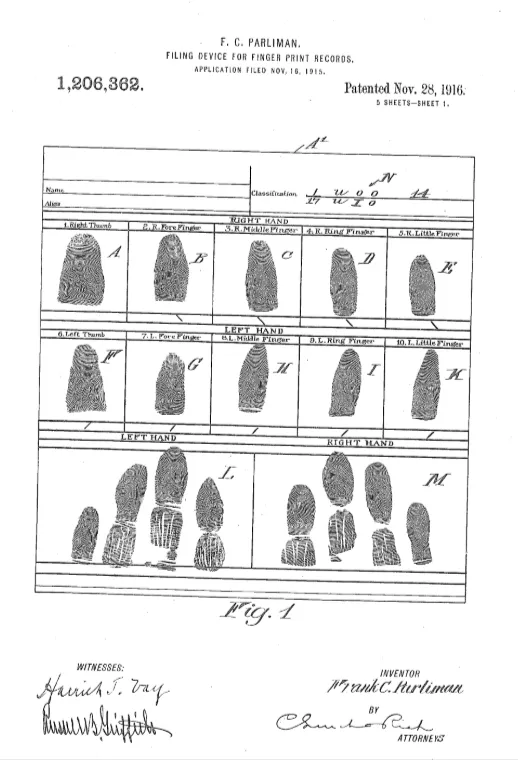
For example, here is an American patent from 1916 (with priority from 1915) for a “device for storing fingerprints,” where its inventor writes that his goal was “to create a simple and convenient device for storing records of fingerprints that allows for grouping various records with common primary characteristics” and “to make this instantaneous.” But in fact, it was just a slightly improved Henry system, and regarding its instantaneous nature, the author slightly overstated.
Here is a patent from 1926 (with priority from 1921) for a “System of identification by a single fingerprint,” which is interesting due to the residence of the author of this invention. He was Walter Charles Stephen Kroczkowski from San Quentin, California. Of course, he was not an inmate of the famous prison but an employee of that institution responsible for fingerprinting prisoners and probably lived in one of the several dozen cottages on the San Quentin peninsula, built near the prison for its staff.
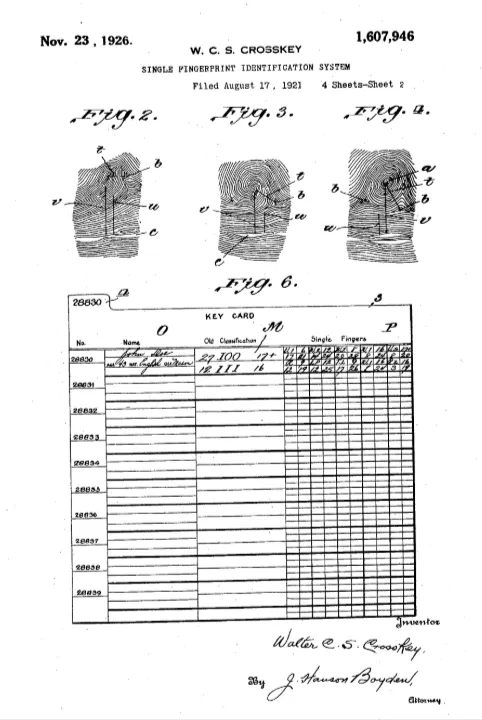
“I developed a new method for classifying fingerprints and also improved the system for indexing, storing, and identifying such prints,” writes the inventor. “My invention is not intended to replace or displace the ten-finger systems currently in use but is designed to be used as an auxiliary tool in conjunction with the old system to complement it and enhance its efficiency. <…> I believe that the numerous advantages of my improved system will be duly appreciated by specialists in this field without unnecessary discussions.”
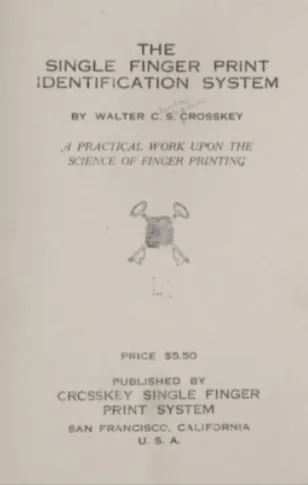
Those interested in the combinatorics of Walter Crox's papillary patterns can browse his book “The single finger print identification system: a practical work upon the science of finger printing,” published in 1923, that is, after he filed “patent applications covering our new method of classifying fingerprints and the improved data storage system in the United States, England, Canada, Australia, and all foreign countries around the world.” His book begins with a warning: “We warn everyone against attempting to use these inventions without the proper license.”
Mr. Kroksi was right about the fact that in real practice, criminalists encounter fingerprints of one finger or several much more often than all ten at once. But he hoped in vain that his classification would be appreciated by specialists “without unnecessary discussions.” By the end of the 1930s, there were more than 30 main systems of fingerprint registration accepted as standards at different times in different countries (including the system of the first head of the Moscow investigative police, Vasily Ivanovich Lebedev). By the way, the author of one of the classification systems, which was used for a time in the early 20th century by the police of France, Belgium, Switzerland, and Spain and which featured only four fingers of the right hand, was Alphonse Bertillon (his table of fingerprint formulas can be viewed here).
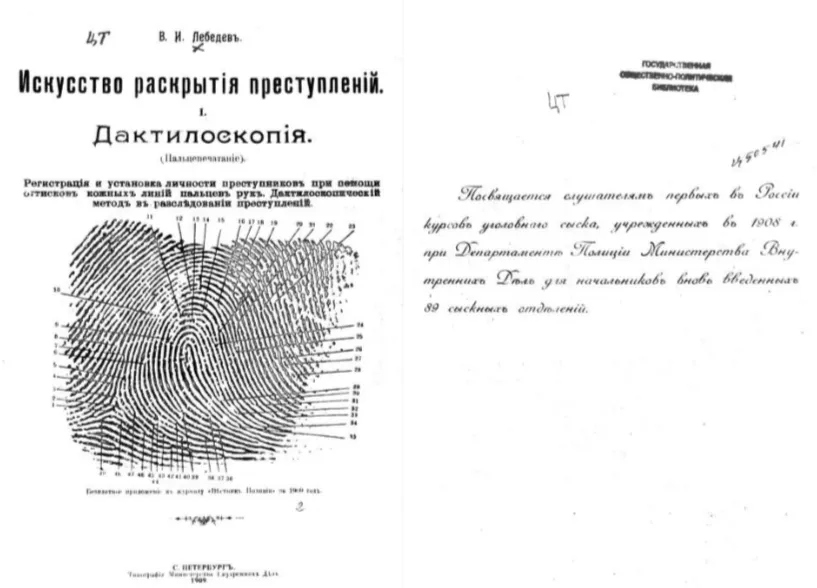
The pros and cons of all these fingerprint classifications have been discussed in the monumental 7-volume “Treatise on Criminalistics” by the well-known French criminalist Edmond Locard “Traité de criminalistique” (1931-1940). New methods of encoding fingerprint patterns are still being invented (for instance, see the domestic patent No. 2381554C1 from 2010 and the list of similar patents by other inventors). However, with the advent of the computer age and the emergence of automated fingerprint identification systems (AFIS), manual card methods of personal authentication have become anachronistic. Just as pre-war methods of taking fingerprints and revealing hidden, invisible to the naked eye prints have been replaced by laser and other modern physico-chemical technologies. This, however, has only an indirect relation to biometrics as such; rather, it is pure physics and chemistry at the service of biometrics.
One hundred years later, Alphonse Bertillon's identification card consists only of fingerprints and a photo of the face. His measurements and the creation of body proportion tables have been reduced to the identification and authentication of the geometry of that person's face.
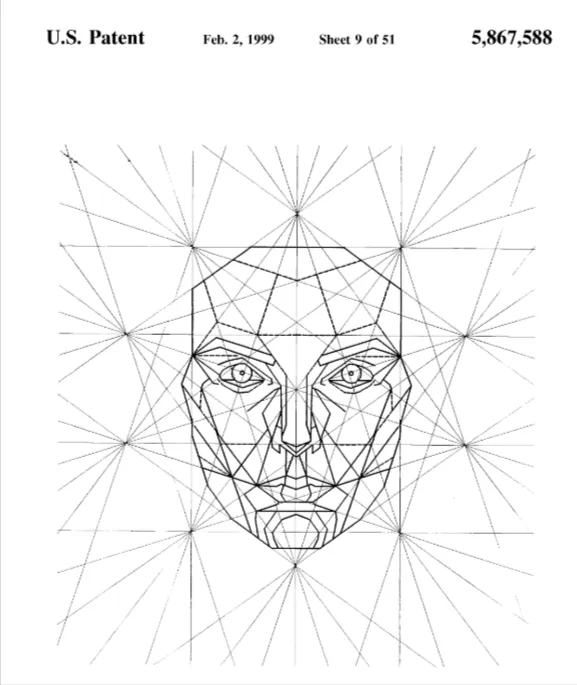
For example, the patent from 1999 (with priority from 1994) for "Method and device for analyzing the configuration and components of a face" is interesting in that its preamble is much shorter and clearer than in reference books and encyclopedias. It outlines the history of attempts to develop parameters for the quantitative assessment of facial proportions, specifically of beautiful faces, rather than the grotesque ones like those of Lombroso's clients, starting from the ancient Greek mathematical apparatus of the "golden ratio" through the Renaissance and up to the present day. However, the reality is that in practical biometric identification and authentication, the geometry of a person's hand is currently in much greater demand. It is simpler and cheaper, and the probabilistic result is the same.
The same goes for photography. Currently, 3D photos taken from different angles are analyzed by neural networks, but practical applications are found only in the field of facial recognition, often not with positive results. Perhaps the situation will change if the promises of IT specialists that neural networks will soon be able to identify sexual orientation from a photograph of a face come to fruition, and such biometrics become the center of attention for progressive society as a recurrence of "scientific racism" from the time of Francis Galton. A loud scandal does not always harm an invention or discovery; sometimes the opposite occurs.
About the Online Patent service:
Online Patent is the number 1 digital system in the ranking of Rospatent. Since 2013, we have been creating unique LegalTech solutions for the protection and management of intellectual property. Register at the Online Patent service and gain access to the following services:
Online registration of programs, patents for inventions, trademarks, and industrial designs;
Submission of an application for inclusion in the register of domestic software;
Options for expedited service processing;
Free searches in patent, program, and trademark databases;
Monitoring of new applications by criteria;
Online support from specialists.









Write comment