- DIY
- A
Rigonda 2.0: How I Married Alice on a Radio, or Two Reasons to Open a Soviet Music Center
I bought a refurbished Soviet radio to finally get a smart home. The restorers built Alice and a "guitar input" into it.
Hello everyone! I am Yegor Kuzmichev, Tech Lead from Deckhouse Managed Services. I have this urge to dismantle everything new, especially if it contains electrical circuits inside. Because out of the box, it is almost never fully thought out. My poor electric guitars no longer know where to hide.
And it happened! I bought myself a restored Soviet radio to listen to records. The crafty manufacturers offer various kinds of addons. There are exactly two significant ones for the story: a guitar input and an integrated Alice.
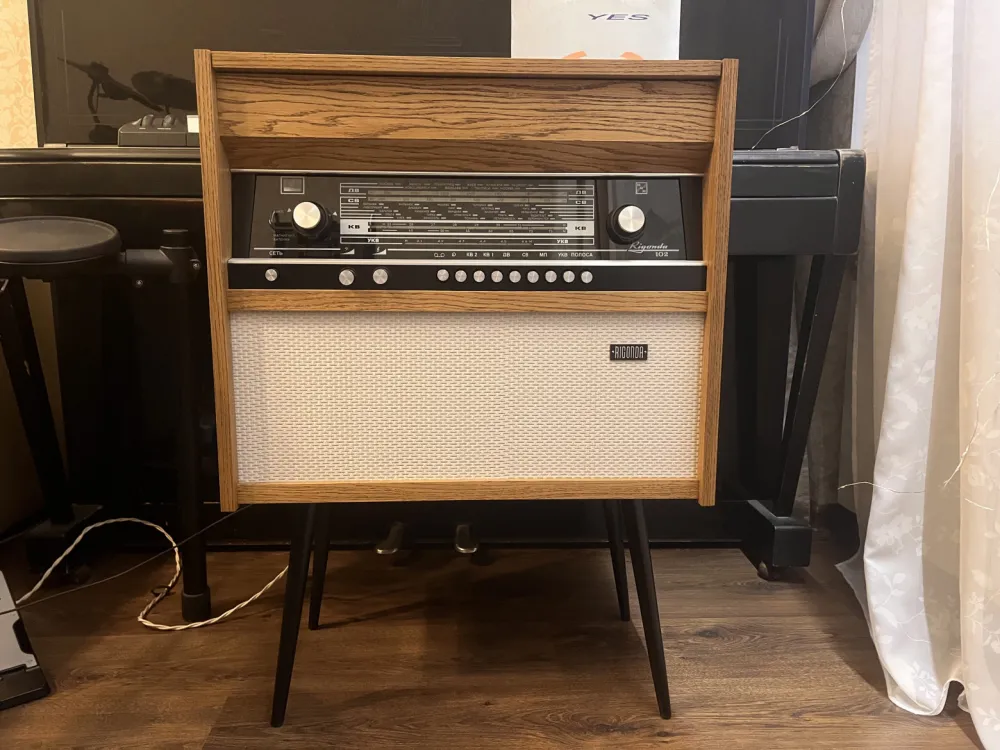
"Well, I thought, everyone already has smart homes, and I'm somehow missing out. I'm a programmer! Let my radio become the center of the house."
I'm telling how a lamp relic turned into digital convenience — with Alice, who finally started talking, and a guitar input that actually works. And why sometimes the best solution is not programming behavior, but a simple relay and a bit of faith in GOST.
The radio arrived — Alice is silent, the input is not right
The anticipation of delivery and the first turn-on brought exactly the thrill for which everything was started. But not for long — the inner stickler crawled out and began to notice the imperfections of the device. Overheated myself, in short.
Firstly, the guitar input turned out to be 3.5 mm — that is, under AUX. But after re-reading the correspondence, I realized that I made it up for myself. It was simply about the audio input.
Secondly, Alice on board turned out to be completely useless — like a Talking Bird locked on the planet Shalezyaka: disconnected "Rigonda" = disconnected Alice.
And while the issue of replacing the audio input can be solved with two soldering iron pokes, the task with Alice went to the background.
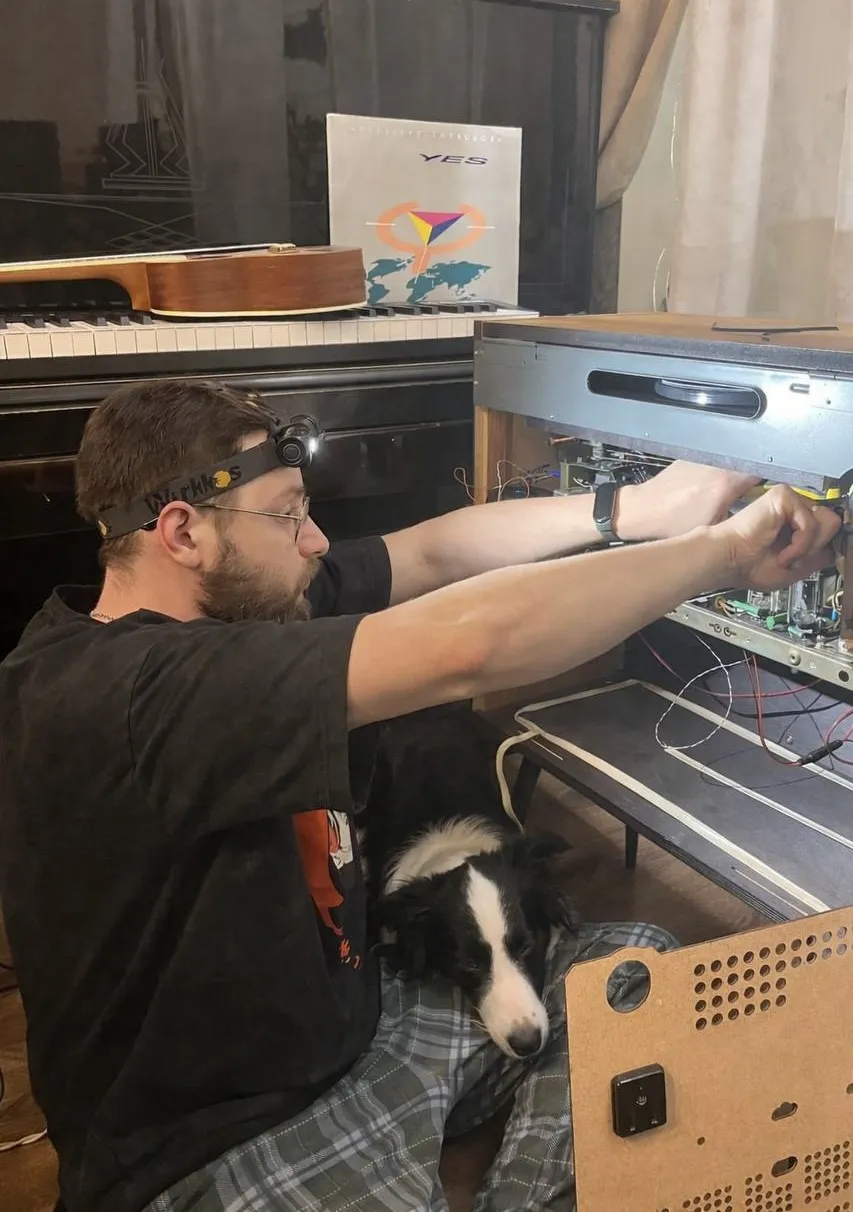
And here, three months later — when my floral-candy period with all the new things is ending — I opened the back cover with a clear conscience.
Motivation/Pain
The radio is the brainchild of Soviet engineers and a hostage of its time, even if restored. It is not designed for continuous power connection — this is explicitly stated in the instructions.
Alice is a modern device that should indeed be connected 24/7; otherwise, how will she hear the question: "What’s the weather outside?"
Detailed description of the solution
I open the case and see that Alice is connected to the power line of "Rigonda" using the original power supply after the power button. This means that when the button is pressed, power is supplied to Alice and the amplifier lamps start to heat up simultaneously.
First thought:
I take the smart assistant's power supply outside, and here you have a healthy cell of society. Well, almost... The sound output through a neat technological hole in Alice's case goes to the radio amplifier board. And while the radio itself is turned off, it can only listen attentively but not respond. And why do I need direct competition for my dog? Right, there's no need.
Second thought:
I'm going to order a smart socket now, teach Alice to turn on the radio, and that's it. "Rigonda" turns into a cyberpunk artifact, and Alice gains purpose. Fortunately, the market promised to deliver the socket to me in 30 minutes. Done deal.
Third thought:
What kind of nonsense is this:
— Alice, turn on the radio
— Alice, what's the weather like outside?
— It’s -3 degrees outside right now.
— Alice, turn off the radio.
It's inconvenient. And slow.
Fourth thought:
I just need to teach Alice to choose which speaker to talk through — the internal or external one. And for this task, I know four magical letters: R-E-L-E.
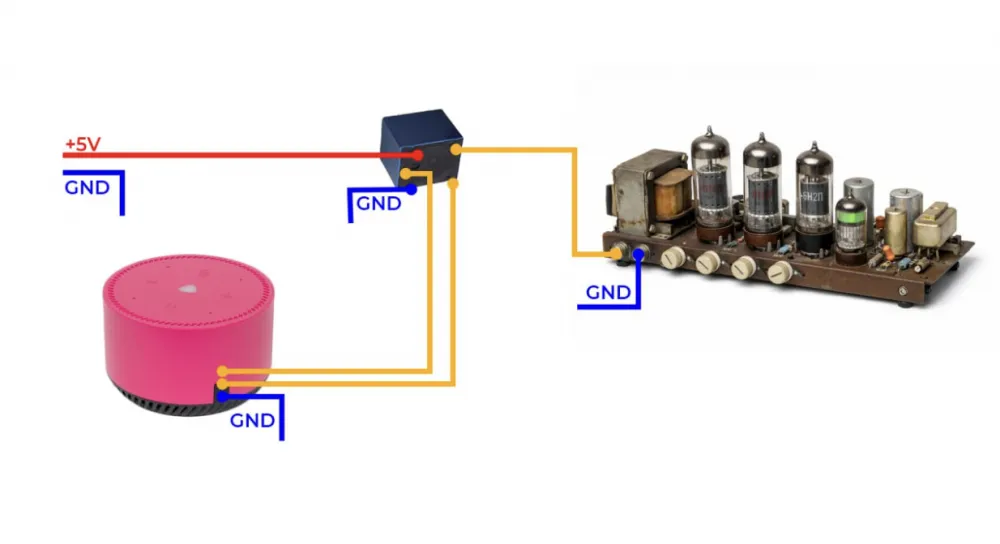
It's simple: I take the positive line coming from Alice's board and break it with the help of a relay. The normally closed contact (NC) directs the sound to the internal speaker, while the normally open contact (NO) goes to the radio board.
And I don't even need to invent anything because I plug in the first 5-volt power supply I find into the old power supply spot for Alice, vandalize a long-forgotten microUSB cable, splice it with my favorite twisted pair, and power the relay. I get exactly the behavior I need:
When Alice turns on the radio through the smart socket — the relay clicks, and the sound goes to the tube amplifier.
When the radio is turned off — the relay disconnects, and Alice speaks through her native speaker again.
I rush to open Alice to restore the broken line to the internal speaker… But not so fast.
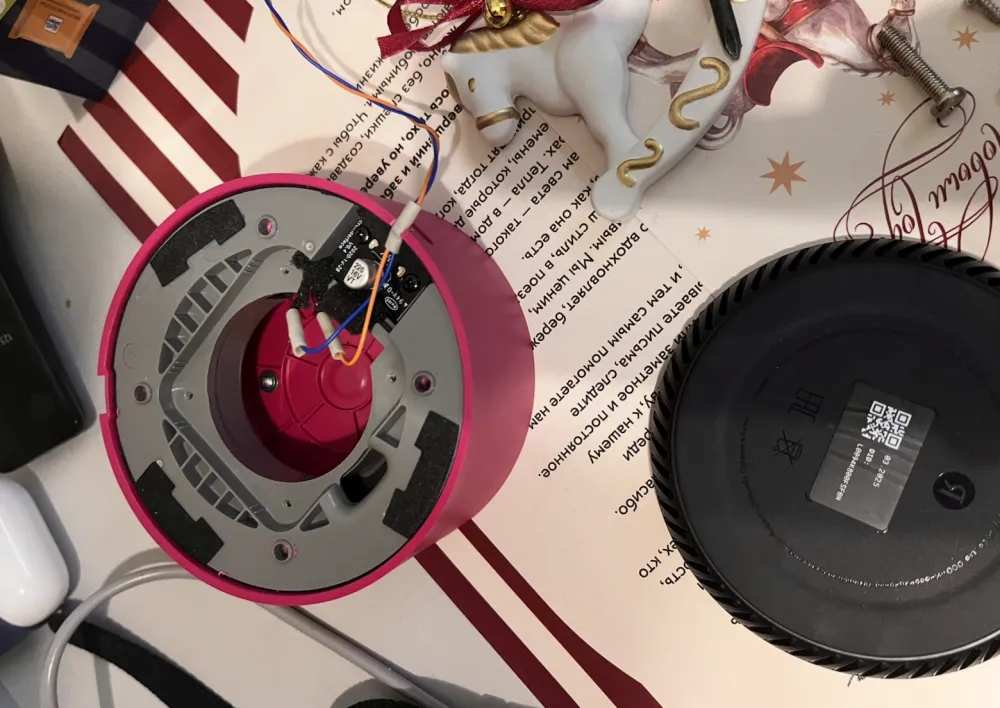
Where is the speaker? Or how I found a donor in five minutes
It seems someone has already been here before me…
I don’t understand anything.
Why did they take my speaker?
It’s a case of the stolen striped elephant, no doubt.
And this is where my favorite part of any DIY begins.
With a quick glance, squinting a bit, I surveyed the room in search of a device capable of producing sound.
The television nervously swallowed.
— Alright… keep broadcasting for now, — I thought.
The computer speakers abruptly stopped tuning into the radio.
— I’ll jot you down with a pencil for now.
Ah! There you are! An old-modern vinyl player with built-in speakers. And it even has a tired turntable motor, which makes the composition When The Levee Breaks sound even more sluggish. Congratulations, now you’re also mono, just like “Rigonda 102.”
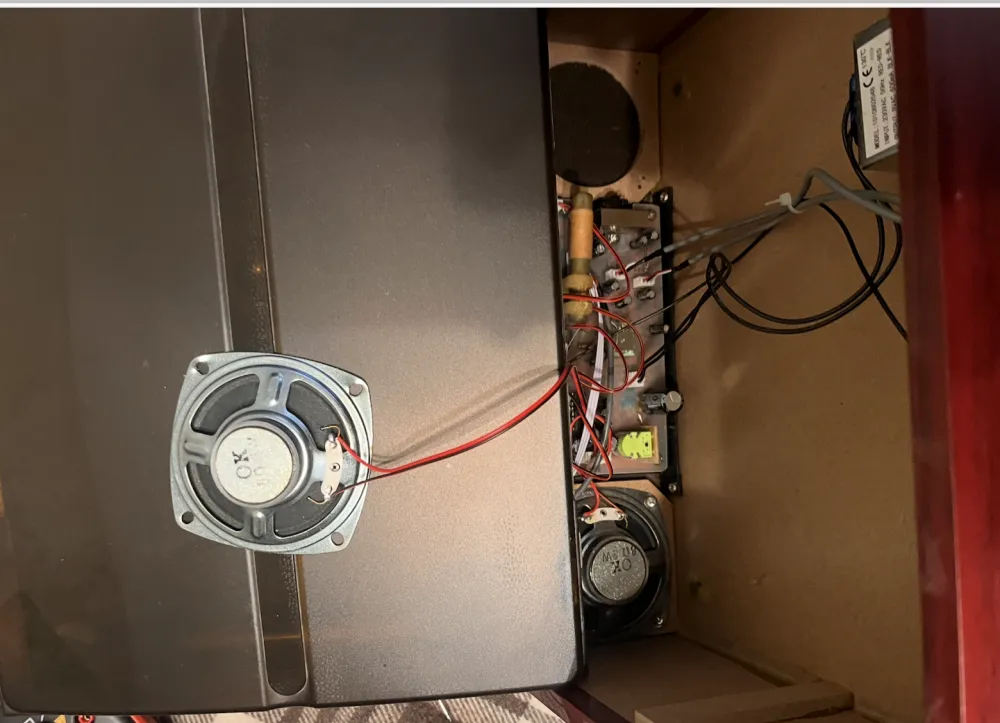
The donor issue is resolved, gathering everything together.
I was a bit shaky — whether from enthusiasm or the third cup of coffee, hence I couldn’t boast about the neatness of my execution.
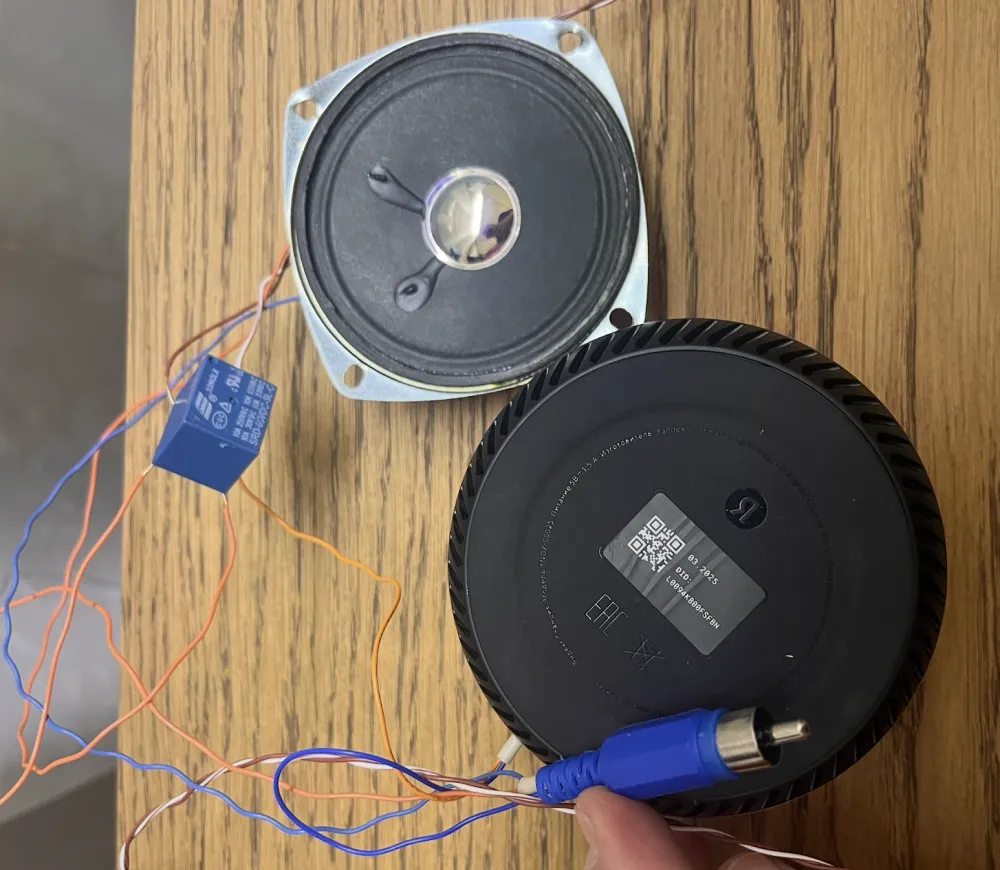
I lied to myself that as soon as I could, I would redo everything to make it look nice.
I’m eagerly connecting all the ports.
— Knock-knock, testing connection. How’s the weather?
— It’s −3 degrees outside right now.
— Alice, turn on the radio.
— Turning on.
— Alice, what time is it?
— Zero hours, forty-one minutes.
Here’s a video with the result (it’s on YouTube):
So, why did I even get into this? Ah, right — the guitar input
With a quick glance, squinting a bit, I… Okay, this time without unnecessary drama. Where is my purple guitar from “Zombie”? Let’s see… And then it starts to wail in B-flat minor. Alright, I agree, all that’s left from the factory is just the neck.
Today, the Soviet effects pedal “Heavy Metal” from “Gamma” is being used, which has long been converted into a sustain pedal for a MIDI keyboard. Instead of an eye, it now has an interface.
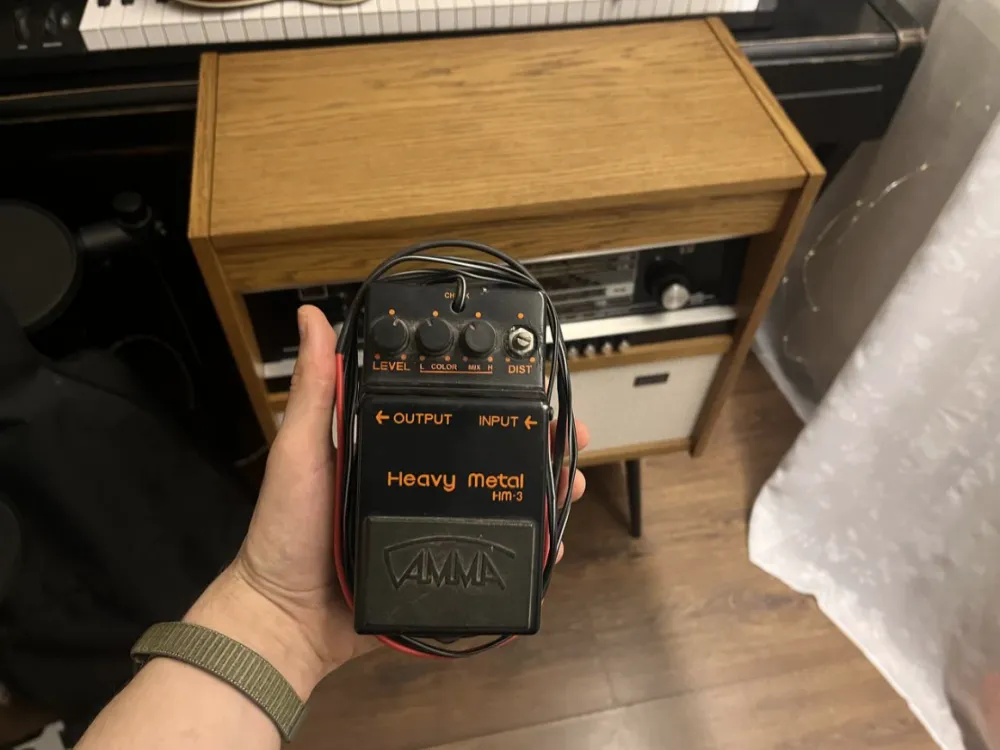
It’s a legendary thing — thanks to it, I even got an automatic grade in circuit design at university by presenting my own “development” to the professor (luckily, he wasn’t too attentive).
The main thing is, it no longer needs the 6.3 mm ports.
But I do — very much!
And this is yet another proof in my wife's protests that I am a hoarder and she is generally tired of my junk in the house. IT WILL BE NEEDED!
With precise movements, I extracted the Soviet (read - quality) guitar input.
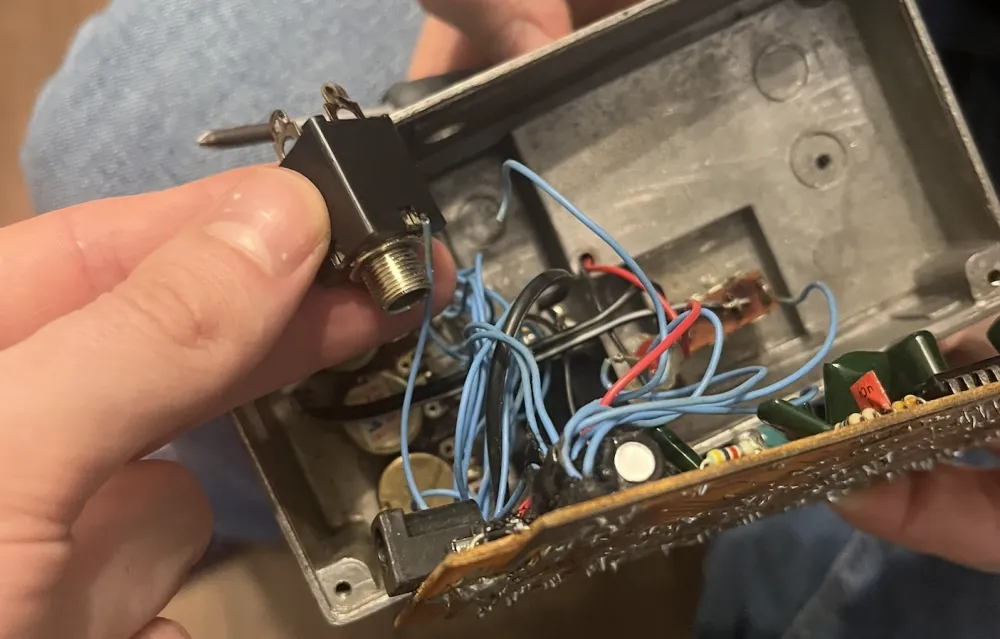
And, not surprisingly, the connector fits perfectly into the technological hole of the back panel: snugly, neatly, with a slight click, perfectly aligned with the other connectors.
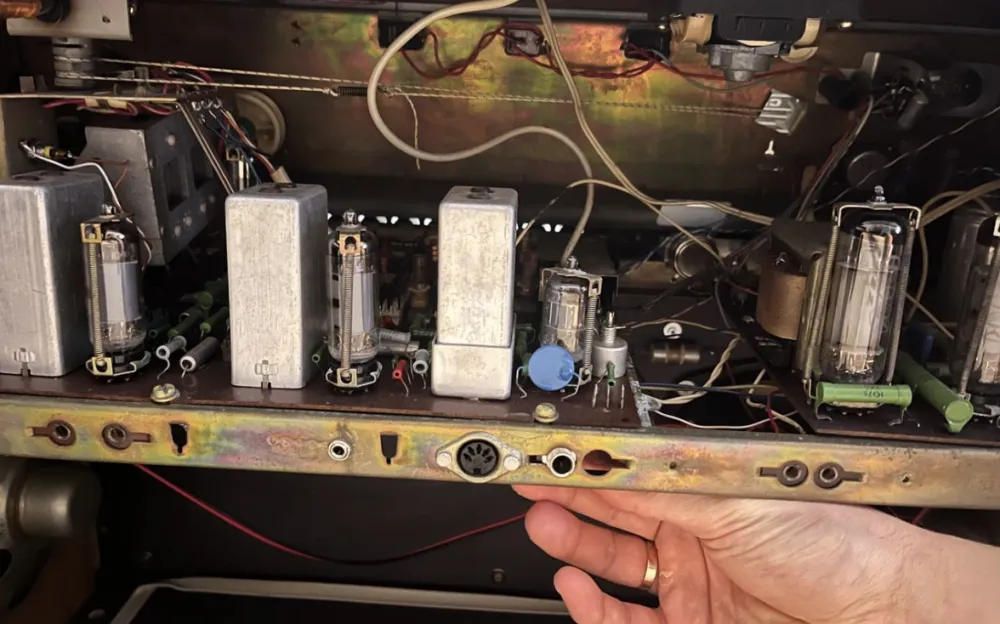
This is what it means to follow GOST! A great thing - and you say...
Click-clack - the back cover is in place, the cable is in the guitar. The tubes are warmed up - neighbors, rise!
Considered Alternatives
You know, the money I spent on the radio could have been invested in the minimum subsistence capital. Or at least buy a good modern stereo system with a class D amplifier and listen to old Melodiyа records on it.
But…
“How can you not understand?! It's alive! And it glows!”
P. S.
Also read in our blog:
How I taught an old DVR to send alerts from home surveillance cameras to Telegram
Checking if the fire extinguishing module could have caused the fire in the warehouse
How I built a solar station myself: a detailed overview of components and the assembly process

Write comment