- DIY
- A
Acoustic Diode?
Sometimes it happens that ideas, known to everyone in one of the fields, do not leave scientists alone, forcing them to explore the possibility of applying these ideas in an entirely different field. A bright example of such an approach is the invention of the so-called "acoustic diodes"...
We all know the usual diodes in electronics, but as it turns out, scientists have been working for quite some time on the possibility of implementing similar one-way transmission in the sound sphere!
Just think about how promising this would be — the creation of perfect sound-absorbing materials alone would find applications in many fields, ranging from sound recording to fighting unwanted city noise: special films on windows, perfectly sound-absorbing curtains (for example, window curtains) that allow air to circulate freely and, accordingly, ventilate the room, while completely blocking out unwanted external noise; undoubtedly, this will be useful for future scientific applications as well...
This whole story began back in 2010 with a landmark work by a group of Chinese physicists, who, for the first time, practically implemented the first acoustic diode, thus confirming previous theoretical developments in reality.
Let’s take a closer look at the picture above:
On the right side (blue), you can see a layer of suspension, represented by a medical gel with microparticles, typically used in ultrasound diagnostics;
On the left side, you can see the assembly block, made up of layers of glass interspersed with layers of water;
On the right side of the entire assembly is the ultrasonic emitter;
On the left side of the assembly is the ultrasonic receiver (both the emitter and receiver are devices of the same type).
Thus, the entire experiment starts from right to left, and accordingly, the sound wave passes through the entire assembly from right to left.
The entire right part of the assembly is conditionally named NLM (Nonlinear Medium) — nonlinear medium — because as the sound wave passes through this block, it changes its properties (frequency), which is caused by the oscillations of air bubbles in the gel, which start to re-emit this wave at the doubled frequency.
Re-emission at the doubled frequency does not mean that the original wave is converted into a wave of double frequency and the wave of the original frequency disappears — not at all, it freely passes through the suspension block.
The entire left part of the assembly is called “Superlattice” and acts as a frequency filter, blocking the original frequency and allowing only the re-emitted doubled frequency to pass through.
The cancellation of the original frequency occurs due to the superposition of the sound wave entering this assembly and the part of the wave reflected from the medium boundaries (water/glass between layers) in an anti-phase (destructive interference).
For such reflection to work, it is necessary that the distances between the boundaries of the media (you could say the “layer thicknesses”) are of a certain size, and in this experiment, they were chosen in such a way that the wavelength of the original ultrasound emitter was cancelled, while the doubled frequency passed through without problems.
By the way, about these emitters: each of them was used both as an emitter and as a receiver:
In the first case, when the wave was sent from right to left, the passage of the wave through the entire assembly was tested, and the left ultrasonic device worked as a receiver.
In the reverse case, the passage from left to right was tested, during which almost complete suppression of this wave was recorded, with only 0.01% of the original wave passing through.
Thus, in practice, the functionality of the acoustic diode concept was tested, and if anyone is interested, this assembly on the left (superlattice) is also called a phononic crystal — a rather interesting thing overall, if anyone is curious... You can create blockers for arbitrary frequencies! ;-)
This experiment initiated a whole series of studies by many followers, essentially spawning a new branch of developments.
When closely examining the experiment described above, its main problem becomes evident, without the solution to which its widespread use for practical purposes might be difficult (except for narrow scientific uses, of course): extreme narrowbanding — meaning, effective operation with only one frequency (the entire system works effectively only with one frequency input).
Therefore, one of the main directions for further developments has been attempts to expand the frequency range within which the device can operate effectively.
And one of the interesting designs that successfully solves the posed task is described here, and the principle diagram of the device is shown below:
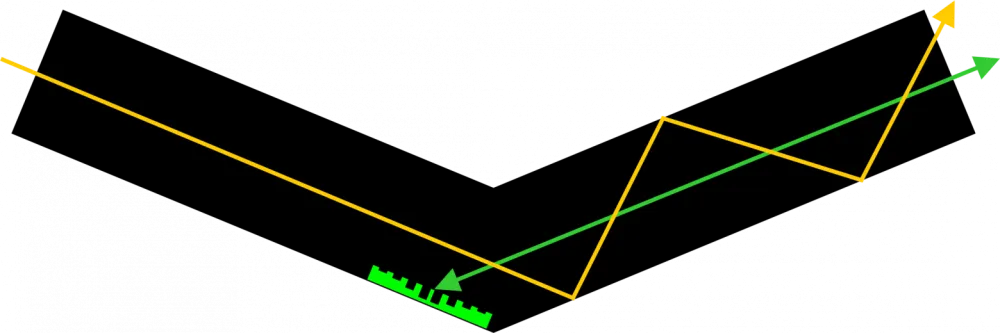
The device is represented by a bent waveguide, bent at a 135° angle (or "waveguide" in the broad sense, since they are not limited to just sound), and positions this device also as a solution for one-way wave transmission in liquid media.
It works as follows: on one of the bends of the waveguide, there is a small section of the so-called "metasurface," represented by grooves of varying depths, where the groove depth increases as it approaches the edge of the wave impact spot (see Figure 2, here). The main task of these grooves is to redirect the wave in the opposite direction.
Interestingly, if you look at the literature used for the research and the research itself, you can see that the timing of the study had a significant impact (2018 was the year of the publication, and the study itself was probably conducted even earlier), so it is evident that at that time, it was assumed that the metasurface would be mechanically manufactured, and despite this, it worked excellently*.
Unlike that time, now all this can be easily manufactured using photopolymer 3D printing.
Thus, we see a structure that closely resembles a Fresnel lens: only here the same use of discrete regions for concentration at a single point is employed, but the difference is that concentration is not the goal, and the whole design works to reflect waves in a specific direction (one could even say, at a specific angle).
*The developers claim that this elbow-shaped tunnel, despite its simplicity, is a highly effective device providing unidirectional transmission with a rate close to one, over a wide frequency range (5300–19000 Hz), while reverse transmission approaches zero.
Nevertheless, we see that the main issue with these devices, if considered as noise suppressors, had not yet been resolved at that time — the size.
And one of the main trends in this field right now is directed at miniaturizing devices, preferably to an extreme degree.
This primarily implies a radical reduction in thickness, as this promises significant benefits in terms of manufacturing various thin films for sound control. Within this concept, the creation of "sub-wavelength" metasurfaces is expected — that is, films much thinner than the wavelength of the manipulated sound.
Interestingly, perhaps one of the most original ways of solving this problem was found by the development team back in 2014, when they proposed creating the simplest device with 99.4% absorption (though only for one of the sound wave frequencies).
Yes, this is not an acoustic diode in its pure form that we are talking about, but still, the device is definitely interesting in the context of sound damping.
The device is incredibly simple: a thin (0.2 mm) polymer film is taken, with a weight placed in the center, after which the film is tightly stretched on a round.
For the device to function properly, it is important that there is a cavity behind this film, filled with a certain gas. By adjusting the size of this cavity, the tension of the membrane, and the weight of the weight, resonance can be achieved at the desired frequency. In experiments, it was found that the complex oscillation pattern of the membrane, where the central part oscillates with a relatively large amplitude and the edges with a relatively smaller one, at the target frequency almost completely (99.4%) absorbs the energy of the incoming sound wave, converting it into other forms (heat or, for example, electricity — if the device is designed to generate electricity, where a neodymium magnet oscillates in a coil instead of a weight, etc.).
The principle itself shows that it is quite functional and can be applied to create either a single device or an array of devices (as an option, operating at different frequencies).
Sometimes, there are scattered pieces of information about laboratory work in the field of creating multi-frequency films, where many resonators with multiple weights, operating at different frequencies, are made on the same film. However, as far as can be understood, work in this area has still not left the laboratories...
Unfortunately, at the moment, I have not been able to find any successful completed research that has achieved significant results in wideband sound absorption using films specifically. Therefore, it seems that for now, we can only state that the current level of scientific achievements allows the feasibility of the described designs to be realized to some extent: either relatively mechanical, or, without mechanics, but relatively large and not particularly compact.
Nevertheless, some positivity comes from the development of 3D printing, which, if desired, allows for the creation of quite complex shapes — for example, creating the same array of bent waveguides with metamaterial at one of the bends, which just recently was absolutely unrealistic.
P.S. Finally, I want to say that a very interesting thing was mentioned above, such as phononic crystal, where the creation of layered structures can form blockers of different frequencies. It is thought that in the field of deeper development of this direction, there are also certain prospects, potentially allowing the creation of a truly simple and compact device, consisting only of alternating layers.

Write comment