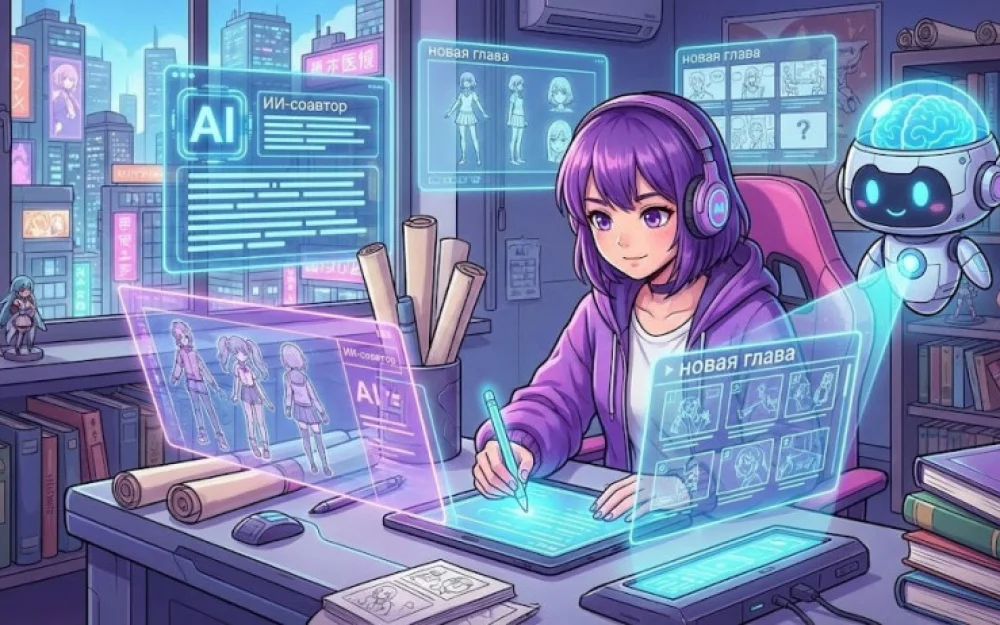
- AI
- A
How artificial intelligence influences modern Japanese literature
Disclaimer: We asked Japanologist and translator Polina Gulenok to write an article about AI in the contemporary Japanese literary process
In 2024, the Japanese literary world was shaken by unexpected news: writer Rie Kudan, who received the Akutagawa Prize that same year for her novel "Sympathy Tower Tokyo," confessed that she used artificial intelligence to write it.
It should be noted that the Akutagawa Prize named after Ryunosuke Akutagawa is a prestigious award, and each year its laureates become the subject of close attention from readers, with their books automatically landing on bestseller lists. In 2025, the prize had no laureate at all – the jury could not choose a worthy candidate among the nominees, and awarding the prize to just anyone would mean lowering its prestige. Naturally, the award-winning writer's statement about using AI caused a huge resonance.

But we should not hastily accuse Rie Kudan of dishonesty. Her novel pays a lot of attention to the theme of AI, and the author generated some AI responses through ChatGPT within the novel where, according to the plot, the characters consult with an AI agent. In this way, she wanted to convey the feeling of discomfort and limitation that arises when communicating with a machine. Even with this, according to the writer, only about 5% of the text of the work was created with the help of ChatGPT.
Shortly after the loud announcement, the magazine "Kokoku" invited Rie Kudan to participate in a literary experiment and write a story where she would write 5% of the text herself, while the remaining 95% would be entrusted to AI. This way, readers could compare "Sympathy Tower" and the resulting story and assess how significant the contributions of AI and the writer herself were. Rie Kudan agreed, and the story "Shadow Rain" came to light. It has been posted online in Japanese with all the prompts so that anyone can track how the text was brought into existence. The writer noted that "the AI did not suggest any ideas significantly exceeding the capabilities of human intelligence."
In Japan, AI is also already being used for literature research. In 2025, the Japanese Center for the Promotion of Research in Digital Humanities and Social Sciences at Nagoya University announced the launch of the conversational AI system Humanitext Aozora. The section on Japanese literature in the system is based on the database of the electronic library Aozora Bunko, which includes about 1,000 authors and 17,000 works (all of these are works by people who died more than 50 years ago, whose works have entered the public domain in Japan (in Russia, it must be 75 years - editor's note).
The system allows you to choose a model on which it will operate – gemini-3-flash-preview, gemini-3-pro-preview, gpt-5.2, and gpt-5-mini. It has four main modes of operation. Two serve a practical function: one is "question-answer," where you can ask questions about literary works and authors and receive answers with links to sources, and the other is a detailed analysis mode, which analyzes several sources like a researcher and provides in-depth interpretations in the form of essays/reports (again, necessarily with a list of sources). The next pair of modes is more playful. One creates a chat with a writer or literary character, allowing you to interact with your favorite classic, while the other helps generate texts by imitating the style of a chosen author.
However, the convergence of the world of literature with AI in the fields of experimental literature and scientific research does not mean that the Japanese have fully accepted the new reality where artificial intelligence can become part of the writing process. A loud story demonstrating the opposite occurred in 2025. A web novel with the long title "Cleaning is actually a cool skill! An office lady, a corporate slave, accidentally causes a revolution in another world and becomes the object of romantic interest of the head of the knights and the emperor" won the grand prize and the reader's choice award at the 17th Fantasy Novel Award from the publishing house Alphapolis.

The author received a monetary award and the right to a printed edition of the series and comic adaptation. Soon after, he openly stated that the text of the work was mostly generated by AI, and in December 2025, Alphapolis introduced a new rule prohibiting the use of generative AI for works participating in competitions and applications for print publication. Plans for publishing books on this subject were abandoned, although this rule did not exist at the time of the competition application.
This created a precedent demonstrating two things. First, literary platforms and publishers can retroactively change the rules of competitions and revoke awards. Second, the Japanese publishing world is not yet ready to take risks and publish works that actively used AI. Meanwhile, "Cleaning is a cool skill!" had strong support from readers online. However, the publisher deemed it more important not how successful the work was, but rather HOW it was written. Most likely, it was frightened by the uncertainty regarding how copyright law applies to AI-generated works.
Japanese media are also concerned about the spread of AI in the humanities. Last year, the Association of Publishers and Editors of Japanese Newspapers appealed to the government, urging them to provide legal protection for materials from news websites against unauthorized use of AI. The association believes that if people can get news simply by typing a query into ChatGPT, they will have no reason to visit news websites, leading to losses for those sites. Additionally, AI may provide inaccurate and incomplete information, undermining public trust in official media.
In the end, an interesting trend emerges: writers, researchers, and other content creators are experimenting with AI with interest, yet publishers are hitting the brakes and cautiously accepting the results of such experiments. Perhaps one day this paradox will lead to a more sustainable balance. For now, one thing is clear – AI has already become part of the Japanese literary process, and there is no turning back.
About the Online Patent Service:
Online Patent is the number 1 digital system in the Rospatent ranking. Since 2013, we have been creating unique LegalTech solutions for the protection and management of intellectual property. Register on the Online Patent service and gain access to the following services:
Online registration of programs, patents for inventions, trademarks, industrial designs;
Application for inclusion in the domestic software registry;
Options for expedited service processing;
Free search in patent, program, and trademark databases;
Monitoring of new applications by criteria;
Online support from specialists.







Write comment