
- AI
- A
Speech Synthesis 2026: Top 5 Free Neural Networks for Text-to-Speech
In childhood, I dreamed that all toys could talk. You know, like in cartoons, where a stuffed bear gives wise advice and soldiers discuss tactics before battle. Reality was harsher: talking toys of that time delivered five memorized phrases in a squeaky voice that was more frightening than delightful.
Then the first voice assistants appeared, and hope flared up again. But no, these guys spoke as if they were voiced by a robot from "Just You Wait!", that very hare with a mechanical voice. Monotonously, with random pauses, with stresses that made Russian language teachers clutch their hearts. Asking them to read at least a paragraph of text out loud was an act of masochism.
And here we are in 2025. Neural networks have learned to imitate live speech, and now they are being shoved literally everywhere: in audiobooks, podcasts, advertisements, educational courses, video voiceovers. The childhood dream of talking toys seems to have come true, only now everything has started to talk. How well it speaks and whether it is worth it, we will find out now.
In this material, we have gathered 7 speech synthesis services, from industry giants to promising newcomers, and tested each one in practice.
Let's take a look at the results!
How will we test?
To avoid being unsubstantiated, we will run each service through the same text. We specifically composed a paragraph that includes everything that neural networks stumble over:
Test text:
“The director of LLC ‘Chamomile’, Pyotr Zholudev-Zasypaiko, called his colleagues from Rostov-on-Don at 13:47. The agenda included a shortfall of 2,345,000 rubles and a 127-page report. ‘Do you even understand that this is a disaster?!’ he exclaimed indignantly. However, just a minute later he thoughtfully added, ‘Although... maybe it will be fine.’ The lock on the door clicked, and Anna Sergeevna entered with a cup of espresso and the phrase: ‘By the way, some John O'Brien called you regarding the AI project.’
Let's check!
The filling here is rich. For texts, there are 11 models available: ChatGPT, Gemini, Grok, DeepSeek, and a bunch of others. For images, there are 4 generators, including Midjourney and Flux. Transcription, document analysis, link breakdowns, and code writing are all included. And speech synthesis, which is why we are here, is also in place.
There is also a library of ready-made prompts, and this is really convenient. Need an ad text? Here’s a template. A script for a video? Here’s a draft. A post for social media? Sure. Just click, tweak it a bit for yourself, and you’re good to go.
Testing!
The service generally handled the task well. There are pauses in the speech, the intonation is observed, and the stresses are correctly placed. However, there is a characteristic nuance - the voice sounds as if the text is being read by a foreigner who has learned Russian well. The pronunciation is formally correct, but there is a slight unnaturalness that reveals the synthesized nature of the speech.
Google Cloud Text-to-Speech
Google with its cloud API for speech synthesis. This is a serious tool aimed more at developers than at ordinary users. The essence is simple: you input text or SSML markup and get an audio file as output. MP3, LINEAR16, whatever you like.
When it comes to voices, there are no jokes. More than 380 options across 75+ languages, including Russian, English, Arabic, Chinese, and a ton of others. The quality ranges from standard voices to advanced WaveNet, Neural2, and the fresh Chirp 3 HD, which are tailored for conversational assistants with minimal latency and natural intonation.
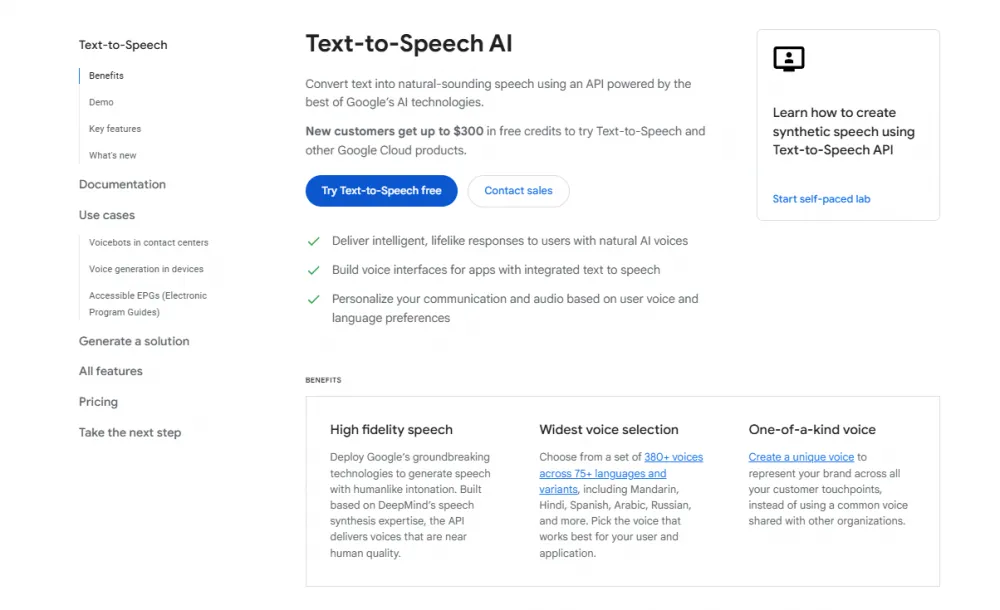
There are also plenty of settings. You can adjust the pitch, speed, and volume of the voice. Through SSML, you manage pauses, pronunciation, and formatting of dates and numbers. Want “01.05.2025” to be read as “the first of May two thousand twenty-five”? No problem, just annotate it, and it will be.
Testing!
Google has also done a very good job - there is basically nothing to complain about here. The speech sounds natural, with high levels of intonation and pronunciation. The only limitation is the volume of text available for free narration. The service refused to accept the entire text at once; however, it was possible to narrate 3–4 sentences without any problems.
ElevenLabs
One of the most hyped services in the world of speech synthesis, and it must be acknowledged that this hype is not unfounded. ElevenLabs is designed for maximum naturalness: intonations, pauses, rhythm, emotions. It works through a web interface or API, making it suitable for quick voiceovers of videos as well as integration into bots or video editors.
The main feature everyone is talking about is voice cloning. You upload a short fragment of a recording, and the service creates a synthetic copy that can then be used to voice any texts. It sounds like magic and is used in dubbing, advertising, and corporate projects with a branded voice. Also, for accessibility: people with visual or speech impairments can benefit from it. If you don't want to upload your own voice, there is a library of ready-made voices: neutral, conversational, specifically for audiobooks.
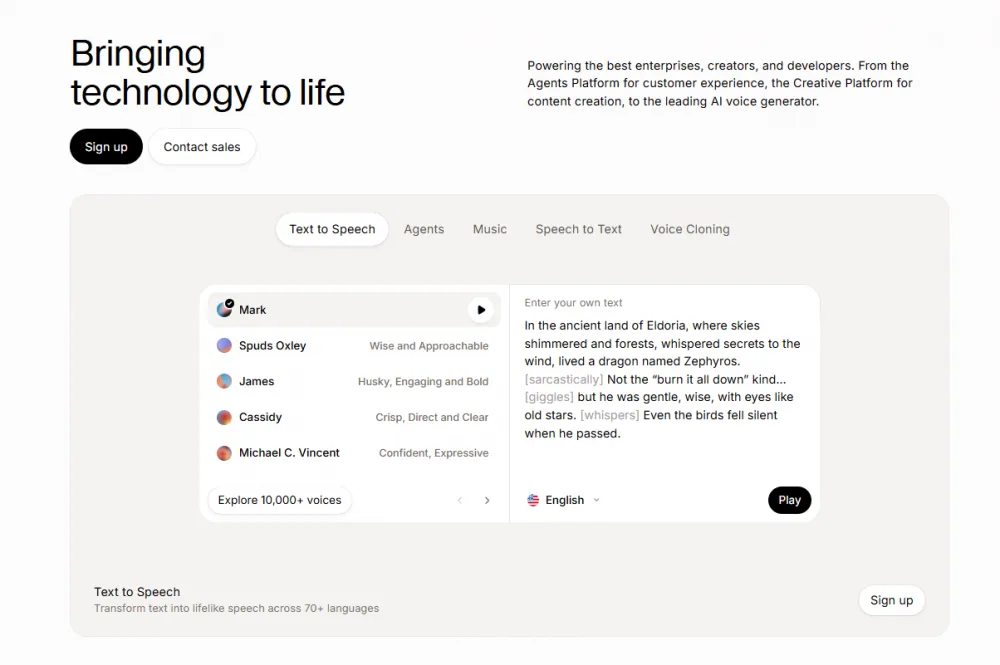
As for languages, everything is solid. The latest version, Eleven v3, supports over 70 languages. There are lighter models, Multilingual v2 and Flash v2.5, for 29 and 32 languages respectively, which work faster. It also handles long texts well: stabilizing the tempo, monitoring fluency, and not acting up on the tenth page. As a bonus, you can automatically translate text before synthesis, while maintaining the intonations of the selected voice.
In terms of settings, you can adjust speed, pauses, and manually place accents. The latter is especially useful for the Russian language, where "замок" and "замок" are two very different things. The service doesn't always guess correctly, but at least it gives you the option to correct it manually.
Testing
The service is undoubtedly well-promoted and popular. And it cannot be said that this is undeserved: it has fully accomplished its task. However, when comparing directly, I preferred the output from Google more. Despite all the advantages of the service, there is still a slight robotic quality in the voice.
Robivox

The domestic service for those who need simple voiceover without unnecessary complexities. You go to the website, enter the text, choose the language and voice, and get MP3 or WAV. No APIs, integrations, or other developer delights, everything is as straightforward as possible.
Surprisingly wide range of languages: Russian, English, Kazakh, Uzbek, Arabic, Turkish, German, and many more options. There are 14 voices, both male and female. "PRO" versions are highlighted separately, which, according to the creators, sound as close to natural speech as possible. We will check how true this is in the test.
From the settings, you can adjust the speed, pauses, and manually set the stress. The latter is especially useful for the Russian language, where "замок" (lock) and "замок" (castle) are two very different meanings. The service does not always guess correctly, but at least it allows for manual correction.
Testing
In terms of sound - it's the typical voice from YouTube videos where the author was too lazy to record the voiceover themselves. A robot is indeed a robot. Formally, everything is in place: pauses are present, stresses are correctly placed, and the text is read without mistakes. But the delivery is monotonous - the voice flows evenly, without emotional highs and lows. Where a live speaker would emphasize a question or surprise with intonation, here everything sounds uniformly flat. It is listenable, but it does not evoke engagement.
Yandex SpeechKit
Yandex also did not stay on the sidelines and created its own cloud service for working with speech. SpeechKit can recognize audio and synthesize it from text. It works through the API or the Yandex Cloud web panel, handling both short phrases and long recordings. The language can be automatically determined if you happen to forget to specify it.
There are several voices to choose from, with different timbres and styles. There is extended markup for fine-tuning: pauses, stress, speed. For a quick test, you can use the demo version and synthesize a couple of paragraphs for free to see if the sound suits you.
For businesses, there are special perks. Brand Voice allows you to create a unique voice based on recordings of your speaker. This will be useful for those who value a consistent brand sound across all products. And SpeechKit Hybrid provides the ability to deploy all speech processing on your own servers if data cannot be sent to the cloud and confidentiality is a priority.
Testing
Yandex handled the task, and there is nothing to formally complain about here. However, there is a sense that it could be better. The voice has a robotic quality, and Google, when compared directly, does this in a somehow more soulful and natural way. It is also worth noting that at the beginning of playback, the service announces information about its origin, which can be somewhat inconvenient during use.
In summary
In conclusion, I want to remind you that it is still too early to unconditionally trust neural networks. They make mistakes, fantasize, and sometimes surprise in the wrong direction. They are good, but only as assistants, nothing more. Algorithms can speed up routines, simplify complex tasks, inspire, and save time. The main thing to remember is that behind all these technologies, we stand.
So trust, but verify. And don’t forget, you are the one directing all of this in the right direction!
Thank you for reaching the end! Now it's your turn. Tell us which neural networks are already in your bookmarks? Perhaps we forgot about some service? Let's add to this list together!





Write comment