- AI
- A
Awesome Claude Code: AI Assistant for PHP Architects
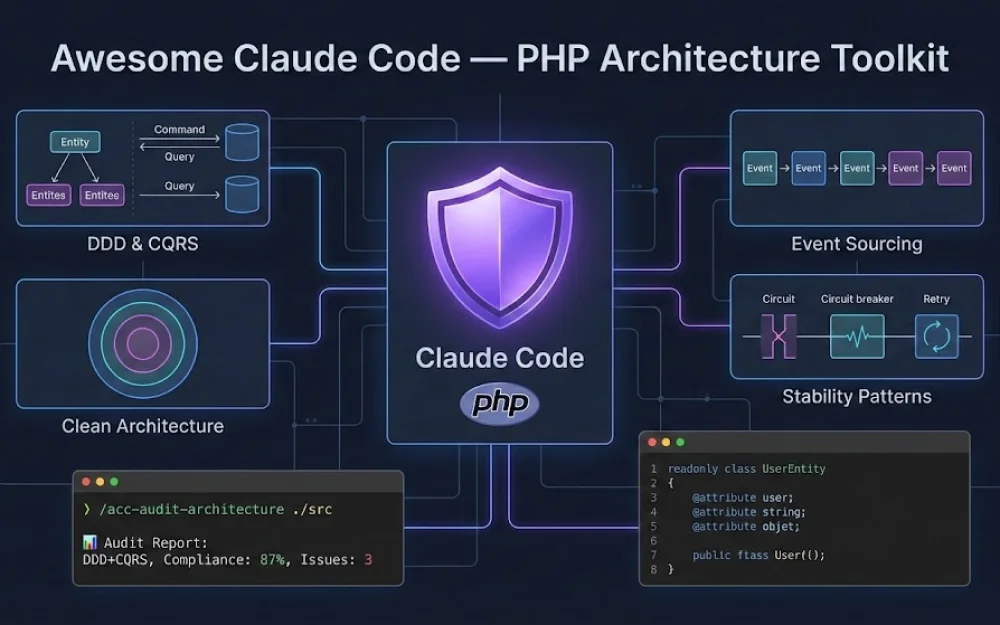
Components of Claude Code for PHP: audit, 3-level code review, automatic error correction, generators, code explanations, refactoring. Over 300 components. More than 50 agents. Over 200 skills.
Introduction: A new era of PHP application development using artificial intelligence.
AI assistants for programming have fundamentally changed how we write software. What began as simple autocompletion has evolved into intelligent systems that understand context, suggest architectural patterns, and even find subtle bugs in the code.
I have personally tested Cursor, Windsurf, Antigravity, and Claude Code, and I can say that each of them is strong in its own way, but Claude Code fits best into the terminal workflow and task automation. However, "out of the box," Claude Code is a general-purpose tool. It does not know that you are building an application based on Domain-Driven Design, that your team follows certain PSR standards, or that you need circuit breakers in your architecture.
I want to share my work on Awesome Claude Code—a Composer plugin that turns Claude Code into a specialized assistant for PHP architecture. After months of developing DDD/CQRS applications and constantly feeling that Claude Code did not understand my patterns well enough, I decided to create a toolkit that encapsulates this knowledge.
Problem
Every PHP developer knows this pain: you are creating a new feature, and suddenly you need an Aggregate Root with events, a Repository interface, DTO, Command/Query handlers, and tests. Hours are spent writing the same patterns you have written dozens of times before.
Or perhaps you are reviewing a PR. You scroll through hundreds of lines, looking for SQL injections, N+1 queries, DDD violations, and gaps in tests. It’s tedious, error-prone, and takes time away from real development.
And what about that legacy code you inherited? You suspect that the architecture has "drifted" everywhere, but manually auditing thousands of files is a separate project.
These are solved problems. You shouldn't have to solve them manually.
Solution
Awesome Claude Code — is a Composer plugin that transforms the Claude Code CLI into a powerful tool for PHP development. Install it once — and receive 300+ specialized components (commands, agents, skills) that deeply understand PHP architecture: DDD, CQRS, Clean Architecture, Event Sourcing, CI/CD, Docker, and much more.
Requirements:
PHP 8.5+
Composer 2.0+
Claude Code CLI
Installation:
composer require dykyi-roman/awesome-claude-codeUpdates:
# Force update to the latest version (creates a backup)
./vendor/bin/acc upgrade
Usage:
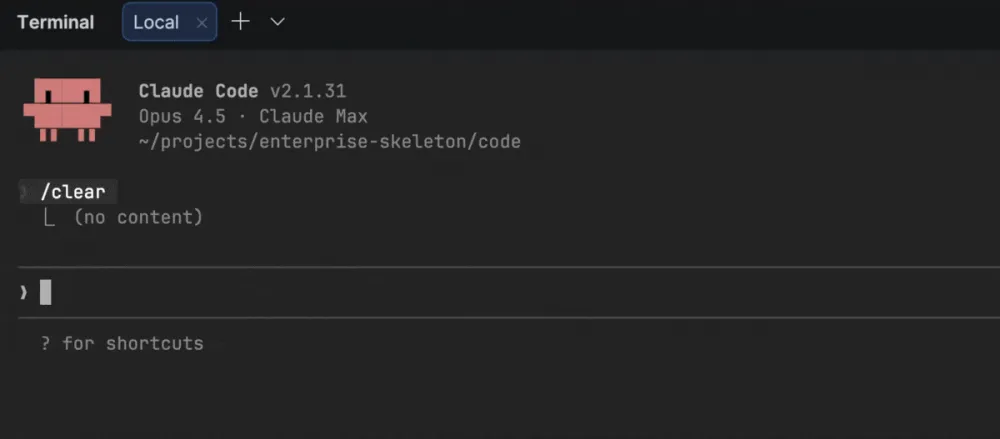
That's it. The plugin automatically copies commands, agents, and skills to the .claude/ directory of your project. No configuration needed.
Intelligent Orchestration
The key feature of ACC is the smart agent and skill matching system. When you invoke a command, the system automatically determines which specialists are needed for the task:
USER COMMAND          COORDINATOR              AGENTS                KNOWLEDGE              GENERATORS
────────────          ───────────              ──────                ─────────              ──────────
/acc-code-review ──→ code-review-coordinator
                            │
                            ├─ LOW ──────→ psr-auditor ─────────→ psr-knowledge ─────────→ create-psr-*
                            │              test-auditor ────────→ testing-knowledge ────→ create-test-*
                            │
                            ├─ MEDIUM ───→ bug-hunter ──────────→ bug-fix-knowledge ────→ generate-bug-fix
                            │              readability-reviewer → code-smells-analyzer
                            │
                            └─ HIGH ─────→ security-reviewer ───→ owasp-skills ─────────→ create-validator
                                           performance-reviewer → optimization-skills
                                           ddd-auditor ─────────→ ddd-knowledge ────────→ create-entity,
                                           │                                               create-value-object,
                                           │                                               create-aggregate...
                                           architecture-auditor → arch-knowledge ───────→ create-*, pattern-*
How it works:
The team accepts your request and determines the context
The coordinator analyzes the task and selects the necessary agents
Specialized agents perform the work using relevant skills
Knowledge Base provides deep expertise for each area
Generator Skills offer refactoring and generate code to fix identified issues
Each agent has access only to the skills they need. The security reviewer uses 14 OWASP skills, while the DDD auditor uses domain design skills with delegation to specialized generators. This is not just a set of tools — it is an ecosystem of experts, each specializing in their area.
An example chain for /acc-audit-architecture:
architecture-auditor (coordinator)
    │
    ├──→ structural-auditor ────→ ddd-knowledge
    │                             clean-arch-knowledge
    │                             hexagonal-knowledge
    │                             solid-knowledge
    │                             grasp-knowledge
    │                             + 6 analyzers
    │
    ├──→ behavioral-auditor ────→ cqrs-knowledge
    │                             event-sourcing-knowledge
    │                             eda-knowledge
    │                             + 14 pattern skills
    │
    ├──→ integration-auditor ───→ saga-knowledge
    │                             outbox-knowledge
    │                             stability-knowledge
    │                             adr-knowledge
    │
    └──→ pattern-generator ─────→ 5 sub-generators → 30+ generator skills
One request /acc-audit-architecture activates multiple agents and dozens of skills, each responsible for its area of expertise.
Three types of skills
Skills are focused knowledge bases and code generators. Each skill does one thing well:
Knowledge - Patterns, anti-patterns, PHP-specific guidelines
Analyzer - Detection of specific issues
Generator - Code generation from templates
This division follows the Single Responsibility Principle. Each component has a clear purpose, making the system maintainable and extensible.
Knowledge skills contain deep expertise: when to use a pattern, when to avoid it, what pitfalls exist. It's like having the books of Evans, Vernon, and Fowler at hand.
Analyzer skills find specific problems: N+1 queries, SQL injections, code smells, violations of SOLID. Each analyzer knows its area and provides actionable recommendations.
Generator skills create production-ready code: Value Objects with validation, Circuit Breaker with correct states, PSR-compliant implementations. The templates have been tested on real projects.
Key Features
Code Review System — 3 levels of analysis
The /acc-code-review command passes your PR through up to 9 specialized reviewers:
Low Level - Compliance with PSR-12, test quality
Medium level - Low Level + Logical errors, null pointer, naming, complexity
High level - Medium level + OWASP Top 10, N+1 queries, memory leaks, DDD compliance, complete architecture
Example:
/acc-code-review feature/payment high -- implement Stripe payment processingResult:
# Code Review Report

**Branch:** `feature/payment` → `main`
**Files Reviewed:** 12 (+456/-23 lines)

## 🔴 Critical (1)
| ID | Category | Location | Issue |
|----|----------|----------|-------|
| CR-001 | Security | PaymentService.php:45 | SQL injection via string concatenation |

## 🟠 Major (3)
| CR-002 | Bug | Order.php:89 | Null pointer when items empty |
| CR-003 | Performance | CartRepository.php:34 | N+1 query in loop |
| CR-004 | DDD | PaymentService.php:12 | Domain logic in Application layer |

**Task Match:** 85% | **Verdict:** ❌ REQUEST CHANGES
The system also calculates the "task match score" — how well the code meets the stated task. Ideal for catching scope creep.
Bug Fixing System — from Diagnosis to Testing
Found a bug? Don't just fix it — let the system diagnose, fix, and prevent regression:
/acc-bug-fix "NullPointerException in OrderService::process()"
/acc-bug-fix src/Domain/Order.php:45 "off-by-one error"
/acc-bug-fix @storage/logs/error.log -- focus on validation
Process:
Diagnostics - Categorizes bugs (9 types), finds root causes
Fixing - Generates a minimal, safe fix with a set of specialized skills
Testing - Creates a regression test
Verification - Applies the fix, runs tests, reports results
Defined categories of bugs: logical errors, null pointer, edge cases, race conditions, resource leaks, exception handling, type issues, SQL injections, infinite loops
Architectural audit engine — 10+ patterns
The team
/acc-audit-architectureanalyzes your codebase for compliance with industry standards:Structural:
DDD (Aggregates, Value Objects, Domain Events, Repositories)
Clean Architecture (Use Cases, Boundaries)
Hexagonal Architecture (Ports & Adapters)
Layered Architecture
SOLID and GRASP principles
Behavioral:
CQRS (separation of Command/Query)
Event Sourcing (Event stores, Projections)
Event-Driven Architecture
GoF Behavioral: Strategy, State, Template Method, Visitor, Iterator, Memento, Chain of Responsibility, Decorator, Null Object
GoF Structural:
Adapter, Facade, Proxy, Composite, Bridge, Flyweight
Integration and stability:
Saga Pattern (Orchestration, Compensation)
Outbox Pattern (Transactional messages)
Circuit Breaker, Retry, Rate Limiter, Bulkhead
Each audit provides actionable recommendations with specific locations in the files.
Individual audits
Launching targeted audits without a complete architectural analysis:
Refactoring system — managed process
Code refactoring with analysis and pattern recommendations:
/acc-refactor ./src/Domain/Order.php
/acc-refactor ./src/Services/ -- apply Strategy pattern
The coordinator analyzes code quality, suggests improvements, and generates recommendations.
Code explanation system — 5 modes
The team /acc-explain understands your codebase and explains it at the required level:
/acc-explain src/Domain/Order/Order.php         # Quick — one file
/acc-explain src/Domain/Order/                   # Deep — module analysis with diagrams
/acc-explain .                                   # Onboarding — complete guide to the project
/acc-explain GET /api/orders                     # Route — resolve HTTP route to handler
/acc-explain src/Payment business                # Business — non-technical overview
/acc-explain src/Domain qa -- how are discounts calculated?  # QA — point answer
The system automatically determines the necessary mode: file → quick, directory → deep, . → onboarding, HTTP route or console command → quick. Four specialized agents perform the work:
CI/CD system — Setup, Fix, Optimize
The CI/CD system provides complete management of pipelines through a single coordinator:
/acc-ci-setup                    # Create CI pipeline from scratch
/acc-ci-fix                      # Diagnosis and fixing of pipeline errors
/acc-ci-optimize                 # Optimization of execution time
/acc-audit-ci                    # Comprehensive CI audit
Pipeline architects understand the specifics of PHP:
Static analysis: PHPStan levels, Psalm strictness, DEPTRAC layers
Testing: unit, integration, parallel execution, coverage
Security: composer audit, OWASP checks, secret scanning
Docker: multi-stage builds, layer caching, PHP extensions
Docker Expert System — 8 specialized agents
A full-fledged expert system for Docker with a coordinator and narrow-profile specialists:
/acc-generate-docker                  # Generation of Docker components
/acc-audit-docker                     # Comprehensive audit of Docker configuration
System architecture:
docker-coordinator (coordinator)
    │
    ├──→ docker-architect-agent ────→ Multi-stage builds, stage organization
    ├──→ docker-image-builder ─────→ Base images, PHP extensions
    ├──→ docker-compose-agent ─────→ Services, networks, health checks
    ├──→ docker-performance-agent ──→ Build time, image size, caching
    ├──→ docker-security-agent ────→ Security audit, hardening
    ├──→ docker-production-agent ──→ Health checks, graceful shutdown, monitoring
    ├──→ docker-debugger-agent ────→ Build errors, runtime issues
    └──→ docker-agent (CI/CD) ─────→ Docker in CI pipelines
The system understands the specifics of PHP: correct base images, extensions for DDD projects (intl, opcache, redis), multi-stage builds, OPcache optimization, PHP-FPM tuning. Supports 40+ Docker skills — from generating Dockerfiles and docker-compose to optimizing image sizes and auditing container security.
Docker Audit Process:
Architecture - Analysis of multi-stage, stage organization
Security - Secrets, permissions, vulnerabilities
Performance - Image size, layer caching
Production - Health checks, graceful shutdown, logging
DevOps Teams
CI Fixes — automatic correction of pipeline errors:
/acc-ci-fix                           # Analyze and fix failing CI
/acc-ci-fix --pipeline=github-actions # Specify a specific CI
/acc-ci-fix @.github/workflows/ci.yml # Fix a specific workflow
Typical problems it solves:
PHPStan/Psalm type-level errors
Failing tests (analysis + fix + regression test)
Code style violations (PSR-12, PHP CS Fixer)
Incompatible dependencies in composer.json
Security vulnerabilities in packages
Code Generation — 50+ Components
Generation of production-ready code with tests through specialized generators (based on recommendations from /acc-audit-*).
Generates:
.claude/commands/validate-order.md— Custom slash command
Available generators (through architectural audits):
DDD - Entity, ValueObject, Aggregate, Repository, DomainEvent, DomainService, Specification, Factory
CQRS - Command, Query, Handler, UseCase, ReadModel
Patterns - Strategy, State, Decorator, Builder, ObjectPool, CircuitBreaker, Saga, Outbox, Adapter, Facade, Proxy, Composite, Visitor, Memento
PSR - Logger (PSR-3), Cache (PSR-6/16), HTTP (PSR-7/15/17/18), Container (PSR-11), Clock (PSR-20)
Comparison with Alternatives
PHPStan/Psalm — ACC adds architectural patterns, DDD compliance, code generation
Rector — ACC specializes in DDD/CQRS patterns, generates new code
Deptrac — ACC adds full architecture audit (DDD, Clean, Hexagonal), generates remediation suggestions
GitHub Copilot — ACC has over 300 PHP-specific components, deeply understands architecture
Manual CI/CD setup — ACC generates optimized pipelines considering PHP best practices
ACC does NOT replace but complements these tools. Use PHPStan for type checking, Rector for mass refactoring, and ACC for working at the architecture level.
Conclusion
Awesome Claude Code transforms Claude Code from a general AI assistant into a specialized toolkit for PHP architects. It automates repetitive parts of software engineering — boilerplate generation, code review, architectural audits — while teaching you patterns along the way.
GitHub: dykyi-roman/awesome-claude-code
Documentation:
Commands — slash commands
Agents — specialized sub-agents
Skills — skills (knowledge, generators, analyzers)
Hooks — PHP/DDD hooks
MCP — MCP server configuration
Quick Reference — Paths, formats, best practices
License: MIT







Write comment