- DIY
- A
Become a Welder and a Python Developer. Personal Experience from Welding to Development and Back
Personal experience in learning welding and development. How technology changes the training and implementation of specific projects through my example.
I should clarify right away: this article is not about the pros and cons of professions and certainly not about "who is better." It’s simply my experience that I decided to share on a Friday, which involves preparing specialists to solve some practical tasks in two different fields.
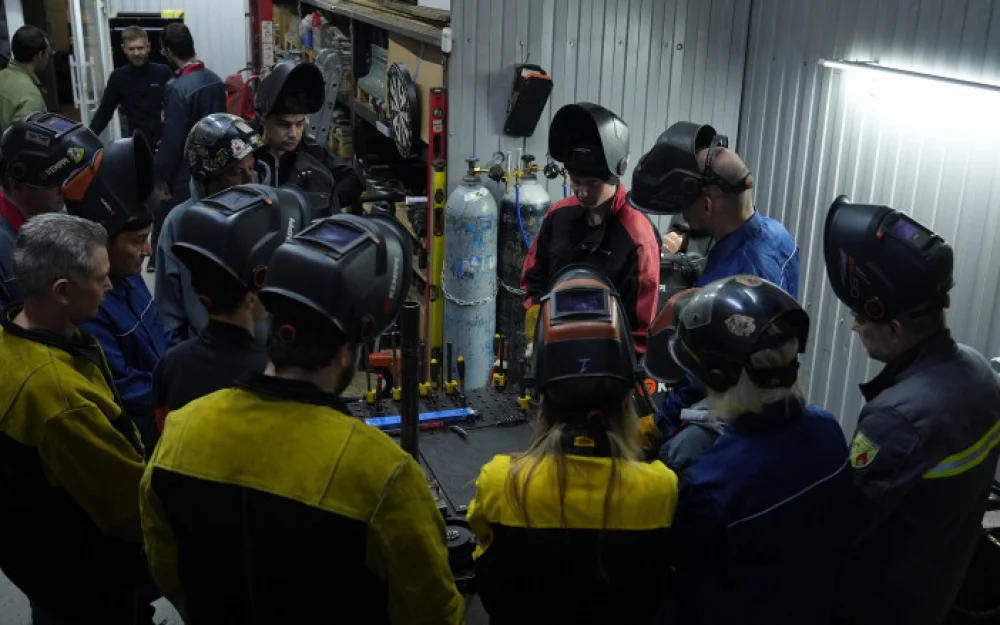
Welding is what our team is engaged in.
Python and development are what I wanted to master myself during this work process. I didn't set out to become a developer and don’t even consider myself close to that, but I enjoy it, as it could potentially solve pressing tasks beyond the welding shop and add "modernity" to the production environment.
From Welders to Developers
Until 2022, we used either Google Calendar or Asana for task distribution, workload accounting, and project management.
In 2022, some of these services left the market, while the remaining ones significantly raised their prices. At the same time, none of the solutions met our key need — task distribution linked to the workplace:
· instructor
· welding booth
· client
· time
At some point, it became clear that adapting someone else's tools to our logic would be long and costly. So I decided to try to create my own planner.
By this time, I already had a certain technical background:
· Arduino
· 3D printers (Ultimaker)
· homemade copters
Therefore, the idea of trying to learn development in Python and implementing the project myself didn't seem impossible, and Python attracted me because it could be applied to solve potential tasks involving analytics.
It’s important to note that we were a welding team, but there were also teams for web development, design, and mobile applications nearby. This added confidence — even if something didn’t work out, there would be someone to ask for help.
Online Course as a Tool, Not a Goal
I signed up for a paid course on one of the online resources (I intentionally leave the name out) with promised practice and personal consultations.
Employment did not interest me — I viewed this course exclusively as a tool for solving a specific practical task.
The group was large — about 40 people. It became clear from the first classes that the format of mass online learning had to focus on the most basic level. The level of participants was extremely heterogeneous — from people without a technical background to those who were already writing code.
For my task, I needed more than just Python (or so it seemed to me):
· databases
· understanding Docker
· deploying a web server
I am one of those people for whom theory does not stick in my head until it starts being applied in a real project, so I tried to stay ahead of the curriculum and focus solely on my task.
Personal consultations with instructors did not answer questions like "how to deploy a web server on VDS." At that moment, it became clear that I would have to seek answers on my own.
ChatGPT and the first working result
About that time, I stumbled upon the newly released ChatGPT.
It’s important to emphasize: in my case, it did not replace development as a profession, but rather became a tool for quick answers to my specific questions. Sometimes not so quick, and often confusing, but still, I managed to find answers.
It was clunky, not perfect, but while completing the course assignments I wrote a scheduler with its help:
· a calendar
· a mobile version
· user rights segregation
This was monolithic code, far from what I ideally wanted. But it solved our problem, and we used it for about six months.
Later, I turned to a development team. They helped:
· analyzed my code
· recorded about 4 hours of explanatory videos for me
· helped properly package everything in Docker
· pointed out critical vulnerabilities
· supplemented the API solution
By then, it had already become obvious how much deeper and more complex development is as a profession than it seems from the outside when solving a specific task.
What I took away from this
My personal conclusion turned out to be:
· the course format was weakly connected to my real applied task
· expectations from learning did not match the outcome
· ChatGPT unexpectedly reduced the motivation to deeply dive into the basic fundamentals right at the start
In the context of my deadlines and tasks, I was afraid that a deep study, for example, of algorithms would not provide a significant advantage at this stage — it was not the lack of optimization but the speed of obtaining a working solution that demotivated.
Later, we completely abandoned my solution and turned to the professionals of the team, who rewrote the project from scratch.
From Developers to Welders
We have been training welders for a long time — since 2016.
Almost from the very beginning, we regularly encounter requests for "remote welding training from scratch" from organizations.
Paradoxically, such requests even came in the pre-COVID times when Zoom and teleconferencing were not yet widespread. Usually, it looked like a request to remotely "make a welder" out of a worker from another profession.
It is perplexing that representatives of companies, who will later hire such specialists, sincerely believe in this. If you dig deeper — we have also encountered educational organizations that prepared welders without practical experience. We understand this, but do not approve.
Even large manufacturers offer welding simulators where instead of a real arc — there is a screen. Previously, we perceived this as a formality "for certificates". Over time, such requests have decreased — the market is gradually starting to understand that documents do not replace skills.
In welding, there is no assistant who will complete the task for you. If you can't do it with your hands — no one else will do it.
Practice Before Theory
Today, our welding training is more often built from practice to theory, rather than the other way around.
I am not saying that theory is useless. I am talking about priorities: it is better to be able to make a quality weld without understanding Ohm's law than to know the physics of the process but not be able to implement it with your hands.
When developers and analysts come to us, we often hear the same request: "I want to feel the result of the completed work with my hands, to touch it."
How We Approached Training
Step 1. Understand the ultimate goal
What does the person want to be able to do? For example, weld a fence on their property.
Step 2. Try different welding methods
Compare them and choose the appropriate one.
Step 3. See the work of a professional
Look from different angles, ask questions, see the standard.
Step 4. Try it yourself under the instructor's supervision
Complete the first samples.
Step 5. Analyze mistakes
With your own perspective and with the help of a mentor.
Step 6. Set priorities
What is critical and what is secondary.
Step 7. Practice and correct.
My interim conclusion
Theory in welding is important and extensive. But for practical work, applied theory is crucial:
· how settings work
· how materials differ
· how modes affect and so on
As practical experience accumulates, theory begins to be perceived much more meaningfully.
Conclusion
My personal experience has shown that development and welding are not opposed, but complement each other.
With time and a knowledgeable mentor, one can achieve a working result in a short period.
Knowledge in IT can sometimes even help expand the capabilities of welding equipment, especially considering that some machines have "limited functionality" until a subscription is paid or features are unlocked =) If only I could find such a specialist))
The only difference is that a "virtual assistant" has already emerged in development, which has proven useful to me for a specific one-time task. There is currently no such assistant in welding.
It is difficult to practice skills remotely. But remotely, you can look at your abilities from a new angle.
Happy Friday to everyone 🙂


Write comment